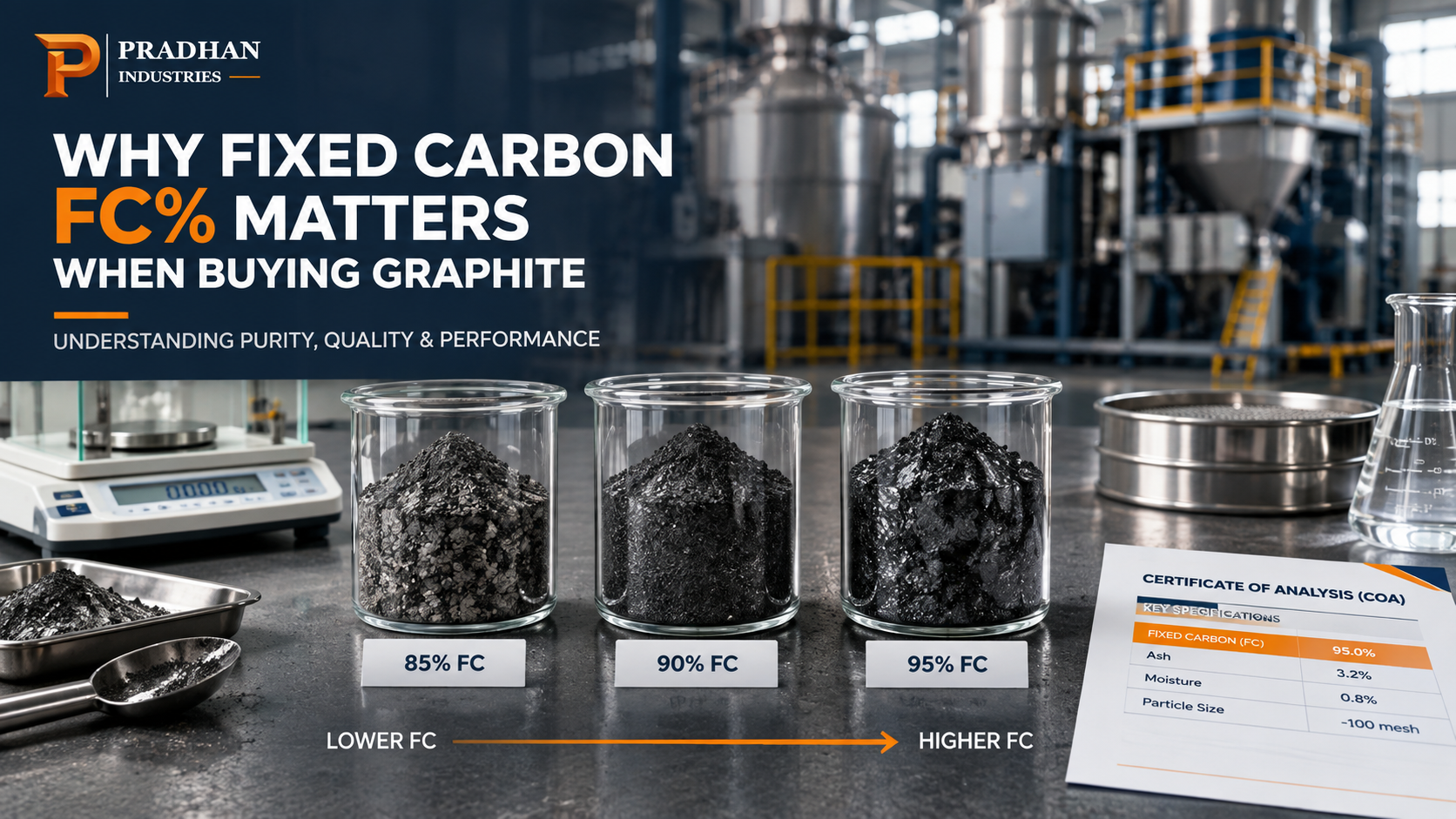
When buying graphite for industrial applications, one of the first specifications buyers usually check is fixed carbon (FC%). But what does FC% actually mean, and why is it important when choosing between different graphite grades?
Understanding fixed carbon in graphite can help buyers compare materials, evaluate quality, and select a graphite grade that matches their production requirements.
Fixed carbon is an important quality indicator, but it should not be considered by itself. Other factors such as ash, moisture, mesh size, particle-size distribution, flake characteristics, processing condition, and Certificate of Analysis (COA) can also affect graphite performance.
For example, a buyer may find graphite with 90–92% FC and another grade with 94–95% FC. At first glance, the 94–95% grade may appear to be the obvious choice. However, the correct grade depends on the application, required particle size, purity requirements, and overall cost.
In this guide, we explain what fixed carbon in graphite means, why FC% matters, how it is evaluated, and what buyers should check before purchasing graphite in bulk.
What Is Fixed Carbon in Graphite?
Fixed carbon (FC%) is a commonly reported specification used to describe the carbon-rich portion of a graphite material according to a defined analytical method and reporting basis.
In simple terms, FC% helps buyers understand the carbon concentration of a particular graphite grade.
Commercial graphite may be supplied in different FC ranges, such as
- 60–65% FC
- 80–85% FC
- 90–92% FC
- 94–95% FC
A higher FC percentage generally indicates a higher stated carbon concentration.
However, it is important to remember that FC% is only one part of graphite quality.
The complete technical specification should also be considered before deciding whether a graphite grade is suitable for a particular application.
For readers who want to understand the material itself before looking at purity specifications, our guide to natural crystalline graphite and its properties provides useful background on graphite structure, characteristics, and industrial uses.
Why Does Fixed Carbon Matter When Buying Graphite?
The amount of fixed carbon in graphite matters because different industrial processes require different levels of carbon purity.
Graphite is valued for properties including:
- High-temperature performance
- Thermal conductivity
- Electrical conductivity
- Lubricity
- Low friction
- Chemical stability
- Carbon addition
- Refractory characteristics
The required FC percentage depends on how the graphite will be used.
For example, a process that requires a relatively high carbon concentration may specify a minimum FC value before accepting a material. Another application may be able to use a lower FC grade if it meets the other technical requirements.
This is why buyers should not simply ask:
“What is the highest FC graphite available?”
Instead, the better question is
“What FC specification does my application require?”
That approach can help avoid both under-specification and unnecessary over-spending.
Does Higher FC% Always Mean Better Graphite?
No.
A higher FC percentage does not automatically mean that a graphite product is better for every application.
For example, if a manufacturing process is designed around 90–92% FC graphite, purchasing 94–95% FC material may not provide enough additional performance to justify the higher cost.
On the other hand, an application with strict purity requirements may specifically require a higher FC grade.
Therefore, graphite should be selected according to the required specification, not simply the highest FC number.
The right graphite is the one that provides the required combination of:
- Carbon content
- Ash level
- Particle size
- Physical characteristics
- Consistency
- Documentation
- Cost
How Is Fixed Carbon in Graphite Evaluated?
When buying graphite, fixed carbon should be considered together with other quality parameters such as ash, moisture, particle size, and flake characteristics. Ash content is particularly important because it indicates the amount of non-carbon material remaining in the graphite sample after controlled heating. Buyers who want to understand how ash is evaluated can refer to the ASTM C561-23 Standard Test Method for Ash in a Graphite Sample, which provides a standardized method for determining ash in graphite samples. Checking this type of laboratory information alongside the supplier’s Certificate of Analysis (COA) can help buyers compare graphite grades more confidently and select material that matches their application requirements.
Why the Testing Method Matters
A test result is meaningful only when the buyer knows what was tested and under what method or basis.
When comparing suppliers, ask for the relevant test method, reporting basis, and Certificate of Analysis.
This becomes especially important when buying large quantities of graphite because even a small difference in specification can affect material cost and production performance.
Fixed Carbon vs. Ash: What Is the Difference?
Fixed carbon and ash are related to graphite quality, but they describe different aspects of the material.
Fixed carbon indicates the carbon-rich portion reported according to the applicable analytical method.
Ash represents the residue remaining after the graphite sample is subjected to the relevant ash-testing procedure.
ASTM C561-23 is an active standard specifically titled Standard Test Method for Ash in a Graphite Sample. ASTM explains that the method provides a practical determination of ash content and that ash values can be useful when comparing the relative purity of commercial graphite grades.
This makes ash an important specification for buyers who need to compare graphite purity.
Why Buyers Should Check Ash Along With FC%
Imagine two graphite grades:
Grade A: 90–92% FC
Grade B: 90–92% FC
At first glance, both appear identical from the FC perspective.
But if their ash levels, particle sizes, or other specifications are different, they may not be equivalent for your application.
That is why a better purchasing approach is
FC% + Ash + Moisture + Particle Size + Application Requirements
rather than simply comparing FC%.
What Is the Relationship Between FC% and Graphite Purity?
FC% is often used as a key indicator when buyers discuss graphite purity, but the complete meaning of “purity” depends on the application and the specifications being measured.
A higher FC grade generally contains a greater stated proportion of carbon, while non-carbon components are represented through parameters such as ash and other impurities.
For specialized applications, buyers may also need to evaluate specific elemental impurities.
ASTM also has a separate active test method, D8186-25, covering measurement of certain impurities in graphite. This illustrates why technical graphite evaluation can involve more than a single carbon percentage.
For most commercial purchasing decisions, however, the first step is to clearly define the required FC%, ash, moisture, and physical specifications.
FC% and Graphite Mesh Size
Fixed carbon and mesh size describe two different characteristics of graphite. FC% indicates the carbon content, while mesh size relates to the fineness of the graphite material. For example, graphite supplied in 100 mesh, 200 mesh, or 300 mesh grades can have different particle-size characteristics even when the FC% is similar. Buyers should therefore understand both parameters before selecting a grade. Our graphite mesh size guide explains the differences between common mesh specifications and why particle size matters for industrial applications.
High-purity graphite
Pradhan Industries currently publishes crystalline graphite grades, including 80–85%, 90–92%, and 94–95% FC in different mesh sizes and processing conditions. Its published specifications include combinations such as 90–92% FC at -100, -200, and -300 mesh, as well as 94–95% FC at the same mesh levels.
This is a good example of why buyers should consider FC and particle size together.
Why Mesh Size Matters
Two graphite grades can have the same FC percentage but different particle sizes.
For example:
90–92% FC, -100 Mesh
and
90–92% FC, -300 Mesh
may have different handling and processing characteristics even though their stated FC range is the same.
If you are comparing different graphite particle sizes, read our graphite mesh size guide to understand how 100, 200, and 300 mesh specifications differ and why particle size matters when buying graphite.
Why Particle-Size Distribution Matters
Mesh size is useful, but buyers should also consider the actual particle-size distribution when the application is sensitive to particle size.
Particle-size characteristics can influence:
- Mixing
- Dispersion
- Feeding
- Surface area
- Packing behavior
- Coating performance
- Processing consistency
For this reason, a buyer should provide the supplier with a clear particle-size requirement whenever the application depends on powder characteristics.
Instead of simply requesting “fine graphite,” it is better to specify the required mesh or particle-size range.
Fixed Carbon and Graphite Processing
Natural graphite does not necessarily go directly from mine to final industrial product.
Depending on the required grade, graphite can go through several processing stages, including:
- Mining
- Crushing
- Grinding
- Beneficiation
- Concentration
- Drying
- Pulverization
- Classification
- Quality testing
- Packaging
These processes help produce graphite grades with specific chemical and physical characteristics.
If you want to understand how natural graphite is upgraded and prepared for industrial use, our detailed guide to the graphite beneficiation process explains the major stages involved in graphite processing and quality improvement.
Understanding beneficiation is useful for buyers because processing directly affects the final product’s purity, particle characteristics, and consistency.
Why Graphite Flake Characteristics Matter
FC% does not describe every physical characteristic of natural graphite.
Depending on the application, buyers may also need to consider:
- Flake size
- Flake structure
- Crystallinity
- Particle morphology
- Mesh size
- Pulverized or unpulverized condition
For example, two products with similar FC values may behave differently if their physical characteristics are significantly different.
This is particularly important for industrial buyers who are replacing an existing graphite grade with material from a new supplier.
The replacement material should be compared using a complete technical specification rather than FC% alone.
What Is a Certificate of Analysis (COA)?
A Certificate of Analysis (COA) is a quality document that reports test results for a specific graphite batch or product.
Depending on the supplier and grade, a graphite COA may contain:
- Fixed Carbon (FC%)
- Ash
- Moisture
- Mesh size
- Particle-size information
- Product grade
- Batch number
- Test date
- Other relevant test results
A COA gives the buyer a documented basis for comparing the supplied material with the agreed specification.
Why a COA Is Important When Buying Graphite
Suppose you order:
90–92% FC, -200 Mesh Graphite
The supplier’s COA allows you to check whether the tested batch corresponds with the specification you ordered.
This is particularly important for regular industrial purchases because consistency between batches can directly affect production.
A professional supplier should be able to explain the specifications shown on its COA and provide relevant testing documentation.
What Should Buyers Check on a Graphite COA?
Before accepting a graphite batch, review the parameters that matter to your application.
Fixed Carbon
Check whether the reported FC% falls within the agreed range.
Ash
Check whether the ash value meets your application’s requirement.
Moisture
Confirm the moisture result and understand the reporting basis.
Mesh or Particle Size
Check whether the material matches the required mesh or particle-size specification.
Batch Information
Look for batch identification and test information so the material can be traced back to the relevant production batch.
A complete COA review can reduce misunderstandings between the buyer and supplier.
How to Choose the Right FC% for Your Application
There is no single FC percentage that is ideal for every graphite application.
The correct grade depends on your process.
Step 1: Identify Your Application
First, determine where the graphite will be used.
Common applications include:
- Steel and metallurgy
- Foundry
- Refractory products
- Friction materials
- Lubricants
- Coatings
- Conductive applications
- Other industrial processes
Your application should determine the starting point for selecting the graphite grade.
Step 2: Define the Minimum FC Requirement
Instead of asking for “high-purity graphite,” define a specific FC range.
For example:
Required FC: 90–92%
or:
Required FC: 94–95%
A clear specification makes supplier comparison easier.
Step 3: Define the Mesh Requirement
Next, specify the required particle size.
For example:
90–92% FC, -200 Mesh, Pulverized
is much more precise than:
High-carbon graphite powder
Step 4: Specify Other Quality Parameters
Depending on your application, also define:
- Maximum ash
- Maximum moisture
- Particle-size requirement
- Flake characteristics
- Packaging requirements
- COA requirements
Step 5: Compare Supplier Consistency
If you purchase graphite regularly, ask how the supplier maintains consistent quality between batches.
A supplier’s ability to repeatedly deliver the same specification can be more important than one excellent test result.
Common Mistakes Buyers Make When Buying Graphite
Mistake 1: Looking Only at FC%
FC% is important, but it does not describe every characteristic of graphite.
Always check the complete specification.
Mistake 2: Assuming Higher FC Means Better Value
A higher FC grade may cost more but may not provide a meaningful benefit for every application.
Choose according to your technical requirements.
Mistake 3: Ignoring Mesh Size
Correct carbon content does not compensate for an unsuitable particle-size specification.
Mistake 4: Buying Without a COA
Without testing documentation, it becomes more difficult to verify whether the supplied graphite meets the agreed specification.
Mistake 5: Comparing Suppliers Only by Price
The lowest price is not always the lowest total cost.
Quality consistency, testing, documentation, packaging and delivery reliability should also be considered.
How to Choose a Reliable Graphite Manufacturer in India
Choosing the right supplier is an important part of graphite purchasing.
A reliable graphite manufacturer in India should be able to clearly communicate:
- Available FC grades
- Mesh-size options
- Processing condition
- Product specifications
- Testing information
- COA availability
- Bulk supply capability
- Packaging options
- Delivery support
It is also useful to understand the source and processing of the graphite.
For buyers interested in Indian natural graphite, our guide to Odisha crystalline graphite explains the characteristics and industrial importance of graphite sourced from Odisha.
Why Batch-to-Batch Consistency Matters
One successful test report does not necessarily guarantee consistent performance over multiple orders.
For industrial buyers, the bigger question is:
Can the supplier deliver the same specification repeatedly?
Batch consistency can be important for manufacturers because changes in FC%, ash, moisture or particle size may affect production conditions.
Before entering into a long-term supply arrangement, ask the supplier about:
- Quality-control procedures
- Testing frequency
- Batch documentation
- Raw-material sourcing
- Processing controls
- Product consistency
This can help reduce surprises when moving from a sample order to regular bulk purchases.
FC% Is Only One Part of Graphite Quality
A common mistake is to treat FC% as a complete measure of graphite quality.
It is not.
A more complete evaluation should consider:
Chemical Quality
- Fixed Carbon
- Ash
- Moisture
- Relevant impurities
Physical Quality
- Mesh size
- Particle-size distribution
- Flake size
- Processing condition
- Particle characteristics
Supply Quality
- Batch consistency
- COA documentation
- Packaging
- Delivery reliability
- Production capacity
This broader approach helps buyers make better decisions and reduces the risk of selecting a grade based on one specification alone.
Graphite Buying Checklist
Before placing a bulk graphite order, ask these questions:
Chemical Specifications
- What is the FC%?
- What is the ash content?
- What is the moisture content?
- Are there any application-specific impurity limits?
Physical Specifications
- What is the mesh size?
- What is the particle-size distribution?
- Is the material pulverized or unpulverized?
- What are the relevant flake characteristics?
Documentation
- Is a COA available?
- What test methods are used?
- Is the batch number included?
- Can the supplier provide a technical data sheet?
Supplier Capability
- Can the supplier provide consistent batches?
- What is the available supply capacity?
- What packaging options are available?
- Can the supplier meet the required delivery schedule?
Final Thoughts on Fixed Carbon in Graphite
Understanding fixed carbon in graphite is essential when buying graphite for industrial applications.
FC% provides an important indication of the carbon specification, but it should not be treated as the only measure of quality.
A better purchasing decision considers:
FC% + Ash + Moisture + Mesh Size + Particle Characteristics + COA + Application Requirements
A 94–95% FC grade may be the right choice for one application, while a 90–92% FC grade may be more practical for another.
The best graphite is not necessarily the graphite with the highest FC%.
The best graphite is the grade that matches your technical requirements, delivers consistent performance and provides good overall value.
Before placing a bulk order, clearly define your required FC%, mesh size, ash, moisture and other application-specific specifications. Then request a COA and compare the tested values with your purchasing requirements.
This simple process can help industrial buyers make more informed graphite purchasing decisions and build a more reliable supply relationship.
Frequently Asked Questions About Fixed Carbon in Graphite
What does FC% mean in graphite?
FC% means fixed carbon percentage. It is a commonly reported specification used to describe the carbon-rich portion of a graphite material according to the applicable analytical method and reporting basis.
Is higher FC% always better?
No. A higher FC% is not automatically better for every application. The correct FC range depends on the requirements of the manufacturing process.
What is the difference between fixed carbon and ash?
Fixed carbon describes the carbon-rich portion reported according to the applicable analytical method, while ash represents the residue remaining after the relevant ash-testing procedure.
Why is mesh size important when buying graphite?
Mesh size relates to particle-size classification. Particle size can affect mixing, dispersion, feeding, packing and other processing characteristics.
Should I ask for a graphite COA?
Yes. A COA provides test information that can help you verify whether a graphite batch meets the agreed specification.
What should I check besides FC%?
Check ash, moisture, mesh size, particle-size distribution, flake characteristics, COA and batch consistency in addition to FC%.
Can two graphite products with the same FC% perform differently?
Yes. Graphite products with the same FC% can have different particle sizes, ash levels, moisture levels, flake characteristics or processing conditions. These differences can affect suitability for a particular application.
How do I choose the right graphite grade?
Start with your application requirements. Define the required FC%, mesh size, ash, moisture and other relevant specifications, then compare supplier COAs and technical data before making a bulk purchase.