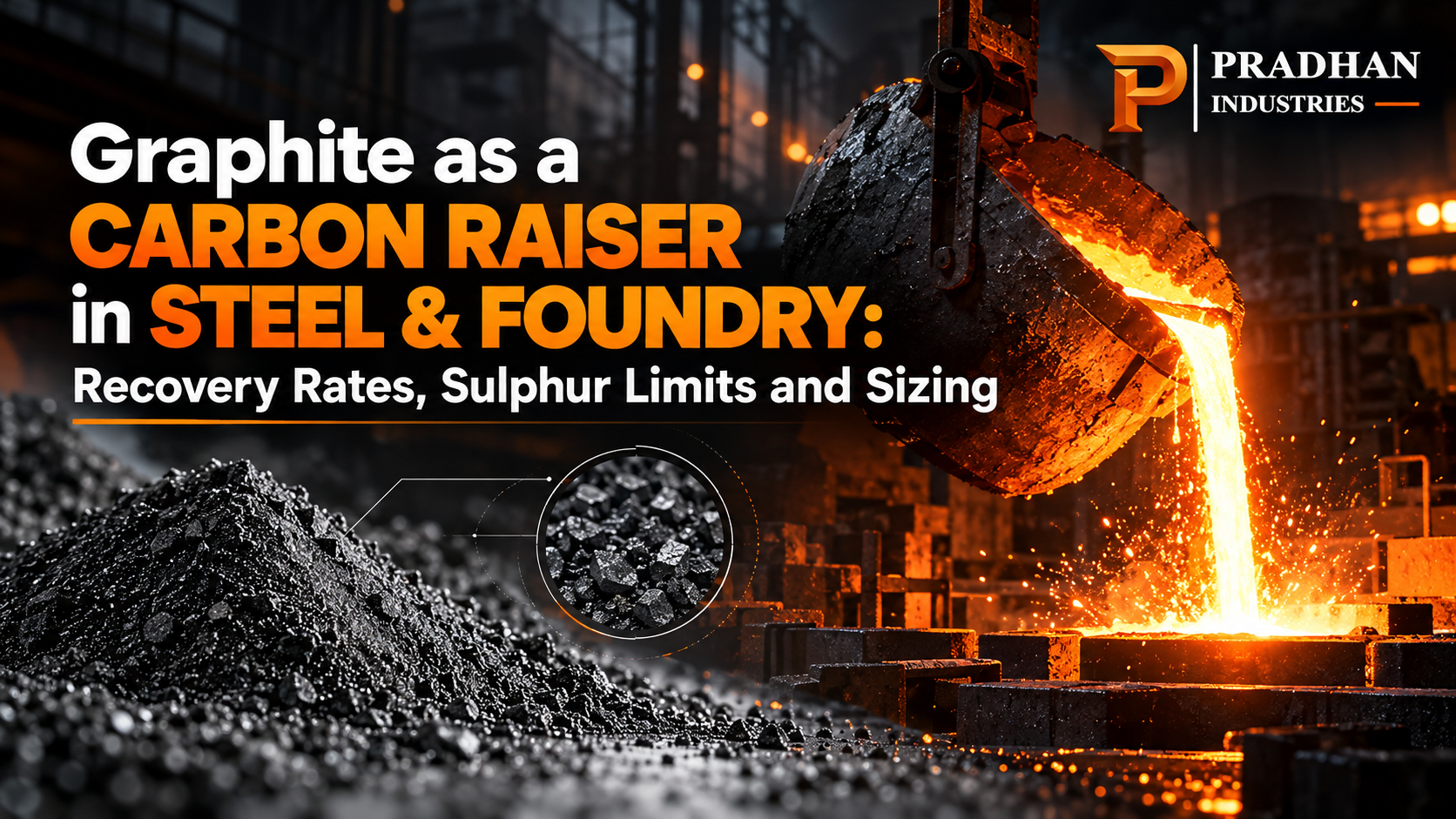
A heat that comes out of the furnace low on carbon costs time, power, and sometimes the casting itself. Choosing a graphite carbon raiser for steel or iron melting is therefore more than a purchasing line item. How much carbon actually reaches the melt depends on the raiser’s fixed carbon, its sulfur, nitrogen, ash, and moisture; its particle size; and how and when it is added.
This guide explains what controls carbon recovery, how natural graphite compares with calcined petroleum coke and synthetic graphite, which impurities matter, and how to estimate an addition. A working calculator is included.
What Is a Carbon Raiser in Steelmaking and Foundry Operations?
A carbon raiser (also called a recarburizer or carburizer) is a high-carbon material added to molten metal to bring its carbon content up to a target value.
Foundries use carbon raisers when melting cast iron from charges rich in steel scrap, which carries far less carbon than the final iron needs. Steel melt shops use them to correct carbon in induction furnaces, electric arc furnaces, or, where the practice allows, in the ladle.
The carbon raiser is only one input. It does not replace sound melting practice, slag control, or chemical analysis. It supplies carbon; the process decides how much of that carbon stays in the metal.
Every addition starts from two numbers: the melt’s current carbon and the target carbon. The gap between them, multiplied by the melt weight, is the carbon you need to recover. The right material depends on the grade of steel or cast iron, the furnace, the process conditions, and the final chemistry required.
What Affects Carbon Recovery Rates?
The theoretical addition assumes every kilogram of carbon in the raiser dissolves into the melt. In practice, some carbon is lost. Carbon recovery is the share of added carbon that actually ends up in the metal.
Recovery is plant-specific. These factors drive it:
- Fixed carbon. Lower fixed carbon means more non-carbon material is added for every kilogram of carbon delivered.
- Particle size, bulk density, and dissolution. Very fine material can be carried away by hot gases or trapped in slag. Very coarse material dissolves slowly. Density affects whether particles sink into the metal or float on the slag.
- Furnace type and conditions. Induction furnaces stir the bath electromagnetically, which helps dissolution. Other furnaces and ladles behave differently.
- Addition timing and point. Adding with the solid charge onto the bath surface or into the ladle stream gives different contact times and exposures to air.
- Slag and oxidation. A thick or oxidizing slag layer can hold particles away from the metal or burn carbon off.
- Mixing, temperature, and holding time. Carbon needs enough time and stirring to dissolve.
- Handling practice. Spillage, wet material, and inconsistent weighing all show up as lower apparent recovery.
Furnace vs. ladle additions. In-furnace additions, especially with the charge, usually give the carbon longer to dissolve. Ladle additions offer less time and stirring, so the particle size and dissolution rate of the raiser matter more, and recovery tends to be harder to predict. Whether ladle carbon correction is acceptable at all depends on the grade and the plant’s practice.
What published research shows. In one study using a small (about 20 kg) induction furnace with the carburizer added to the solid charge, average carburization efficiency was close to 99% for synthetic graphite, around 95% for surface-activated petroleum coke, and 90% for petroleum coke, with the lowest result for a natural graphite containing about 85% carbon and 11% ash (Janerka et al.). Those figures reflect one test setup and one set of materials. They show why purity matters, but they are not values to plan production around. Use your own plant’s validated recovery data.
Natural Graphite vs. Calcined Petroleum Coke vs. Synthetic Graphite
No carbon raiser is best for every melt. Selection depends on the chemistry you need, how the material behaves in your process, supply availability, and the total cost of carbon recovered—not the price per tonne.
| Material | Key Characteristics | Potential Advantages | Important Checks | Suitable Evaluation Context |
|---|---|---|---|---|
| Natural crystalline graphite | Mined and beneficiated; crystalline graphite structure; purity varies widely by grade | Graphitic carbon: sulfur can be low depending on the source; a domestic supply option | Fixed carbon and ash (ash adds to slag and can lower recovery); moisture; particle-size distribution | Where its purity, ash, and sizing meet the melt specification and trials confirm recovery |
| Calcined petroleum coke | Made by calcining petroleum coke; carbon largely non-graphitic | Widely available; high carbon in good grades | Sulphur and nitrogen, which vary strongly by grade; volatile matter; dissolution behavior | Applications where its sulfur and nitrogen fit the product specification |
| Synthetic graphite | Produced by graphitizing coke at very high temperature | Very high carbon, low ash; generally fast dissolution | Cost: nitrogen and sulfur by grade; sizing | Demanding grades, or where its cost is justified by recovery and chemistry |
Comparisons should always be made on like-for-like data: the same test methods, comparable particle-size distributions, and recovery measured in your own furnace.
Sulfur, Nitrogen, Ash, and Moisture Limits
Fixed carbon tells you how much carbon you are buying. The other parameters tell you what else comes with it.
Sulphur. Sulphur from the carbon raiser enters the melt. In many steel grades, sulfur must be kept low. In ductile (SG) iron, sulphur interferes with magnesium treatment, so ductile iron producers usually set tighter sulphur limits than grey iron foundries. The acceptable level comes from your product specification, not from a generic figure.
Nitrogen. Nitrogen pickup can matter for certain steel grades and for some cast irons, where it can contribute to gas-related defects. Coke-based raisers can vary considerably in nitrogen depending on source and processing, so it should be specified and tested where it matters.
Ash. Ash is the mineral residue that does not dissolve as carbon. It adds to the slag volume and, depending on its chemistry, can affect slag behavior. High ash generally means less carbon per kilogram and may reduce recovery.
Moisture. Moisture adds weight that is not carbon, makes weighing less accurate, and wet material added to molten metal is a safety concern. Check moisture at receipt, especially after monsoon storage or transport.
Fixed carbon. Distinguish the declared fixed carbon from the other parameters. Fixed carbon is often calculated by difference after moisture, volatile matter, and ash are determined, while total-carbon analyzers measure all carbon present. Know which method sits behind each number.
Permissible levels must be set for each material grade, end product, process route, and buyer specification. There is no single acceptance limit that applies everywhere.
Choosing the Right Particle Size and Mesh
Particle size affects how a carbon raiser handles it, how it enters the melt, how fast it dissolves, and how much is lost.
- Too fine: fines can be carried off by thermal currents above the melt, burn at the surface, or get caught in slag.
- Too coarse: large particles take longer to dissolve, which matters when holding time is short.
The best sizing depends on the addition point, furnace practice, and the material’s density. A size range that works well with the charge in an induction furnace may not suit a ladle addition.
A nominal mesh description such as –100 mesh only tells you the top size. Two materials sold at the same mesh can have very different amounts of fines. Ask for a full particle-size distribution, measured with test sieves conforming to a recognized specification such as ASTM E11.
Sizing checklist for buyers
- Agreed mesh or size range for the intended addition point
- Agreed sieve-analysis method
- Full particle-size distribution on the COA
- Packaging suited to keeping material dry and intact
- Size consistency checked across lots
How to Calculate Carbon Addition
A simple mass balance gives a theoretical estimate of how much carbon raiser to add.
Step 1 – Carbon deficit Carbon deficit (kg) = Melt weight (kg) × (Target C % − Initial C %) ÷ 100
Step 2 – Carbon raiser addition Estimated addition (kg) = Carbon deficit (kg) ÷ [(Fixed carbon % ÷ 100) × (Recovery % ÷ 100)]
Worked example (illustrative values only): a 1,000 kg melt at 3.0% carbon needs to reach 3.4%. The deficit is 1,000 × 0.4 ÷ 100 = 4 kg of carbon. With a raiser of 90% fixed carbon and an assumed 85% recovery, the estimated addition is 4 ÷ (0.90 × 0.85) ≈ 5.23 kg.
This is a theoretical estimate based on the inputs you provide. Actual additions must be adjusted using your plant’s validated recovery data, process conditions, and chemical analysis of the melt.
Common Carbon Raiser Procurement Mistakes
- Choosing on fixed carbon alone. Sulphur, nitrogen, ash, and sizing can matter as much.
- Ignoring sulfur and nitrogen requirements. A cheap raiser that pushes sulfur out of specification is not cheap.
- Comparing nominal mesh sizes without the same test method or full distribution.
- Assuming published recovery values will match your plant. Recovery depends on your furnace and practice.
- Overlooking moisture, ash, and batch variation. Lot-to-lot changes alter both chemistry and recovery.
- Not checking the COA against the purchase specification for every delivered lot.
- Switching grades or suppliers without controlled plant trials.
Incoming Quality Checks Before Accepting a Carbon Raiser
- Supplier and batch identification confirmed
- Purchase specification verified
- COA matches the delivered lot
- Fixed carbon and ash reviewed
- Sulphur and nitrogen verified where required
- Moisture checked
- Particle-size distribution checked
- Sampling and retained-sample records kept
- Lot traceability and any deviations documented
For a fuller receiving routine, see our guide on lot-to-lot consistency in graphite supply [VERIFY URL once published] and our quality control page.
How to Evaluate a Graphite Carbon Raiser Supplier
Ask these questions before approving a supplier:
- Which natural crystalline graphite grades are available, and which are used as carbon raisers?
- What fixed carbon and impurity specifications (sulphur, nitrogen, ash, moisture) are documented?
- Which particle-size ranges can be supplied for your addition point?
- Is a lot-specific COA provided, and which test methods are used?
- Can a sample be evaluated before a commercial order?
- How are batches identified on bags and documents?
- What information does the supplier need from you to suggest a grade for evaluation?
You can review current graphite grades on our technical specifications page. Suitability for a specific furnace or melt should be confirmed through discussion and trials.
Discuss Your Graphite Carbon Raiser Requirements
If you are evaluating a natural graphite carbon raiser for steel or foundry melting, share your requirements with Pradhan Industries:
- Application and furnace type
- Melt weight and target carbon adjustment
- Required fixed carbon and particle size
- Sulphur, nitrogen and ash requirements
- Expected quantity and packaging needs
- COA or other technical documents required
Our team will review your requirements and discuss suitable grades for evaluation.
Website: https://pradhanindustries.com/ Email: info@pradhanindustries.com Phone: +91 707-780-5666
Frequently Asked Questions
What is a good carbon recovery rate for a carbon raiser? There is no single figure. Recovery depends on the raiser’s purity and sizing, the furnace, addition point, slag and holding time. Published studies report widely different values under different test conditions. Use recovery measured in your own plant.
Is natural graphite suitable as a carbon raiser? It can be, depending on its fixed carbon, ash, sulphur and sizing, and on the product being made. Higher-ash natural graphite adds more slag and may give lower recovery, so purity matters. Plant trials are the reliable way to confirm suitability.
Why does sulphur matter in a carbon raiser? Sulphur in the raiser enters the melt. Many steel grades and ductile iron have tight sulphur limits, so a raiser’s sulphur content must fit the final product specification.
Which particle size is best for a carbon raiser? It depends on where and how the material is added. Fines may be lost to gases or slag; coarse particles dissolve more slowly. Agree a size range for your practice and check the full particle-size distribution.
How do I calculate how much carbon raiser to add?
Multiply the melt weight by the needed carbon increase.
This gives the carbon deficit.
Then divide by the raiser’s fixed carbon and your assumed recovery.
Use both values as fractions. Adjust the result using your plant’s actual recovery data and melt analysis
Carbon Raiser Addition Calculator
Estimate the theoretical carbon raiser addition for a melt. Example values are illustrative only — replace them with your own data.
Important: This is a theoretical mass-balance estimate based on the values you enter. Actual additions must be adjusted using your plant's validated recovery data, process conditions and chemical analysis of the melt. It is not a process recommendation.
Pradhan Industries
Natural Graphite Mining, Beneficiation & Industrial Carbon Supply Specialists.