When a plant needs graphite in tonnes rather than kilograms, finding a supplier is the easy part. The harder part starts afterwards. Which FC grade does the process actually need? What particle size should the specification state? How will the material be packed, and will that packing survive three weeks in a warehouse before it reaches the shop floor? What documentation comes with each dispatch?
Most sourcing delays in this material happen because those questions get answered late, usually after a trial lot has already gone wrong. Choosing a bulk graphite supplier in India is really a decision about whether the supplier can hold a specification, explain it clearly, and repeat it on the next order.
Pradhan Industries has been in natural graphite since 1976, mining and beneficiating material in Odisha and supplying industrial requirements across India. This article explains how bulk natural graphite buying really works. It covers grades, specs, packing, ordering, and checking suppliers from the buyer’s side.
What Is a Bulk Graphite Supplier?
A bulk graphite supplier is a company that supplies natural graphite in industrial quantities, usually by the tonne, against a defined specification rather than a catalogue item. The supplier is responsible for grade consistency, particle size, packing suitable for bulk handling, dispatch documentation, and coordination of delivery to the buyer’s plant or warehouse.
What Should You Expect From a Bulk Graphite Supplier in India?
A serious industrial supplier should be able to give you a clear answer on each of the following before an order is placed, not after.
A defined grade, not a range with no boundaries. “Around 90% FC” is not a specification. Minimum FC, maximum ash, and maximum moisture are.
Particle size information. The supplier should be able to tell you what size distribution the material is supplied in and whether it can be adjusted.
Quality and testing information. Ask what is tested on each lot, on what basis the result is reported, and what document accompanies the dispatch. A supplier who can explain their own test basis clearly is usually a supplier whose numbers mean something.
Packing suited to bulk handling. Packing that works for a 50-kg trial sample rarely works for a 20-ton order.
Commercial documentation. Invoice, dispatch documents, weight details, and material identification, all consistent with the purchase order.
Communication during ordering. Somebody who answers technical questions without routing everything through a sales script.
Dispatch coordination. Confirmation of loading, transport details, and delivery point, so your stores team is not guessing.
None of this is exotic. It is simply what a buyer needs in order to plan a production schedule around a raw material.
Understanding Natural Graphite Grades
Natural graphite is sold by grade, and a grade is a combination of parameters rather than a single number. The four that appear on almost every specification are fixed carbon, ash, moisture, and particle size.
Fixed carbon (FC) is the carbon content of the material, and it is the headline figure buyers usually quote first.
Ash is the mineral residue that remains after the carbon is burned away. Depending on the application, the composition of the ash can matter in addition to the total ash percentage—a refractory or foundry user may care about what the ash is made of, while another application may only need the total figure held below a limit.
Moisture affects weight, handling, and, in some processes, behavior. It also changes as material moves and is stored.
Particle size determines how the material behaves in mixing, dispersion, charging, or pressing.
Here is the part that gets missed: a higher FC grade is not automatically the better choice. Purity is a specification, not a verdict. A process that performs well on a mid-range FC gains nothing measurable from a higher grade, and the buyer ends up paying for a property the process never uses. In some applications, other parameters—particle size, ash composition, and consistency between lots—influence outcomes more than the last two or three percentage points of carbon.
The correct grade follows from the application and the buyer’s own specification. Any supplier who recommends the highest available grade for every inquiry is selling, not advising.
What Does FC Percentage Mean?
Fixed carbon is the proportion of the material that is carbon, expressed as a percentage. In commercial natural graphite, grades are commonly discussed at levels such as 85% FC, 90% FC, 92% FC, and 95% FC. Pradhan Industries’ publicly communicated range runs approximately from 85% FC to 95% FC.
Treat those figures as illustrative grade levels rather than a stock list. Availability of any particular grade should be confirmed against your requirement at the time of enquiry.
One practical point worth writing into your purchase specification: state the test method and the reporting basis, not just the number. Fixed carbon reported on an as-received basis and on a dry basis will not be the same figure for the same material, and differences in sample preparation and ashing conditions can also shift the result legitimately. [VERIFY TECHNICAL DATA] for the specific method and conditions used. Agreeing this at the PO stage prevents an argument at the gate later.
Why Particle Size Matters
Particle size is where two lots of similar purity start behaving differently. A fine powder disperses and reacts differently from a coarser fraction. A material that works in a blended formulation may not suit a process where the graphite has to be charged, pressed, or held in suspension.
Buyers typically specify powder, fine material, coarser material, or a distribution tied to their own process, and the right answer is set by the application rather than by convention. Because size distribution also affects handling, dust, and storage behavior, it belongs in the specification alongside FC and ash rather than being left to the supplier’s discretion. For the exact ranges available, write to us—[VERIFY AVAILABLE PARTICLE-SIZE RANGE].
Bulk Natural Graphite Supply Across India
Bulk supply follows a fairly predictable sequence once the specification is settled.
It begins with requirement identification: the application, the process stage where the graphite is used, and whether this is a trial, a repeat order, or a scheduled annual requirement. Grade selection follows from that, and it is worth doing jointly rather than sending a one-line inquiry with only an FC number in it.
Quantity comes next, because it affects packing, transport mode, and scheduling. Packing is then confirmed against how the buyer’s plant actually handles material—forklift, manual handling, covered storage, or open yard. Documentation requirements are agreed upon at the same time, so nothing is discovered missing when the vehicle reaches the gate.
Dispatch and delivery coordination close the loop. The buyer’s stores and production teams need advance information on loading and transport so that receiving, testing, and consumption can be planned.
Pradhan Industries supplies industrial requirements across India from its Odisha operations, which include a graphite mine and beneficiation plant at Bandhamandi in Rayagada district and a second beneficiation plant at Laxmipur in Koraput district. Delivery schedules depend on quantity, grade, packing, and destination and are confirmed order by order.
Graphite Packing Options for Bulk Orders
Packing for bulk graphite is a handling decision as much as a protective one.
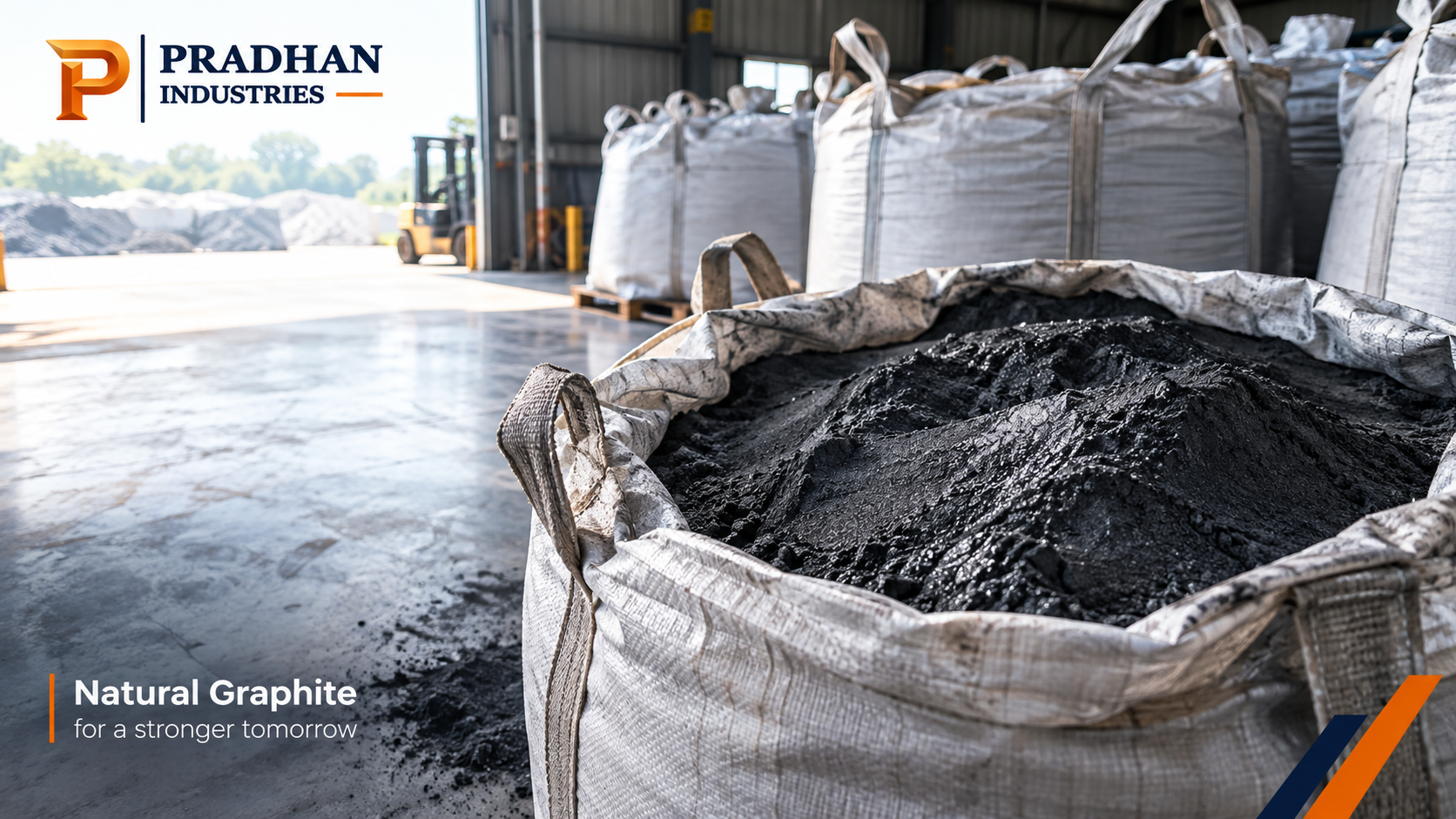
Good packing protects the material from moisture pickup in transit and in storage, survives repeated handling without splitting, stacks safely in a warehouse, carries clear identification so lots do not get mixed, and suits whatever equipment the receiving plant uses. A bag that is comfortable for one plant’s forklift may be awkward for another plant that unloads by hand.
Identification deserves particular attention. If a quality question arises three months later, lot-wise marking is what lets both sides trace the material back to a specific dispatch instead of arguing from memory.
Packing requirements can be discussed according to the quantity, handling requirements, and buyer specification. Confirm packing in writing before dispatch—it is a small step that prevents a large problem at the unloading bay.
How to Order Bulk Natural Graphite From India
Step 1—Share your application. Tell the supplier what the material is used for and at which stage of your process. A supplier who knows the end use can flag a mismatch before it becomes a rejected lot.
Step 2—Share the required grade. Minimum FC, maximum ash, maximum moisture, particle size, and any other parameter your process controls. If you have an existing specification sheet, send it.
Step 3—Confirm quantity. State the quantity per dispatch and the expected annual or monthly offtake if it is a repeat requirement. Order quantities for bulk supply are discussed against the specific requirement.
Step 4—Discuss packing. Cover handling equipment, storage conditions, and identification needs.
Step 5—Confirm quality requirements. Agree what will be tested, on what basis results will be reported, and what document travels with the consignment.
Step 6—Confirm commercial terms. Price, quantity, packing, freight, delivery location, and payment terms, all in one place. Terms are agreed upon in order.
Step 7—Coordinate dispatch and delivery. Loading confirmation, transport details, expected delivery point, and receiving instructions.
What Information Should You Send When Requesting a Graphite Quote?
Send these eight lines and you will get a usable quotation rather than a request for more information:
- Application:
- Required FC:
- Particle size:
- Required quantity (per dispatch and annual):
- Packing preference:
- Delivery location:
- Testing/documentation requirements:
- Expected purchase frequency:
How to Choose a Bulk Graphite Supplier in India
Use the same criteria across every supplier you are evaluating, and evaluate them on evidence rather than presentation.
Look at product consistency first—ask for lot-to-lot variation across recent dispatches, not a single typical value. Check whether specifications are clearly defined, with minimum and maximum limits rather than approximations. Ask what testing and documentation accompanies each lot and on what basis figures are reported.
Consider processing capability, because a supplier that mines and beneficiates its own material controls more of the variables than one that buys and resells. Weigh supply experience in the specific application you are buying for. Assess packing and logistics coordination, since most delivery problems are handling problems. Judge communication by how technical questions get answered. And note whether the supplier understands your application well enough to tell you when a grade is unnecessary.
Why Indian-Origin Natural Graphite Matters for Industrial Buyers
Domestic sourcing changes the practical texture of procurement. Communication happens in the same time zone and often in the same language, which matters more than it sounds when a specification needs clarifying mid-order. Inland logistics can be coordinated directly with the supplier. Plant visits are possible, and a buyer who can walk a beneficiation plant learns more in two hours than in six months of correspondence.
For companies building longer-term supplier relationships, that visibility into where the material comes from and how it is processed is itself a procurement asset.
Applications of Natural Graphite in Industry
Natural graphite is used across steel, foundry, refractories, lubricants, paints, chemicals, and battery and energy-related applications, among other industrial uses. Each of these places has different demands on the material—a refractory manufacturer and a lubricant blender rarely want the same thing from the same mineral.
The rule that holds across all of them is simple: application determines specification, and specification determines grade selection. No single grade suits every application, and a grade that performs well in one process carries no guarantee in another.
Bulk Graphite Supplier India — Why Specification Comes Before Price
This is the section worth reading twice.
Comparing graphite suppliers on price alone is only valid if you are comparing the same material, and you usually are not. Two quotations can differ because the FC differs, the ash differs, the moisture differs, the particle size differs, the test basis differs, the packing differs, or the freight terms differ. Any one of those can move the effective cost more than the quoted rate does.
Moisture is the clearest example. You pay for delivered weight, but you consume dry material. Rejection rate is another—a lot that fails incoming inspection costs the price of the material plus the disruption to your production schedule.
The practical fix is to fix the specification first, then ask for prices against it. Send every supplier the same grade parameters, the same packing requirement, the same delivery point, and the same documentation requirement. Then the numbers you receive are actually comparable.
Buyers who do this consistently tend to change suppliers less often, because they stop discovering after the fact that they bought something different from what they thought they had ordered.
Frequently Asked Questions
Who is a bulk graphite supplier in India?
A bulk graphite supplier in India is a company supplying natural graphite in industrial quantities against a defined specification, typically covering FC, ash, moisture, and particle size, along with suitable bulk packing, dispatch documentation, and delivery coordination to the buyer’s location.
What graphite grades are available in India?
Natural graphite grades are commonly discussed by fixed carbon level. Pradhan Industries’ publicly communicated range is approximately 85% FC to 95% FC. Availability of any particular grade, along with the associated ash, moisture, and particle size parameters, should be confirmed at the time of enquiry against your specific requirement.
What does FC mean in graphite?
FC stands for fixed carbon—the percentage of the material that is carbon. It is the most quoted parameter in graphite specifications, but it should always be read together with ash, moisture, and particle size, and alongside the test method and reporting basis on which the figure was produced.
How should I choose the right graphite grade?
Start from the application. Identify what the process actually requires in terms of purity, particle size, and consistency, write that into a specification, and select the grade that meets it. Higher FC is not automatically better; it is simply higher, and in many applications it is an unnecessary cost.
Can natural graphite be supplied in bulk quantities?
Yes. Bulk supply is standard for industrial users, with quantity, grade, packing, and delivery schedule agreed upon for each order. Share your per-dispatch quantity and expected purchase frequency at the enquiry stage so that packing and dispatch planning can be discussed realistically.
What packing is used for bulk graphite?
Packing for bulk orders is chosen for handling, storage, moisture protection, and lot identification. Requirements can be discussed according to the quantity, handling requirements, and buyer specification and should be confirmed in writing before dispatch so the receiving plant is prepared for what arrives.
Can graphite be supplied across India?
Pradhan Industries supplies industrial requirements across India from its Odisha operations. Delivery arrangements depend on quantity, packing, and destination and are coordinated for each order.
Request a Bulk Natural Graphite Quote
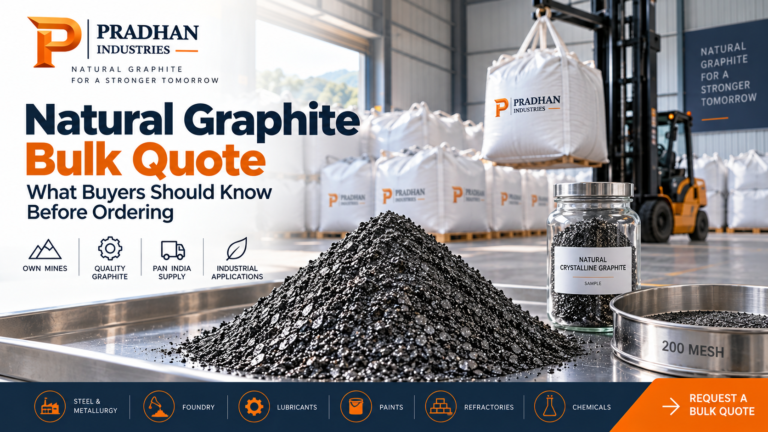
If you are sourcing natural graphite in bulk, share your application, required grade, particle size, quantity, packing preference, and delivery location. We will review the requirement and discuss the supply specification that fits it—including telling you if a lower grade would serve the process just as well.
Pradhan Industries
Plot 1, Trishna Enclave Phase 4 Extn, KIIT Road, near KIIT University, Patia, Bhubaneswar, Odisha 751024, India
Email: info@pradhanindustries.com
Phone: +91 707-780-5666