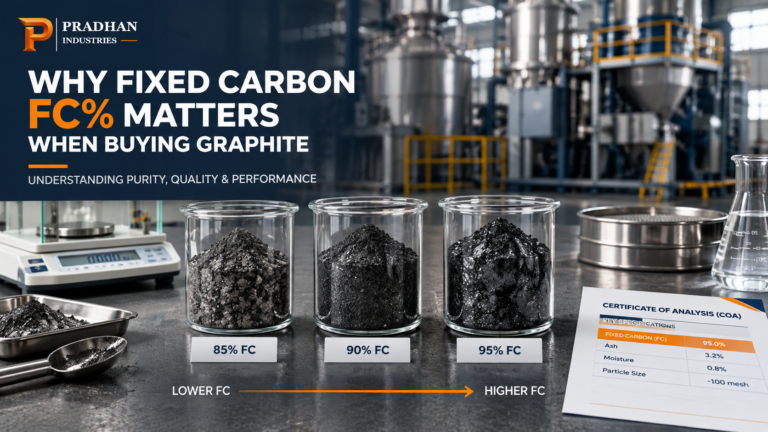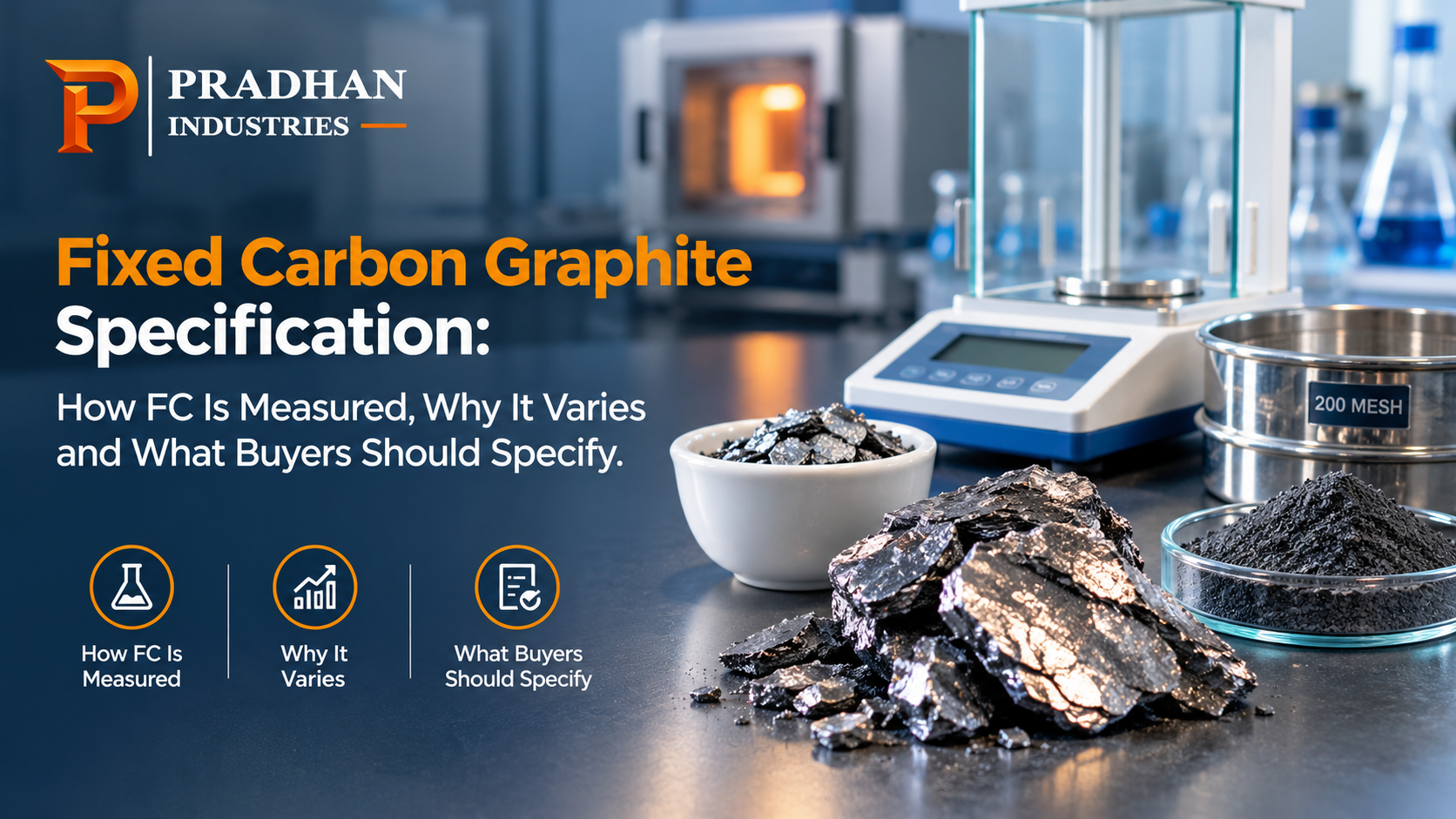
Every graphite purchase comes down to one number: fixed carbon (FC). A clear fixed carbon graphite specification separates a reliable supply from disputed lots, rejected cargo, and unstable production. Refractory plants pay for carbon, not ash. Steel melt shops do graphite to hit a carbon target. Crucible makers depend on a stable carbon matrix to survive repeated thermal cycles. All of them are buying fixed carbon, whether the purchase order says so or not.
Yet FC is also the number most often written loosely. “FC 94%” on a quotation can mean a minimum or an average. It may be on a dry or as-received basis. It may come from a test method the buyer never agreed to. Those gaps are where lot-to-lot drift hides.
The cost of drift is real. A two-point FC drop in a magnesia-carbon brick mix raises ash, weakens hot strength, and shortens lining life. In steelmaking, it shifts carbon recovery and forces rework of addition rates. Often the supplier’s COA still looks “in spec,” because the spec never pinned the number down.
This industrial graphite buying guide explains how FC is measured, why natural crystalline graphite purity changes between lots, and how to write a fixed carbon graphite specification that holds up at the receiving dock.
Understanding Fixed Carbon in Natural Graphite
Fixed carbon is not measured directly. It is what remains after the laboratory subtracts the three non-carbon fractions found by proximate analysis graphite testing.
\text{FC (\%)} = 100 - \text{Ash (\%)} - \text{Volatile Matter (\%)} - \text{Moisture (\%)}| Fraction | What it represents | How it is typically determined |
|---|---|---|
| Moisture | Water adsorbed from the atmosphere | Drying a weighed sample to constant mass; ASTM C562 is the graphite-specific method. |
| Volatile matter (VM) | Gases released on heating without air: residual flotation reagents, organics, bound water in clays | Heating in a covered crucible at high temperature; the method must be named on the COA. |
| Ash | Non-combustible mineral residue: silica, alumina, iron oxides, mica, feldspar | Burning the sample in air until only residue remains; ASTM C561 is the graphite-specific method |
| Fixed carbon | The crystalline carbon the buyer is paying for | Calculated by difference |
A worked example
A flake concentrate tests at 4.6% ash, 0.8% VM, and 0.4% moisture. Its fixed carbon is 100 − 4.6 − 0.8 − 0.4 = 94.2%.
Dry the same sample first, and moisture drops out. FC on a dry basis becomes roughly 94.6%. Same material, two different numbers. This is why every fixed carbon graphite specification must state its basis.
Why Proximate Analysis Matters to Your Fixed Carbon Graphite Specification
Because FC is calculated by difference, any error in ash, volatile matter, or moisture flows straight into the FC figure. A fixed carbon graphite specification that names the basis and method for each fraction removes that uncertainty.
The standard methods also have limits. ASTM C561 gives a practical estimate of non-burnable residue for comparing commercial grades. It is not intended for purified graphites, such as nuclear-grade material. ASTM C562 covers only moisture adsorbed from the air, not graphite wetted by rain or container condensation.
Expert insight: some COAs report total carbon from a combustion analyzer instead of FC by difference. Total carbon includes carbon in volatiles and carbonate minerals, so it can read higher than true fixed carbon. A clean graphite COA specification states which value is reported and by which method.
Why Fixed Carbon Varies Lot to Lot
Natural graphite is a mined mineral, not a synthesised chemical, so some variation is built in. The real question is whether the processor controls it. Four stages drive most of the drift.
1. Ore body variability
Flake graphite occurs in metamorphic host rocks such as schists and gneisses. Head grade, flake size, and gangue mineralogy change across a deposit, sometimes within meters. Ore rich in mica or clay is harder to clean than ore with quartz gangue. Blending run-of-mine ore from several faces before milling gives a much steadier feed.
2. Grinding and flotation efficiency
Froth flotation separates hydrophobic graphite from hydrophilic gangue. Its efficiency depends on grind size, reagent dosing, pulp density, and air rate. Grind too coarse, and gangue stays locked to the flakes. Grind too fine and the large flakes, the most valuable fraction, break apart. Small shifts in these settings can move concentrated FC by a point or more.
3. Multi-stage cleaning and purification
One rougher stage rarely yields a commercial concentrate. Higher purities come from repeated cleaner stages, often with gentle regrinds in between to release locked gangue. Each extra stage raises FC but costs recovery and throughput. When stages are bypassed to meet volume targets, purity drops first.
4. Drying and classification
Drying temperature controls residual moisture, and excessive heat can begin to oxidize fine particles. Screening then splits the concentrate into mesh fractions. Coarse flakes usually clean better than fines, so flake graphite carbon content often differs between the +50 mesh and −100 mesh fractions of one batch.
What Variation Means for Your Fixed Carbon Graphite Specification
Variation cannot be eliminated, but it can be bounded. Ask suppliers how they blend ore, how many cleaning stages they run, and whether FC is tested on the exact size fraction shipped. Their answers show how tight a fixed carbon graphite specification they can realistically hold.
How to Write a Foolproof Fixed Carbon Graphite Specification
A strong fixed carbon graphite specification removes every point of interpretation. Work through these six elements.
Set a minimum and a tolerance band.
“FC 94%” invites argument. “FC 94.0% minimum, dry basis” does not. Where a target helps, write the tolerance into the fixed carbon graphite specification as a band:
- ±0.5% for high-purity refractory and crucible grades, where performance is sensitive
- ±1.0% for carbon-raiser and general industrial grades
Tight bands cost more, so use them only where your process genuinely needs them.
State the basis and test methods.
Specify dry basis or as received. Name the method for each fraction: ASTM C561 for ash, ASTM C562 for moisture, and an agreed method for volatile matter. If total carbon by combustion is acceptable instead of FC by difference, say so.
Limit impurities, not just FC.
Add maximum limits for ash, volatile matter (usually under 1% for flotation concentrates), and moisture (typically 0.5% maximum at dispatch). Add sulfur and iron limits where your application is sensitive to them.
Tie purity to mesh size
Specify the particle size distribution alongside FC, and require FC on the delivered fraction. That way the fixed carbon graphite specification applies to the material you actually receive. A sound clause reads: “+80 mesh, 90% minimum retained (ASTM E11 sieves); FC 94.0% minimum on this fraction, dry basis.”
Fix sampling and dispute rules.
- Define a lot, such as one production batch or one container.
- Require a composite sample drawn from multiple bags across the lot.
- Set a lot-average minimum and a per-sample floor, for example, 94.0% average with no sample under 93.5%.
- Require a sealed retained sample, held for an agreed period.
- Name an umpire laboratory whose result is binding in a dispute.
Define the COA format
Attach the required COA format to the fixed carbon graphite specification. A reliable COA shows the lot number, sampling date, basis, method per parameter, actual measured values, and the sieve analysis. Reject “typical” values presented as results, missing methods, or a COA with no link to the lot shipped.
Verifying Samples Against Your Fixed Carbon Graphite Specification
A specification is only as good as the verification behind it. Procurement teams can close the loop in four steps.
- Request a representative sample. Ask for material from a recent production lot of the exact grade and mesh you plan to buy, with its matching COA and lot number.
- Test it independently. Send a split to your own lab or a third-party lab, using the same methods named in your fixed carbon graphite specification. A persistent gap usually points to a method or basis mismatch to resolve before the first order.
- Run a trial lot. A small commercial shipment shows whether production material matches the sample. Compare its COA and your incoming results with the fixed carbon graphite specification.
- Use pre-shipment inspection for large orders. A buyer-appointed inspection agency can draw samples at the plant before loading, so problems surface before the cargo sails.
At Pradhan Industries, every dispatch of natural crystalline graphite from our Odisha operations comes with a batch-wise COA and an MSDS for the grade supplied. Because we run the chain from mine to market, each lot traces back to its production batch. We welcome independent testing and buyer-appointed pre-shipment inspection.
Frequently Asked Questions
What should a fixed carbon graphite specification include?
At minimum: an FC minimum with a tolerance band, the basis (dry or as-received), the test method for each fraction, limits on ash, volatile matter, and moisture, the mesh size distribution, and the sampling and dispute rules. It should also define the COA format the supplier must provide.
What is a good fixed carbon percentage for natural flake graphite?
It depends on the application. Many refractory and crucible buyers specify flake graphite carbon content in the mid-90s, while carbon raisers and some general industrial uses accept lower grades. Match FC to your process need instead of buying the highest natural crystalline graphite purity by default.
Why does my lab result differ from the supplier’s COA?
The usual causes are a different basis, a different test method, moisture picked up in transit, or a non-representative sample. Fixing methods and basis in your fixed carbon graphite specification and keeping a retained sample prevents most disputes.
Conclusion: Specify Precisely, Buy With Confidence
Fixed carbon decides how graphite performs, what it costs and whether a lot is accepted. A precise fixed carbon graphite specification, one that states a minimum, a basis, test methods, impurity limits, the mesh fraction and sampling rules, leaves no room for drift to hide.