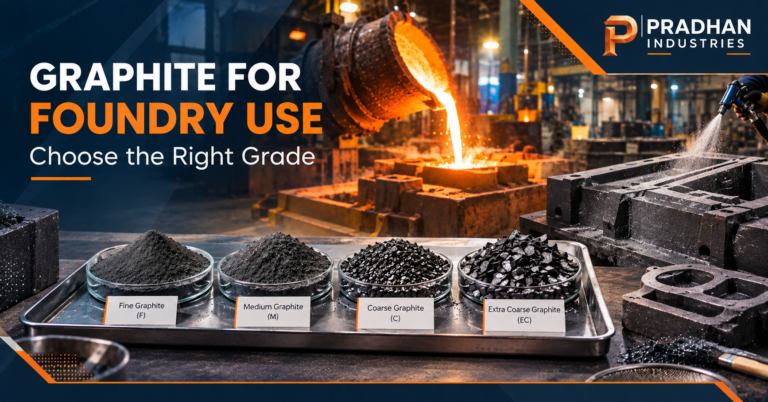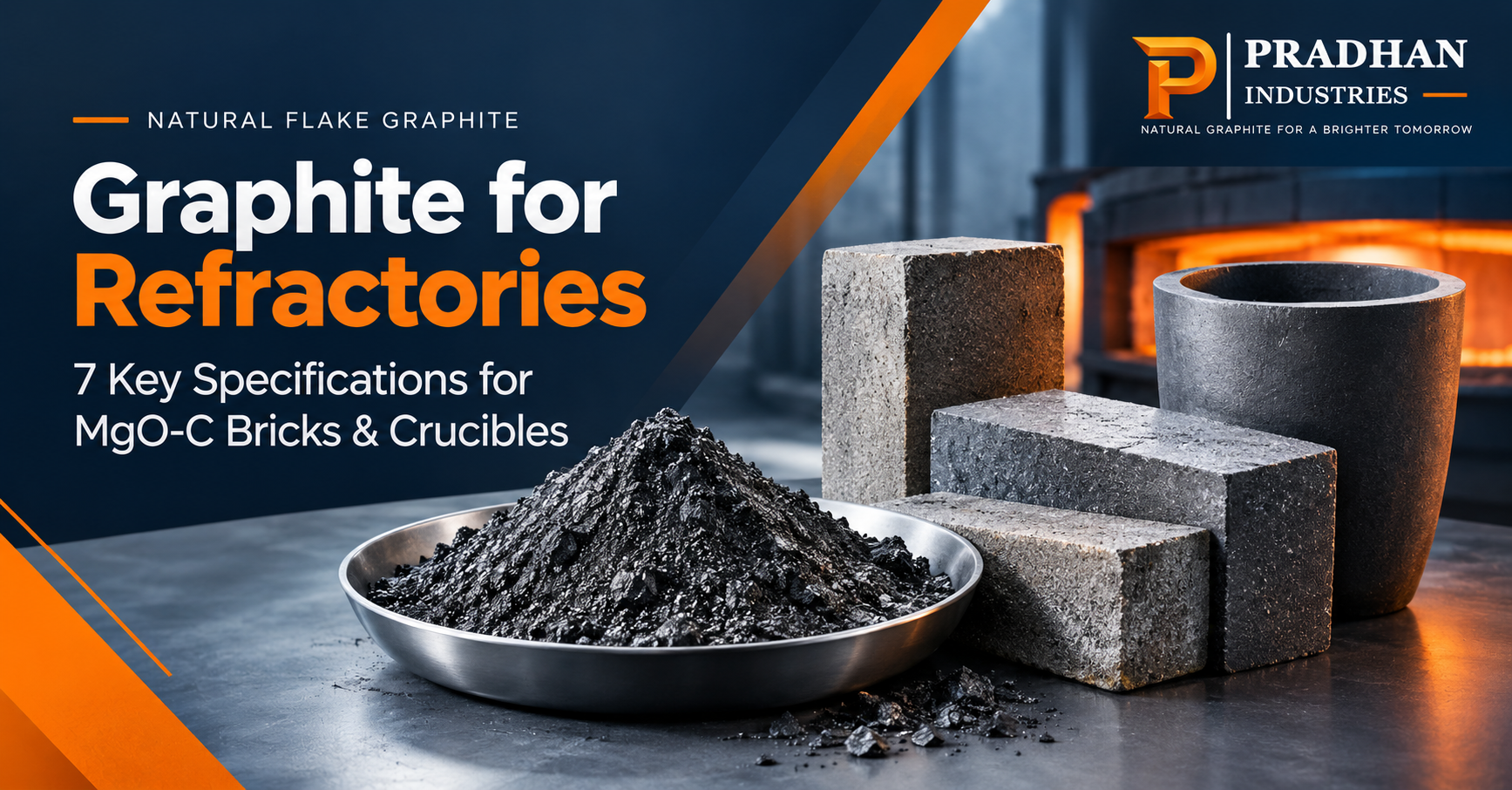
Graphite for refractories plays an important role in high-temperature industrial applications. It helps manage thermal shock, slag corrosion, heat transfer, and chemical stability. These factors can determine refractory service life. Natural flake graphite is particularly important in magnesia-carbon (MgO-C) bricks, while graphite is also used in crucibles, alumina-carbon refractories, foundry materials, and other carbon-containing refractory products.
But selecting graphite for a refractory application is not simply a matter of buying the highest fixed-carbon material available.
The right graphite grade depends on the finished refractory, manufacturing process, operating temperature, atmosphere, slag chemistry, particle-size distribution, and required service life. Properties such as fixed carbon, ash, flake size, moisture, and impurity levels can influence both processing and final refractory performance.
Industry references identify flake size, carbon content, and impurity levels as important characteristics when natural graphite is selected for refractory applications.
For manufacturers and industrial buyers, understanding these factors makes it easier to specify graphite correctly, compare suppliers, and avoid paying for a grade that does not match the actual application.
What Is Graphite for Refractories?
Graphite is a crystalline form of carbon with a layered structure. That structure gives it a combination of properties that are useful in severe high-temperature environments.
Compared with many conventional ceramic materials, graphite has:
- High thermal conductivity
- Low thermal expansion
- Good thermal-shock behavior
- Resistance to wetting by many molten slags and metals
- High-temperature stability in suitable atmospheres
- Useful lubricating characteristics during processing
These properties explain why graphite for refractories is widely used in carbon-containing refractory systems.
Natural flake graphite is especially important because its flake structure can contribute to the performance of MgO-C bricks. The European Carbon and Graphite Association identifies natural graphite for steelmaking refractories as being selected for properties including high-temperature stability and chemical inertness, with flake size, carbon content, and impurity level among the important considerations.
However, graphite also has an important limitation: oxidation.
Carbon reacts with oxygen at elevated temperatures. As a result, graphite-containing refractories must be designed and operated with oxidation in mind. Many MgO-C formulations therefore use antioxidants and carefully controlled microstructures to protect the carbon phase.
Why Is Graphite Used in Refractory Materials?
The value of graphite in refractories comes from the way several properties work together.
1. High Thermal Conductivity
Graphite conducts heat efficiently. In a refractory system, this can help reduce severe temperature differences within the material.
Large temperature gradients can create thermal stress. By improving heat transfer, graphite can contribute to better resistance to thermal shock and spalling.
2. Low Thermal Expansion
Graphite has a relatively low coefficient of thermal expansion compared with many oxide refractory phases.
When a refractory is repeatedly heated and cooled, differences in expansion between its components can generate internal stress. The low expansion of graphite is one reason it is valuable in carbon-containing refractory formulations.
3. Resistance to Slag Wetting
Graphite is not easily wetted by many molten slags. This characteristic can help reduce liquid penetration into the refractory structure.
Nippon Steel’s technical report specifically notes that natural flake graphite used in MgO-C bricks suppresses slag infiltration because graphite is not easily wetted by slag. The same source identifies its thermal conductivity and low thermal expansion as contributors to spalling resistance.
4. High-Temperature Stability
Graphite can withstand very high temperatures when oxygen exposure is controlled.
This makes it useful in refractory systems operating around molten steel, molten metals, and other high-temperature materials.
5. Flake Structure
Natural flake graphite is particularly useful because its morphology is different from fine amorphous carbon.
Flake size and distribution can influence mixing, packing, microstructure, and the final behavior of the refractory. For this reason, graphite should be specified according to both chemical composition and physical characteristics.
Graphite in Magnesia-Carbon Bricks
One of the most important applications of graphite for refractories is the production of magnesia-carbon bricks, commonly called MgO-C bricks.
MgO-C bricks combine a magnesia refractory phase with graphite and other components such as antioxidants and resin binders.
According to Nippon Steel, MgO-C refractories are composed of magnesia clinker, flake graphite, antioxidants, and resin. The composition can be adjusted according to the specific damage mechanism and location within a steelmaking vessel.
This combination provides a useful balance of:
- Corrosion resistance
- Thermal-shock resistance
- Slag-infiltration resistance
- Mechanical durability
- High-temperature performance
MgO-C bricks are widely associated with steelmaking equipment, including converters, electric arc furnaces, and ladles.
How Graphite Works Inside an MgO-C Brick
Think of an MgO-C brick as a carefully engineered composite rather than simply a mixture of magnesia and graphite.
The magnesia provides the primary refractory ceramic phase.
The graphite contributes thermal conductivity, low thermal expansion, and resistance to slag wetting.
The antioxidants help protect the carbon phase from oxidation.
The binder helps hold the shaped material together and contributes to the final carbon-containing structure after processing.
The exact balance depends on the application.
Nippon Steel reports that changing magnesium particle-size composition, graphite addition, and antioxidant content can significantly affect strength, physical properties, corrosion resistance, and spalling resistance.
That is why there is no single MgO-C recipe that should be applied to every furnace location.
Typical MgO-C Brick Specifications
A common mistake in refractory procurement is treating one published composition as a universal specification.
It is not.
MgO-C brick formulations vary according to the furnace, lining zone, slag chemistry, operating temperature, and expected wear mechanism.
For example, historical Indian Bureau of Mines data lists graphite used in magnesia-carbon refractories at approximately 12% of the refractory composition, with 87–90% fixed carbon and a particle size of 150–710 microns in the cited industry data.
This is an example of an industry specification, not a universal formulation.
| Parameter | Why It Matters |
|---|---|
| Fixed carbon | Determines the carbon contribution of the graphite |
| Flake size | Influences processing and refractory microstructure |
| Particle-size distribution | Affects packing, mixing, and final structure |
| Ash | Indicates non-carbon mineral residue |
| Impurity chemistry | Can influence high-temperature reactions |
| Moisture | Important for consistent processing |
| Graphite morphology | Influences thermal and structural behavior |
| Oxidation behavior | Important during high-temperature service |
For procurement, the specification should be agreed between the graphite supplier and refractory manufacturer before bulk supply begins.
Fixed Carbon: Is Higher Always Better?
Fixed carbon is one of the first numbers buyers look at when purchasing graphite for refractories.
But higher fixed carbon does not automatically mean better refractory performance.
A higher-carbon graphite generally contains less mineral matter, but the finished refractory depends on much more than carbon percentage.
The buyer should also consider:
- Flake size
- Particle-size distribution
- Ash content
- Ash chemistry
- Moisture
- Consistency between batches
- Compatibility with the refractory formulation
- Processing requirements
For example, Indian Bureau of Mines guidance identifies fixed carbon and ash among the important specifications for refractory graphite.
Therefore, instead of asking only:
“What is the highest-carbon graphite available?”
A better technical question is
“Which graphite specification gives the required refractory performance consistently?”
Graphite Flake Size for Refractories
Flake size is particularly important when selecting natural flake graphite for refractories.
The graphite particle must interact correctly with the other raw materials during mixing and pressing. Its size and morphology can affect packing, pore structure, and the distribution of the carbon phase.
The European Carbon and Graphite Association identifies flake size as one of the important properties of natural graphite used in refractory applications and notes that natural flake graphite with larger crystals can contribute to mechanical strength in refractory products.
However, bigger flakes should not automatically be treated as better.
The ideal size depends on:
- Brick formulation
- Graphite percentage
- Mixing equipment
- Pressing process
- Desired density
- Required thermal properties
- Target refractory microstructure
For this reason, buyers should request a particle-size distribution, rather than relying only on a simple description such as “flake graphite.”
Ash Content and Impurities in Refractory Graphite
Ash is another important specification when purchasing graphite for refractories.
Graphite itself is carbon, but natural graphite concentrates also contain mineral matter. After testing or combustion, this non-carbon material contributes to the measured ash.
The total ash value is useful, but refractory manufacturers should also consider what is inside the ash.
Potential mineral constituents can include compounds containing:
- Silica
- Alumina
- Iron
- Calcium
- Magnesium
- Other mineral phases
Their effect depends on the refractory formulation and service temperature.
This is why a supplier’s Certificate of Analysis (COA) should provide meaningful chemical information rather than only a headline fixed-carbon percentage.
For consistent production, manufacturers should monitor both the total ash level and relevant impurity chemistry.
Magnesia-Carbon Bricks in Steelmaking
MgO-C bricks are widely used in steelmaking because they must survive a combination of high temperature, molten steel, slag attack, mechanical stress, and thermal cycling.
The European Carbon and Graphite Association identifies graphite flakes as a major raw material in magnesia-carbon bricks used in basic oxygen furnaces (BOF), electric arc furnaces (EAF), and high-wear areas such as ladle slag lines.
Nippon Steel similarly describes MgO-C bricks as widely used in converters, vacuum degassers, and ladles.
BOF and Converter Applications
A basic oxygen furnace exposes its refractory lining to severe chemical and thermal conditions.
The lining can encounter:
- Basic slag
- Molten steel
- High temperatures
- Thermal cycling
- Mechanical wear
- Oxidizing conditions
MgO-C bricks provide a combination of magnesia’s refractory characteristics and graphite’s thermal and anti-wetting properties.
The exact formulation can change depending on the position inside the converter.
Nippon Steel describes the use of different refractory compositions in different converter lining zones because the dominant wear mechanisms vary from one area to another.
EAF Applications
Electric arc furnaces create intense thermal conditions and can expose refractory linings to aggressive slags and repeated thermal changes.
MgO-C bricks are commonly used in demanding EAF areas because graphite contributes to thermal-shock resistance while magnesia provides the principal refractory phase.
The graphite specification should therefore be matched to the expected operating conditions rather than selected only according to carbon percentage.
Ladle Applications
Steel ladles also use MgO-C refractories in demanding areas, particularly around slag lines.
The refractory must tolerate:
- Molten steel contact
- Slag interaction
- Heating and cooling
- Mechanical handling
- Repeated steelmaking cycles
A consistent graphite supply is important because changes in particle size or impurity content can influence the finished refractory formulation.
Graphite for Crucibles
Another important application of graphite for refractories is crucible manufacturing.
Graphite-containing crucibles are used for high-temperature melting and holding applications because graphite offers useful thermal properties and resistance to wetting by many molten materials.
However, not all graphite crucibles use the same formulation.
Depending on the product, graphite can be combined with materials such as
- Clay
- Silicon carbide
- Other refractory minerals
- Binders and additives
Therefore, the graphite specification should be selected according to the crucible formulation.
Historical Indian Bureau of Mines data demonstrates this difference. The cited specifications distinguish graphite used in magnesia-carbon refractories from graphite used in clay-bonded and silicon-carbide crucibles.
Graphite Specifications for Crucibles
Published technical information from the Indian Bureau of Mines also provides industry data on graphite specifications. This includes fixed carbon, particle size, and applications in refractory products.
When buying graphite for crucible production, manufacturers may consider:
- Fixed carbon
- Flake size
- Particle-size distribution
- Ash
- Moisture
- Silica and other relevant impurities
- Flake morphology
Indian Bureau of Mines data lists clay-bonded crucible graphite at +80% fixed carbon in the cited specification and separately identifies graphite used for silicon-carbide crucibles at 80–89% fixed carbon.
Again, these are published industry examples rather than a universal recipe.
The right graphite grade depends on the crucible’s raw-material system, manufacturing process, and intended molten-metal application.
Graphite for Alumina-Carbon Refractories
Graphite is also used in alumina-carbon refractory systems.
In these materials, graphite can contribute thermal-shock resistance and resistance to wetting by molten phases, while alumina provides the primary refractory component.
Indian Bureau of Mines data gives an example of graphite used in graphitized alumina-carbon refractories at approximately 8–10% of the refractory composition with a minimum fixed carbon specification of 85%.
As with MgO-C bricks, the actual formulation should be designed around the required performance rather than copied from a generic specification.
How to Select Graphite for Refractory Manufacturing
The best way to select graphite for refractories is to begin with the finished product.
Step 1: Define the Refractory Application
First determine whether the graphite will be used for:
- MgO-C bricks
- Alumina-carbon refractories
- Crucibles
- Ramming mixes
- Monolithic refractories
- Foundry coatings
- Other carbon-containing refractory products
Each application can require a different graphite specification.
Step 2: Define the Operating Environment
Consider:
- Maximum operating temperature
- Atmosphere
- Molten metal
- Slag chemistry
- Thermal cycling
- Mechanical wear
- Expected service life
These factors help determine the required balance of graphite properties.
Step 3: Specify Fixed Carbon
Set a realistic fixed-carbon range based on the formulation.
Do not automatically specify the highest possible FC if the finished product does not require it.
Step 4: Specify Flake Size
Define the required particle-size range or distribution.
For example, the buyer may need a particular coarse-flake or controlled-size graphite rather than a generic “natural graphite” grade.
Step 5: Control Ash and Impurities
Set limits for total ash and relevant impurity elements.
This is especially important for high-performance refractory formulations where unwanted mineral phases can influence high-temperature behavior.
Step 6: Check Moisture
Moisture should be controlled to maintain consistent processing and prevent unwanted variation during mixing.
Step 7: Require Batch Consistency
A reliable refractory-grade graphite supplier should be able to provide consistent material from one shipment to the next.
A technically suitable grade is much more valuable when its chemistry and particle size remain stable.
Graphite vs. Other Carbon Sources in Refractories
Graphite is not the only carbonaceous raw material used in refractory manufacturing.
Other carbon sources may be used depending on the product and formulation. However, natural flake graphite has a particular combination of thermal conductivity, low thermal expansion, and non-wetting behavior that makes it valuable in MgO-C systems.
The European Carbon and Graphite Association notes that natural flake graphite is primarily used in magnesia-carbon bricks, while amorphous graphite powder is used more often in monolithic refractory applications.
The decision should therefore be based on performance rather than simply price per tonne.
A lower-cost carbon source may have:
- Different ash chemistry
- Different particle morphology
- Different oxidation behavior
- Different processing characteristics
The cheapest raw material is not necessarily the lowest-cost solution if it reduces refractory performance or creates production problems.
Oxidation: An Important Limitation of Graphite
The major challenge associated with graphite for refractories is oxidation.
Graphite can react with oxygen at elevated temperatures, causing carbon loss and changes in the refractory structure.
This can eventually contribute to:
- Increased porosity
- Reduced strength
- Greater slag penetration
- Faster refractory wear
For this reason, many MgO-C systems include antioxidants.
Nippon Steel describes the use of antioxidants in MgO-C refractories and reports that additives such as metallic aluminum and other antioxidant systems have been investigated to suppress graphite oxidation.
Oxidation resistance should therefore be considered as part of the complete refractory formulation.
It should not be treated as an isolated property of the graphite alone.
Quality Control for Refractory-Grade Graphite
A good procurement program should combine supplier documentation with appropriate testing.
A typical quality-control checklist can include:
| Test / Parameter | Purpose |
|---|---|
| Fixed carbon | Measures carbon concentration |
| Ash | Determines mineral residue |
| Moisture | Controls processing consistency |
| Particle size | Controls formulation and packing |
| Flake morphology | Helps maintain consistent material behavior |
| Impurity analysis | Identifies potentially important mineral constituents |
| Bulk density | Useful for material handling and formulation |
| COA verification | Confirms batch compliance |
The Indian Bureau of Mines guidance identifies fixed carbon, ash, and fusion point among specifications considered for refractory graphite.
For critical applications, manufacturers can also compare incoming graphite with a qualified reference sample to detect changes in chemistry or particle size.
Why Supplier Consistency Matters
Two graphite products can both be labelled “90% FC natural graphite” and still behave differently in a refractory formulation.
Why?
Because fixed carbon is only one part of the specification.
The materials may differ in:
- Flake size
- Flake morphology
- Ash chemistry
- Moisture
- Particle-size distribution
- Trace impurities
- Beneficiation quality
This is why refractory manufacturers should qualify graphite based on a complete technical specification rather than a single carbon number.
For buyers sourcing natural graphite from India, reviewing the supplier’s technical data, available grades, and batch-testing approach can help establish whether the material is suitable for the intended refractory application.
Explore Pradhan Industries’ Natural Graphite Products
Natural Graphite Supply for Refractory Applications
For industrial buyers, supply consistency is just as important as laboratory specifications.
A refractory manufacturer may require a particular combination of:
- Fixed carbon
- Mesh or particle size
- Flake morphology
- Ash limits
- Moisture
- Packaging
- Delivery quantity
- Batch consistency
View Pradhan Industries’ Graphite Grades & Technical Specifications
Pradhan Industries supplies natural crystalline graphite sourced from Odisha, with published product grades covering different fixed-carbon and mesh combinations. The company’s website lists grades including 80–85%, 90–92%, and 94–95% fixed-carbon ranges in different particle sizes.
For buyers evaluating graphite for refractories, the appropriate grade should be selected according to the finished refractory formulation rather than simply choosing the highest FC listed.
Graphite Beneficiation and Refractory Quality
The quality of graphite supplied to a refractory manufacturer is closely connected with beneficiation and grading.
Beneficiation helps separate graphite from unwanted mineral matter and can improve the consistency of the final concentrate.
Read the Graphite Beneficiation Process in Odisha.
A controlled beneficiation process can help manufacturers produce graphite grades with defined carbon content and particle characteristics. For refractory applications, consistency is especially important because variations in ash, particle size, or carbon content can affect the finished product.
The objective should therefore be more than simply achieving a high carbon number.
It should be to produce a repeatable graphite specification that performs consistently in the customer’s refractory formulation.
Storage and Handling of Graphite
Proper storage is often overlooked.
Graphite should be protected from contamination and excessive moisture, particularly when it is intended for controlled refractory production.
Good handling practices include:
- Store material in dry conditions
- Prevent contamination with other mineral powders
- Keep different grades clearly separated
- Maintain batch identification
- Protect bags or bulk containers from moisture
- Follow the supplier’s storage recommendations
For large-volume refractory production, batch traceability is particularly useful because it allows manufacturers to connect raw-material variations with finished-brick performance.
What Should a Refractory Graphite Purchase Specification Include?
A practical purchase specification should clearly state:
Material: Natural flake graphite
Application: MgO-C brick / crucible / alumina-carbon refractory / other
Fixed carbon: Defined minimum or acceptable range
Ash: Defined maximum
Moisture: Defined maximum
Particle size: Defined mesh or micron distribution
Flake morphology: Defined where relevant
Impurity limits: Based on the refractory formulation
Packaging: Agreed bag or bulk format
COA: Required for each batch or shipment
Sampling: Agreed testing and acceptance procedure
This approach makes supplier comparison much easier.
Instead of comparing vague descriptions such as “premium graphite,” buyers can compare measurable parameters against an agreed technical requirement.
Final Thoughts: Choosing the Right Graphite for Refractories
Graphite for refractories is not a one-grade-fits-all material.
Natural flake graphite is particularly important in MgO-C bricks because its thermal conductivity, low thermal expansion, and resistance to slag wetting can contribute to thermal-shock and corrosion performance. Graphite is also used in alumina-carbon refractories, crucibles, and other high-temperature products.
The key is to match the graphite specification with the finished refractory.
For most industrial buyers, the critical parameters include
- Fixed carbon
- Ash
- Flake size
- Particle-size distribution
- Impurity levels
- Moisture
- Flake morphology
- Batch consistency
Published industry data also shows that graphite requirements vary significantly between refractory products. For example, graphite specifications reported for magnesia-carbon refractories differ from those reported for clay-bonded and silicon-carbide crucibles.
The practical lesson is straightforward:
Do not select graphite for refractories based on fixed carbon alone. Select it according to the job the finished refractory must perform.
When the graphite grade, particle size, purity, and formulation are properly matched, the raw material can contribute to better processing consistency and reliable refractory performance in demanding high-temperature environments.
Request a Graphite Quote from Pradhan Industries
Frequently Asked Questions
1. What is graphite for refractories?
Graphite for refractories is graphite selected for use in high-temperature refractory products such as MgO-C bricks, alumina-carbon refractories, crucibles, and certain monolithic materials. Important characteristics include fixed carbon, flake size, ash, impurity levels, and particle-size distribution.
2. Why is graphite used in MgO-C bricks?
Graphite contributes high thermal conductivity, low thermal expansion, and resistance to wetting by many slags. These properties can help MgO-C bricks resist thermal shock, spalling, and slag infiltration.
3. What fixed carbon is required for refractory graphite?
There is no single fixed-carbon specification for every refractory application. Published industry data includes different grades and applications. The appropriate FC level should be determined by the finished refractory formulation and operating requirements.
4. Is higher fixed carbon always better?
No. Fixed carbon is important, but refractory performance also depends on flake size, particle-size distribution, ash chemistry, impurities, formulation, and operating conditions.
5. What graphite is used in magnesia-carbon bricks?
Natural flake graphite is commonly used in MgO-C bricks. Technical literature identifies flake graphite as a major constituent alongside magnesia, antioxidants, and resin.
6. Where are MgO-C bricks used?
MgO-C bricks are used in demanding steelmaking applications, including converters, electric arc furnaces, vacuum degassers, and steel ladles.
7. What graphite properties are important for crucibles?
Depending on the crucible formulation, important properties can include fixed carbon, flake size, ash, moisture, particle-size distribution, and impurity levels. Different crucible systems can require different graphite specifications.
8. Why does graphite flake size matter?
Flake size can influence mixing, packing, microstructure, and the behavior of graphite inside the refractory. The appropriate size depends on the product formulation and manufacturing process.
9. What causes graphite oxidation in refractories?
Graphite can react with oxygen at elevated temperatures. This carbon loss can alter the refractory structure and contribute to wear. MgO-C formulations may therefore use antioxidants and other strategies to reduce oxidation.
10. How should manufacturers select refractory-grade graphite?
Manufacturers should first define the finished refractory and operating conditions, then specify fixed carbon, ash, flake size, particle-size distribution, moisture, and relevant impurities. Supplier consistency and batch-level COA testing should also be considered.