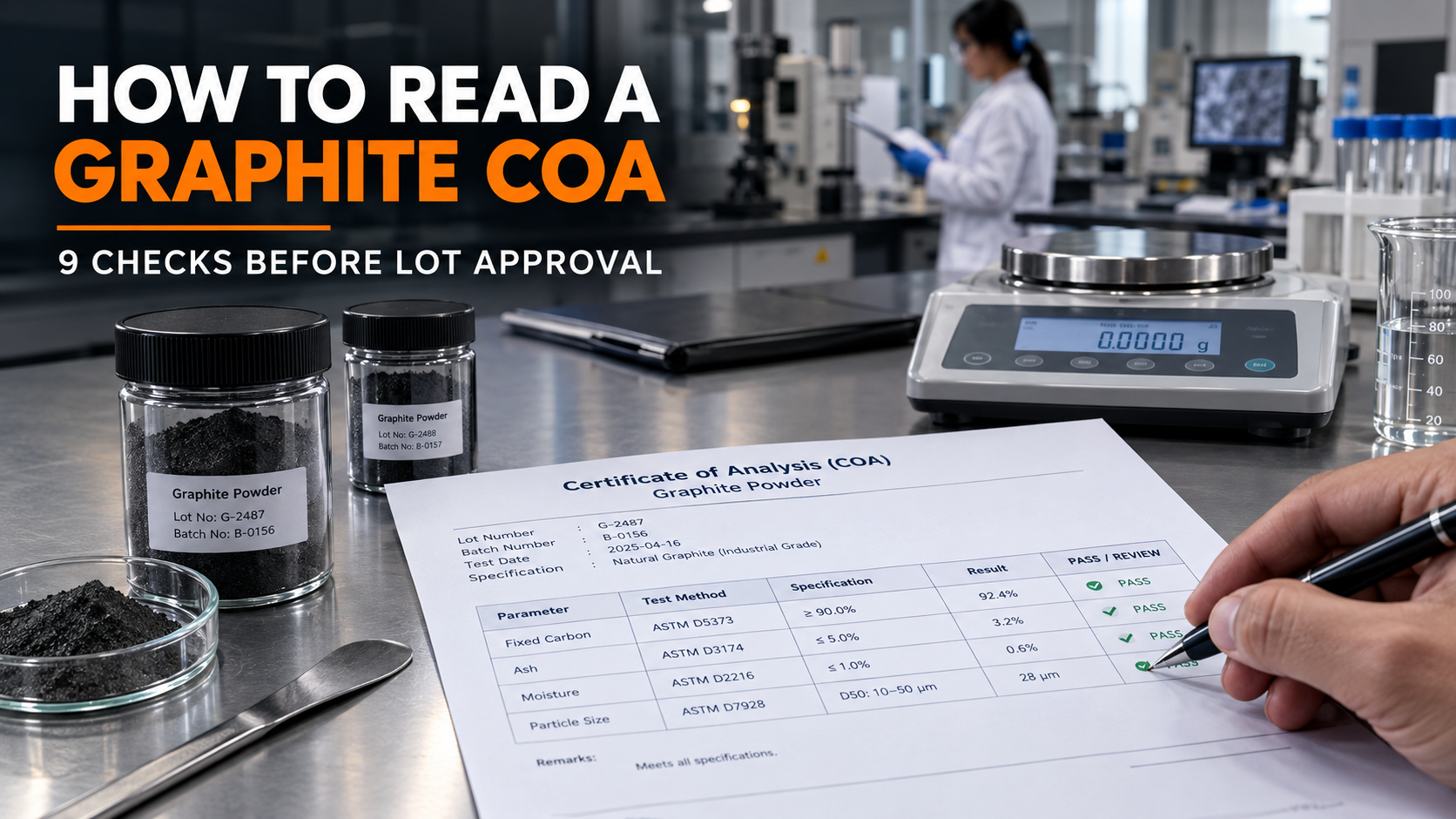
How to Read a Graphite COA: 9 Checks Before Lot Approval
Buying graphite in bulk is not simply about checking the price per tonne. Before approving a shipment, buyers need to know whether the material actually matches the agreed specification.
This is where a graphite COA (Certificate of Analysis) becomes important.
A COA provides test results for important quality parameters such as fixed carbon, ash, moisture, particle size, and other characteristics. However, simply receiving a COA is not enough. You need to know how to read it and compare the reported values with your purchase specification.
If you are sourcing natural graphite for industrial applications, understanding graphite quality testing can help reduce quality problems, production variation, and disputes with suppliers. You can also learn more about different graphite grades in our guide to Crystalline vs. Amorphous Graphite: Which Grade Is Right for Your Industry?.
In this guide, we will look at 9 important checks you should make before approving a graphite lot.
What Is a Graphite COA?
A graphite COA, or Certificate of Analysis, is a document that reports the quality or test results of a particular graphite material or production lot.
The document normally includes information such as
- Fixed carbon
- Ash
- Moisture
- Particle size or mesh
- Test method
- Lot or batch number
- Sample information
- Date of testing
- Supplier information
The exact information can vary depending on the graphite grade, supplier, application, and customer specification.
A COA should therefore be treated as a quality verification document, not simply as a piece of paperwork.
For buyers, the main question is
Does the material reported on the COA actually match the material ordered?
That question should be answered before the lot is approved.
Why Should Buyers Check a Graphite COA?
Graphite can be used in different industrial applications, and each application can require different specifications.
For example, a buyer may require high fixed carbon but also have strict requirements for ash, moisture, and particle size. Another application may place greater importance on flake size or particle distribution.
This is why a graphite lot that looks acceptable based on one number may still create problems during processing.
For a broader understanding of graphite quality, buyers can also review our article on Graphite Quality Testing: How to Check Quality Before Bulk Purchase.
The COA should always be checked against the actual purchase specification and intended application.
9 Checks Before Approving a Graphite Lot
1. Check the Fixed Carbon Value
The first number many graphite buyers look at is fixed carbon (FC).
Fixed carbon represents the carbon content of the graphite material after considering other components such as ash and volatile matter, depending on the test method used.
For example, a specification might require:
| Parameter | Purchase Requirement | COA Result |
|---|---|---|
| Fixed Carbon | ≥ 95% | 95.6% |
| Ash | ≤ 4% | 3.2% |
| Moisture | ≤ 1% | 0.5% |
In this example, the fixed carbon result appears to meet the requirement.
However, do not stop at the FC number.
A buyer should also check how the value was measured and whether the reported result corresponds to the agreed specification.
A graphite product advertised as high purity should be evaluated using the complete quality profile rather than a marketing claim.
If you are comparing graphite grades for industrial use, our graphite products and grades can help you understand how specifications can vary according to application.
Why Fixed Carbon Matters
Higher fixed carbon is often required where carbon purity is important to the end application.
However, the required FC level depends on the customer’s process.
Therefore, the correct question is not
“Is this graphite high carbon?”
Instead, ask:
“Does this graphite meet the fixed-carbon specification required for my application?”
2. Check the Ash Content
Ash is another important value on a graphite COA.
Ash represents the non-combustible residue remaining after the carbonaceous material is burned under specified testing conditions.
For many applications, lower ash can indicate a higher-purity graphite product.
For example:
- 90% FC graphite may contain considerably more non-carbon material than
- 95% FC graphite,
- While 98% or 99% FC material may require further purification or processing.
But buyers should avoid assuming that a lower ash number automatically means the material is better for every application.
The required ash level should be based on the agreed specification.
Always Compare Ash With the Purchase Specification
Suppose your purchase order specifies:
Ash: Maximum 4%
But the COA reports:
Ash: 5.1%
Even if the fixed carbon value appears acceptable, the lot may not meet the agreed specification.
This is why every important parameter should be checked individually.
3. Check the Moisture Content
Moisture is easy to overlook, but it can affect handling, transportation, storage, weighing, and processing.
A graphite COA may report moisture as a percentage.
For example:
Moisture: 0.6%
The important question is whether this value falls within the agreed limit.
Moisture can also vary depending on storage and environmental conditions. Therefore, buyers should understand whether the reported result is based on the production sample, dispatch sample, or another sampling point.
If the graphite will be used in a process where moisture control is important, this parameter should receive particular attention.
A Simple Moisture Check
Compare:
Purchase specification → COA result → acceptable limit
For example:
| Parameter | Requirement | COA |
|---|---|---|
| Moisture | ≤ 1.0% | 0.6% |
| Status | — | Meets specification |
This simple comparison can prevent unnecessary confusion during lot approval.
4. Check the Mesh Size and Particle Size
A graphite COA may also include mesh size, particle size, or particle-size distribution.
This is particularly important because graphite with the same fixed carbon content can behave differently if the particle size is different.
For example, graphite is specified as
-100 mesh
does not necessarily provide the same processing behavior as a product with a broader or narrower particle-size distribution.
Depending on the application, buyers may need information about:
- Mesh size
- D10
- D50
- D90
- Particle-size distribution
- Flake size
- Oversize material
- Undersize material
The exact parameters depend on the product specification.
If particle size is important to your process, do not rely only on a statement such as “100 mesh graphite.”
Ask the supplier what testing method and particle-size measurement were used.
5. Check the Test Method
This is one of the most important checks that buyers often miss.
Two laboratories can sometimes report different results if they use different testing procedures, sample preparation methods, or measurement conditions.
Therefore, a COA should ideally identify the test method or relevant standard used for the reported value.
For example, instead of simply reporting:
Fixed Carbon: 95.4%
A stronger quality document would identify the applicable test method or standard used to determine that result.
For general information about international standards and standardization, buyers can refer to the International Organization for Standardization (ISO).
For laboratory and testing requirements, the International Laboratory Accreditation Cooperation (ILAC) provides useful information about laboratory accreditation and conformity assessment.
These resources can help buyers understand why the testing method matters when evaluating laboratory results.
Why Test Methods Matter
Imagine two COAs report:
Supplier A: 95.5% FC
Supplier B: 96.1% FC
At first glance, Supplier B appears better.
But before making that conclusion, you should check whether both results were produced using comparable testing procedures.
A number without its testing context may not tell the whole story.
6. Compare the COA with your purchase order.
A COA should never be reviewed in isolation.
The most useful comparison is
Purchase Order → Product Specification → COA
For example:
| Parameter | Purchase Specification | COA Result | Status |
|---|---|---|---|
| Fixed Carbon | ≥ 95% | 95.8% | Pass |
| Ash | ≤ 4% | 3.1% | Pass |
| Moisture | ≤ 1% | 0.5% | Pass |
| Particle Size | -100 mesh | -100 mesh | Pass |
This type of comparison makes lot approval much easier.
It also provides a clear record if there is a later quality dispute.
Don’t Compare Only One Parameter
A common mistake is to approve a graphite lot because the fixed carbon value looks good.
For example:
FC = 96%
may look excellent.
But if the purchase order also requires
Ash ≤ 3%
and the COA reports:
Ash = 4.2%
The lot does not meet the complete specification.
The material must therefore be evaluated against all agreed parameters.
7. Verify Lot and Batch Traceability
A good COA should be connected to a specific production lot, batch, or shipment.
Look for information such as
- Lot number
- Batch number
- Product name
- Sample identification
- Testing date
- Production or dispatch information
- Supplier identification
The purpose is simple:
You should be able to connect the COA to the physical material you received.
Imagine receiving five tonnes of graphite with a COA showing excellent test results.
But the COA does not identify the lot number.
How can you be certain that the report belongs to the shipment?
This is where traceability becomes important.
Why Traceability Matters
If a quality issue appears later, lot identification allows the supplier and buyer to investigate the specific material involved.
It also makes future purchasing decisions easier because historical lot performance can be tracked.
8. Look for red flags on the COA.
Not every COA is equally detailed.
Buyers should look for warning signs that may require clarification.
Some common red flags include:
Missing Test Methods
If important values are reported without identifying how they were tested, ask for clarification.
Missing Lot Information
A COA that cannot be connected to a specific shipment creates a traceability problem.
Unusually Perfect Numbers
Repeated results such as exactly 95.00%, 96.00%, or 97.00% for every lot may deserve additional questions, particularly if the document provides no supporting testing information.
Mismatch With Previous Lots
If your previous shipments consistently showed 95–96% FC but the latest lot suddenly reports 99%, ask whether there was a change in grade, processing, sampling, or testing.
Incomplete Quality Information
If your purchase specification lists particle size, moisture, and ash, but the COA reports only fixed carbon.The document may not give enough information for full lot approval.
A professional buyer should not hesitate to ask for clarification.
9. Confirm the COA Matches the Actual Material
The final check is the most practical:
Does the material you received match the COA?
A document can be correct while the shipment is still wrong.
For example, check:
- Product name
- Packaging
- Lot number
- Batch number
- Labels
- Quantity
- Particle size
- Physical appearance
- Sampling information
If possible, the receiving and quality teams should verify that the physical shipment corresponds to the documentation.
For larger or critical purchases, buyers may also consider independent testing.
This can be particularly useful when the graphite will be used in a process where material variation can have a significant impact.
What If the Graphite COA Does Not Match Your Specification?
Suppose your purchase order requires:
Fixed Carbon ≥ 95%
but the COA reports:
Fixed Carbon = 92.8%
Do not immediately approve the shipment.
Instead, follow a structured process.
Step 1: Put the Lot on Hold
Do not mix questionable material with approved inventory until the issue has been investigated.
Step 2: Recheck the Documentation
Confirm:
- Purchase order
- Product specification
- COA
- Lot number
- Batch number
- Test date
- Test method
Step 3: Contact the Supplier
Ask the supplier to explain the difference.
Possible reasons could include:
- Wrong material supplied
- Sampling problem
- Testing variation
- Documentation error
- Production variation
- Incorrect specification
Step 4: Consider Independent Testing
If the issue cannot be resolved from documentation alone, an independent laboratory test may help establish the actual material quality.
Step 5: Make a Documented Decision
The final decision could be:
- Accept
- Reject
- Accept with deviation
- Retest
- Replace
- Negotiate a corrective action
The important point is to document the decision.
Graphite Quality Testing Should Support Your Buying Decision
A COA is useful, but it should be part of a broader quality-control process.
If you regularly purchase graphite, establish a consistent incoming inspection procedure.
This may include:
- Document verification
- Lot identification
- Sampling
- Laboratory testing
- COA comparison
- Physical inspection
- Final lot approval
The exact procedure should depend on your material specification and application.
For buyers who want a more detailed overview, our guide on how to check graphite quality before bulk purchase explains the key quality factors that should be considered before placing or approving a large order.
Don’t Judge Graphite Quality by Fixed Carbon Alone
Fixed carbon is important, but it is only one part of the quality picture.
Consider two graphite lots:
| Parameter | Lot A | Lot B |
|---|---|---|
| Fixed Carbon | 95.5% | 96.0% |
| Ash | 3.2% | 2.8% |
| Moisture | 0.6% | 1.4% |
| Particle Size | Within spec | Outside spec |
Lot B has higher fixed carbon.
But if your process requires moisture below 1% and the specified particle size, Lot A may actually be the better choice.
This is why professional graphite procurement focuses on specification compliance, not simply the highest FC number.
How COA Testing Can Improve Supplier Management
COAs can also help buyers evaluate suppliers over time.
Instead of looking at each shipment separately, maintain a record of historical results.
For example:
| Lot | FC | Ash | Moisture | Particle Size | Result |
|---|---|---|---|---|---|
| A001 | 95.4% | 3.2% | 0.5% | Within spec | Pass |
| A002 | 95.7% | 3.0% | 0.6% | Within spec | Pass |
| A003 | 94.9% | 3.8% | 0.7% | Within spec | Review |
| A004 | 95.5% | 3.1% | 0.5% | Within spec | Pass |
Over time, this information can reveal patterns.
For example, if fixed carbon repeatedly falls close to the minimum specification, you may want to discuss tighter process control with the supplier.
This turns the COA from a simple document into a supplier-performance monitoring tool.
What Should a Good Graphite COA Include?
There is no single universal format for every graphite COA, but a useful document should provide enough information to identify and evaluate the material.
A typical COA may include:
| COA Information | Why It Matters |
|---|---|
| Supplier name | Identifies source |
| Product name | Confirms material |
| Grade | Confirms ordered grade |
| Lot/Batch number | Provides traceability |
| Fixed Carbon | Indicates carbon content |
| Ash | Indicates non-carbon residue |
| Moisture | Helps assess handling/process requirements |
| Particle size | Confirms physical specification |
| Test method | Provides testing context |
| Test date | Shows when testing occurred |
| Sample identification | Connects result to sample |
| Authorisation | Confirms document approval |
The exact format will vary according to the supplier and customer’s requirements.
Graphite COA Checklist for Buyers
Before approving a lot, ask these nine questions:
1. Does the fixed carbon meet the specification?
2. Is the ash within the agreed limit?
3. Is moisture within specification?
4. Does the particle size meet the requirement?
5. Are the test methods identified?
6. Does the COA match the purchase order?
7. Is the lot or batch traceable?
8. Are there any unusual or missing results?
9. Does the physical shipment match the documentation?
If the answer to all nine questions is yes, you have a much stronger basis for lot approval.
How to Read a Graphite COA in 60 Seconds
For routine purchasing, you can use a quick review process.
First 10 Seconds: Identify the Material
Check:
Product → Grade → Lot Number
Next 20 Seconds: Check Critical Numbers
Review:
Fixed Carbon → Ash → Moisture → Particle Size
Next 15 Seconds: Check Testing
Look for:
Test Method → Testing Date → Sample Information
Final 15 Seconds: Compare With the PO
Ask:
Does every required parameter meet the agreed specification?
If yes, move the lot forward for normal approval.
If no, stop and investigate before accepting the material.
Why Application-Specific Specifications Matter
There is no single graphite specification that works for every industry.
Different applications can require different combinations of:
- Fixed carbon
- Ash
- Moisture
- Particle size
- Flake size
- Purity
- Bulk density
- Electrical properties
- Thermal properties
- Chemical characteristics
For this reason, buyers should define the required specification before purchasing, rather than trying to determine quality only after receiving the shipment.
If you are evaluating graphite for a particular industrial requirement, discussing the intended application and required specifications with the supplier can help avoid unnecessary material mismatches.
Final Thoughts: A COA Is More Than a Piece of Paper
Learning how to read a graphite COA can make bulk graphite purchasing much more reliable.
The most important point is simple:
Do not approve a graphite lot based on one number.
Check the complete specification.
Review fixed carbon, ash, moisture, particle size, testing methods, lot traceability, and the relationship between the COA and your purchase order.
A good COA gives you useful information about the tested material. A good quality-control process goes one step further by connecting that information to the actual shipment, specification, sampling process, and end application.
For buyers, this approach can reduce avoidable quality issues and make supplier evaluation more consistent.
When graphite quality matters, the goal is not simply to receive a COA. The goal is to understand what the COA actually tells you.
Frequently Asked Questions About Graphite COA
1. What does COA mean in graphite?
COA means Certificate of Analysis. It is a document that reports test results for a specific graphite product, grade, batch, or lot.
2. What is the most important value on a graphite COA?
Fixed carbon is often an important parameter, but it should not be considered alone. Ash, moisture, particle size, test method, and other application-specific requirements may also be critical.
3. How do I know if a graphite COA is reliable?
Check whether the COA identifies the product, lot or batch, test date, test methods, and relevant quality parameters. For critical applications, independent testing can provide additional verification.
4. Can two graphite COAs show different fixed carbon values?
Yes. Differences can result from material variation, sampling, sample preparation, testing procedures, or laboratory measurement. This is why the test method and sampling information are important.
5. Should I approve graphite if the fixed carbon meets my requirement?
Not automatically. Check the complete purchase specification, including ash, moisture, particle size, and any other parameters relevant to your application. A lot should be approved based on overall specification compliance.
About Pradhan Industries
Pradhan Industries is involved in the supply and manufacturing of natural graphite for industrial requirements. If you are evaluating graphite grades, purity, particle size, or quality specifications for bulk procurement, understanding the complete material specification is an important part of the buying process.
Explore more information about Pradhan Industries and its graphite products to understand the available graphite solutions and industrial applications.