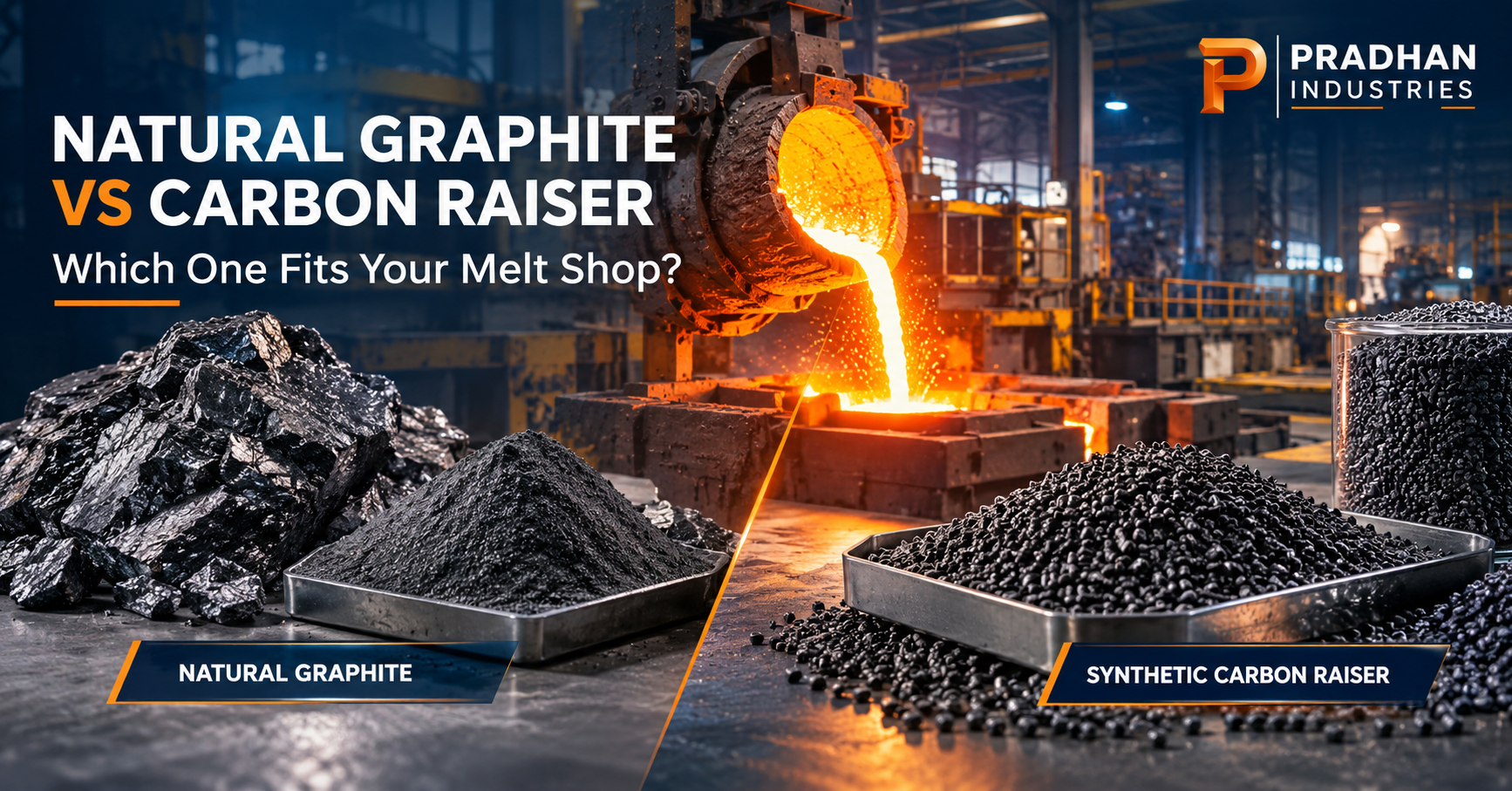
When a melt shop needs to adjust carbon content, the purchasing decision can look straightforward: compare the carbon percentage, check the price, and place the order.
In practice, it is rarely that simple.
Natural graphite vs. carbon raiser is a comparison that requires more than looking at the fixed carbon number on a quotation. Melt shops also need to consider ash, sulfur, moisture, particle size, addition method, carbon recovery, consistency, and the actual cost of achieving the required chemistry.
A material that looks attractive on paper may not necessarily deliver the same result in your furnace.
So, how should a foundry or melt shop compare these materials?
The answer starts with understanding what each material is and then matching its specification to the actual melting process.
What Is Natural Graphite?
Natural graphite is a naturally occurring form of carbon that is mined, processed, and sized for different industrial applications. Its properties can vary depending on the deposit, graphite type, beneficiation process, and final grade.
The U.S. Geological Survey (USGS) explains that natural graphite occurs in several forms and is used across a range of industrial applications. It also distinguishes natural graphite from synthetic graphite, which is manufactured through high-temperature processing.
For a melt shop, however, the term “natural graphite” does not describe one single specification.
Buyers should check:
- Fixed carbon
- Ash
- Moisture
- Sulphur
- Other relevant impurities
- Particle size
- Particle-size distribution
- Lot consistency
- COA information
- Applicable test methods
For current background information on graphite production, uses, and market data, buyers can refer to the U.S. Geological Survey Graphite Statistics and Information.
This is important when evaluating natural graphite vs. carbon raiser, because two carbon-bearing materials can have different characteristics even when their quoted carbon values appear similar.
What Is a Synthetic Carbon Raiser?
A synthetic carbon raiser is a manufactured carbon material designed for applications where carbon needs to be introduced into a molten metal system.
Synthetic graphite and other manufactured carbon materials can be produced through controlled industrial processing. Their characteristics depend on the raw material, manufacturing route, and final specification.
A synthetic carbon raiser may be selected where a melt shop requires particular chemical or physical characteristics.
However, the phrase “synthetic carbon raiser” by itself is not enough to approve a product.
A buyer should always request the actual technical specification and COA.
This is one of the most important principles when comparing natural graphite vs. carbon raiser: compare specific grades against your process requirements rather than comparing broad product names.
Natural Graphite vs. Carbon Raiser: Quick Comparison
| Parameter | Natural Graphite | Synthetic Carbon Raiser |
|---|---|---|
| Origin | Naturally occurring graphite processed for industrial use | Manufactured carbon material |
| Fixed carbon | Depends on grade | Depends on grade |
| Ash | Depends on ore and beneficiation | Depends on raw material and processing |
| Sulfur | Must be checked for the specific grade | Must be checked for the specific grade |
| Moisture | Depends on processing and storage | Depends on product and handling |
| Particle size | Available in different sizes | Available in different sizes |
| Carbon recovery | Process-dependent | Process-dependent |
| Consistency | Depends on source and quality control | Depends on manufacturing control |
| Price | Grade and market dependent | Grade and market dependent |
| Suitability | Depends on process specification | Depends on process specification |
The table shows why natural graphite vs. carbon raiser should not be treated as a simple “which has more carbon?” question.
1. Fixed Carbon Is Important, But It Is Not Everything
Fixed carbon is normally one of the first specifications a melt shop reviews.
A higher fixed carbon value means the material contains a higher proportion of fixed carbon under the applicable test method. However, that number alone does not tell you how the material will perform in your furnace.
For example, two products could have similar fixed carbon values but differ in:
- Ash
- Sulphur
- Moisture
- Particle-size distribution
- Bulk density
- Addition behavior
- Actual carbon recovery
Therefore, when evaluating natural graphite vs. carbon raiser, fixed carbon should be treated as one part of the technical specification.
The question should be:
Does the complete material specification fit the melting process?
2. Ash Can Affect the Overall Material Balance
Ash represents the non-combustible residue associated with the carbon material.
For graphite, ASTM C561 provides a published test method for determining ash in a graphite sample. Buyers should always confirm the applicable test method and reporting basis for the specific material being purchased.
Why does this matter?
Because ash is not simply another number on a COA. Its composition can include mineral components that may matter to a particular metallurgical process.
When comparing natural graphite vs. carbon raiser, ask suppliers:
- What is the maximum ash specification?
- Is the result reported on a specified basis?
- Which test method is used?
- Is the result from the actual lot?
- Are additional impurity results available?
The appropriate limits depend on the application.
3. Sulphur Should Be Checked Against Your Process
Sulfur requirements can be particularly important when the final metal chemistry has tight limits.
Do not assume that one carbon-bearing material automatically has a suitable sulfur level simply because its fixed carbon is high.
When evaluating natural graphite vs. carbon raiser, compare the actual sulfur specification of each grade.
Ask your supplier:
- What is the guaranteed sulfur level?
- What is the maximum permissible value?
- Is sulfur tested for every lot?
- Is the result included on the COA?
- Does the value meet your internal material specification?
The same approach should be used for other impurities that are relevant to your alloy or melting process.
4. Particle Size Can Influence Addition Behavior
Particle size is another important factor in natural graphite vs. carbon raiser selection.
A melt shop may require a particular size range because of its addition equipment, furnace operation, and desired material behavior.
Common purchasing descriptions can include:
- Mesh size
- Granular material
- Powder
- Fine fraction
- Controlled particle-size distribution
However, mesh size and fixed carbon are completely different characteristics.
A material can have high fixed carbon and still have an unsuitable particle size for a particular addition system.
If particle size is important to your process, specify the required range and verify it through the supplier’s technical documentation.
For more information, see your related guide on graphite mesh sizes and particle-size selection.
5. Carbon Recovery Is Different From Fixed Carbon
This is one of the most frequently misunderstood areas when discussing natural graphite vs. carbon raiser.
Suppose a product contains a high percentage of fixed carbon.
That does not mean your furnace will automatically recover the same proportion of carbon in the molten metal.
Actual carbon recovery can depend on:
- Furnace type
- Melting temperature
- Addition timing
- Addition location
- Mixing conditions
- Charge composition
- Particle size
- Oxidation conditions
- Slag conditions
- Holding time
- Operating practice
Therefore:
High fixed carbon does not automatically mean high carbon recovery.
For a new material, controlled plant trials can provide useful information about actual performance.
6. Compare Effective Cost, Not Only Price Per Tonne
Price is obviously important to a melt shop.
But natural graphite vs. carbon raiser should not be decided only by the supplier’s quoted price per tonne.
Consider two hypothetical materials.
Material A has a lower purchase price but requires a higher addition rate.
Material B has a higher purchase price but achieves the required carbon addition with a lower addition rate under the plant’s validated operating conditions.
The cheaper material per tonne may not necessarily be cheaper per effective carbon contribution.
A better purchasing analysis should consider:
Material price + required addition rate + validated carbon recovery + process impact
Actual recovery should come from plant data rather than an assumed universal percentage.
7. COA Quality Matters When Buying in Bulk
A Certificate of Analysis gives the buyer information about the tested characteristics of a particular lot, depending on the supplier’s documentation practice.
When comparing natural graphite vs. carbon raiser, review the COA for the parameters relevant to your purchase specification.
These may include:
- Fixed carbon
- Ash
- Moisture
- Sulphur
- Particle size
- Other relevant impurities
- Lot or batch number
- Test method
- Reporting basis
Do not assume that every supplier’s COA contains every parameter.
Also remember the difference between a product specification and a COA.
A specification defines the required characteristics of a product. A COA reports analytical results associated with a particular lot.
For buyers, both documents have different roles.
Natural Graphite vs. Carbon Raiser: Which One Should You Choose?
There is no universal answer to natural graphite vs. carbon raiser.
The appropriate choice depends on the requirements of your melt shop.
Natural graphite may be considered when:
- The material meets the required carbon specification
- Ash and impurity levels are acceptable
- Particle size suits the addition system
- The material provides acceptable process performance
- Supply consistency meets your requirements
- The overall economics are suitable
Synthetic carbon raiser may be considered when:
- A specific manufactured carbon specification is required
- Particular purity characteristics are important
- The process already has validated performance data
- Consistency requirements support the selected material
- Total process economics are acceptable
The important point is that natural graphite vs. carbon raiser is not a universal winner-takes-all comparison.
The correct question is
Which specific grade meets the requirements of this particular melt shop?
8. Check the Material Against Your Furnace
Different melting operations can have different requirements.
An induction furnace, electric arc furnace, or other melting system may have different charge-management practices and carbon-addition procedures.
For that reason, natural graphite vs. carbon raiser should be evaluated against:
- Furnace type
- Alloy being produced
- Initial carbon level
- Target carbon level
- Charge composition
- Addition point
- Addition timing
- Required recovery
- Impurity limits
- Particle-size requirements
This process-specific approach is more useful than choosing a material based on a generic product description.
9. Do a Controlled Trial Before Large-Scale Approval
If you are changing from one carbon material to another, a controlled trial can reduce purchasing and production risk.
During the trial, record:
- Starting chemistry
- Material grade
- Addition quantity
- Addition method
- Melt temperature
- Final carbon result
- Other relevant chemistry
- Slag observations where applicable
- Material consumption
- Process observations
The objective is not simply to prove that a material contains carbon.
The objective is to determine how the specific material performs under your actual operating conditions.
This is especially useful when comparing natural graphite vs. carbon raiser from different suppliers.
Melt-Shop Buyer Checklist
Before approving a carbon-bearing material, ask the supplier for:
Technical information
- Fixed carbon specification
- Ash specification
- Moisture specification
- Sulphur specification
- Relevant impurity limits
- Particle-size specification
- Product datasheet
- Current COA
Quality information
- Lot identification
- Sampling information
- Applicable test methods
- Testing frequency
- Quality-control process
- Lot-to-lot consistency information
Commercial information
- Price
- Packing
- MOQ, if applicable
- Lead time
- Supply capability
- Delivery terms
When comparing natural graphite vs. carbon raiser, keeping these requirements in one purchasing checklist makes supplier comparisons much easier.
Common Mistakes Buyers Should Avoid
Choosing the highest FC automatically
Higher FC can be useful, but it does not provide a complete picture of process performance.
Looking only at price
The cheapest material per tonne may not provide the lowest cost per effective carbon addition.
Ignoring ash and sulfur
These parameters can matter significantly depending on the alloy and process.
Treating mesh as a carbon specification
Particle size and fixed carbon describe different characteristics.
Assuming laboratory results equal plant recovery
Actual furnace performance depends on operating conditions.
Approving a new supplier from an old COA
Always review documentation relevant to the current supplied lot.
Natural Graphite for Industrial Melt-Shop Applications
Natural graphite can be relevant to metallurgical applications where its specified properties match the process requirements.
For a natural graphite supplier, buyers should look beyond a simple product name and evaluate the material specification, processing, quality control, and supply consistency.
Pradhan Industries works with natural graphite for industrial applications and has experience associated with graphite mining, beneficiation, processing, and supply.
For current grades, specifications, and availability, buyers should confirm the latest information directly with the company.
For bulk inquiries:
Email: info@pradhanindustries.com
Phone: +91 707-780-5666
Frequently Asked Questions
Is natural graphite a carbon raiser?
Natural graphite can be used as a carbon-bearing material in certain metallurgical applications. Whether it is suitable depends on the graphite grade, fixed carbon, impurities, particle size, addition method, and the requirements of the specific melt shop.
What is the main difference between natural graphite and synthetic carbon raiser?
Natural graphite originates from naturally occurring graphite deposits and is processed into commercial grades. Synthetic carbon raisers are manufactured carbon materials. Their properties can vary significantly by grade, so the actual technical specification should be compared before purchasing.
Is higher fixed carbon always better?
No. Fixed carbon is an important parameter, but buyers should also evaluate ash, sulfur, moisture, particle size, impurities, recovery, and total process economics.
Can natural graphite be used in an induction furnace?
Certain natural graphite grades may be suitable for induction-furnace applications, depending on the process and material specification. The appropriate grade should be evaluated against the target chemistry, addition method, and impurity requirements.
Does particle size affect carbon recovery?
Particle size can influence material behavior during addition and melting. The effect depends on the furnace, operating conditions, and addition method. Plant-specific trials are preferable to assuming one universal recovery rate.
What should a graphite COA contain?
The required COA parameters depend on the agreed product specification. They may include fixed carbon, ash, moisture, sulphur, particle size, and other relevant properties, together with lot identification and testing information.
How do I compare carbon raiser prices?
Do not compare only price per tonne. Consider the required addition rate, material specification, validated carbon recovery, impurity levels, consistency, and total delivered cost.
Is natural graphite cheaper than synthetic carbon raiser?
There is no universal price difference. Pricing depends on grade, purity, processing, particle size, supply conditions, and commercial terms. Compare actual grades against the same technical requirements.
Pradhan Industries
Natural Graphite Mining, Beneficiation & Industrial Carbon Supply Specialists.