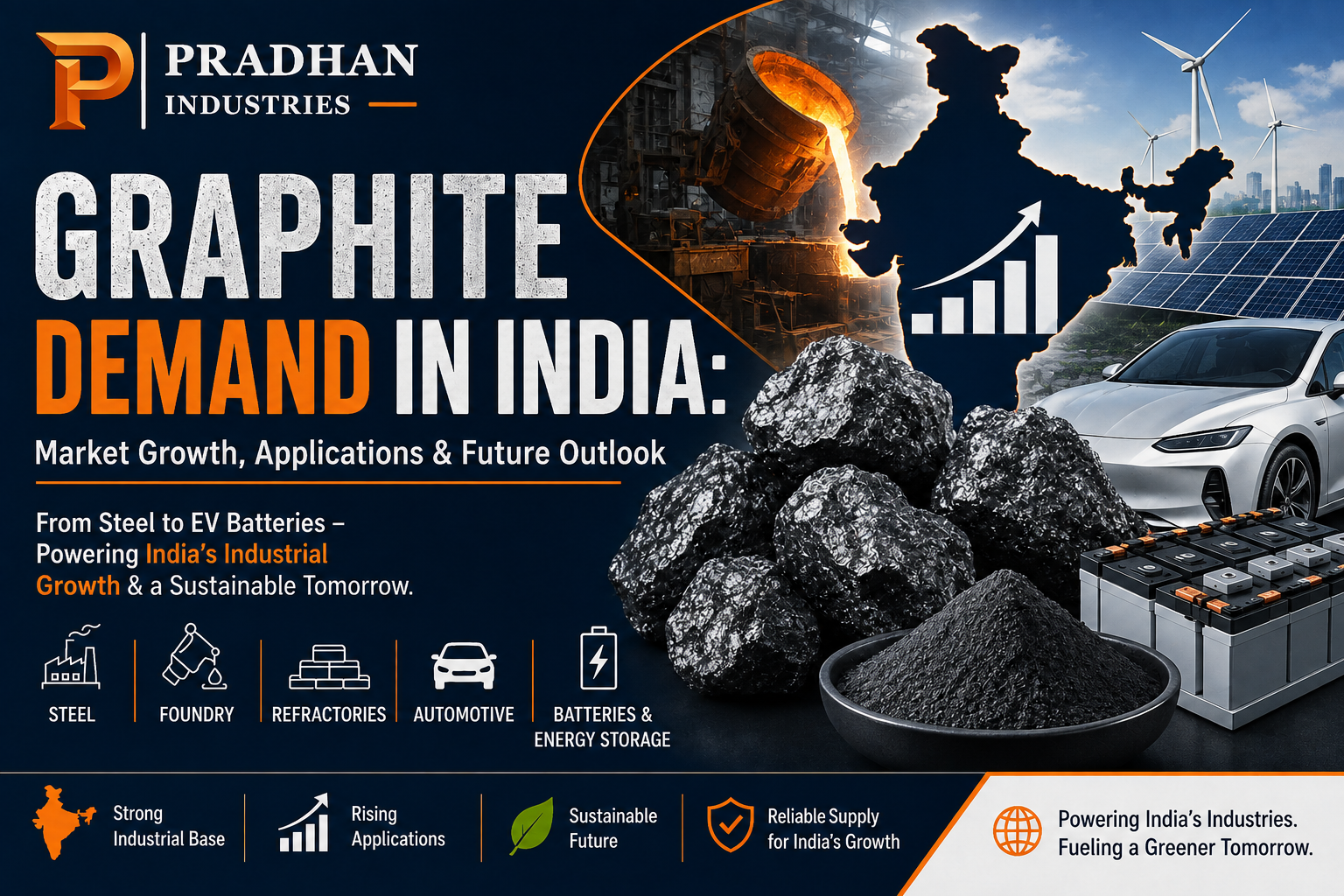
India’s graphite market is changing. For decades, graphite has been an important industrial material for steelmaking, refractories, foundries, lubricants and engineering applications. Now, another source of demand is gaining attention: lithium-ion batteries and electric vehicles.
That does not mean traditional industries have suddenly become less important. Steel, foundry and refractory applications continue to represent a major part of India’s graphite consumption, while battery and energy-storage applications are creating a new growth opportunity.
For Indian manufacturers and bulk buyers, the important question is no longer simply how much graphite India needs. It is which grade of graphite is required, where it will come from, and whether the supply chain can deliver consistent quality at scale.
What Is Driving Graphite Demand in India?
Several industries are contributing to the growth of graphite demand in India.
India’s expanding steel production remains one of the strongest demand drivers, particularly as electric arc furnace (EAF) steelmaking develops. Graphite electrodes are essential to the EAF process because they conduct the electrical current required to melt scrap and other metallic inputs.
At the same time, demand is coming from:
- Steel and electric arc furnace operations
- Foundries and casting industries
- Refractory manufacturing
- Automotive and engineering components
- Industrial lubricants
- Battery manufacturing
- Electric vehicles
- Energy-storage systems
- Selected renewable-energy applications
Market research estimates vary because different reports use different definitions, product categories and market boundaries. However, available estimates point toward continued growth in India’s graphite market through the coming decade.
The more useful takeaway for industrial buyers is that graphite demand is becoming more diversified.
Which Industries Drive Graphite Demand in India?
1. Steel Industry
Steel remains one of the most important markets for graphite-related products.
In electric arc furnace steelmaking, graphite electrodes carry electricity into the furnace and withstand extremely high temperatures. Electrode performance can affect furnace productivity, energy efficiency and operating reliability.
India’s continued investment in steel capacity therefore has a direct relationship with graphite consumption.
This makes the steel industry an important part of the long-term outlook for graphite demand in India.
2. Foundry Industry
Graphite has several applications in foundries.
It can be used in mould and core coatings, crucible linings and certain casting-related lubrication applications. Its ability to withstand high temperatures and help produce smoother casting surfaces makes it valuable in demanding foundry environments.
As India’s automotive, engineering and manufacturing sectors expand, foundries supplying components to these industries can contribute to steady graphite demand.
3. Refractory Industry
Graphite is also important in refractory products designed for high-temperature industrial environments.
Its thermal stability, resistance to thermal shock and chemical properties make it suitable for applications such as magnesia-carbon refractories used extensively in steelmaking.
Growth in steel, cement, glass and other high-temperature industries can therefore support demand for refractory-grade graphite.
4. Automotive and Engineering
Graphite’s role extends beyond steel and casting.
It is used in products such as mechanical seals, carbon brushes, thermal-management components and specialised lubricants. These applications take advantage of graphite’s combination of thermal performance, lubricity and electrical properties.
For India’s growing engineering and automotive manufacturing base, these are relatively specialised applications, but together they add another layer to overall graphite consumption.
5. Batteries and Energy Storage
The battery industry is where the future graphite story becomes particularly interesting.
Graphite is widely used as the anode material in lithium-ion batteries. As battery-cell manufacturing, electric vehicles and energy-storage systems expand, demand for suitable anode-grade graphite is expected to increase.
However, battery-grade graphite should not be treated as interchangeable with conventional industrial graphite. The required purity, particle characteristics and processing route can be substantially different.
India’s Battery and EV Opportunity
The relationship between electric vehicles and graphite demand is relatively straightforward:
More EVs → more lithium-ion batteries → more anode material → greater graphite demand.
India’s developing EV and battery-manufacturing ecosystem is therefore creating a new source of graphite demand. Market research identifies batteries and EVs as one of the faster-growing graphite applications, although traditional industrial uses remain significant today.
The challenge is processing.
Mining graphite is only one part of the supply chain. Battery applications can require additional steps such as beneficiation, spheroidization and purification to achieve the necessary specifications.
This creates an important distinction for India: having graphite resources does not automatically mean having enough battery-grade graphite.
Domestic mining, processing technology and purification capacity all need to develop together if India wants to build a stronger graphite-to-battery supply chain.
Natural Graphite vs Synthetic Graphite
Natural and synthetic graphite serve different markets and are produced differently.
| Factor | Natural Graphite | Synthetic Graphite |
|---|---|---|
| Source | Mined from natural deposits | Manufactured from carbon-rich feedstocks |
| Production | Mining and beneficiation | High-temperature industrial processing |
| Typical applications | Refractories, foundries, lubricants and selected battery applications | Electrodes, battery materials and specialised applications |
| Purity | Depends on deposit and beneficiation | Can be engineered to specific specifications |
| Cost | Often competitive for suitable grades | Can involve higher processing and energy costs |
| Key consideration | Carbon content, flake size and beneficiation | Purity, structure and production consistency |
The choice should ultimately depend on the application rather than simply whether the material is natural or synthetic.
For an industrial buyer, fixed carbon, ash, moisture, particle size, flake size and consistency can be much more important than the product label itself.
Does India Have Enough Graphite?
India has significant graphite-bearing regions, with Odisha among the important states for graphite resources. Other graphite-bearing areas include Jharkhand, Chhattisgarh, Tamil Nadu and Arunachal Pradesh.
But there is an important difference between geological resources and commercially available supply.
A deposit may contain graphite, yet the material still needs to be mined, beneficiated, processed and transported. Different industries also require different grades.
This is particularly relevant to battery materials. Conventional industrial applications can often use graphite grades that do not meet the demanding specifications required for battery anodes.
India’s graphite supply chain therefore faces a dual challenge: developing domestic resources while also increasing processing and purification capabilities.
Why Graphite Quality Matters
Not every graphite product is suitable for every application.
Two materials can both be sold as “graphite” while performing very differently in an industrial process.
Before placing a bulk order, buyers should check:
- Fixed carbon: Indicates the carbon concentration and is central to grade selection.
- Ash content: Higher ash can affect performance in applications where purity matters.
- Moisture: Can influence handling, storage and processing.
- Particle size: Important for processing behaviour and application performance.
- Flake size: Particularly relevant for applications where graphite structure matters.
- Beneficiation quality: Determines how effectively unwanted minerals have been removed.
- Batch consistency: Important for maintaining stable manufacturing performance.
A refractory manufacturer, foundry and battery-material producer may have completely different specifications.
That is why buying graphite purely on price can create problems later in production.
Key Trends Shaping Graphite Demand in India
Several trends are likely to influence the Indian graphite market over the next few years.
Industrial manufacturing continues to expand
Steel, engineering, automotive and foundry activity will remain important sources of demand.
Electric arc furnace steelmaking is gaining importance
The growth of EAF-based steel production supports continued demand for graphite electrodes and related carbon materials.
EV and battery manufacturing is creating a new demand centre
Battery demand is starting from a smaller base compared with traditional industrial applications, but its growth potential is significant.
Domestic mineral development is receiving greater attention
India’s focus on critical minerals is encouraging greater interest in exploration, mining, processing and supply-chain security.
Supply-chain diversification is becoming important
Global graphite supply is concentrated in certain regions. Indian manufacturers are therefore paying greater attention to reliable domestic sources and processing capabilities.
Challenges Facing India’s Graphite Supply Chain
Growth in demand does not automatically translate into a smooth supply chain.
India still faces several challenges:
- Limited processing capacity for certain high-specification grades
- Need for improved beneficiation technology
- Limited battery-grade graphite processing
- Dependence on imports for some specialised materials
- Logistics costs from mining regions
- Variations in quality between suppliers
- International price fluctuations
- Concentration of global supply and processing
These challenges are especially important for companies that require large and regular volumes.
For buyers, supplier selection should therefore focus on more than the quoted price.
What Is the Future of Graphite Demand in India?
The outlook for graphite demand in India is closely connected to two different growth stories.
The first is India’s established industrial economy. Steel, foundries, refractories, engineering and manufacturing will continue to require graphite for a wide range of applications.
The second is the emerging energy-storage economy.
EVs, lithium-ion batteries and stationary energy storage could create a much larger market for processed and high-purity graphite over time.
These two markets should not be confused. Traditional industrial demand is already established, while battery demand is developing rapidly from a smaller base.
For graphite producers and buyers, this means that quality, processing capability and dependable supply will become increasingly important alongside production volume.
What Should Indian Buyers Look for When Purchasing Graphite?
Before purchasing graphite in bulk, companies should confirm:
- Required fixed carbon percentage
- Particle-size distribution
- Flake size where applicable
- Ash and moisture specifications
- Intended industrial application
- Product testing and quality documentation
- Batch-to-batch consistency
- Packaging requirements
- Bulk supply capability
- Delivery and logistics reliability
A supplier that understands the buyer’s application can often recommend a more suitable grade than a supplier simply offering the lowest price.
Sourcing Natural Graphite for Industrial Applications
Pradhan Industries is an Odisha-based natural crystalline graphite manufacturer serving industrial applications. The company works with graphite powder and processed natural graphite, with attention to grade requirements, particle sizing, carbon content and bulk supply.
For Indian and overseas buyers looking for natural graphite, working directly with a processor can make it easier to discuss technical specifications and supply requirements before placing a bulk order.
Looking for natural graphite for your industrial application? Contact Pradhan Industries to discuss grade, fixed carbon, particle size and bulk supply requirements.
Use it when discussing graphite’s importance to batteries, EVs and clean-energy supply chains.
Frequently Asked Questions
What is driving graphite demand in India?
Graphite demand is being supported by steelmaking, foundries, refractories, engineering applications and lubricants, while battery manufacturing, electric vehicles and energy storage are creating additional long-term demand.
Which industries consume the most graphite in India?
Steel, foundry and refractory applications remain important traditional consumers. Battery and energy-storage applications are growing faster but currently represent a newer segment of the Indian graphite market.
Is India a major graphite producer?
India has significant graphite resources, particularly in states such as Odisha, Jharkhand and Arunachal Pradesh. However, domestic production and processing do not currently cover every grade required by Indian industries, resulting in continued imports for certain products.
Why is graphite important for EV batteries?
Graphite is widely used as the anode material in lithium-ion batteries. As India’s EV and battery manufacturing ecosystem develops, demand for suitable anode-grade graphite is expected to increase.
What is the difference between natural and synthetic graphite?
Natural graphite is extracted from mineral deposits and then processed, while synthetic graphite is manufactured through high-temperature industrial processes using carbon-rich feedstocks. Their properties, costs and applications can differ considerably.
How can Indian industries choose the right graphite grade?
Buyers should evaluate fixed carbon, ash, moisture, particle size, flake size and consistency according to the intended application. A grade suitable for refractories may not be suitable for battery materials.
How can companies source graphite in bulk?
Industrial buyers should look for suppliers that can provide documented specifications, consistent batches, suitable packaging, reliable logistics and demonstrated bulk-supply capability.