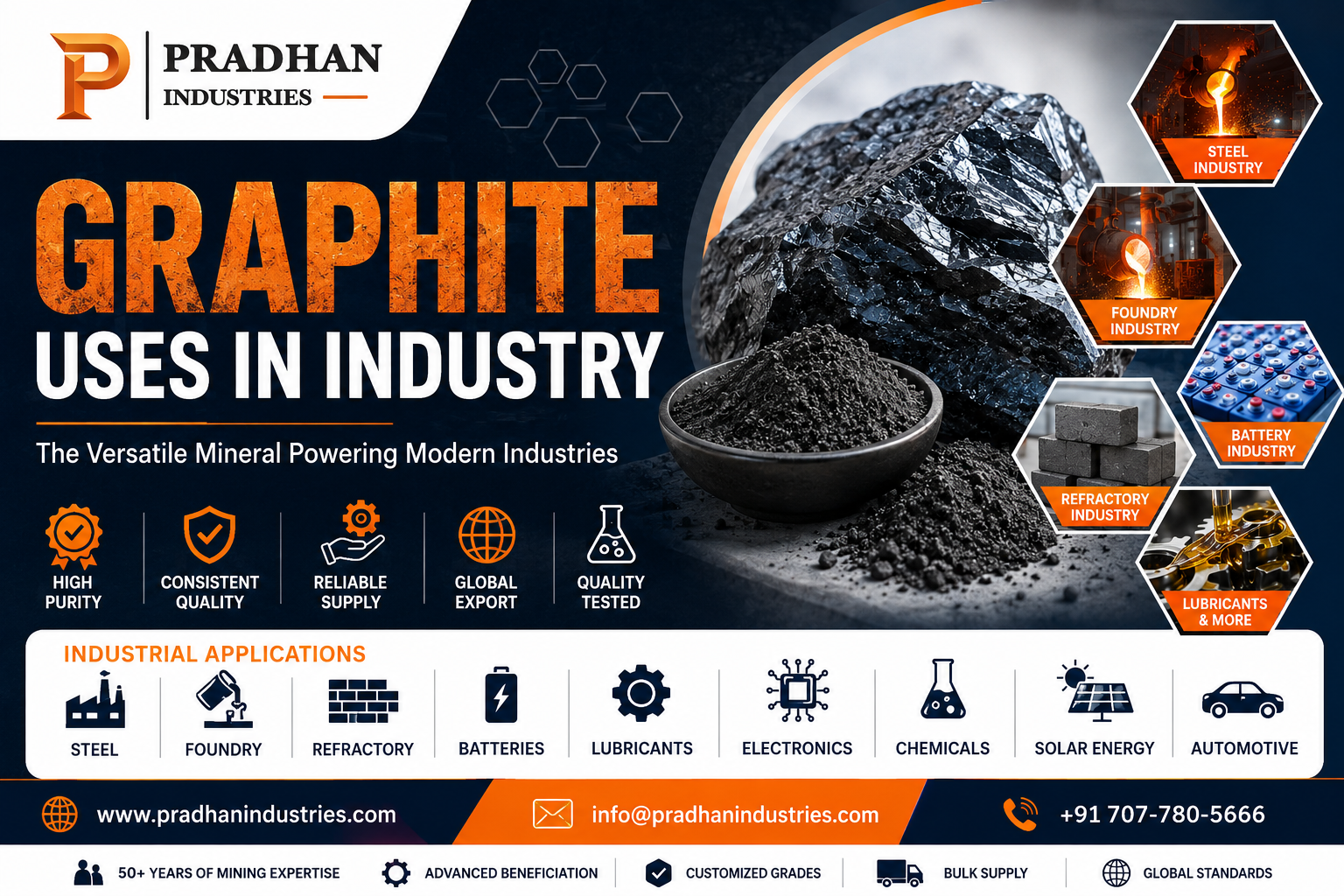
Walk through any steel plant, foundry, or battery assembly line and you will find graphite doing quiet, essential work somewhere in the process. Ask a procurement manager at a refractory unit why graphite uses in industry have grown so steadily over the past two decades, and the answer usually comes down to three things: it conducts heat and electricity exceptionally well, it survives extreme temperatures without breaking down, and it does all this at a cost that synthetic alternatives struggle to match.
This article breaks down exactly where and why graphite is used across major industrial sectors, what properties make it valuable, and what buyers should look for when sourcing it in bulk.
Quick Overview: Graphite is a naturally occurring crystalline form of carbon used across steel manufacturing, foundries, refractories, lithium-ion batteries, electric vehicles, lubricants, electronics, and dozens of other industrial applications. Its unique combination of electrical conductivity, heat resistance, and chemical stability makes it irreplaceable in modern manufacturing.
What is Graphite?
Graphite is a crystalline form of carbon that forms deep in the earth’s crust over millions of years, under intense heat and pressure acting on carbon-rich sediments and metamorphic rock. This slow geological process arranges carbon atoms into flat, hexagonal sheets stacked loosely on top of each other — a structure that explains almost every useful property graphite has.
Because these sheets can slide over one another, graphite is naturally soft and slippery, which is why it works so well as a dry lubricant. At the same time, the strong bonds within each sheet give it excellent electrical conductivity and resistance to heat, which is why it performs reliably in furnaces, electrodes, and batteries.
Natural vs Synthetic Graphite
Natural graphite is mined directly from ore deposits and then refined through crushing, flotation, and purification. Synthetic graphite, by contrast, is manufactured from petroleum coke through a high-temperature graphitization process that can take weeks and consume enormous amounts of energy.
Natural graphite generally costs less to produce, has a lower carbon footprint, and — when sourced from high-grade crystalline deposits — offers purity and conductivity that rivals synthetic material for most industrial uses. Synthetic graphite still holds an edge in a handful of ultra-high-purity applications, but for the vast majority of industrial graphite applications, natural crystalline graphite is the preferred and more economical choice.
Natural graphite itself is classified into three types: amorphous, flake, and vein (crystalline) graphite. Flake and crystalline graphite carry higher carbon content and larger, better-formed crystal structures, which is why they command a premium in demanding applications like batteries, refractories, and foundry facings.
Importance in Industries
Few minerals sit at the intersection of as many industries as graphite does. It is used in traditional heavy industries like steel and foundries, in precision sectors like electronics and aerospace, and increasingly in the clean-energy supply chain through lithium-ion batteries and fuel cells. This spread across old and new industries is exactly why global demand for graphite has kept climbing even as other industrial minerals have plateaued.
Why Industries Depend on Graphite
The range of graphite uses in industry isn’t accidental — it comes down to a specific set of physical properties that are difficult to replicate cheaply with any other material.
Electrical conductivity: Graphite conducts electricity almost as well as some metals, which is why it forms the backbone of electrodes, carbon brushes, and battery anode material.
Heat resistance: Graphite doesn’t melt under normal industrial conditions — it sublimes at temperatures above 3,600°C — making it ideal for crucibles, furnace linings, and refractories.
Lubrication: The layered crystal structure allows graphite to reduce friction between surfaces without any oil or grease, which matters in high-temperature or contamination-sensitive environments.
Chemical stability: Graphite resists attack from most acids, alkalis, and corrosive gases, so it holds up well in chemical processing equipment.
Mechanical strength: Despite being soft to the touch, graphite composites and graphite-based materials offer strong structural performance at high temperatures where metals would weaken.
Thermal conductivity: Graphite moves heat away from hot components quickly, which is why it shows up in heat exchangers and thermal management systems.
Lightweight properties: Compared to many metals with similar performance characteristics, graphite is considerably lighter, which is valuable in aerospace, EV, and electronics applications where weight matters.
Top 15 Uses of Graphite in Industry
1. Steel Industry
Graphite in steel industry applications centers on electric arc furnace (EAF) electrodes, which conduct the massive electrical currents needed to melt scrap steel. A single EAF electrode column can carry currents in the range of tens of thousands of amps, and graphite is essentially the only material that survives this combination of heat and electrical load repeatedly.
Graphite is also used as a carbon raiser, added directly into molten steel to adjust carbon content and achieve the desired grade. As global steel production shifts toward EAF methods (which produce lower emissions than blast furnaces), demand for graphite electrodes has grown steadily, and that trend is expected to continue through the next decade.
2. Foundry Industry
In foundries, graphite is used as a facing material on mold surfaces to create a smooth, non-stick finish on cast metal parts. It’s also mixed into mold and core washes, which prevent molten metal from reacting with the sand mold and reduce surface defects on the finished casting.
Graphite crucibles are another mainstay in foundries handling non-ferrous metals like brass, bronze, and aluminum, since they resist thermal shock from repeated heating and cooling cycles.
3. Refractory Industry
Graphite uses in refractories are built around one core advantage: it doesn’t react easily with molten metal or slag, even at extreme temperatures. Magnesia-carbon and alumina-carbon refractory bricks, both of which rely on graphite content, line the interiors of steel ladles, converters, and blast furnaces.
These graphite-based refractories extend furnace lining life significantly compared to non-carbon alternatives, which directly reduces downtime and maintenance costs for steel producers.
4. Battery Manufacturing
Graphite is the primary anode material in most commercial batteries produced today, including standard alkaline and rechargeable formats. Its layered structure allows lithium ions (or other charge carriers) to intercalate between graphite sheets during charging and discharging without damaging the material.
Graphite for batteries typically requires processing into fine, high-purity powder with tightly controlled particle size distribution, which is a more demanding specification than most other industrial graphite applications.
5. Lithium-ion Batteries
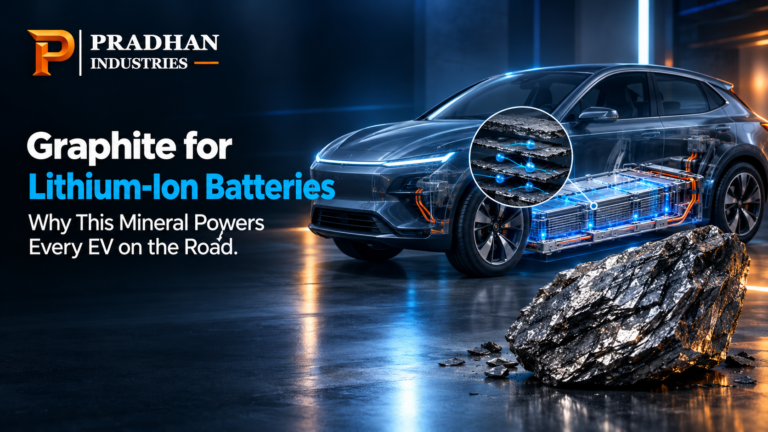
Lithium-ion batteries deserve a category of their own because of how much graphite they consume — a single EV battery pack can contain tens of kilograms of graphite anode material, often more graphite by weight than any other single mineral in the cell. Both natural and synthetic graphite are used, frequently blended together to balance cost, capacity, and cycle life.
As battery gigafactories scale up worldwide, graphite demand from this single application has become one of the fastest-growing segments in the entire industrial minerals market.
6. Electric Vehicles
Beyond batteries, EVs use graphite in brake components, thermal management systems, and certain lightweight structural composites. The push toward electric mobility has effectively created a second major graphite demand curve on top of traditional industrial consumption, and this is reshaping how graphite producers plan long-term supply.
7. Solar Industry
Graphite crucibles and components are used in the production of silicon ingots for solar photovoltaic cells, where they need to withstand the extreme heat of the crystal growth process without contaminating the silicon. As solar capacity installations continue expanding globally, this niche but steady application adds to overall graphite consumption.
8. Electronics
Graphite sheets are used for thermal management in smartphones, laptops, and other compact electronics, drawing heat away from processors and batteries far more efficiently than many traditional materials. It also appears in electromagnetic shielding and in certain conductive coatings on circuit components.
9. Lubricants
Graphite lubrication uses take advantage of its ability to reduce friction without oil, which matters in high-temperature settings like locomotive engines, industrial chains, and open gears where liquid lubricants would burn off or attract contamination. Dry graphite lubricants are also preferred in food processing and other environments where oil contamination is a concern.
10. Carbon Brushes
Carbon brushes made from graphite conduct current between stationary and rotating parts in electric motors and generators. Graphite’s self-lubricating property means these brushes wear evenly and don’t require external lubrication, which extends motor service life considerably.
11. Mechanical Seals
Graphite-based mechanical seals are used in pumps, compressors, and rotating equipment across chemical plants and refineries, where they need to handle both high temperatures and chemically aggressive fluids. Graphite’s chemical stability makes it one of the few materials suited to this dual demand.
12. Nuclear Industry
High-purity graphite has historically been used as a neutron moderator in certain nuclear reactor designs, slowing neutrons to sustain a controlled fission reaction. This is a highly specialized, tightly regulated application requiring exceptionally pure graphite grades, but it remains a meaningful part of the global graphite demand picture.
13. Chemical Processing
Graphite heat exchangers and reaction vessels are widely used in chemical processing plants dealing with corrosive acids like hydrochloric or sulfuric acid, where metal equipment would corrode quickly. Impervious graphite, which is graphite impregnated with resin to eliminate porosity, is particularly common in this application.
14. Friction Materials
Graphite is blended into brake pads and clutch facings, both for automotive and industrial machinery, to help manage heat buildup and provide consistent friction performance under repeated use. It reduces brake fade during heavy or prolonged braking, which matters in commercial vehicles and industrial equipment.
15. Paints & Coatings
Conductive and anti-corrosive coatings often use graphite powder as a functional filler, particularly in coatings applied to pipelines, tanks, and structural steel exposed to harsh environments. Graphite’s chemical inertness helps these coatings resist degradation over long service periods.
Bonus Applications: Expandable Graphite, Graphene, Furnaces, Heat Exchangers & Crucibles
Expandable graphite is treated to expand dramatically when heated, and this property is used in fire-retardant seals, gaskets, and intumescent fire-stopping materials in construction. Graphene manufacturing, one of the most closely watched frontiers in materials science, starts with high-purity graphite as its raw source material, since graphene is essentially a single atomic layer peeled from the graphite structure.
Industrial furnaces rely on graphite crucibles, electrodes, and linings wherever repeated high-temperature cycles would degrade other materials. Heat exchangers built from graphite blocks are standard equipment in corrosive chemical process lines. And crucibles made from graphite remain the go-to choice for melting non-ferrous metals in foundries and laboratories worldwide, prized for their thermal shock resistance and long service life.
Industries That Use Graphite
| Industry | Application | Benefits |
|---|---|---|
| Steel | Electrodes, carbon raiser | High conductivity, heat resistance |
| Foundry | Mold facings, crucibles | Smooth finish, thermal shock resistance |
| Refractories | Furnace linings, bricks | Long service life, slag resistance |
| Battery Manufacturing | Anode material | Stable charge-discharge cycling |
| Electric Vehicles | Battery anodes, brakes, thermal parts | Lightweight, efficient heat management |
| Solar | Crucibles for silicon ingots | High-temperature purity retention |
| Electronics | Thermal sheets, shielding | Efficient heat dissipation |
| Chemical Processing | Heat exchangers, seals | Corrosion and acid resistance |
| Lubricants | Dry lubrication | Performs without oil at high heat |
| Construction (Fire Safety) | Expandable graphite seals | Fire retardance, expansion under heat |
Advantages of Natural Graphite
High purity: Well-processed crystalline graphite achieves carbon content levels suitable for demanding applications like batteries and refractories without extensive synthetic processing.
Cost-effective: Mining and beneficiation of natural graphite typically cost less than the energy-intensive graphitization process used for synthetic graphite.
Long service life: Components made from natural graphite, from crucibles to refractory bricks, withstand repeated thermal cycling without rapid degradation.
Eco-friendly: Natural graphite production generates a smaller carbon footprint than synthetic graphite manufacturing, which requires extremely high processing temperatures sustained over days.
Excellent conductivity: High-grade natural graphite delivers electrical and thermal conductivity that meets the requirements of most industrial and battery applications.
High thermal stability: Natural graphite maintains its structure and performance characteristics across an exceptionally wide temperature range, from sub-zero storage to furnace-level heat.
How Pradhan Industries Supplies High-Quality Industrial Graphite
Pradhan Industries has been engaged in natural crystalline graphite mining and processing for more than 50 years, operating out of established graphite mines in Odisha, one of India’s most significant graphite-bearing regions. This long operating history means our beneficiation processes, quality control systems, and logistics network have been refined over decades of actual production, not just built on paper.
Our processing facility uses advanced beneficiation techniques to upgrade run-of-mine ore into consistent, high-carbon graphite products suited to demanding industrial buyers. Every batch goes through quality testing before dispatch, so buyers receive material that matches the specification they ordered, shipment after shipment.
We supply graphite in customized grades and particle sizes, based on the requirements of each customer’s process, whether that’s a refractory manufacturer needing specific flake sizes or a battery-material processor needing tightly controlled powder specifications. Our supply capability covers both bulk domestic orders and export shipments, backed by a logistics network built to handle scheduled, reliable delivery for buyers who cannot afford production delays caused by inconsistent raw material supply.
Why Industrial Buyers Choose Pradhan Industries
Quality: Decades of mining and processing experience translate into graphite that consistently meets stated carbon content and particle specifications.
Experience: Over 50 years in the graphite business means we’ve worked through the practical challenges of ore variability, beneficiation, and quality control that newer suppliers are still learning.
Supply capacity: Our mining and processing operations are structured to support bulk industrial orders without the volume constraints smaller suppliers face.
Competitive pricing: Direct mine-to-processing operations reduce the number of intermediaries in the supply chain, which supports pricing that stays competitive for large-volume industrial buyers.
Technical support: Our team works directly with procurement and technical teams to match grade selection to actual process requirements, rather than leaving buyers to guess.
Reliable delivery: A dedicated logistics setup for both domestic and export shipments means buyers can plan production schedules around dependable delivery timelines.
Future of Graphite in Industry
The next decade of graphite uses in industry looks meaningfully different from the last one, largely because of forces outside traditional heavy industry. Electric vehicle production is scaling rapidly across multiple continents, and every battery pack manufactured needs graphite anode material in significant quantities — this alone is reshaping long-term demand projections for the mineral.
Renewable energy expansion adds a second growth driver, since battery storage systems for grid-scale solar and wind projects rely on the same graphite-based battery chemistry used in EVs. Semiconductor manufacturing and the broader AI infrastructure buildout are creating additional demand for high-purity graphite components used in thermal management and specialized processing equipment.
Green manufacturing trends are also nudging buyers toward natural graphite over synthetic alternatives, given its comparatively lower production footprint. Meanwhile, graphene research continues to mature from laboratory studies into early commercial applications, and since graphene is derived from graphite, this adds a longer-term demand layer on top of already growing traditional and battery-related consumption. Taken together, these trends point toward sustained, multi-sector demand growth for graphite through the coming years.
Frequently Asked Questions
1. What is graphite used for in industry?
Graphite is used across steel manufacturing, foundries, refractories, batteries, lubricants, electronics, and chemical processing, primarily because of its electrical conductivity, heat resistance, and chemical stability. It appears in components ranging from furnace electrodes to battery anodes to mechanical seals.
2. What are the industrial applications of graphite?
Industrial applications include electric arc furnace electrodes, refractory bricks, foundry crucibles, battery anode material, carbon brushes, mechanical seals, dry lubricants, and conductive coatings. Its versatility comes from a combination of properties that few other minerals share.
3. Why is graphite important in manufacturing?
Graphite is important because it withstands extreme heat, conducts electricity efficiently, and resists chemical attack, all while remaining relatively affordable compared to synthetic alternatives. These properties make it difficult to substitute in high-temperature and high-conductivity manufacturing processes.
4. How is graphite used in steel production?
Graphite is used to manufacture electrodes for electric arc furnaces, which conduct the electrical current needed to melt scrap steel. It’s also added directly as a carbon raiser to adjust the carbon content of molten steel to meet specific grade requirements.
5. How is graphite used in batteries?
Graphite serves as the primary anode material in most lithium-ion and other rechargeable batteries, allowing charge-carrying ions to move in and out of its layered structure during charging and discharging. This makes it one of the highest-volume materials by weight in a typical battery cell.
6. What are graphite uses in refractories?
Graphite is combined with materials like magnesia or alumina to produce refractory bricks used in steel ladles, converters, and furnace linings. It resists reaction with molten metal and slag, extending the service life of refractory linings significantly.
7. What are graphite uses in foundries?
Foundries use graphite as a mold facing material for smooth casting surfaces, in mold washes to prevent metal-sand reactions, and in crucibles for melting non-ferrous metals. Its resistance to thermal shock makes it suitable for repeated heating and cooling cycles.
8. What are graphite uses in lubricants?
Graphite works as a dry lubricant in high-temperature or contamination-sensitive environments where oils and greases would fail or attract debris. It’s commonly used in open gears, chains, and locomotive components.
9. Is natural graphite better than synthetic graphite?
Natural graphite is generally more cost-effective and has a lower production footprint, while offering purity and conductivity suitable for most industrial applications. Synthetic graphite still holds an advantage in a small number of ultra-high-purity, specialized applications.
10. Where does Pradhan Industries source its graphite?
Pradhan Industries mines and processes natural crystalline graphite from established deposits in Odisha, India, using beneficiation techniques refined over more than 50 years of operation. Every batch undergoes quality testing before it’s supplied to domestic and export customers.