Natural graphite with 90–92% fixed carbon is an important industrial material for manufacturers seeking a balance between carbon content, functional performance, and production requirements. It is used in selected steelmaking, foundry, refractory, lubricant, and other industrial applications where graphite’s thermal stability, lubricity, and carbon properties offer practical advantages.
At Pradhan Industries, we focus on natural crystalline graphite products for industrial buyers who need clearly defined specifications, consistent supply, and material suitable for their intended applications. Selecting the right graphite grade involves more than comparing the fixed-carbon percentage. Particle size, ash content, moisture, handling requirements, and end-use performance also influence the suitability of a material.
In this guide, we explain the key specifications of 90–92% fixed carbon natural graphite, the available mesh options, its industrial uses, quality considerations, and the factors buyers should evaluate before placing a bulk order.
What Is 90–92% Fixed Carbon Natural Graphite?
90–92% fixed carbon natural graphite is naturally occurring crystalline graphite with a specified fixed-carbon content within the 90–92% range, determined using an appropriate analytical method.
Natural graphite is extracted from mineral deposits and processed through operations such as crushing, grinding, pulverising, screening, and, where required, additional beneficiation. The final product is supplied in different particle-size distributions and grades according to customer requirements.
Fixed carbon is a key purchase parameter. It shows the share of carbon found under the applicable test method. However, it should not be confused with a statement that the entire product consists of pure elemental carbon. Natural graphite may also contain ash-forming mineral matter, moisture, and other constituents.
For industrial applications, a 90–92% fixed-carbon grade may be suitable where the required performance can be achieved without the additional cost of a higher-carbon material. The final selection should always reflect the customer’s process conditions and quality specifications.
Why Is Fixed Carbon Important in Natural Graphite?
Fixed-carbon content helps buyers compare graphite grades and assess their suitability for different industrial processes.
Its importance depends on the application:
-
Steelmaking and foundries: Graphite may be used as a carbon-bearing material in processes where carbon addition is required.
-
Refractory manufacturing: Graphite can contribute to thermal performance and other material properties in appropriately formulated products.
-
Lubricants: Graphite’s layered crystalline structure supports its use in certain solid-lubricant formulations.
-
Industrial formulations: Graphite may be incorporated into specialized products where electrical, thermal, lubricating, or physical properties are relevant.
A higher fixed-carbon percentage does not automatically make one grade the best choice for every application. Particle size, impurities, dosage, processing conditions, and the required finished-product properties must also be considered.
90–92% Fixed Carbon Natural Graphite Specifications
Before purchasing graphite powder or another processed natural graphite product, industrial buyers should evaluate the complete specification sheet rather than relying on the carbon percentage alone.
The following table outlines the principal parameters to confirm with a supplier.
| Specification | What Buyers Should Check |
|---|---|
| Fixed carbon | Target range of 90–92%, verified using an agreed test method |
| Mesh size | Required particle-size grade, such as -100, -150, -200, or -300 mesh |
| Particle-size distribution | Whether the material meets the required percentage passing through specified sieve sizes |
| Ash content | Maximum permitted ash level and applicable test method |
| Moisture content | Agreed moisture limit for storage, handling, and processing |
| Appearance | Typical graphite color and physical form |
| Material type | Natural crystalline graphite and the applicable processed grade |
| Packaging | Bag type, net weight, labelling, and bulk-packaging requirements |
| Quality documentation | Technical data sheet, certificate of analysis, and relevant test results |
These parameters should be finalized before ordering because different applications can require different combinations of carbon content, particle size, and impurity limits.
1. Fixed Carbon Content: 90–92%
The defining characteristic of this grade is its 90–92% fixed-carbon specification.
When evaluating a quotation, buyers should confirm whether the stated range is a guaranteed specification, a typical value, or an indicative product description. They should also establish the test method used to determine fixed carbon and whether the supplier can provide batch-specific test results.
For repeat purchases, a documented specification helps procurement teams compare consignments and identify deviations before the material enters production.
2. Ash Content and Mineral Impurities
Ash content represents the residue remaining after a sample is tested under the specified analytical procedure. It is an important quality parameter because mineral impurities may influence performance in certain applications.
A graphite grade containing 90–92% fixed carbon should not automatically be assigned an ash value based on its carbon percentage. The actual ash content must be measured and documented.
Buyers should specify the maximum acceptable ash content, particularly when graphite is used in formulations or processes with strict impurity requirements.
3. Moisture Content
Moisture can affect the net quantity of dry material delivered, storage behavior, handling, and processing consistency.
For bulk procurement, the buyer and supplier should agree on an acceptable moisture limit and the method used to determine it. Packaging should also protect the graphite from avoidable exposure to moisture during transportation and storage.
4. Particle Size and Mesh Distribution
Particle size influences how graphite behaves during mixing, dispersion, feeding, and other manufacturing operations. The appropriate size depends on the application and the equipment used.
A mesh designation is a useful starting point, but it does not fully describe particle-size distribution. Buyers with demanding process requirements should request sieve-analysis results or another suitable particle-size report.
5. Consistency Between Batches
Consistent material specifications help manufacturers reduce unnecessary production adjustments and maintain predictable processing conditions.
For recurring orders, buyers should agree on acceptable tolerances for fixed carbon, ash, moisture, and particle size. A documented certificate of analysis can support incoming quality checks and supplier-performance reviews.
Mesh Options for 90–92% Fixed Carbon Natural Graphite
Mesh size is one of the most important considerations when purchasing natural graphite powder. It influences particle fineness, surface coverage, mixing behavior, dispersion, and suitability for different manufacturing processes.
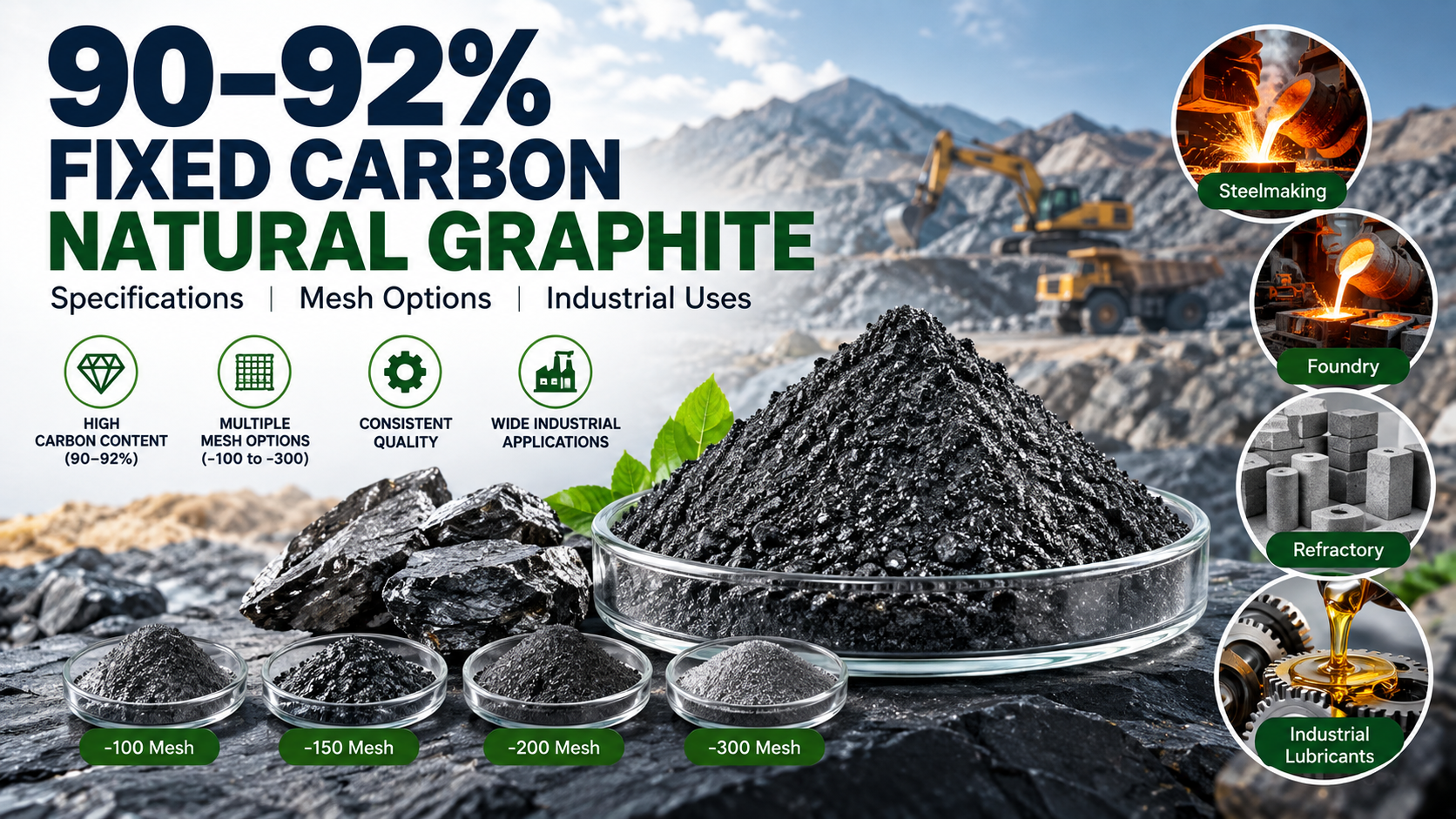
Pradhan Industries works with industrial graphite specifications that include mesh options such as -100, -150, -200, and -300 mesh, subject to product availability and the agreed specification.
The following table explains how buyers can approach mesh selection.
| Mesh option | General particle-size interpretation | Selection considerations |
|---|---|---|
| -100 mesh | Relatively coarser powder than finer mesh grades | Consider where the process requires a comparatively coarser particle distribution. |
| -150 mesh | Intermediate powder fineness | Evaluate for processes requiring a controlled balance between fineness and handling. |
| -200 mesh | Fine graphite powder | Consider applications requiring finer powder and suitable mixing characteristics. |
| -300 mesh | Finer powder grade | Evaluate where finer particles and improved distribution are required. |
Important: Mesh numbers are associated with sieve openings, but the exact particle-size specification depends on the applicable sieve standard. A minus sign generally indicates material passing through the stated sieve. It does not mean that every particle has the same size. Confirm the required sieve standard and particle-size distribution before ordering.
Which Mesh Size Should You Choose?
The correct mesh size depends on the manufacturing process rather than the fixed-carbon percentage alone.
For example, a foundry may prioritize feeding characteristics and carbon addition requirements, while a lubricant manufacturer may focus on particle fineness, dispersion, and formulation stability. A refractory producer may evaluate particle size alongside thermal performance and the characteristics of the other raw materials.
Before selecting a grade, we recommend confirming:
-
The target particle size and permitted size variation.
-
The required fixed-carbon and maximum ash specifications.
-
The mixing, feeding, or dispersion method used in production.
-
The technical requirements of the finished product.
-
Whether the material must comply with a particular customer specification.
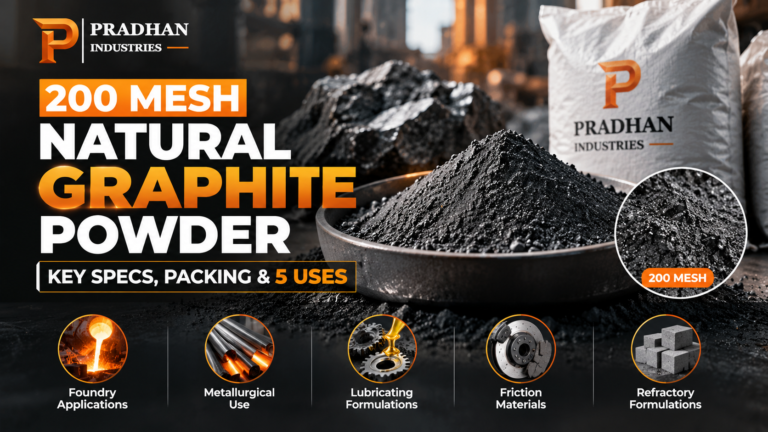
For more information about finer graphite powder, read our related article on
200 Mesh Natural Graphite Powder: Key Specifications, Packing, and Uses.
Industrial Uses of 90–92% Fixed Carbon Natural Graphite
Natural graphite is valued for its crystalline structure, lubricity, thermal properties, and role as a carbon-bearing material. The U.S. Geological Survey describes graphite’s relevance to metallurgy, steelmaking, lubricants, and refractory applications in its graphite research and technical publications.
The suitability of a 90–92% fixed-carbon grade must still be assessed for each intended use.
1. Steelmaking and Metallurgical Applications
Graphite is used in selected metallurgical processes where carbon-bearing materials are required. Depending on the process, carbon additions may support the adjustment of carbon levels or contribute to specific material requirements.
For buyers evaluating natural graphite for steelmaking, important factors include fixed-carbon content, ash, moisture, particle size, addition rate, and the operating conditions of the furnace or process.
A 90–92% fixed-carbon grade may be considered where its complete specification meets the required process limits. The material should be evaluated through technical documentation and, where necessary, production trials.
2. Foundry Applications
Foundries use graphite-containing materials in various applications associated with metal casting and moulding. Depending on the formulation and process, graphite can contribute to surface characteristics, lubrication, thermal behaviour, or carbon-related requirements.
When selecting graphite for foundry use, buyers should identify the exact application rather than relying on a general-purpose product description.
Particle-size distribution, impurities, moisture, and consistency between batches can all influence handling and process performance.
3. Refractory Manufacturing
Refractory materials are designed to withstand demanding high-temperature environments. Graphite is incorporated into selected refractory formulations because of its useful thermal properties and resistance to certain operating conditions.
Potential applications include graphite-containing refractory products used in metallurgical environments. The actual suitability of a 90–92% fixed-carbon grade depends on the complete refractory formulation, impurity limits, oxidation conditions, and required product performance.
Manufacturers should assess graphite alongside the other raw materials rather than treating carbon content as the only selection criterion.
4. Industrial Lubricants
Graphite has a layered crystalline structure that allows its layers to slide relative to one another, contributing to its lubricating behaviour. This makes graphite useful in certain solid-lubricant applications and specialised industrial formulations.
For lubricant manufacturers, particle size, dispersion, impurities, and compatibility with the formulation can be particularly important.
A finer mesh grade may be worth evaluating when the application requires a finer distribution, but finer particles do not automatically guarantee better performance. Testing under the intended operating conditions is the most reliable way to assess suitability.
5. Industrial Carbon Formulations
Some industrial processes require carbon-bearing raw materials to meet defined formulation targets. Natural graphite may be considered for these applications when its chemical and physical properties match the production requirements.
Before using 90–92% fixed-carbon graphite in a formulation, manufacturers should verify the actual composition, ash content, moisture, and particle-size distribution.
Where impurity limits are especially strict, a higher-purity grade may be more appropriate. The decision should be based on the finished product’s technical requirements and total production economics.
90–92% Fixed Carbon vs. Higher-Carbon Graphite Grades
Industrial buyers often compare graphite grades based on fixed-carbon content. However, a meaningful comparison must include the complete specification and the cost of achieving the required performance.
| Evaluation factor | 90–92% fixed carbon | Higher-carbon graphite |
|---|---|---|
| Fixed-carbon level | Specified within the 90–92% range | Depends on the grade, such as 94–95% or higher |
| Ash content | Must be verified from test results | Must also be verified; do not infer it from carbon content alone |
| Particle size | Selected according to the required mesh and distribution | Selected according to the same application-specific considerations |
| Application suitability | Suitable where the complete specification meets process requirements | May be preferred where higher carbon content or tighter impurity limits are necessary |
| Purchasing decision | Evaluate performance against price and specifications | Evaluate the benefit of the higher grade against its additional cost, if any |
A higher-carbon grade is not automatically the most economical option. Conversely, a lower-priced grade is not necessarily suitable if it causes production difficulties or fails to meet the finished product’s quality requirements.
The best approach is to compare documented specifications, conduct trials where appropriate, and calculate the material cost in relation to the required process outcome.
How to Select a Reliable Natural Graphite Supplier
Choosing a graphite supplier is an important procurement decision, particularly for manufacturers that depend on consistent raw materials and repeat deliveries.
At Pradhan Industries, we encourage buyers to evaluate the following factors before finalising an order.
1. Clear Technical Specifications
A reliable quotation should identify the graphite grade, fixed-carbon range, mesh size, ash limit, moisture limit, and other agreed parameters.
Avoid comparing suppliers solely on a headline figure such as 90% or 92% fixed carbon. A complete technical data sheet provides a more useful basis for evaluating material suitability.
2. Quality Testing and Documentation
Request a certificate of analysis (COA) or relevant test report to verify the supplied material against the agreed specification.
For recurring orders, establish acceptance criteria before shipment and confirm how non-conforming material will be handled.
3. Appropriate Packaging
Packaging should protect the graphite during handling, storage, and transportation. Buyers should confirm bag material, net weight, labelling, palletisation, and bulk-packaging requirements before placing an order.
Storage conditions should minimise unnecessary moisture exposure and prevent contamination from other materials.
4. Supply Planning and Communication
For industrial buyers, dependable communication is as important as the initial product quotation. Discuss order quantities, delivery schedules, dispatch arrangements, and the ability to meet repeat-order specifications.
A clearly documented purchase specification helps both parties maintain consistent expectations throughout the supply process.
5. Application-Based Grade Selection
The supplier should understand the intended application and help identify the specifications that need to be verified. A graphite grade suitable for one industrial process may not be appropriate for another.
Before confirming a bulk order, provide the required fixed-carbon range, mesh specification, impurity limits, intended use, and any additional customer requirements.
Frequently Asked Questions About 90–92% Fixed Carbon Natural Graphite
What is 90–92% fixed carbon natural graphite?
It is natural graphite specified to contain 90–92% fixed carbon under an agreed analytical method. The grade is used in industrial applications where its complete chemical and physical specifications meet process requirements.
Which mesh sizes are available for natural graphite powder?
Commonly requested mesh options include -100, -150, -200, and -300 mesh. Availability depends on the supplier’s product range and the agreed specification. Buyers should confirm the sieve standard and particle-size distribution before ordering.
Is 90–92% fixed carbon graphite suitable for steelmaking?
It may be suitable for certain steelmaking and metallurgical applications, depending on the process, carbon requirements, impurity limits, and particle size. The grade should be evaluated against the technical requirements of the specific operation.
Can 90–92% fixed carbon graphite be used in refractory products?
Graphite is used in selected refractory formulations. Whether a 90–92% grade is appropriate depends on the formulation, ash limits, operating environment, and required finished-product properties.
What is the difference between 90–92% and 94–95% fixed carbon graphite?
The primary stated difference is the fixed-carbon range. However, ash content, moisture, particle size, and other specifications must also be compared. A 94–95% grade may be necessary for applications with higher carbon requirements, while a 90–92% grade may meet other applications’ specifications.
What information should buyers provide when requesting a quotation?
Buyers should provide the required fixed-carbon range, mesh size, quantity, intended application, ash and moisture limits, packaging preference, delivery destination, and any required quality documentation. These details help suppliers prepare a more relevant quotation.
How can buyers verify graphite quality before bulk procurement?
Request a technical data sheet, relevant test results, and a batch-specific certificate of analysis where available. For critical applications, evaluate a representative sample against the agreed specifications before committing to regular bulk purchases.
Conclusion: Choosing the Right 90–92% Fixed Carbon Natural Graphite
90–92% fixed carbon natural graphite can be a practical choice for industrial manufacturers when the grade’s composition, particle size, and quality characteristics meet the requirements of their production processes.
The most effective purchasing decision considers the complete specification rather than fixed-carbon content alone. Mesh size, ash content, moisture, batch consistency, packaging, and supply requirements all contribute to successful procurement.
At Pradhan Industries, we supply natural crystalline graphite for industrial applications and support buyers in evaluating grade requirements for their intended uses. Whether you are sourcing graphite for steelmaking, foundries, refractory manufacturing, lubricants, or other industrial formulations, defining the required specifications is the first step towards selecting an appropriate material.
For additional product information, visit the Pradhan Industries website or explore our guide to 200 Mesh Natural Graphite Powder.
To learn more about graphite properties and industrial applications, consult the U.S. Geological Survey’s graphite resources.
Request a Natural Graphite Quotation from Pradhan Industries
Are you looking for 90–92% fixed carbon natural graphite powder for your manufacturing requirements? Contact our team with your preferred carbon grade, mesh size, quantity, and application details.
We can discuss the required specifications and help you identify the product information needed for your procurement evaluation.
-
Company: Pradhan Industries
-
Location: Bhubaneswar, Odisha, India
-
Phone: +91 7077805666
-
Email: info@pradhanindustries.com
-
Website: https://pradhanindustries.com/
Pradhan Industries — Delivering High-Purity Natural Graphite from Mine to Market.