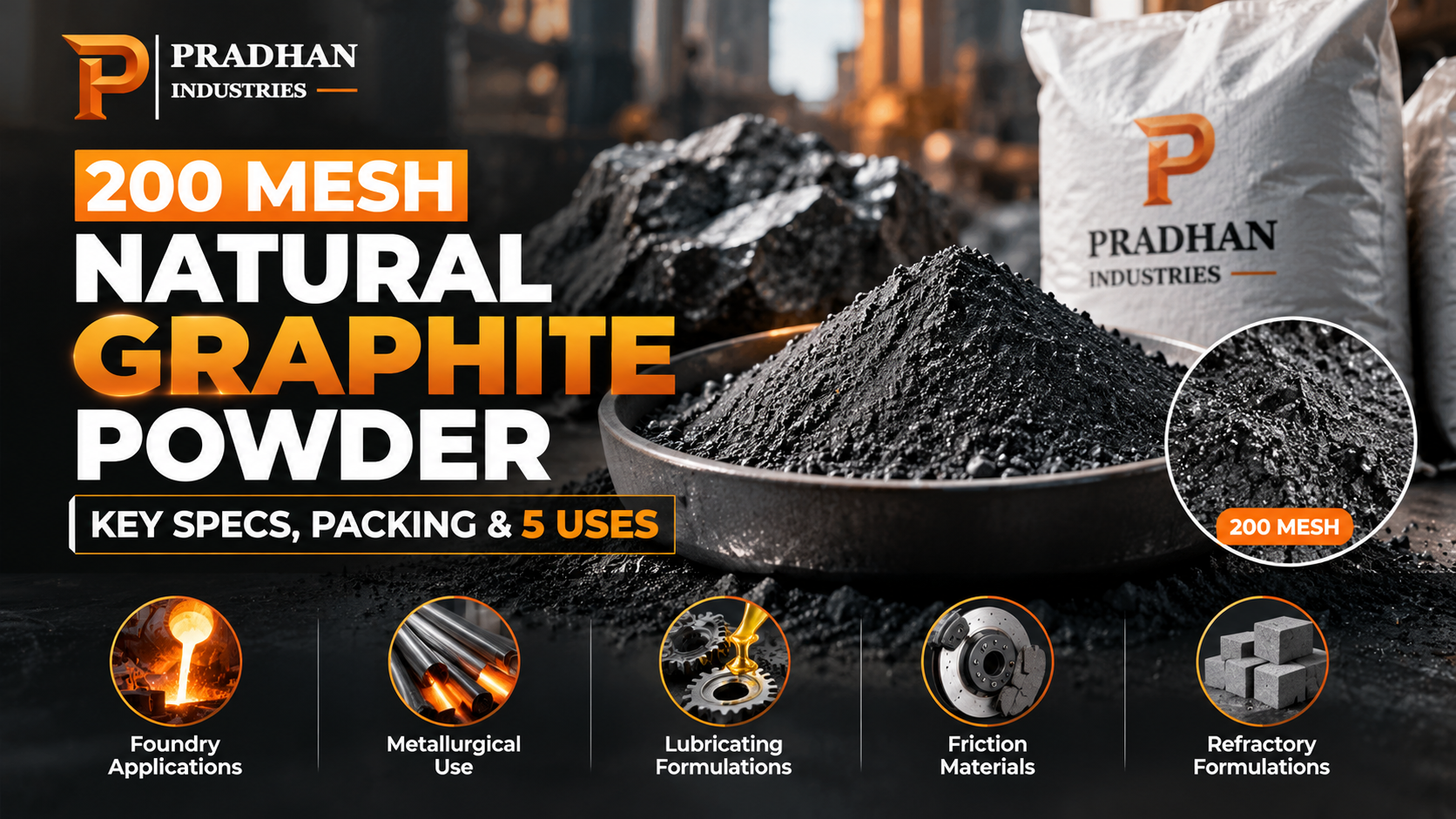
200 mesh natural graphite powder is an industrial carbon material. It is used where particle size, fixed carbon content, and material consistency matter. From foundry coatings and metallurgical processes to lubricating formulations and selected industrial compounds, the right graphite specification can make a difference to how a material performs in production.
However, not every 200 mesh graphite powder is the same. Two products can have similar particle-size classifications but differ in fixed carbon content, ash, moisture, and other characteristics.
For manufacturers, foundry operators, and bulk material buyers, understanding these differences is essential before placing an order.
Pradhan Industries supplies natural crystalline graphite grades in multiple fixed carbon ranges and mesh specifications. In this guide, we explain the specifications, packing considerations, and five typical industrial applications of 200 mesh natural graphite powder.
What Is 200 Mesh Natural Graphite Powder?
Natural graphite is a naturally occurring form of crystalline carbon. After extraction and processing, it can be graded into different particle sizes for use in industrial applications.
The term “200 mesh natural graphite powder” refers to graphite classified using a sieve specification. Mesh describes the number of sieve openings per linear inch under a defined sieve standard. The actual particle-size distribution depends on the screening method, processing conditions, and product specification.
A 200-mesh classification is commonly linked to a nominal sieve opening of about 75 micrometers. However, you should always confirm the correct standard and product designation with the supplier.
It is important to understand that mesh size is not a measure of graphite purity. A 200-mesh product does not automatically have a particular fixed carbon percentage or ash content.
For accurate purchasing decisions, buyers should evaluate particle size alongside the chemical and physical specifications of the material.
200 Mesh Natural Graphite Powder Specifications
When sourcing graphite powder for industrial use, the product specification sheet should clearly identify the grade, particle size, and relevant quality parameters.
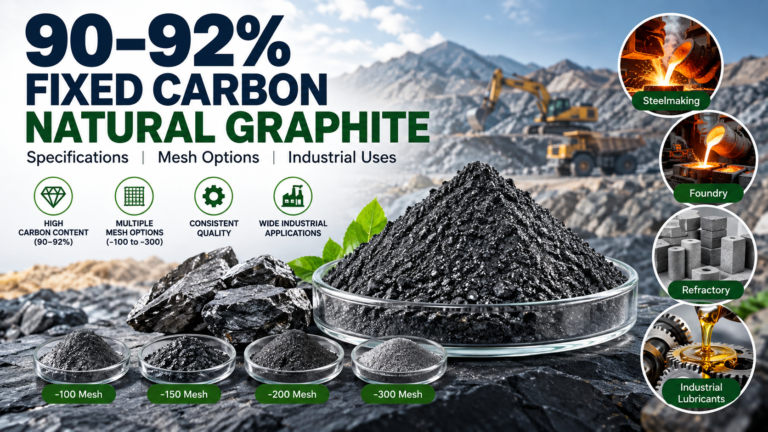
Pradhan Industries lists 200 mesh pulverized crystalline graphite in several fixed carbon ranges, including 60–65%, 80–85%, 90–92%, and 94–95% FC.
The appropriate grade depends on the intended application and the customer’s technical requirements.
Technical specification overview
| Specification | What buyers should check |
|---|---|
| Material type | Natural crystalline graphite |
| Mesh size | 200 mesh; confirm the applicable sieve specification |
| Fixed carbon | Available grades include 60–65%, 80–85%, 90–92%, and 94–95% FC. |
| Processing state | Pulverized |
| Ash content | Confirm the specified value or acceptable limit. |
| Moisture content | Confirm the product specification. |
| Particle-size distribution | Request details when required by the application. |
| Quality documentation | Request the technical data sheet and relevant test reports. |
| Packaging | Confirm available bag types and weights with the supplier. |
Note: These are specification categories for evaluating a product, not a substitute for a batch-specific technical data sheet. Confirm current grade availability and exact limits with Pradhan Industries before ordering.
1. Fixed carbon content
Fixed carbon (FC) indicates the carbon content determined using the relevant analytical method. It is one of the primary parameters buyers consider when comparing industrial graphite grades.
A higher fixed carbon grade may be necessary for certain applications, but the highest percentage is not automatically the right choice for every process.
For example, a foundry coating manufacturer may have different requirements from a buyer purchasing graphite for a metallurgical process or a lubricating compound.
Before choosing a grade, confirm the required carbon percentage, ash limits, moisture limits, and other relevant parameters with your technical team.
2. Mesh size and particle distribution
Mesh classification helps buyers identify the approximate fineness of a powder. However, the same nominal mesh classification does not guarantee identical particle-size distributions across suppliers.
Depending on the application, buyers may also need information about the percentage passing a specified sieve, the percentage retained, or a measured particle-size distribution.
This information is especially useful when the powder must disperse evenly, pass through processing equipment, or meet a specific formulation requirement.
3. Ash and moisture content
Ash content represents the inorganic residue remaining after a specified testing procedure. Its importance depends on the application and the acceptable impurity levels.
Moisture can also affect storage, handling, and processing. Buyers should therefore request the relevant specifications rather than assuming that every product in a particular carbon grade has identical properties.
For repeat orders, use agreed quality limits and compare supplied material against the purchase specification.
5 Industrial Uses of 200-Mesh Natural Graphite Powder
The applications of graphite depend on its grade, particle characteristics, and the process in which it is used. The following are five areas where appropriately specified natural graphite powder may be considered.
1. Foundry coatings and casting applications
Graphite is used in certain foundry coatings and mold-facing formulations. Its properties can help provide a suitable interface between the mold and molten metal when the formulation and process are properly designed.
The correct graphite grade depends on the metal being cast, the moulding system, the coating binder, the application method, and the required surface finish.
A 200-mesh classification may be considered where the particle-size requirements are compatible with the coating formulation. Buyers should test the material under their actual production conditions before approving it for regular use.
2. Metallurgical and steelmaking applications
Graphite and other carbon-bearing materials are used in selected metallurgical processes. Their suitability depends on the required carbon contribution, impurity limits, particle size, and process conditions.
For buyers considering graphite powder for metallurgical use, fixed carbon content and ash specifications are important starting points.
The material should be evaluated against the requirements of the particular furnace or production process. Not every graphite grade is interchangeable with every carbon additive.
3. Industrial lubricating formulations
Graphite has a layered crystalline structure that allows its layers to slide relative to one another under suitable conditions. This characteristic contributes to its use in certain solid-lubricant formulations.
Depending on the formulation, graphite may be incorporated into lubricants, anti-seize compounds, or other industrial products where its properties are suitable.
The final performance depends on factors such as particle size, purity, concentration, operating temperature, contact materials, and the other ingredients in the formulation.
Manufacturers should confirm compatibility and conduct application-specific testing before selecting a grade.
4. Friction materials and industrial components
Graphite is used in some friction materials, including selected brake and clutch formulations. In these products, the material’s contribution depends on the complete formulation and the operating conditions.
A suitable grade must meet the manufacturer’s requirements for particle size, chemistry, and processing behavior.
Buyers should not assume that all graphite powders are suitable for friction products. Material selection should be based on formulation trials and the technical requirements of the finished component.
5. Refractory and high-temperature formulations
Graphite is used in certain refractory products and high-temperature industrial formulations because of its thermal characteristics.
The appropriate grade depends on the finished product, operating atmosphere, temperature, binder system, and required physical properties.
A 200-mesh graphite powder may be suitable for some formulations, while others may require a different particle size or material form. Always verify the application requirements before specifying the product.
How to Choose the Right 200 Mesh Graphite Grade
Selecting the correct grade requires more than confirming the mesh number. Buyers should compare the full technical specification with the intended process.
Consider the following factors before placing an order.
Define the application. Tell the supplier whether the graphite is intended for a foundry coating, metallurgical process, lubricant, friction material, or another use.
Confirm the fixed carbon range. Specify your required FC percentage and any acceptable tolerance.
Check impurity limits. Confirm ash, moisture, and other relevant chemical parameters.
Review particle-size requirements. Verify the sieve specification and request a particle-size distribution when necessary.
Request documentation. Obtain a technical data sheet and, where available, a certificate of analysis for the supplied batch.
Test before bulk approval. Where the application is critical, evaluate a sample under representative operating conditions.
For more information about natural graphite characteristics, read our guide to natural graphite and its properties.
Packing and Storage of 200 Mesh Natural Graphite Powder
Packing plays an important role in maintaining product condition during handling, storage, and transportation.
Fine graphite powder can generate dust during transfer and may be affected by moisture or contamination if packaging is unsuitable. The appropriate packing arrangement depends on the order quantity, transport method, storage conditions, and customer requirements.
Common packing considerations
- Bag type: Confirm whether suitable sealed bags or other industrial packaging formats are available.
- Pack weight: Specify the required net weight per bag or unit.
- Moisture protection: Use packaging suitable for the expected storage and transportation conditions.
- Dust control: Ensure handling and transfer procedures minimise airborne dust.
- Labelling: Include product grade, mesh size, batch identification, net weight, and relevant handling information as applicable.
- Transport protection: Protect the packages from damage, moisture, and contamination during transit.
Available packaging formats and weights should be confirmed directly with Pradhan Industries before the purchase order is finalised.
Storage recommendations
Store graphite powder in a dry, clean, and well-ventilated location. Keep bags sealed when not in use and protect the material from water, foreign particles, and incompatible substances.
Follow the supplier’s safety data sheet and workplace procedures for handling fine powders. Use suitable dust-control measures and appropriate personal protective equipment based on the product documentation and the conditions at your facility.
Why Consider Pradhan Industries for Natural Graphite Powder?
Pradhan Industries is a natural crystalline graphite manufacturer and supplier based in Odisha, India.
The company lists pulverised graphite grades in multiple fixed carbon ranges, including 60–65%, 80–85%, 90–92%, and 94–95% FC, with 200 mesh among its published specifications.
Industrial buyers can discuss their requirements with the company to determine which available grade is appropriate for their application.
When requesting a quotation, provide the following information:
- Required fixed carbon percentage.
- 200 mesh specification and any additional particle-size requirements.
- Intended industrial application.
- Required ash and moisture limits.
- Estimated order quantity and repeat-order frequency.
- Packaging and delivery requirements.
- Required quality documents.
Visit the Pradhan Industries website to explore its graphite products and supply information.
You can also review the company’s graphite beneficiation process and its guide to high-carbon crystalline graphite for additional information about graphite grades and processing.
Frequently Asked Questions
What is 200 mesh natural graphite powder?
It is natural graphite processed and classified to meet a 200 mesh sieve specification. The exact particle-size distribution depends on the relevant sieve standard and product specification.
What is the approximate particle size of 200 mesh graphite?
A 200 mesh sieve is commonly associated with an opening of approximately 75 micrometres. The actual product specification should be checked with the supplier because classification standards and particle distributions can vary.
What fixed carbon grades are available from Pradhan Industries?
Pradhan Industries lists pulverised 200 mesh crystalline graphite in fixed carbon ranges including 60–65%, 80–85%, 90–92%, and 94–95%. Confirm current availability and detailed specifications before ordering.
What are the main applications of 200 mesh graphite powder?
Potential applications include selected foundry coatings, metallurgical processes, lubricating formulations, friction materials, and refractory formulations. Suitability depends on the product grade and the technical requirements of the application.
How is 200 mesh graphite powder packed?
Packaging depends on supplier availability and buyer requirements. Confirm the bag type, net weight, moisture protection, labelling, and bulk-order options before placing an order.
Is 200 mesh graphite suitable for every industrial application?
No. Mesh size alone does not establish suitability. Fixed carbon, ash content, moisture, particle-size distribution, and process requirements must also be evaluated.
How can I request a quotation from Pradhan Industries?
Visit Pradhan Industries and provide your required grade, mesh size, quantity, application, packaging preferences, and delivery destination. Ask for the relevant technical documentation before confirming the order.
For additional information about natural graphite, its properties, and industrial applications, refer to the U.S. Geological Survey (USGS) — Graphite Statistics and Information. This resource provides useful background on graphite as an industrial mineral and its role in the global minerals industry.
Conclusion
200 mesh natural graphite powder can be a useful industrial material when its specifications match the requirements of the intended process. Before you buy, check fixed carbon content, particle size, ash, moisture, packaging, and quality documents.
The five application areas discussed in this guide demonstrate why buyers should assess graphite according to its intended use rather than selecting a product on mesh size alone.
Pradhan Industries lists natural crystalline graphite grades for industrial buyers, including pulverised 200 mesh options across multiple fixed carbon ranges.
If your business needs natural graphite powder for foundry, metallurgical, or other industrial uses, contact Pradhan Industries. Discuss available grades, technical specifications, packing options, and bulk supply needs.