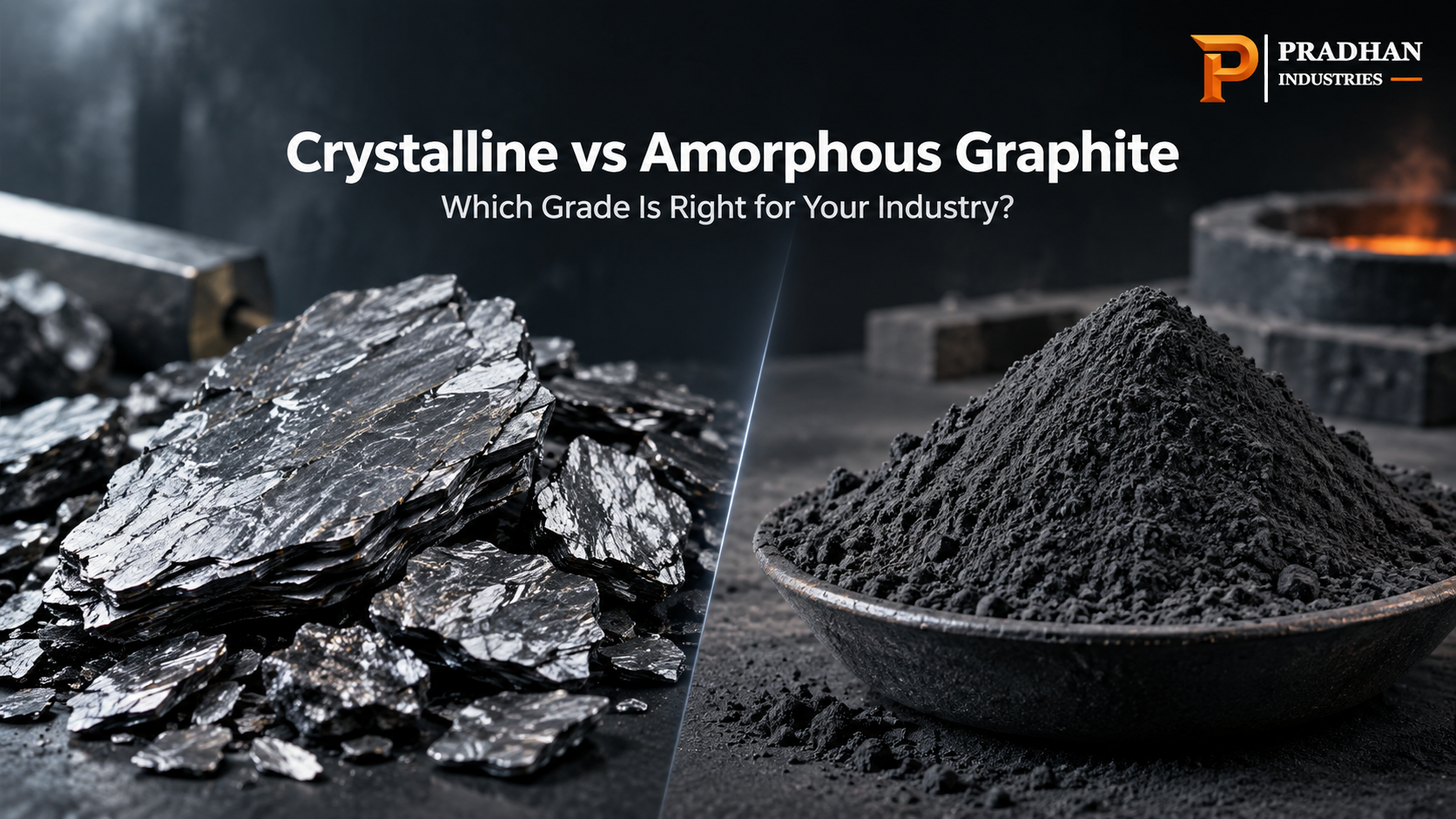
Crystalline vs. amorphous graphite is an important comparison for manufacturers selecting the right natural graphite grade for industrial applications. Although both materials are forms of natural graphite, they differ in crystal size, morphology, particle characteristics, processing behavior, purity requirements, and typical applications.
Choosing the appropriate graphite grade can affect product quality, manufacturing efficiency, thermal performance, conductivity, material consumption, and overall production cost. For this reason, industrial buyers should look beyond the graphite name and evaluate technical parameters such as fixed carbon, ash content, moisture, particle size, flake structure, and end-use requirements.
Pradhan Industries supplies high-purity natural crystalline graphite from Odisha for industrial applications, including steel manufacturing, foundries, refractories, friction materials, and other carbon-based applications. Explore Pradhan Industries’ graphite manufacturing and product capabilities.
In this guide, we explain crystalline and amorphous graphite. We compare their properties and uses. We also discuss how manufacturers can choose the right graphite grade for their needs.
Understanding Crystalline and Amorphous Graphite
Natural graphite is a naturally occurring form of carbon with a distinctive layered structure. Its combination of thermal stability, electrical conductivity, chemical resistance, lubricity, and high-temperature performance makes it valuable across numerous industries.
The U.S. Geological Survey identifies natural graphite according to form, including amorphous, crystalline flake, and vein or lump graphite. The classification is related to crystallinity, grain size, and morphology.
U.S. Geological Survey – Graphite Statistics and Information
Understanding these distinctions is important because two graphite products can have similar carbon percentages but behave differently during processing or in the final application.
What Is Crystalline Graphite?
Crystalline graphite is natural graphite with a well-developed graphite crystal structure. Commercial natural graphite commonly includes crystalline flake graphite, while lump or vein graphite represents another crystalline form.
Crystalline flake graphite occurs as plate-like particles within metamorphic rocks. Its layered structure gives the particles characteristic cleavage and contributes to the lubricating and thermal properties associated with graphite.
The industrial performance of crystalline graphite depends on several characteristics, including
- Fixed carbon content
- Flake size
- Particle-size distribution
- Flake integrity
- Ash content
- Moisture
- Mineral impurities
- Processing method
Large or well-preserved flakes can be valuable for applications where flake morphology is important, while finely processed crystalline graphite can be used where controlled particle size is required.
According to the USGS, crystalline flake graphite is used in a range of applications, including refractory products, lubricants, batteries, and metallurgical applications.
Pradhan Industries focuses on natural crystalline graphite grades with different fixed-carbon and mesh-size specifications for industrial applications.
View Pradhan Industries’ natural graphite information and technical specifications.
What Is Amorphous Graphite?
Amorphous graphite is a fine-grained form of natural graphite. The term “amorphous” does not mean that the material contains no crystalline structure. Instead, it generally refers to graphite with extremely small crystal domains or microcrystalline structure.
The USGS describes amorphous graphite as microcrystalline graphite and distinguishes it from crystalline flake and lump graphite based on crystallinity and morphology.
Amorphous graphite is commonly associated with carbon-rich sedimentary materials that have undergone metamorphism. Its fine-grained structure gives it different physical and processing characteristics compared with coarse flake graphite.
Typical applications can include:
- Foundry coatings
- Refractory materials
- Carbon additives
- Metallurgical applications
- Lubricants
- Friction materials
- Conductive formulations
- Industrial graphite powders
The appropriate grade depends on the application’s carbon requirement, ash limit, particle size, moisture level, and other technical specifications.
Crystalline vs. Amorphous Graphite: Key Differences
When comparing crystalline vs. amorphous graphite, the most important differences relate to crystal size, particle morphology, flake structure, processing characteristics, and application requirements.
| Property | Crystalline Flake Graphite | Amorphous Graphite |
|---|---|---|
| Crystal structure | Well-developed graphite crystals | Very fine or microcrystalline structure |
| Physical form | Distinct flakes | Fine-grained or compact particles |
| Particle morphology | Layered, plate-like particles | Fine, compact particles |
| Flake characteristics | Flake size and integrity can be important. | Flake structure is generally not the primary characteristic. |
| Typical applications | Refractories, batteries, crucibles, lubricants, metallurgy | Foundries, coatings, refractories, carbon additives |
| Processing | Beneficiation, classification, grinding, and purification may be used. | Grinding, sizing, and impurity control may be used. |
| Commercial factors | Carbon content, flake size, purity, and application | Carbon content, ash, particle size, and application |
| High-end applications | Battery feedstock and specialized industrial products | Selected industrial and metallurgical applications |
These characteristics are general rather than universal. Natural graphite properties vary according to the deposit, ore characteristics, beneficiation process, purification, and final particle-size classification.
For this reason, manufacturers should compare actual product specifications and test results, not simply the commercial grade name.
Crystalline Graphite vs Amorphous Graphite: Carbon Purity
One of the most common misconceptions in graphite purchasing is that crystallinity and purity mean the same thing.
They do not.
Crystallinity describes the structure of the graphite, while carbon purity describes the amount of carbon present relative to other components.
A crystalline graphite product can contain mineral impurities, while an amorphous graphite product can also be supplied at a specified carbon content.
For industrial procurement, fixed carbon and ash should therefore be evaluated separately from crystal structure.
Fixed Carbon Content
Fixed carbon is an important specification for graphite used in:
- Steelmaking
- Foundries
- Refractories
- Carbon additives
- Friction materials
- Metallurgical processes
The required carbon content depends on the application.
For example, a manufacturer using graphite as a carbon additive may have a specific carbon-recovery requirement, while a refractory manufacturer may be more concerned with the combination of carbon content, particle size, thermal behavior, and formulation compatibility.
Pradhan Industries offers multiple crystalline graphite specifications, including grades in different fixed-carbon and mesh-size ranges.
Explore Pradhan Industries’ graphite grades and specifications.
Ash Content
Ash represents inorganic material remaining after a defined testing procedure.
In graphite applications, lower ash may be required where mineral impurities could influence:
- Product chemistry
- Refractory performance
- Metallurgical reactions
- Electrical characteristics
- Finished-product consistency
However, the acceptable ash level depends on the intended application.
A manufacturer should define the maximum permissible ash content before selecting a graphite supplier.
Moisture Content
Moisture is another important purchasing parameter, particularly for graphite powders.
Excess moisture can influence:
- Material handling
- Storage
- Weighing
- Mixing
- Dispersion
- Process consistency
Graphite should therefore be stored and transported under conditions appropriate for the product specification.
Crystalline vs. Amorphous Graphite for High-Temperature Applications
Graphite is widely used in high-temperature industries because of its thermal characteristics and chemical properties.
The USGS notes that graphite combines properties such as thermal conductivity, thermal resistance, chemical inertness, and lubricity, making it useful in several industrial applications.
Crystalline Graphite in Refractories
Crystalline flake graphite can be incorporated into refractory formulations where its thermal conductivity, layered structure, and thermal-shock-related properties are beneficial.
Graphite-containing refractories can be used in demanding environments involving:
- Furnaces
- Foundries
- Molten metals
- Steelmaking
- High-temperature processing
The final performance of a refractory product depends on the complete formulation, not graphite alone. Binder chemistry, particle distribution, porosity, manufacturing method, and other raw materials all influence performance.
Amorphous Graphite in Refractory Applications
Amorphous graphite is also used in selected refractory and foundry formulations.
Its fine particle size can provide useful dispersion characteristics when the formulation requires finely distributed carbon.
The appropriate graphite grade depends on the final product’s required thermal, mechanical, chemical, and processing properties.
Therefore, the question is not simply whether crystalline or amorphous graphite is “better.” The correct question is which graphite specification matches the manufacturing process?
Electrical Conductivity of Crystalline and Amorphous Graphite
Graphite is electrically conductive because of the structure and bonding of carbon atoms within its graphitic layers.
However, the electrical performance of a graphite powder or graphite-containing product can vary according to:
- Crystal structure
- Particle size
- Particle contact
- Density
- Orientation
- Porosity
- Impurities
- Binder system
- Processing conditions
Crystalline Graphite for Conductive Applications
Crystalline graphite can be used in conductive formulations and as a feedstock for further processing into specialized carbon materials.
Its suitability depends on the required electrical characteristics and the physical properties of the final product.
For specialized applications, buyers should not rely solely on fixed carbon content. Application-specific testing may be required.
Amorphous Graphite for Conductive Formulations
Amorphous graphite can also be used in selected conductive coatings and industrial formulations.
The performance of the final product depends on the interaction between graphite, binder, particle size, concentration, and processing conditions.
Consequently, conductivity should be evaluated in the finished formulation, rather than assuming that graphite grade alone determines final electrical performance.
Crystalline vs. Amorphous Graphite for Foundry Applications
Foundry manufacturers use graphite in several ways, including mold coatings and carbon-containing formulations.
Graphite’s lubricity, thermal behavior, and carbon characteristics make it useful in selected foundry processes.
Crystalline Graphite for Foundry Coatings
Fine or appropriately classified crystalline graphite can be used in foundry applications where particle morphology and carbon characteristics are beneficial.
The required grade depends on:
- Mold material
- Metal being cast
- Coating formulation
- Particle size
- Surface-finish requirements
- Application method
Amorphous Graphite for Foundry Applications
Fine-grained amorphous graphite is also used in selected foundry coatings and related formulations.
Its fine particle structure can support uniform distribution within suitable coating systems.
The final performance depends on more than graphite type. Suspension stability, binder compatibility, coating thickness, drying, and application technique also matter.
Graphite for Steelmaking and Metallurgical Applications
Natural graphite is used in several metallurgical applications, including as a carbon source and in refractory-related products.
The USGS identifies steelmaking, refractories, powdered metals, lubricants, batteries, and brake linings among major natural graphite uses.
In metallurgical applications, graphite specifications may include:
- Fixed carbon
- Ash
- Moisture
- Particle size
- Sulphur
- Other impurity limits
- Addition rate
- Carbon recovery
The correct grade depends on the individual process.
A carbon additive for an induction furnace may require a different specification from graphite used in a refractory formulation.
For this reason, procurement teams should communicate the complete application requirement to the graphite supplier.
Crystalline Graphite and Battery Manufacturing
The relationship between crystalline and amorphous graphite becomes particularly important when discussing lithium-ion batteries.
Natural flake graphite is an important feedstock for battery-anode materials. USGS information identifies crystalline graphite as a significant material for lithium-ion battery anodes.
However, industrial crystalline graphite should not automatically be described as battery-grade graphite.
Battery applications require tightly controlled characteristics and additional processing.
Particle Size and Shape
Battery graphite may undergo:
- Milling
- Classification
- Shaping
- Purification
- Coating
- Other specialized processing
Particle-size distribution and morphology influence packing behavior and electrochemical performance.
Purity Requirements
Natural graphite can contain mineral impurities that may need to be reduced substantially for specialized battery applications.
The appropriate purification process depends on the feedstock and final battery-material specification.
Therefore, manufacturers should evaluate the complete technical specification before considering a graphite product for battery-related applications.
Can Amorphous Graphite Replace Crystalline Flake Graphite in Batteries?
Amorphous graphite is not simply interchangeable with processed natural flake graphite used for conventional battery-anode applications.
The different particle morphology and crystal characteristics mean that suitability must be determined through application-specific testing and electrochemical evaluation.
A high carbon percentage by itself does not make a graphite product battery-grade.
Crystalline vs. Amorphous Graphite: Particle Size Matters
Particle size is one of the most important specifications when selecting graphite for industrial use.
A graphite supplier may offer material in different mesh sizes or particle-size distributions depending on the application.
Particle size can influence:
- Mixing
- Dispersion
- Flowability
- Surface area
- Packing density
- Coating performance
- Reactivity
- Material handling
For crystalline graphite, flake size and integrity may also be important.
For amorphous graphite, fine particle distribution may be more relevant depending on the application.
This is why manufacturers should specify the required particle-size range rather than simply asking for “graphite powder.”
Graphite Pricing: What Determines the Cost?
The price of graphite depends on multiple factors rather than simply whether the product is crystalline or amorphous.
Important commercial factors include:
- Fixed carbon content
- Ash content
- Flake size
- Particle size
- Purity
- Beneficiation requirements
- Processing requirements
- Packaging
- Order quantity
- Delivery location
- Market conditions
USGS data demonstrates that natural graphite is traded in different forms, including flake, high-purity, amorphous, lump, and chip graphite.
This makes it important for buyers to compare like-for-like specifications when requesting quotations.
A lower-priced product may not necessarily reduce production cost if it requires higher consumption or additional processing.
Similarly, a higher-priced grade may not provide additional value if the application does not require its specialized characteristics.
How to Choose the Right Graphite Grade for Your Industry
Selecting between crystalline and amorphous graphite should begin with the final application.
Step 1: Identify the End Use
Determine exactly how graphite will be used.
Common applications include:
- Steelmaking
- Foundries
- Refractories
- Friction materials
- Lubricants
- Conductive products
- Metallurgical additives
- Battery-material processing
Each application can require a different graphite specification.
Step 2: Define Fixed Carbon
Establish the minimum fixed-carbon requirement.
For example, a buyer may specify a particular FC range according to the production process.
Do not assume that the highest available carbon content is automatically the most appropriate option.
Step 3: Define Ash Limits
Specify the maximum acceptable ash level.
If certain mineral impurities are particularly important to your process, those should also be included in the purchasing specification.
Step 4: Specify Particle Size
Define the required mesh size or particle-size distribution.
Where crystalline flake graphite is required, specify the desired flake size as well.
Step 5: Check Moisture
Establish a suitable moisture limit and storage requirement.
This can help maintain consistent material handling and processing.
Step 6: Request a Certificate of Analysis
A Certificate of Analysis (COA) provides documented test information for a supplied batch.
Depending on the product, a COA can include:
- Fixed carbon
- Ash
- Moisture
- Particle size
- Other relevant chemical parameters
Pradhan Industries states that its graphite batches undergo laboratory testing with COA documentation for grade compliance.
Step 7: Conduct Application Testing
Before switching suppliers or changing graphite grades, conduct representative trials where practical.
Testing can reveal differences in:
- Consumption
- Mixing
- Dispersion
- Product quality
- Process stability
- Finished-product performance
This approach provides a stronger basis for purchasing decisions than comparing price alone.
Quality Control in Graphite Supply
Consistent graphite quality is important for manufacturers that depend on repeatable production performance.
A reliable graphite supply program should consider:
- Batch consistency
- Laboratory testing
- Sampling procedures
- COA documentation
- Particle-size control
- Carbon-content control
- Ash control
- Moisture control
- Packaging
- Traceability
Pradhan Industries describes its graphite operations as including beneficiation, micronization, grading, and laboratory quality assurance, with crystalline graphite grades available across different carbon and mesh specifications.
Learn more about Pradhan Industries and its graphite processing capabilities.
Why Choose Pradhan Industries for Natural Graphite?
Pradhan Industries is an India-based graphite manufacturer and processor supplying natural crystalline graphite from Odisha for industrial applications.
The company states that it has more than 50 years of experience in mineral processing and supplies graphite grades for sectors including steel, foundries, refractories, friction materials, and other industrial applications.
Its published product specifications include different fixed-carbon ranges and mesh sizes, allowing industrial buyers to evaluate graphite according to their technical requirements.
For manufacturers evaluating a graphite supplier, important questions include:
- What fixed-carbon grades are available?
- What particle sizes are available?
- Is the material laboratory tested?
- Is a COA supplied?
- Can the supplier provide consistent batches?
- What applications is the grade intended for?
- What packaging and delivery options are available?
For direct inquiries, visit the Pradhan Industries contact page for current contact and quotation information.
Contact Pradhan Industries for graphite requirements.
Frequently Asked Questions About Crystalline vs. Amorphous Graphite
What is the main difference between crystalline and amorphous graphite?
The main difference is crystal size and morphology. Crystalline flake graphite has well-developed graphite crystals that occur as distinct flakes, while amorphous graphite is very fine-grained or microcrystalline.
Is crystalline graphite better than amorphous graphite?
Neither material is universally better for every application. The appropriate graphite depends on the required carbon content, particle size, morphology, purity, thermal properties, processing requirements, and final application.
Which graphite is used in lithium-ion batteries?
Natural flake graphite is an important feedstock for producing graphite anode materials for lithium-ion batteries. However, industrial graphite must undergo appropriate processing and meet specialized specifications before being considered battery-grade.
Is amorphous graphite suitable for refractory applications?
Yes. Amorphous graphite can be used in selected refractory and foundry applications. The appropriate grade depends on carbon content, ash, particle size, formulation, and operating conditions.
Does higher fixed carbon mean better graphite?
Not necessarily. Fixed carbon is an important specification, but particle size, ash, moisture, morphology, impurities, and application-specific performance must also be considered.
What is the difference between natural graphite and synthetic graphite?
Natural graphite is obtained from geological deposits, while synthetic graphite is manufactured from carbon-rich feedstocks through industrial processes. Their properties, production methods, cost structures, and applications can differ.
What graphite grade is suitable for steelmaking?
The appropriate grade depends on the specific steelmaking process, addition method, required carbon contribution, impurity limits, particle size, and desired carbon recovery. A technical specification should be established before selecting the product.
How do I select a graphite supplier in India?
Compare suppliers based on technical specifications, carbon consistency, ash levels, particle-size control, laboratory testing, COA availability, supply capacity, packaging, logistics, and application support rather than price alone.
Conclusion: Crystalline vs. Amorphous Graphite for Industrial Applications
Understanding crystalline vs. amorphous graphite is essential for manufacturers that need consistent performance from natural graphite.
Crystalline flake graphite is characterized by its developed flake structure and is used across applications including refractories, metallurgy, foundries, lubricants, and battery-material production. Amorphous graphite has a much finer microcrystalline structure and is used in selected foundry, refractory, metallurgical, lubricant, and carbon-based applications.
The right graphite grade depends on the specific technical requirements of the application.
Before purchasing, manufacturers should evaluate:
- Fixed carbon
- Ash content
- Moisture
- Particle size
- Flake size and integrity
- Impurity levels
- Application requirements
- COA and laboratory testing
- Batch consistency
- Total production cost
Pradhan Industries provides natural crystalline graphite from Odisha in multiple specifications for industrial requirements. Its published product range includes different fixed-carbon and mesh-size grades, supported by laboratory testing and COA documentation.
For manufacturers comparing crystalline vs. amorphous graphite, the most effective approach is to match the material specification to the production process rather than selecting a grade based on carbon percentage or price alone.
A clearly defined technical specification, application testing, and reliable quality documentation can help manufacturers achieve more consistent graphite performance and make informed procurement decisions.