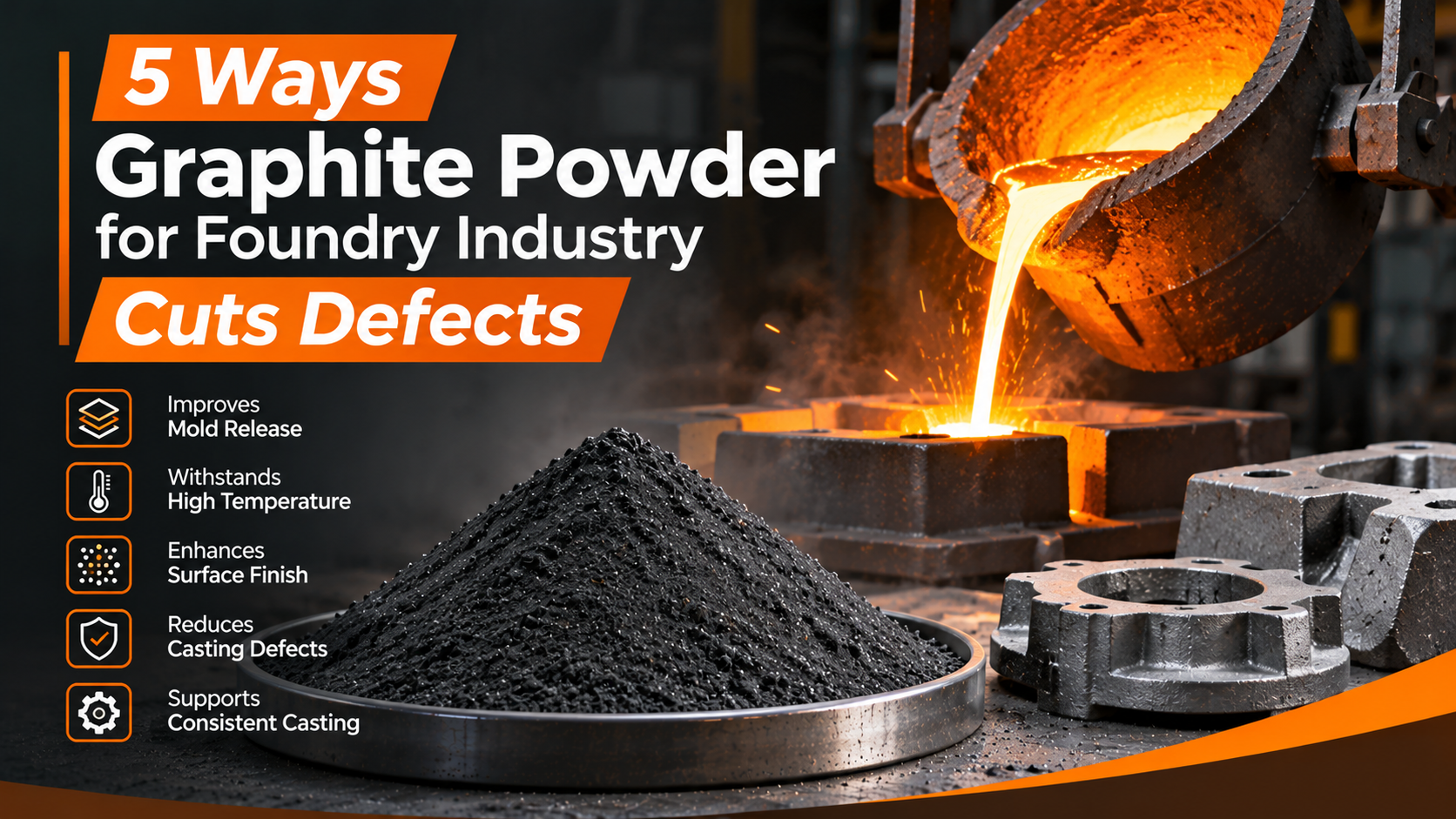
Graphite powder for the foundry industry is not an extra cost. When used in the right grade and dose, it is one of the easiest ways to reduce casting defects. It can improve surface finish and cut rework in iron and steel foundries.
Many defects start at the mold-metal interface. Sand burn-on, metal penetration, rough surface, veining, and poor peel are common when the coating is wrong or the carbon level is low.
This guide explains five practical ways graphite powder for the foundry industry helps and how to select the grade that fits your moulding line.
1. It Creates a Clean Barrier Between Metal and Mold
Molten metal at 1,400°C+ reacts with silica sand. Without a barrier, metal penetrates the sand and sticks to the casting.
Graphite powder for the foundry industry forms a thin, refractory layer on the mold and core surface. It stops direct contact between metal and sand, so the casting releases cleanly.
Use a fine, uniform powder for coatings, typically -200 mesh or finer, with low ash. A coarse or uneven powder leaves gaps and causes patchy burn-on.
Apply it as a water-based or alcohol-based wash. Keep the coating thickness even. A thin, even coat works better than a thick, cracked one.
For the right coating grade, explore our natural graphite products and check the mesh size on the COA.
2. It Reduces Sand Burn-On and Metal Penetration
Burn-on is the most visible defect in green sand and CO₂ molds. It increases fettling time, damages the surface, and can lead to rejection.
Graphite has high thermal stability and does not melt or burn easily. It keeps the mold surface stable while metal solidifies, which reduces penetration into sand pores.
Foundries using graphite powder for the foundry industry in mold washes often report smoother castings and less shot blasting. The saving is not just in quality; it is in labor and time after casting.
Check your current burn-on rate before and after a trial. Use the same sand, the same metal temperature, and the same coating method; only change the graphite grade. That gives you a clear result.
3. It Improves Surface Finish and Dimensional Accuracy
A rough casting needs more machining. That adds cost and eats into your margin.
Fine graphite powder fills micro-pores on the mold surface. It gives a smoother skin to the casting, with fewer pits and less roughness.
This matters for automotive, pump, valve, and engineering castings where surface finish is checked by the buyer. A consistent finish also improves dimensional accuracy, as there is less uneven metal build-up.
Use graphite with controlled particle size. If the powder is too coarse, the finish will stay rough. If it is too fine and dusty, handling and coating control become difficult.
Pradhan Industries supplies graded foundry powder with sieve analysis. Learn more about Pradhan Industries and our grading and lab checks.
4. It Acts as a Carbon Additive and Reduces Veining
In green sand, graphite is also used as a carbonaceous additive. It burns during pouring and creates a reducing atmosphere at the mold surface.
That reducing atmosphere prevents oxidation and reduces veining defects. It also helps control lustrous carbon formation, which improves peel and surface quality.
The dose matters. Too little graphite, and you get veining and poor peel. Too much, and you get excess gas, pinholes, and mould weakness.
Most iron foundries use 2% to 5% carbon additive in green sand, but the exact dose depends on your sand system, bentonite, coal dust, and metal type. Start with a trial lot and adjust in small steps.
For bulk supply planning, request a bulk quote with your monthly sand and casting volume.
5. It Cuts Rework, Fitting, and Rejection Costs
All four benefits above lead to one business result: fewer rejections.
When graphite powder for the foundry industry is used correctly, foundries see less burn-on, less grinding, less welding repair, and fewer customer complaints. Fettling time falls, and the casting moves faster to dispatch.
Calculate it simply. Compare your current rejection percentage and fettling hours with the cost of a trial lot of graded graphite. In most cases, the saving on one avoided rejection batch is more than the graphite cost.
That is why leading foundries treat graphite not as a consumable but as a quality input. The cheapest powder is rarely the cheapest casting.
Choosing the Right Grade: A Quick Checklist
- For mold wash/coating: Fine powder, -200 to -325 mesh, low ash, high fixed carbon 85%+.
- For green sand additive: Powder with good lustrous carbon yield, consistent size, and low sulphur.
- For core wash: Fine, stable suspension, no settling, good adhesion to core.
- Packing: 25 kg bags for trials, 500 kg / 1 MT jumbo bags for regular use.
Always ask for fixed carbon, ash, moisture, volatile matter, and sieve analysis. COA-verified material and in-house lab testing help you hold the same quality lot after lot.
To compare with refractory use, read our related guide: High Purity Graphite for Refractories: 2026 Buyer’s Guide.
Graphite Powder for Foundry Industry: Technical Specifications Table
Refer to graphite production and use data from the Indian Bureau of Mines and global supply trends from the USGS Mineral Commodity Summaries when planning annual purchase volumes.
Common Mistakes to Avoid
- Buying only on price, without checking carbon and ash.
- Using one grade for both wash and sand additive.
- Changing supplier every month, which changes your defect rate.
- Skipping a trial lot before a bulk order.
A short trial with clear defect tracking will tell you more than any brochure.
Image Ideas:
- Foundry worker applying graphite coating to a sand mold – Alt Text: Graphite Powder for Foundry Industry Mould Coating Application
- Finished iron casting with a smooth surface next to graphite powder bags—Alt Text: Graphite Powder for Foundry Industry smooth casting finish
FAQs
1. What is Graphite Powder for the Foundry Industry used for?
It is used in mold and core washes and as a carbon additive in green sand to prevent burn-on, improve surface finish, and reduce veining.
2. Which mesh size is best for foundry coating?
For mold wash, -200 to -325 mesh fine powder is commonly used. It gives a smooth, even barrier and better surface finish.
3. How much graphite powder should I add to green sand?
Most iron foundries use 2% to 5%, depending on sand, bentonite, and metal type. Start with a trial and adjust based on peel and defect rate.
Call to Action:
Want fewer defects and cleaner castings? Contact Pradhan Industries for a trial lot of foundry-grade graphite powder, with COA, grade guidance, and bulk pricing. Request a bulk quote.