Demand for natural graphite has moved well beyond the traditional steel and foundry sectors. Battery manufacturers, refractory producers, and specialty chemical companies are all competing for the same tonnage, and that’s pushed bulk buyers to think more carefully about where their graphite actually comes from. A supplier that can’t explain their mining source or hold a consistent particle size from one shipment to the next becomes a liability fast, especially once your production line depends on it.
Quality inconsistency is the single biggest complaint procurement teams raise about graphite sourcing. One batch tests clean on carbon content, the next has elevated ash, and suddenly your furnace efficiency or your lubricant formulation is off. That’s why choosing the right supplier matters as much as choosing the right grade.
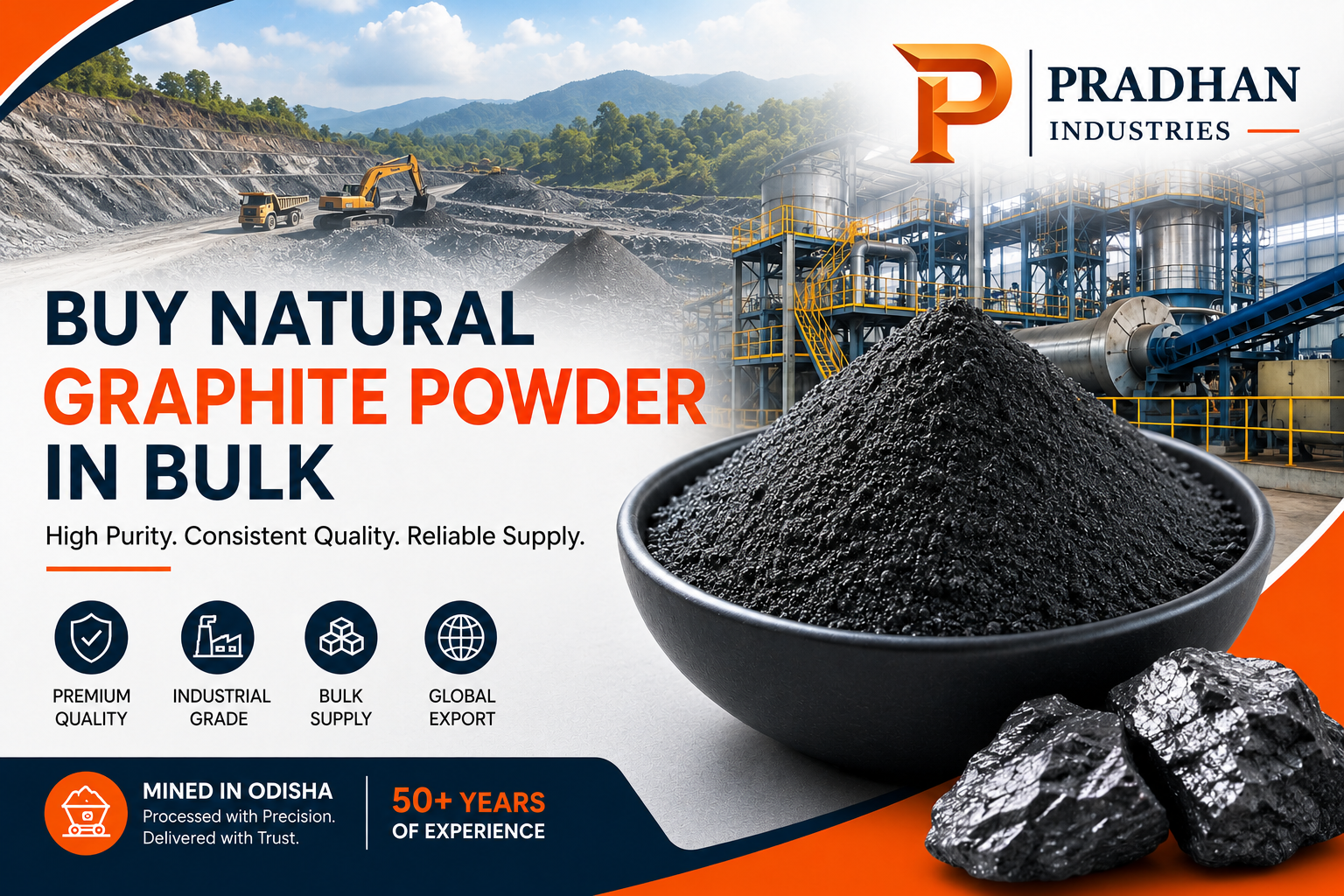
Pradhan Industries has been mining and processing natural graphite out of Odisha for more than five decades, supplying steel plants, foundries, and industrial buyers across India, Europe, the Middle East, Asia, and the US. This guide walks through what natural graphite powder actually is, how to evaluate it, what drives pricing, and what to check before you commit to a bulk order.
What is Natural Graphite Powder?
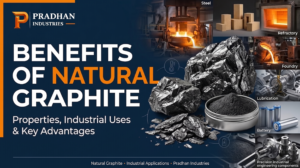
Natural graphite forms over millions of years as carbon-rich sedimentary and metamorphic rock is subjected to intense heat and pressure. What comes out the other end is a crystalline form of carbon with a layered structure — sheets of carbon atoms that slide easily against one another, which is exactly why graphite works so well as a lubricant and why it conducts heat and electricity efficiently.
Commercially, natural graphite is sold in a few recognizable forms: flake graphite, amorphous graphite, and vein (or lump) graphite, with flake generally commanding the highest value because of its larger crystal size and higher purity potential. Once mined, the ore is beneficiated — crushed, floated, and refined — to raise carbon content and strip out silica, iron, and other impurities.
For industrial buyers, three specifications matter most:
- Carbon content — typically ranges from 80% up to 99%+ depending on grade and application
- Particle size — measured in mesh or microns, and tightly linked to end-use performance
- Purity — ash content, moisture, and trace mineral levels that affect processing behavior
Graphite that looks fine visually can still fail on any of these three counts, which is why lab testing (not just a supplier’s spec sheet) should be part of your buying process.
Why Buy Natural Graphite Powder in Bulk?
Buying in bulk isn’t only about unit price, though that’s usually the first thing procurement teams calculate. The bigger operational win is supply certainty.
Lower procurement cost. Larger order volumes typically bring per-kilogram pricing down, since processing and export overhead get spread across more tonnage.
Consistent supply. A single bulk order locked to one batch specification removes the variability you’d get from sourcing smaller lots across multiple suppliers or shipments.
Better production planning. Knowing your graphite supply is secured for a quarter or a year lets manufacturing teams plan output without worrying about a mid-cycle shortage.
Custom packaging. Bulk orders make it economical for a supplier to accommodate packaging formats — jumbo bags, container-specific loading — tailored to your facility’s handling equipment.
Reduced logistics cost per unit. Freight and customs costs are largely fixed per shipment, so higher volumes lower the effective landed cost per kilogram.
Long-term contracts. Bulk buyers are often able to negotiate fixed-term pricing, insulating operations from short-term market volatility.
Industries That Use Natural Graphite Powder
Steel Industry
Graphite is used as a carbon raiser (recarburizer) in steelmaking, helping adjust carbon content precisely during the melt to hit target alloy specifications.
Foundry
Foundries use graphite in mold and core washes, and as a facing material, because it withstands high temperatures without reacting with molten metal.
Battery Manufacturing
Natural graphite, after further processing, is a core anode material in lithium-ion batteries, valued for its conductivity and charge-cycle stability.
Refractories
High-purity graphite goes into refractory bricks and crucibles used in furnaces, where thermal shock resistance and chemical stability are essential.
Lubricants
Graphite’s layered crystal structure lets it function as a dry or wet lubricant in high-temperature or high-pressure applications where oils break down.
Paints & Coatings
Conductive and anti-corrosive coatings use graphite powder as a functional pigment, particularly in industrial and marine paint systems.
Brake Linings
Friction material manufacturers use graphite to manage heat dissipation and wear characteristics in brake pads and clutch linings.
Carbon Components
Graphite is a raw input for carbon brushes, electrodes, and other molded carbon components across electrical and mechanical industries.
Chemical Industry
Its chemical inertness makes graphite useful in gaskets, seals, and linings that need to resist corrosive process chemicals.
Electrodes
Graphite electrodes, particularly for electric arc furnaces, rely on high-purity, high-carbon feedstock to perform under extreme current loads.
Key Properties of High-Quality Graphite Powder
| Property | Why It Matters |
|---|---|
| High carbon purity | Determines performance in metallurgical and electrical applications |
| Thermal conductivity | Critical for heat-dissipation and refractory uses |
| Electrical conductivity | Essential for battery anodes, electrodes, brushes |
| Lubrication | Layered structure reduces friction without liquid lubricants |
| Chemical stability | Resists acids, alkalis, and most industrial solvents |
| Oxidation resistance | Maintains integrity at high operating temperatures |
| Particle size distribution | Affects flow, mixing, and end-product consistency |
| Moisture content | Impacts handling, storage life, and processing behavior |
| Ash content | Lower ash generally signals higher-purity, cleaner-processed material |
✔ Expert Tip: Always request a Certificate of Analysis (CoA) with every batch, not just at the start of a contract. Graphite quality can drift even within the same mine as extraction moves through different seams.
How to Choose the Right Bulk Graphite Supplier
Sourcing decisions get expensive to reverse once a production line is committed, so it’s worth being deliberate upfront.
- Mining source — Suppliers who own or directly control their mining operations can guarantee consistency in a way traders reselling third-party material usually can’t.
- Processing technology — Ask how beneficiation is done; flotation and thermal purification methods affect final purity and cost.
- Quality certifications — ISO certification and documented QC processes are a baseline, not a bonus.
- Testing — Confirm the supplier runs carbon, ash, and moisture testing in-house rather than relying solely on third-party labs for every batch.
- Customization — Can they adjust mesh size, carbon percentage, or blend to your exact application?
- Production capacity — Verify they can actually sustain your required volume across multiple shipments, not just fulfil a one-off order.
- Export experience — Documentation, customs handling, and shipping reliability matter as much as the material itself.
- Packaging — Confirm available formats match your receiving and handling setup.
- Lead time — Ask for realistic timelines, including buffer for customs and freight delays.
- Technical support — A supplier who can advise on grade selection for your specific process adds real value beyond the transaction.
✔ Buyer Checklist
- Supplier owns or controls mining source
- CoA provided with every batch
- ISO or equivalent quality certification
- Sample testing completed before bulk order
- Packaging options match your logistics setup
- Export documentation and Incoterms clearly agreed
- Lead time confirmed in writing
Why Pradhan Industries is Trusted Worldwide
Pradhan Industries has operated in Odisha’s graphite belt for more than 50 years, which means the company has weathered multiple market cycles and built processing know-how that’s hard to replicate quickly. A few things set the operation apart:
Direct access to Odisha’s graphite deposits gives tighter control over consistency than buyers get from resellers. The processing facility is built around maintaining stable carbon content and particle size across production runs, and every batch goes through internal quality checks before dispatch. Pricing stays competitive because the company controls the supply chain from mine to export, and grades can be customized for specific industrial applications rather than offered as one-size-fits-all.
Export logistics — documentation, container loading, customs coordination — are handled in-house, which reduces friction for international buyers. None of this makes Pradhan Industries the right fit for every buyer, but for companies that need dependable bulk graphite with real traceability back to source, it’s a track record worth checking.
Factors Affecting Natural Graphite Powder Price
Graphite pricing isn’t a single number — it moves based on several variables buyers should understand before requesting quotes.
Carbon purity. Higher carbon percentage grades cost more due to the additional processing required to reach them.
Mesh size / flake size. Finer mesh sizes and larger, intact flakes typically command premium pricing over coarser or fragmented material.
Processing level. Raw beneficiated graphite costs less than material that’s undergone additional purification or micronization.
Order quantity. Larger volumes generally unlock better per-unit pricing, as discussed above.
Packaging requirements. Custom or specialized packaging adds marginal cost compared to standard bulk bags.
Transportation. Freight rates, fuel surcharges, and destination port fees all factor into landed cost.
International demand. Battery-sector demand growth in particular has added upward pressure on graphite pricing globally in recent years.
Quality Testing Before Buying Bulk Graphite
Before committing to a bulk order, insist on documented testing across:
- Carbon percentage — via LOI (loss on ignition) or similar combustion testing
- Ash percentage — indicates mineral impurity levels
- Moisture percentage — affects both handling and effective carbon content by weight
- Particle size analysis — sieve testing or laser diffraction depending on required precision
- Chemical composition — trace element analysis where application sensitivity requires it
- Independent lab testing — third-party verification for high-value or first-time orders
- Pre-shipment inspection — physical inspection of loaded containers before dispatch
✔ Common Mistakes Buyers often accept a single sample test result as representative of an entire bulk order. Insist on batch-level testing, particularly for shipments split across multiple mining seams or processing runs.
Packaging & Bulk Supply Options
| Packaging Format | Typical Use Case |
|---|---|
| 25 kg bags | Smaller industrial buyers, easier manual handling |
| 50 kg bags | Standard mid-volume industrial orders |
| Jumbo bags (500–1,000 kg) | Large-volume buyers with mechanized handling |
| Customized packaging | Buyers with specific labeling, moisture-barrier, or regulatory needs |
| Container loading | Full container load (FCL) export shipments |
| Export packaging | Compliant with international shipping and customs standards |
✔ Pro Insight: Moisture-barrier packaging is worth the marginal extra cost for shipments crossing humid ports or facing extended transit times — it protects both weight consistency and processing quality on arrival.
Frequently Asked Questions
1. What is the minimum order quantity for bulk natural graphite powder?
Minimum order quantities vary by supplier and grade, but bulk pricing typically applies from one metric ton upward. Contact Pradhan Industries directly for current MOQ terms.
2. What carbon content should I look for in industrial graphite powder?
It depends on application. Steel and foundry use often works with 80–90% carbon grades, while battery and electrode applications typically require 94%+ purity.
3. How is natural graphite powder priced?
Pricing depends on carbon purity, particle size, processing level, order volume, and current international demand, particularly from the battery sector.
4. Can graphite grades be customized for my application?
Yes. Reputable manufacturers, including Pradhan Industries, can adjust mesh size, carbon content, and blend composition to match specific industrial requirements.
5. What documentation should come with a bulk graphite shipment?
Expect a Certificate of Analysis, packing list, export documentation, and, where applicable, a certificate of origin.
6. How do I verify graphite quality before a large order?
Request samples for independent lab testing, and for first-time large orders, consider a pre-shipment inspection before the container is sealed.
7. What’s the difference between flake and amorphous graphite?
Flake graphite has larger, more ordered crystal structure and generally higher purity potential; amorphous graphite has a finer, less crystalline structure and is typically used in lower-purity applications.
8. Does Pradhan Industries export internationally?
Yes, Pradhan Industries exports to buyers across Europe, the Middle East, Asia, and the US, alongside serving the Indian domestic market.
9. How long does a bulk graphite order typically take to ship?
Lead times depend on order volume, packaging requirements, and destination, but should always be confirmed in writing before order confirmation.
10. Is natural graphite powder used in lithium-ion batteries?
Yes, natural graphite is a widely used anode material in lithium-ion batteries, though it typically undergoes additional purification before battery-grade use.
Conclusion
Buying natural graphite powder in bulk comes down to two things: understanding the specification your application actually needs, and finding a supplier who can deliver that specification consistently, shipment after shipment. Price matters, but a cheaper batch that fails quality testing costs far more once it disrupts your production line.
Pradhan Industries has spent more than 50 years building the mining, processing, and export experience to support industrial buyers who need graphite they can rely on. If you’re evaluating suppliers for an upcoming bulk order, request a sample and a quotation, and compare it against the checklist in this guide.