Graphite is one of the most versatile industrial minerals used across metallurgy, foundries, refractories, lubricants, batteries, friction materials, and numerous high-temperature applications. However, not all graphite is the same. Different industries require different crystalline graphite grades based on fixed carbon content, mesh size, particle distribution, and processing type.
Selecting the right graphite grade directly impacts product performance, operational efficiency, wear resistance, thermal stability, electrical conductivity, and production costs. Whether you manufacture refractory products, foundry consumables, brake linings, lubricants, or industrial coatings, understanding graphite grades helps you choose the ideal material for your application.
At Pradhan Industries, we manufacture and supply premium-quality Natural Crystalline Graphite Powder in multiple Fixed Carbon (F.C.) grades, mesh sizes, and processing options to meet diverse industrial requirements across India and international markets.
In this comprehensive guide, you’ll learn everything about crystalline graphite grades, how they differ, where each grade is used, and how to select the right graphite powder for your industry.
What is Crystalline Graphite?
Crystalline graphite is a naturally occurring form of carbon with a highly ordered crystal structure. Unlike amorphous graphite, crystalline graphite possesses well-developed graphite flakes that provide excellent thermal conductivity, electrical conductivity, lubricating properties, and high-temperature resistance.
Due to these unique characteristics, crystalline graphite has become an essential raw material in industries such as:
- Refractory manufacturing
- Steel and iron foundries
- Carbon products
- Lubricants
- Brake linings
- Friction materials
- Batteries
- Conductive coatings
- Industrial paints
- Metallurgical applications
Its outstanding chemical stability and resistance to heat make it one of the most preferred industrial minerals worldwide.
What are Crystalline Graphite Grades?
Crystalline graphite grades refer to the classification of graphite based on several technical specifications, including:
- Fixed Carbon (F.C.) percentage
- Mesh size (particle size)
- Processing method
- Purity level
- Industrial application
Among these, Fixed Carbon (F.C.) is considered the primary factor for determining graphite quality.
Generally, higher carbon content indicates higher graphite purity, improved conductivity, enhanced lubrication, and better thermal performance.
Different industries require different graphite grades depending on operating temperatures, manufacturing processes, and performance requirements.
Graphite Grades Available at Pradhan Industries
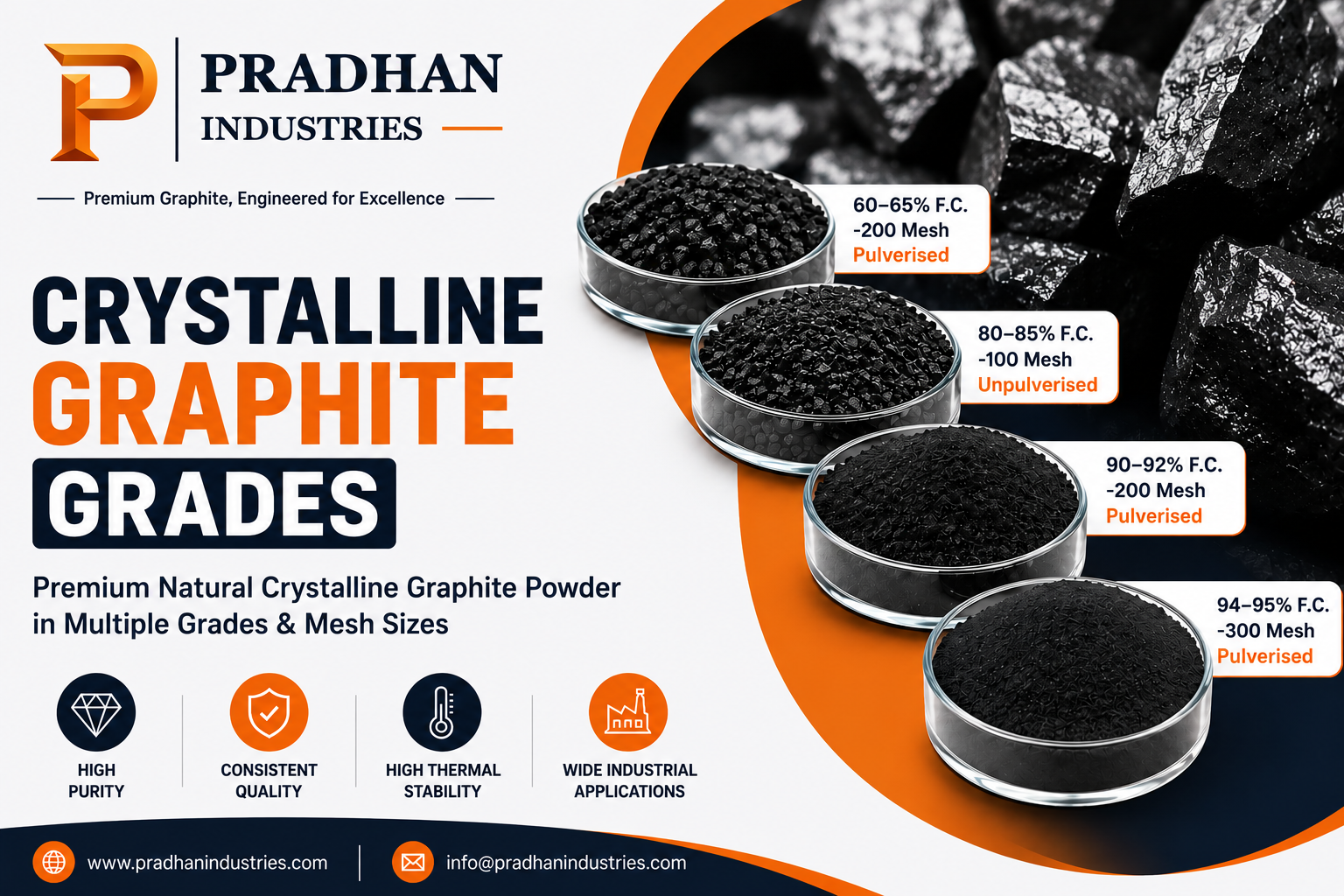
Pradhan Industries manufactures and supplies a wide range of Natural Crystalline Graphite Powder with various carbon contents and particle sizes suitable for multiple industrial applications.
Crystalline Graphite Grade Specifications
| # | Fixed Carbon (F.C.) | Mesh Size | Processing State |
|---|---|---|---|
| 1 | 60–65% F.C. | -200 Mesh | Pulverised |
| 2 | 80–85% F.C. | -100 Mesh | Unpulverised |
| 3 | 80–85% F.C. | -200 Mesh | Pulverised |
| 4 | 90–92% F.C. | -100 Mesh | Unpulverised |
| 5 | 90–92% F.C. | -200 Mesh | Pulverised |
| 6 | 90–92% F.C. | -300 Mesh | Pulverised |
| 7 | 94–95% F.C. | -100 Mesh | Unpulverised |
| 8 | 94–95% F.C. | -200 Mesh | Pulverised |
| 9 | 94–95% F.C. | -300 Mesh | Pulverised |
Graphite is a naturally occurring crystalline form of carbon known for its excellent thermal conductivity, lubricating properties, and chemical stability. According to the Encyclopaedia Britannica, graphite is widely used in refractory products, lubricants, batteries, and industrial applications.
Understanding Fixed Carbon (F.C.) in Graphite
Fixed Carbon (F.C.) represents the percentage of pure carbon present in graphite after removing moisture, volatile matter, and ash content. It is one of the most critical quality parameters used to evaluate graphite performance.
A higher Fixed Carbon percentage generally provides:
- Better thermal conductivity
- Improved electrical conductivity
- Higher lubricating efficiency
- Reduced ash content
- Better oxidation resistance
- Enhanced chemical stability
- Superior performance in high-temperature applications
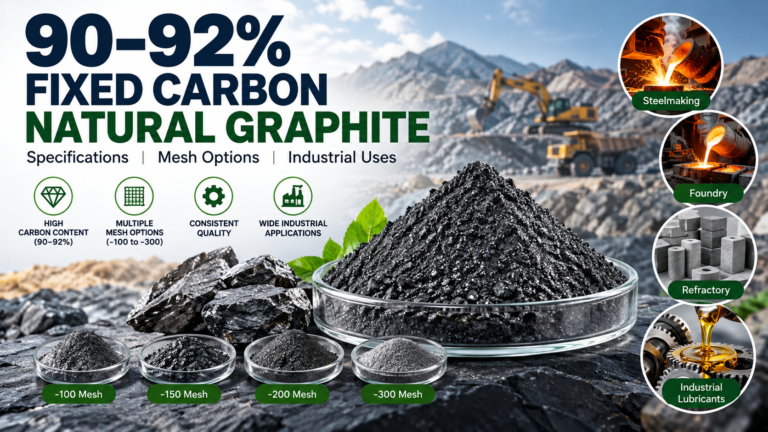
Industries that require maximum purity often prefer graphite with 90–95% Fixed Carbon, while general industrial applications can efficiently use grades ranging from 60–85% Fixed Carbon depending on performance requirements.