Graphite is no longer just a material used in pencils and industrial lubricants. Today, it sits at the centre of a global industrial revolution powered by electric vehicles, lithium-ion batteries, renewable energy systems, steel manufacturing, and advanced electronics. From EV battery anodes to high-temperature industrial applications, graphite manufacturing has become one of the most strategically important industrial processes in the modern world. Global demand for graphite is rapidly increasing due to the expansion of battery technology and clean energy infrastructure. Recent industry reports suggest that graphite demand could rise dramatically over the next decade because of EV adoption and energy storage systems.
What makes graphite fascinating is its dual identity. It exists naturally in the earth as a mineral, but it can also be produced synthetically through highly controlled industrial processes. Both forms have unique manufacturing methods, applications, and performance characteristics. Industries now depend heavily on high-purity graphite materials because even tiny impurities can affect conductivity, thermal resistance, and battery efficiency. That means manufacturers must follow extremely precise processing steps from raw material extraction to final purification.
This guide walks through the complete graphite manufacturing process step by step. You’ll learn how raw graphite ore is transformed into high-performance industrial graphite, how synthetic graphite is manufactured using petroleum coke, what purification technologies are used, and why the graphite industry has become essential to the future of clean energy and advanced manufacturing.
What Is Graphite and Why Is It Important?
Graphite is a crystalline form of carbon known for its excellent electrical conductivity, thermal resistance, lubricating properties, and structural stability. Imagine a material that can survive extreme heat, conduct electricity efficiently, and still remain lightweight. That’s graphite. Its layered atomic structure allows electrons to move freely, making it incredibly valuable for industrial and technological applications.
The importance of graphite has exploded because of the electric vehicle industry. Lithium-ion batteries depend heavily on graphite anodes, and battery-grade graphite requires exceptionally high purity levels. Modern EV batteries use significantly more graphite than lithium by weight, which surprises many people. While lithium often gets all the headlines, graphite quietly powers the battery’s performance behind the scenes.
Natural vs Synthetic Graphite
Natural graphite comes directly from mined graphite ore deposits. It is processed and purified before industrial use. Synthetic graphite, on the other hand, is manufactured from petroleum coke and coal tar pitch through high-temperature graphitization. Synthetic graphite generally offers higher purity and better consistency, but it also costs more to produce.
Key Industrial Applications of Graphite
Graphite is everywhere once you start looking closely. It is used in:
- Lithium-ion batteries
- Electric arc furnace electrodes
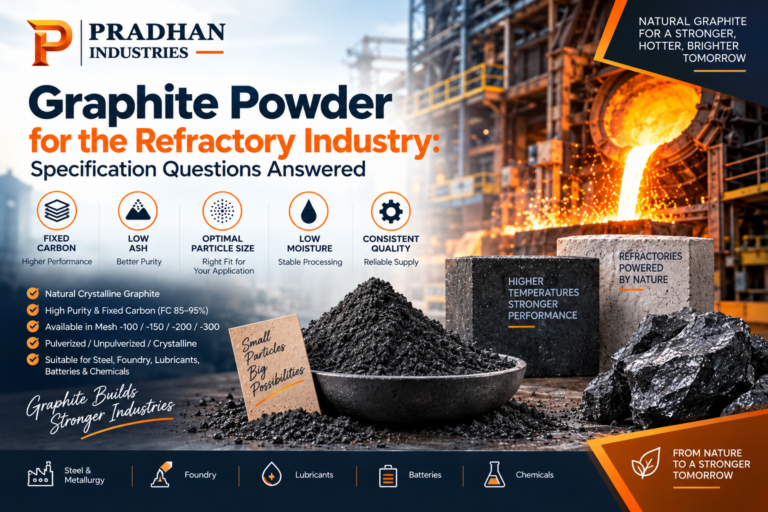
- Refractory materials
- Lubricants
- Foundries
- Aerospace components
- Nuclear reactors
- Solar panel manufacturing
- Electronics and semiconductors
Recent market studies show that synthetic graphite dominates a large portion of industrial demand because of its reliability and conductivity.
Overview of the Graphite Manufacturing Industry
The graphite industry is undergoing massive transformation due to global electrification. Governments and manufacturers are investing billions into battery supply chains, which has increased demand for both natural and synthetic graphite materials. Industry reports estimate that graphite demand could rise more than 300% by 2036 because of battery anode production growth.
Asia-Pacific currently dominates the graphite market, especially China, which controls a major share of graphite refining and battery-grade graphite production. This dominance has encouraged countries like the United States, Canada, and several European nations to invest in local graphite processing facilities to reduce supply chain dependency.
Rising Global Demand for Graphite
Electric vehicles are the biggest growth driver. Every EV battery requires substantial graphite content for its anode structure. Renewable energy storage systems also depend heavily on lithium-ion batteries, creating additional demand pressure.
Role of Graphite in EV Batteries
Think of graphite as the “engine room” of a lithium-ion battery. During charging and discharging cycles, lithium ions move into and out of graphite layers. Without graphite, the battery cannot function efficiently. This explains why automakers and battery companies are racing to secure long-term graphite supply agreements.
Raw Materials Used in Graphite Manufacturing
The graphite manufacturing process starts with selecting the right raw materials. The quality of these inputs directly affects conductivity, density, thermal stability, and final product performance.
Natural Graphite Ore
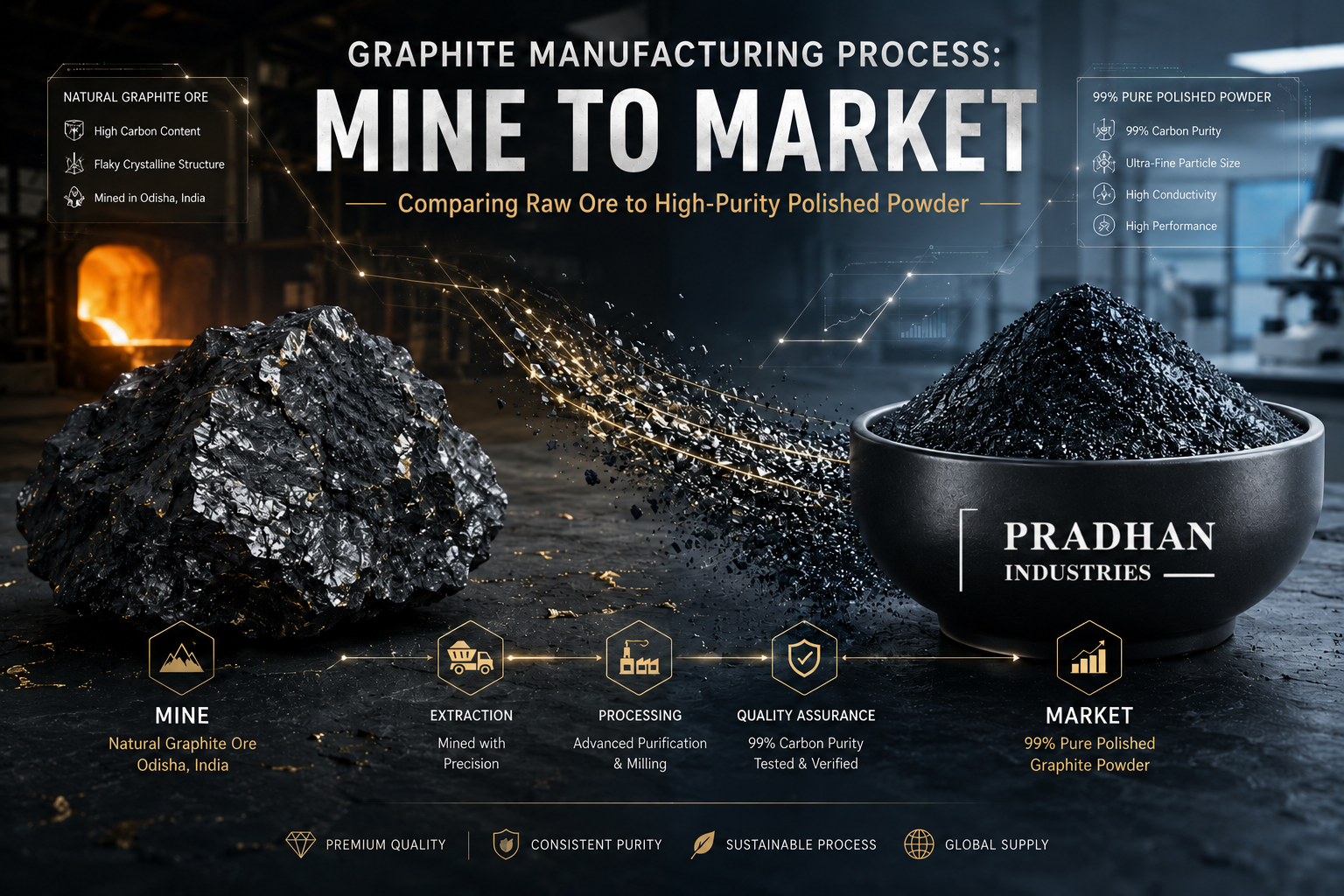
Natural graphite ore is mined from deposits containing crystalline carbon structures. The ore often contains impurities like silica, clay, iron, and other minerals. Manufacturers must remove these impurities through beneficiation and purification processes.
Natural graphite is available in several forms:
| Type | Characteristics | Common Uses |
|---|---|---|
| Flake Graphite | High purity and conductivity | Batteries, lubricants |
| Amorphous Graphite | Lower crystallinity | Refractories |
| Vein Graphite | Extremely pure | Specialty applications |
Petroleum Coke and Coal Tar Pitch
Synthetic graphite production relies heavily on petroleum coke and coal tar pitch. Petroleum coke acts as the carbon source, while pitch functions as a binding material during shaping and molding. These materials are mixed into a homogeneous mass before undergoing heat treatment at temperatures exceeding 2500°C.
The manufacturing process for synthetic graphite is energy-intensive but produces highly uniform graphite materials ideal for battery and industrial applications.
Step 1 – Mining and Extraction of Graphite
Graphite mining begins with geological surveys to locate economically viable deposits. Once a deposit is confirmed, mining companies determine whether open-pit or underground mining is more suitable.
Open-Pit Mining Process
Open-pit mining is commonly used for shallow graphite deposits. Heavy machinery removes layers of soil and rock to expose graphite ore bodies. Large excavators, drilling equipment, and haul trucks transport ore to processing plants.
This method is cost-effective and allows high-volume extraction. However, it also creates environmental challenges such as land disturbance and dust generation.
Underground Mining Techniques
Underground mining is used when graphite deposits are located deep below the surface. Miners create tunnels and shafts to access ore veins. While underground mining reduces surface disruption, it involves higher operational costs and greater safety risks.
The extracted graphite ore usually contains only a small percentage of graphite carbon. That means extensive processing is required before the material becomes commercially valuable.
Step 2 – Crushing and Grinding
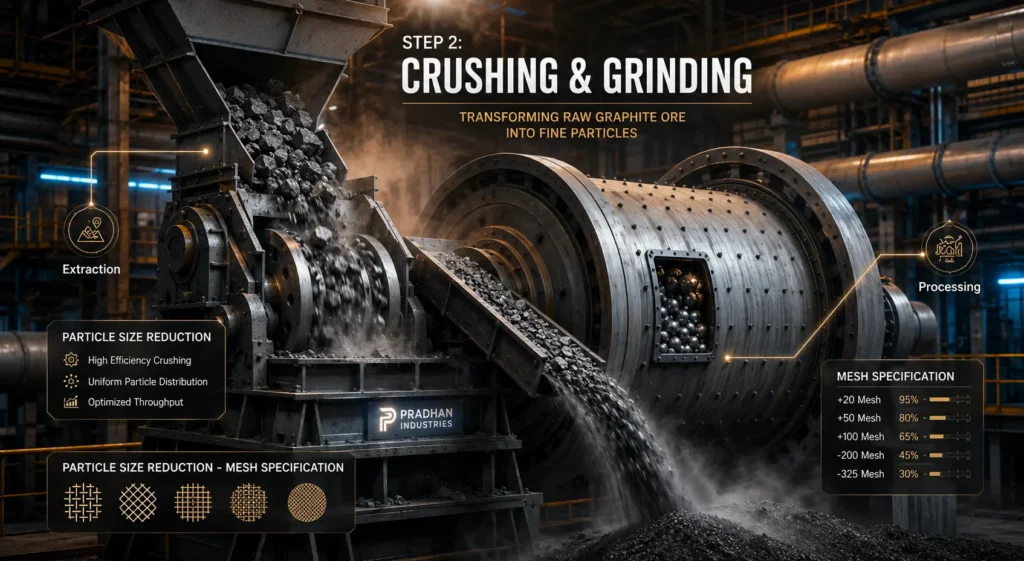
- After mining, graphite ore enters the crushing and grinding stage. The goal here is simple: separate graphite flakes from surrounding rock without damaging their structure.
Primary Crushing
- Large jaw crushers break ore into smaller fragments. Secondary crushers further reduce particle size. Manufacturers carefully control crushing pressure because excessive force can damage graphite flakes and reduce product quality.
Fine Grinding and Particle Sizing
- Grinding mills reduce the ore into fine particles suitable for flotation processing. This stage is incredibly important because particle size affects purification efficiency and final application performance.
- Battery manufacturers often require very specific particle distributions for anode production. Even slight inconsistencies can affect battery charging efficiency and lifespan.
Step 3 – Flotation and Ore Beneficiation
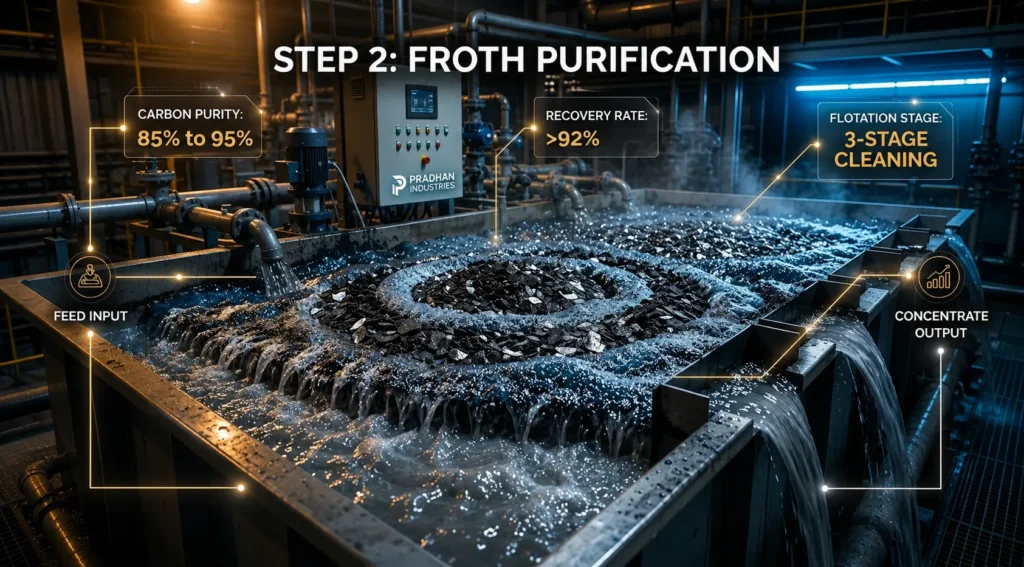
Flotation is the heart of natural graphite processing. It separates graphite particles from unwanted minerals using differences in surface properties.
Froth Flotation Method
During flotation, ground graphite ore mixes with water and chemical reagents inside flotation tanks. Air bubbles attach to graphite particles, causing them to float to the surface while impurities sink.
This process may involve multiple flotation stages to improve carbon purity. High-quality graphite concentrates can achieve carbon contents above 90% after beneficiation.
Removing Impurities from Graphite
Impurities like silica, iron, sulfur, and ash content must be removed for industrial applications. Battery-grade graphite often requires purity levels exceeding 99.95%.
The purification challenge is one reason graphite manufacturing remains highly specialized and technologically demanding.
Step 4 – Drying and Screening
After flotation, graphite concentrate contains moisture that must be removed before further processing. Industrial drying systems reduce moisture content using controlled heat.
Screening equipment then separates graphite particles by size. Different industries require different particle sizes. Fine powders are suitable for battery applications, while coarse flakes may be used in refractories and lubricants.
Particle uniformity matters enormously. Think of it like baking a cake—uneven ingredients produce inconsistent results. In graphite manufacturing, inconsistent particle size can reduce conductivity and mechanical strength.
Step 5 – Graphite Purification Process
Purification transforms graphite concentrate into high-performance industrial material. This step determines whether graphite can be used for batteries, electronics, or specialty applications.
Chemical Purification
Chemical purification uses acids such as hydrofluoric acid to dissolve mineral impurities. This method achieves extremely high purity levels but raises environmental and safety concerns due to hazardous chemicals.
Thermal Purification
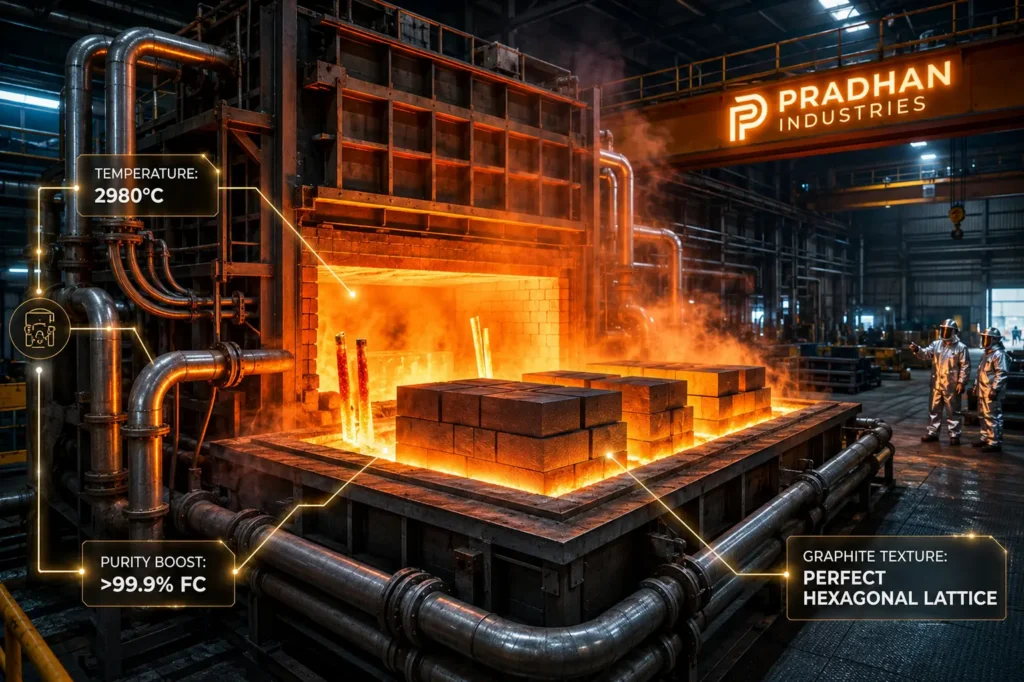
Thermal purification heats graphite to temperatures exceeding 2500°C. At such extreme heat, impurities vaporize while carbon remains stable.
T>2500∘C
Thermal purification is cleaner than chemical methods but consumes enormous amounts of energy. Manufacturers increasingly seek environmentally friendly purification technologies to reduce emissions and operating costs.
Step 6 – Manufacturing Synthetic Graphite
Synthetic graphite production differs significantly from natural graphite processing. Instead of mining carbon directly from the earth, manufacturers engineer graphite structures through controlled industrial heating.
Mixing and Molding
Petroleum coke is crushed, screened, and mixed with coal tar pitch. The mixture forms a dense carbon mass suitable for shaping.
Manufacturers use techniques such as:
- Extrusion
- Isostatic pressing
- Vibration molding
- Die molding
Each method affects density, porosity, and mechanical strength.
The shaped material first undergoes carbonization at around 1000°C in oxygen-free furnaces.
T≈1000∘C
This stage removes volatile substances and creates strong carbon bonds within the material. The carbonized material then enters graphitization furnaces operating at temperatures close to 3000°C.
T≈3000∘C
At these ultra-high temperatures, carbon atoms rearrange into highly ordered graphite crystal structures. This transformation gives synthetic graphite its exceptional electrical conductivity, thermal resistance, and structural stability, making it ideal for batteries, electrodes, and advanced industrial applications.
Step 7 – Shaping and Machining Graphite Products
Once graphite is purified or graphitized, manufacturers machine it into final products. Graphite is relatively soft compared to metals, making precision machining possible.
Industrial graphite products include:
| Product | Application |
|---|---|
| Graphite Electrodes | Steel manufacturing |
| Battery Anodes | EV batteries |
| Graphite Blocks | Furnaces |
| Crucibles | Metal melting |
| Graphite Sheets | Electronics |
Computer numerical control (CNC) machining ensures high dimensional accuracy. Precision is especially important in aerospace, semiconductor, and battery industries.
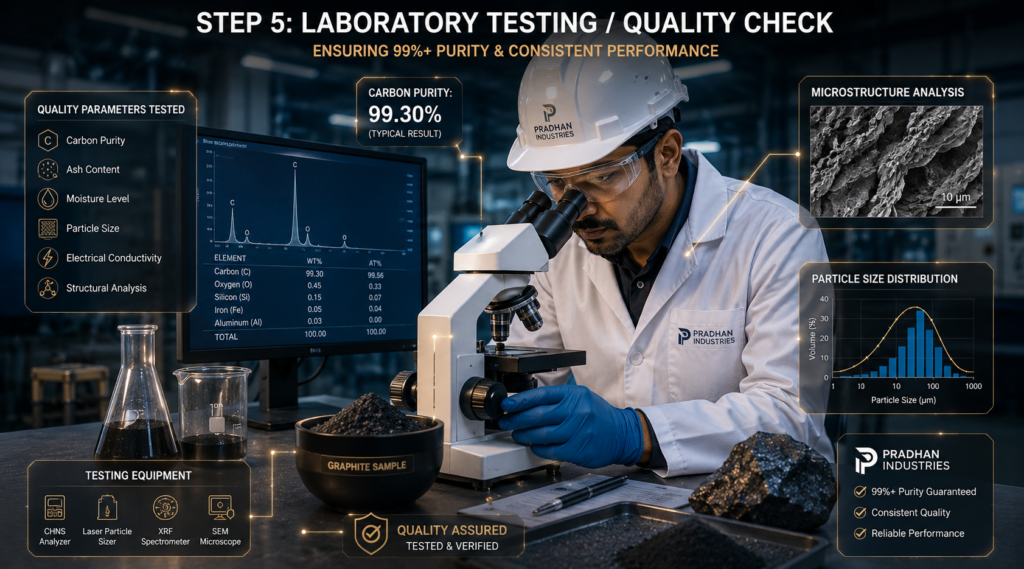
Step 8 – Quality Testing and Inspection
Quality control is one of the most critical stages in graphite manufacturing. Manufacturers test:
- Carbon purity
- Particle size
- Density
- Electrical conductivity
- Thermal conductivity
- Mechanical strength
- Ash content
Battery-grade graphite requires extremely strict quality standards because impurities can reduce battery performance and safety.
Advanced laboratories use electron microscopes, spectroscopy systems, and thermal analyzers to evaluate graphite structure and purity.
Environmental Impact of Graphite Manufacturing
Graphite manufacturing offers enormous benefits for clean energy technologies, but it also raises environmental concerns. Mining operations can disturb ecosystems, while purification and graphitization processes consume significant energy.
Synthetic graphite manufacturing is particularly energy-intensive because graphitization requires ultra-high temperatures. Some manufacturers are now developing lower-emission production methods and recycling technologies to reduce environmental impact.
Industry experts are also focusing on graphite recycling from used lithium-ion batteries. Recycled graphite could become a major supply source in the future as EV battery waste increases globally.
Future Trends in the Graphite Industry
The graphite industry is evolving rapidly. Battery manufacturers are pushing for higher purity, lower emissions, and localized supply chains. Governments worldwide now classify graphite as a critical mineral because of its strategic importance.
Several major trends are shaping the future:
- Expansion of battery-grade graphite plants
- Growth of synthetic graphite production
- Development of recycling technologies
- Increased investment outside China
- Cleaner purification technologies
- AI-driven manufacturing optimization
China currently dominates graphite refining and synthetic graphite production, but Western countries are investing heavily to diversify supply chains.
Community discussions around battery materials also reflect strong long-term optimism about graphite demand growth.
The global battery industry keeps compounding on the back of energy storage + EVs.
China controls 95% of the global supply of graphite, which is vital for EV battery production.
Learn more about our Natural Graphite Powder manufacturing process for industrial applications.
According to the International Energy Agency (IEA), graphite demand is rising rapidly due to EV battery production.
Conclusion-
The graphite manufacturing process is far more advanced and strategically important than many people realize. What begins as mined graphite ore or petroleum coke eventually becomes a high-performance material powering electric vehicles, renewable energy systems, electronics, and heavy industry.
Every stage—from mining and crushing to purification and graphitization—plays a critical role in determining graphite quality. As global demand for lithium-ion batteries continues rising, graphite manufacturing will become even more essential to the future of transportation and clean energy.
Manufacturers now face a balancing act between increasing production, maintaining purity standards, reducing environmental impact, and securing stable supply chains. The companies that master these challenges will shape the next generation of battery technology and industrial innovation.