A steel mill running short on recarburizer material can’t wait three weeks for a trader to source replacement stock from a third country. That’s the real cost of buying graphite through layers of middlemen instead of directly from the source.
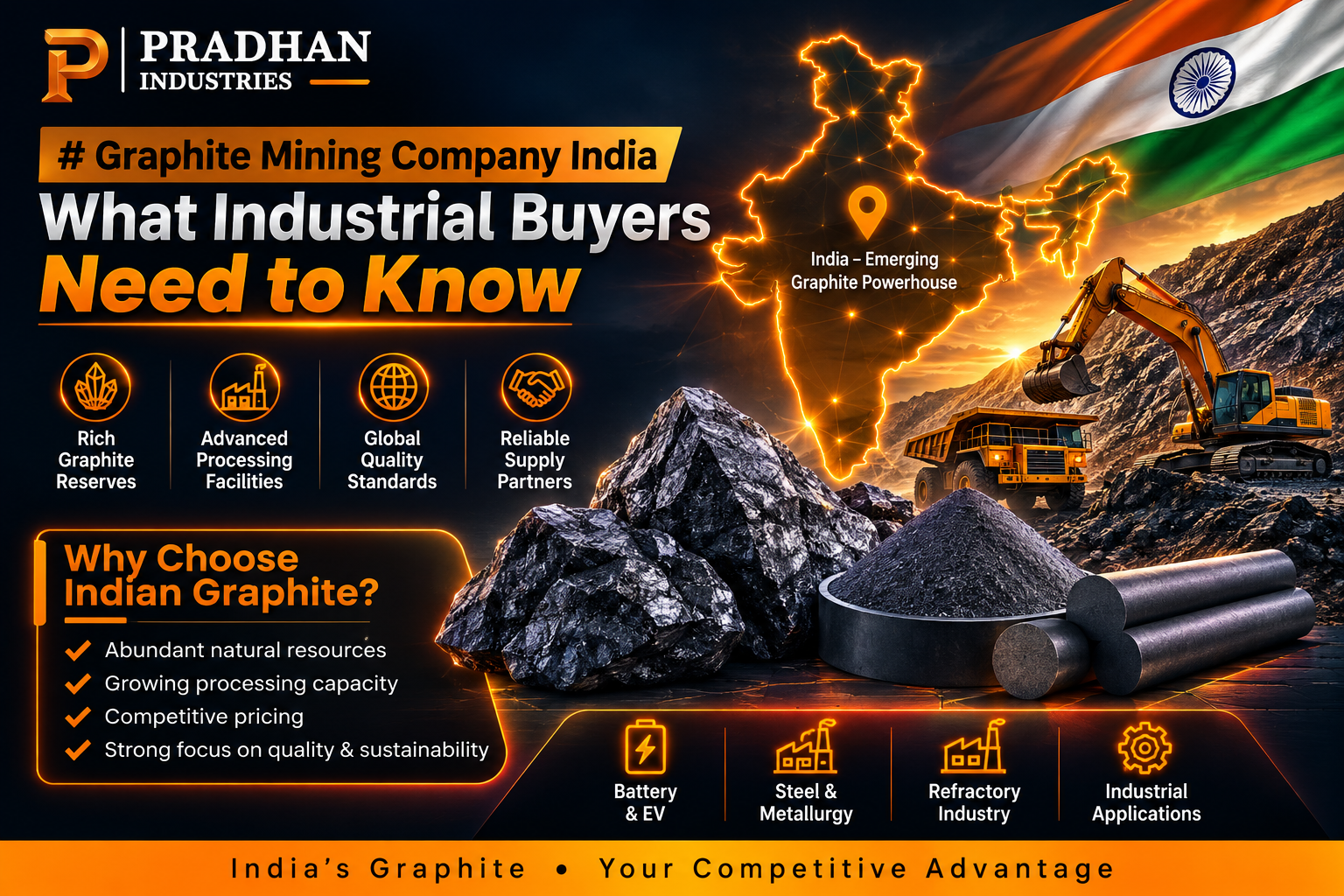
Sourcing from an established graphite mining company in India gives industrial buyers something a trading desk can’t: pricing security, consistent purity from lot to lot, and supply that doesn’t depend on someone else’s inventory decisions. For steel mills, foundries, and EV battery supply chain managers, that difference shows up directly on the production floor.
This guide covers how graphite mining actually works in India, what a mine-to-market operation looks like step by step, and how to vet a mining partner before signing a supply agreement.
The Landscape of Graphite Mining in India
Geological Reserves vs. Active Production Belts
India holds substantial graphite reserves, but reserve size and active production capacity are two different things. The main producing belts:
- Odisha (Eastern Ghats belt) — The country’s most established crystalline graphite mining region, with operations running for over five decades in some cases. Known for consistent flake quality.
- Jharkhand (Chotanagpur plateau)—Significant flake graphite reserves supporting both domestic supply and export.
- Tamil Nadu (Sivagangai region) — Active flake graphite mining with strong recovery rates.
- Andhra Pradesh and Rajasthan — Additional reserve regions with ongoing extraction activity.
Types of Graphite Extracted
- Natural high-crystallinity flake graphite — Distinct plate structure, higher value, found in metamorphic rock formations across the Eastern Ghats and Chotanagpur belts.
- Amorphous vein deposits — Fine-grained, lower crystallinity, generally lower-value material used in bulk industrial applications.
India’s Position in the Critical Minerals Transition
Graphite is now classified as a critical mineral by several governments tracking EV battery supply chain security. India’s reserve base and existing mining infrastructure position domestic producers as a real alternative to single-source global dependency, particularly for buyers trying to diversify away from concentrated processing regions.
Mine-to-Market: A Leading Graphite Mining Company in India Actually Does
Step 1: Geological Surveying and Sustainable Open-Cast Extraction
Before any ore comes out of the ground, geological surveys map deposit boundaries and grade distribution. Most Indian graphite operations use open-pit (open-cast) extraction methods, which are cost-efficient for the relatively shallow deposits common across these belts.
Step 2: Primary Crushing and Screening at the Mine Head
Run-of-mine (ROM) ore typically carries only 10-20% fixed carbon at extraction. Primary crushing at the mine head reduces particle size and prepares material for beneficiation, avoiding long-haul transport of low-grade waste rock.
Step 3: Technical Froth Flotation and Carbon Beneficiation
This is where ROM ore gets upgraded significantly. Flotation exploits graphite’s natural hydrophobic property—it sticks to air bubbles while waste minerals sink. Through rougher and cleaner flotation stages, fixed carbon content climbs from 10-20% ROM grade up to 90-98% concentrate.
Step 4: Micronization, Precision Grading, and Lab Testing
Concentrate is milled and screened into specific mesh grades, then tested in accredited labs. Reputable operations run NABL-accredited or ASTM-compliant testing for fixed carbon, ash content, moisture, and volatile matter on every production batch.
Step 5: Direct Domestic Dispatch and Export Containerization
Finished material moves either to domestic industrial buyers via road/rail freight or gets containerized for export through East Coast ports serving Odisha and Andhra Pradesh mining regions.
   MINE-TO-MARKET FLOW
   --------------------
   Geological Survey
        |
   Open-Cast Extraction (ROM ore, 10-20% C)
        |
   Primary Crushing/Screening
        |
   Froth Flotation Beneficiation (90-98% C)
        |
   Micronization & Mesh Grading
        |
   Lab Testing (NABL/ASTM)
        |
   Domestic Dispatch  <-->  Export Containerization
Direct-From-Mine Advantage vs. Middlemen/Traders
Cost Transparency
Buying direct removes dealer markups layered on top of production cost. A captive mining operation prices from actual extraction and processing costs, not from a trading margin stacked on someone else’s quote.
Lot-to-Lot Carbon Purity Consistency
Traders often blend material from multiple sources to fill an order, which creates purity variation between lots. A single mining operation with its own beneficiation plant delivers more consistent fixed carbon, ash, and volatile matter numbers batch after batch.
Custom Mesh Sizing and Tailored Pulverization
Direct mining partners can adjust pulverization to specific mesh requirements—-100, -200, and -300 mesh—for a buyer’s exact application, rather than offering only whatever a trader happens to have in stock.
Scalable Long-Term Supply Agreements
Buyers locking in multi-year offtake agreements with a mining company avoid the price volatility of spot-market purchases, which can spike sharply during supply disruptions.
Comparison Table: Sourcing Channels
| Sourcing Parameter | Direct Indian Mining Partner | Third-Party Traders | Overseas Imports |
|---|---|---|---|
| Pricing transparency | High (direct cost basis) | Lower (margin stacking) | Variable (currency + freight risk) |
| Lot-to-lot consistency | High | Variable (blended sources) | It depends on origin control |
| Custom mesh/grade options | Yes, direct request | Limited to stock availability | Limited, longer lead time |
| Supply chain control | Full traceability | Limited traceability | Often opaque |
| Lead time for bulk orders | Moderate, predictable | Variable | Longer (customs, shipping) |
| Long-term contract flexibility | High | Low to moderate | Moderate |
Our detailed guide on high-carbon crystalline graphite can help you understand fixed-carbon levels, grades, and common applications.
Primary Industries Powered by Indian Mined Graphite
Steelmaking & metallurgy Graphite serves as a recarburizer, raising carbon content in induction furnace steel production. Consistent fixed carbon and low sulfur content directly affect melt quality.
Foundries & refractories: Crucibles, continuous casting powders, and mold coatings all depend on graphite’s thermal shock resistance and heat conductivity to survive repeated molten metal exposure.
Friction materials & brake linings Automotive OEM suppliers use graphite’s natural lubricity in brake pad and friction material formulations, where consistent particle size affects wear performance.
Energy storage & EV batteries Flake graphite serves as feedstock for spherical graphite (SPG) processing, feeding into lithium-ion battery anode material supply chains as EV production scales.
Conductive paints, lubricants, and gasket manufacturing Fine and ultra-fine graphite powders go into conductive coatings, industrial lubricant blends, and gasket materials where chemical inertness and lubricity matter more than particle size.
How to Vet and Select a Reliable Graphite Mining Company in India
1. Verify captive lease ownership. Confirm the company holds an actual mining lease and operates its own pit, rather than reselling ore purchased from smaller unlicensed operators. Lease documentation should be verifiable through state mining department records.
2. Assess beneficiation capacity. Ask whether flotation and processing happen on-site or get outsourced. In-house beneficiation capacity usually means better quality control and faster turnaround on custom grade requests.
3. Request Certificate of Analysis (COA) transparency. Every shipment lot should come with an independently verifiable COA covering fixed carbon, ash, moisture, and volatile matter — not just a general product spec sheet.
4. Confirm delivery logistics capability. Check whether the company has established freight relationships for both domestic dispatch and export containerization through nearby ports, with a track record of on-time delivery.
5. Review environmental compliance status. Ask for evidence of environmental clearances and tailings management practices. A mining partner with a clean compliance history carries less regulatory disruption risk for your supply chain.
Frequently Asked Questions
1. What is the typical fixed carbon grade of run-of-mine graphite ore in India?
Run-of-mine (ROM) graphite ore in Indian deposits typically carries 10-20% fixed carbon before processing. Flotation beneficiation upgrades this to 90-98% concentrate depending on deposit quality and processing stages.
2. Which Indian states have the most active graphite mining operations?
Odisha, Jharkhand, Tamil Nadu, Andhra Pradesh, and Rajasthan host India’s main active graphite mining belts. Odisha’s Eastern Ghats belt is the most established, with some operations running for over fifty years.
3. Why should industrial buyers source directly from a mining company instead of a trader?
Direct sourcing removes dealer markups, improves lot-to-lot purity consistency since material comes from a single beneficiation source, and allows custom mesh sizing requests. It also reduces supply chain opacity compared to buying through multiple trading layers.
4. What extraction method do most Indian graphite mines use?
Most Indian graphite operations use open-pit (open-cast) extraction, which is cost-efficient for the relatively shallow deposits found across the Eastern Ghats and Chotanagpur Plateau belts.
5. Can a graphite mining company in India supply battery-grade material?
Mining companies typically supply flake graphite as feedstock for spherical graphite (SPG) processing, which is a separate downstream step involving spheronization and purification. Buyers seeking finished battery-grade SPG should confirm whether the mining company processes in-house or partners with a spheronization facility.
Graphite is becoming increasingly important across energy and industrial applications. According to the International Energy Agency (IEA), global graphite demand is expected to continue growing, driven in part by clean-energy technologies and batteries.
Final Thoughts
A captive graphite mining company in India offers something the trading channel structurally can’t: direct control over extraction, beneficiation, and quality from the ground up. That control translates into pricing that reflects real production cost, purity numbers that hold steady lot after lot, and mesh grades built to a buyer’s actual spec instead of whatever happens to be sitting in a warehouse.
For steel mills, foundries, and battery supply chain managers building resilient sourcing strategies, the vetting checklist matters more than the sales pitch. Verify the lease, check the COA, confirm the logistics — then build the long-term supply agreement once the fundamentals check out.