Few industrial minerals earn their place in as many demanding applications as graphite. The reason comes down to one property: graphite conductivity. Graphite is one of the only non-metals that conducts electricity well, and it moves heat efficiently at the same time. That rare combination is why natural graphite sits inside lithium-ion batteries, steel furnaces, electric motors, heat exchangers, and semiconductor equipment across the world.
If you buy or specify graphite for industrial use, understanding conductivity helps you choose the right grade, avoid quality problems, and get better performance from your process. This guide explains how graphite conductivity works, what affects it, and how to select the right material—written from the perspective of a natural graphite manufacturer that tests these properties every day.
What is Graphite Conductivity?
Graphite conductivity refers to two related but separate properties.
Electrical conductivity is graphite’s ability to carry an electric current. Good-quality crystalline graphite typically shows electrical conductivity in the range of 10⁴ to 10⁵ S/m along its crystal layers. That is remarkable for a non-metal, though still below copper, which sits near 5.9 × 10⁷ S/m.
Thermal conductivity is graphite’s ability to transfer heat. Depending on grade and orientation, graphite conducts heat at roughly 25–470 W/m·K. For comparison, copper is around 400 W/m·K and stainless steel only about 15 W/m·K.
The difference matters in practice. A battery anode needs electrical conductivity to move electrons during charge and discharge. A furnace crucible needs thermal conductivity to spread heat evenly and survive rapid temperature swings. Many applications — such as electrodes in electric arc furnaces — demand both at once.
Why Does Graphite Conduct Electricity?
Graphite is pure carbon, the same element as diamond. Yet diamond is an insulator, and graphite is a conductor. The explanation lies in how the carbon atoms bond, and it is beautifully simple once you see it.
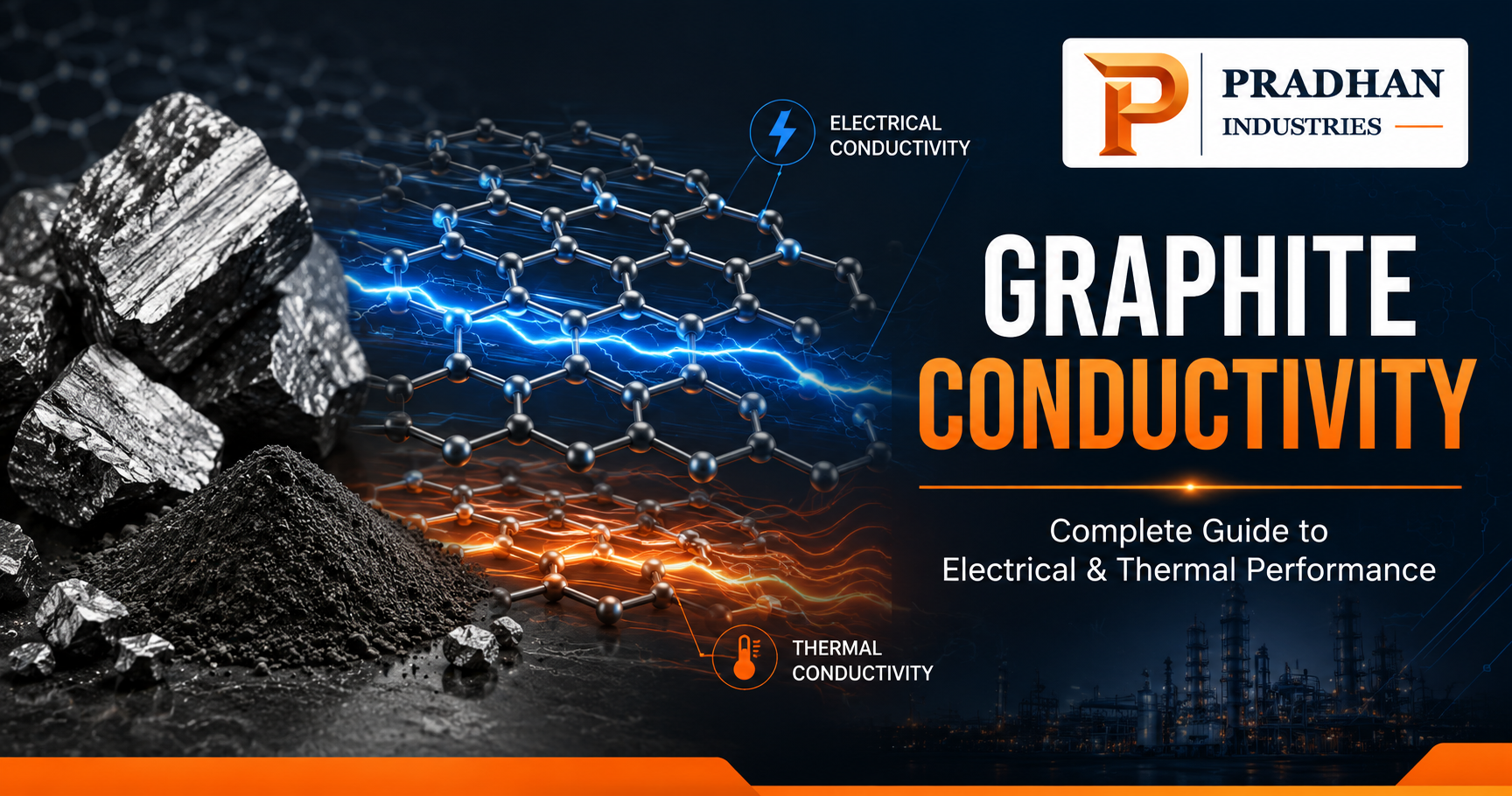
In graphite, each carbon atom forms strong bonds with three neighboring atoms through sp² hybridization. These atoms link into flat sheets of hexagonal rings—imagine chicken wire made of carbon, stacked layer upon layer. Britannica’s entry on graphite describes this same layered structure as the source of nearly all of graphite’s unusual behavior.
Here is the key. Carbon has four outer electrons, but each atom in graphite only uses three of them for bonding. The fourth electron is not tied to any single atom. It becomes delocalized — free to roam across the entire layer.
A simple analogy: think of each graphite layer as a multi-lane highway and the delocalized electrons as cars. Apply voltage, and the cars flow freely down the highway. In diamond, every electron is parked in a fixed bond. No traffic, no current.
Millions of these free electrons moving together is what we measure as electric current. That is the honest, complete answer to why graphite conducts electricity while almost every other non-metal does not.
Graphite Electrical Conductivity Explained
Conductivity Depends on Direction (Anisotropy)
Graphite is anisotropic — its properties change with direction. Along the layers (the basal plane), electrons move freely and conductivity is high. Perpendicular to the layers, electrons must hop between sheets held together only by weak van der Waals forces. Conductivity across the layers can be hundreds to thousands of times lower than along them.
This is why particle orientation matters in real products. In a battery electrode or conductive coating, flakes aligned in the direction of current flow deliver noticeably better performance than randomly oriented particles.
Natural vs Synthetic Graphite: The Short Version
Natural crystalline graphite forms over geological time, giving it large, well-ordered crystals with excellent in-plane conductivity. Synthetic graphite is manufactured from petroleum coke at temperatures around 2,500–3,000°C. It offers consistent purity but generally has smaller crystallites, and it costs significantly more to produce because of the energy involved.
For many conductive applications, high-purity natural flake graphite delivers comparable or better conductivity per rupee spent—one reason battery and coating manufacturers increasingly buy natural graphite instead. We compare the two in more detail later in this guide.
The Graphite Conductivity Formula
Electrical conductivity (σ) is the inverse of resistivity (ρ):
σ = 1/ρ = n · e · μ
where n is the density of charge carriers, e is the electron charge, and μ is carrier mobility. In plain terms: more free electrons and fewer obstacles in their path mean higher conductivity. Every factor discussed later in this article works by changing one of those two variables.
Graphite Thermal Conductivity
Heat moves through graphite mainly through lattice vibrations called phonons, traveling rapidly along the strong carbon-carbon bonds within each layer. The same layered structure that enables electrical conduction makes graphite an outstanding heat conductor in-plane.
This has three big industrial consequences:
- Heat management. Graphite spreads heat quickly and evenly, preventing hot spots in furnaces, molds, and electronic heat sinks.
- Thermal shock resistance. Because graphite equalizes temperature fast and has low thermal expansion, it survives rapid heating and cooling cycles that crack ceramics. This is why graphite crucibles and refractories last through repeated melts.
- High-temperature stability. Unlike metals, graphite’s strength actually increases with temperature up to about 2,500°C in inert atmospheres — well below its extremely high melting point. The IAEA’s graphite knowledge base documents this high-temperature behavior extensively, since nuclear reactors depend on it.
One more useful detail: graphite’s electrical resistance decreases as temperature rises across common industrial ranges — the opposite of metals — while thermal conductivity gradually declines at very high temperatures due to phonon scattering.
Electrical vs Thermal Conductivity: Side-by-Side Comparison
| Aspect | Electrical Conductivity | Thermal Conductivity |
|---|---|---|
| What moves | Delocalized electrons | Phonons (lattice vibrations) + electrons |
| Typical in-plane value | 10⁴–10⁵ S/m | 25–470 W/m·K |
| Direction dependence | Strongly anisotropic | Strongly anisotropic |
| Behaviour with rising temperature | Improves (semimetal behaviour) | Peaks near room temperature, then declines |
| Key applications | Electrodes, batteries, brushes, coatings | Crucibles, heat exchangers, heat sinks, refractories |
Factors That Affect Graphite Conductivity
When we test graphite lots in our own lab, these are the variables that consistently drive conductivity results:
- Carbon purity: Higher fixed carbon (94–99%+) means fewer impurities blocking electron flow. Purity is the single biggest conductivity driver.
- Ash content: Mineral ash (silica, alumina, iron oxides) is non-conductive. Every percentage point of ash reduces effective conductivity.
- Crystallinity: Large, well-ordered crystals give electrons long, uninterrupted paths. Amorphous graphite conducts far worse than crystalline flake.
- Flake and particle size: Larger flakes mean fewer particle-to-particle contactflakes.s, and each contact point adds resistance.
- Density and compaction: Denser compacts have better inter-particle contact and higher bulk conductivity.
- Moisture: Absorbed moisture interferes with particle contact and causes processing defects. Keep it below 0.5% for conductive applications.
- Temperature: Graphite’s resistivity drops as temperature increases through typical industrial ranges.
- Processing and orientation: Pressing, extrusion, and coating methods that align flakes in the current path boost real-world conductivity.
Key takeaway: two graphite samples with identical carbon percentages can perform very differently. Always look at the full picture — purity, crystallinity, sizing, and moisture together.
Applications of High Conductivity Graphite
The range of industrial graphite uses built on conductivity is enormous. Here are the ones that matter most to buyers today.
Lithium-Ion Batteries
Graphite is the dominant anode material in EV and energy storage batteries. Its layered structure stores lithium ions between the sheets, while its electrical conductivity moves electrons to the current collector. A typical EV battery contains 50–70 kg of graphite—more than any other mineral, according to production data tracked by the US Geological Survey.
Graphite Electrodes and Steelmaking
Electric arc furnaces pass enormous currents through graphite electrodes to melt scrap steel. Only graphite combines the conductivity, heat resistance, and machinability the job requires. Steel plants also use graphite powder as a carbon raiser (recarburizer) to adjust carbon content in molten steel.
Refractories and Foundries
Magnesia-carbon bricks, crucibles, molds, and stopper rods rely on graphite’s thermal conductivity and shock resistance to survive direct contact with molten metal, melt after melt.
Conductive Coatings and Polymers
Fine graphite powder makes paints, plastics, and rubber electrically conductive for EMI shielding, anti-static flooring, and electronics housings.
Carbon Brushes and Electrical Components
Motors and alternators use graphite brushes because the material conducts current while self-lubricating against the rotating commutator—two jobs, one material.
Fuel Cells, Heat Exchangers, and Electronics
Bipolar plates in PEM fuel cells use graphite for conductivity plus corrosion resistance. Graphite blocks and flexible graphite sheets manage heat in chemical plants, smartphones, LED lighting, and power electronics.
Semiconductors and Renewable Energy
Graphite crucibles and fixtures handle silicon crystal growth for chips and solar wafers, where purity and thermal uniformity are non-negotiable.
Natural Graphite vs Synthetic Graphite Conductivity
| Parameter | Natural Crystalline Graphite | Synthetic Graphite |
|---|---|---|
| Source | Mined ore, beneficiated | Petroleum coke, graphitized at ~3,000°C |
| Crystal structure | Large, highly ordered flakes | Smaller crystallites |
| In-plane conductivity | Excellent | Good to excellent |
| Typical purity | 90–99.9% after processing | 99%+ |
| Cost | Lower | Roughly 2–3× higher |
| Carbon footprint | Lower | Higher (energy-intensive) |
| Best suited for | Batteries, refractories, coatings, brushes | Arc-furnace electrodes, specialty parts |
For most conductive applications outside arc-furnace electrodes, high-purity natural graphite offers the better cost-performance balance. The chemical identity of both forms is identical pure carbon, as documented in PubChem’s graphite record—the difference is entirely in crystal structure and processing.
How to Choose High Conductivity Graphite: 7-Step Checklist
- Specify fixed carbon content. For conductive uses, start at 94% minimum; batteries and electronics typically need 99%+.
- Check ash and volatile matter. Request full chemical analysis, not just a carbon percentage.
- Match mesh size to your process. Coarse flake (+80 mesh) for maximum conductivity in compacts; fine powder (-200 mesh) for coatings and dispersions.
- Confirm moisture limits. Under 0.5% for most conductive applications.
- Ask for particle size distribution reports, not just a nominal mesh number. Lot-to-lot consistency matters more than one good sample.
- Review test certificates. A capable supplier provides batch-wise CoAs covering carbon, ash, moisture, and sizing.
- Audit supply capability. Conductivity specs mean little if your graphite supplier in India or abroad cannot hold them across bulk volumes and repeat orders.
Why Industries Choose Pradhan Industries
Pradhan Industries has supplied natural graphite to Indian and international buyers across the battery, steel, foundry, refractory, and conductive material segments. As an established graphite exporter, here is what customers consistently tell us they value:
- High-purity crystalline natural graphite with fixed carbon grades tailored to conductive applications
- Batch-wise quality testing, with certificates covering carbon content, ash, moisture, and particle size distribution
- Custom mesh sizes and grades matched to your process rather than off-the-shelf options
- Consistent bulk supply, with the capacity to hold specifications across repeat orders
- Honest technical support to help you select the right grade before you commit to volume
We would rather help you specify correctly on the first order than replace material later. That approach has kept our customers with us for years.
Frequently Asked Questions About Graphite Conductivity
Why is graphite a good conductor of electricity?
Each carbon atom in graphite bonds to only three neighbors, leaving one electron per atom delocalized. These free electrons move easily along graphite’s layered structure when voltage is applied, carrying current much like electrons in a metal. This makes graphite one of the very few non-metallic electrical conductors.
Can graphite conduct heat?
Yes, very well. Graphite’s in-plane thermal conductivity ranges from roughly 25 to 470 W/m·K depending on grade and orientation—comparable to many metals. Combined with low thermal expansion, this gives graphite excellent thermal shock resistance, which is why it is trusted in crucibles, heat exchangers, and electronic heat spreaders.
Is graphite more conductive than copper?
No. Copper’s electrical conductivity (~5.9 × 10⁷ S/m) is far higher than graphite’s (~10⁴–10⁵ S/m in-plane). But graphite wins where copper fails: extreme temperatures, corrosive environments, arc furnaces, and applications needing lubricity or low weight. The two materials serve different roles rather than competing directly.
What affects graphite conductivity the most?
Carbon purity is the biggest factor — impurities and ash physically block electron flow. Crystallinity, flake size, density, moisture, temperature, and particle orientation follow. Two samples with the same carbon percentage can still perform differently if their crystal structure or sizing differs.
Why is graphite used in batteries?
Graphite anodes store lithium ions between their carbon layers during charging (intercalation) and release them during discharge. Its electrical conductivity carries electrons to the current collector, and it stays dimensionally stable across thousands of charge cycles. No other material yet matches this combination at commercial cost.
Is natural graphite conductive?
Yes. Well-crystallized natural flake graphite is highly conductive along its layers—often matching or exceeding synthetic graphite of similar purity, because natural flakes have large, well-ordered crystals formed over geological time. After purification to 99%+ carbon, natural graphite serves demanding uses including battery anodes.
Does graphite conductivity change with temperature?
Yes. Unlike metals, graphite’s electrical resistance generally decreases as temperature rises through common industrial ranges, so it conducts electricity better when hot. Thermal conductivity behaves differently: it peaks near room temperature and gradually declines at very high temperatures as lattice vibrations scatter.
What is anisotropic conductivity in graphite?
It means conductivity depends on direction. Along graphite’s layers, electrons and heat move freely; across the layers, they face weak inter-layer bonds, and conductivity drops by a factor of hundreds or more. Manufacturers exploit this by orienting flakes in the direction current or heat must travel.
What carbon purity do I need for conductive applications?
General conductive fillers and refractories often work at 94–97% fixed carbon. Coatings and electrical components typically need 97–99%. Battery anodes and semiconductor applications require 99%+ with tight impurity limits. Match purity to the application rather than over-specifying, which only raises cost.
How is graphite conductivity tested?
Common methods include four-point probe resistivity measurement on compacted samples for electrical conductivity and laser flash analysis for thermal conductivity. Suppliers also report proxies that predict conductivity—fixed carbon, ash content, and particle size distribution—verified batch-wise on certificates of analysis.
Conclusion: Graphite Conductivity in One Paragraph
Graphite conductivity is the property that turns a simple carbon mineral into an irreplaceable industrial material. Delocalized electrons moving through layered hexagonal crystals give graphite electrical performance no other non-metal matches, while the same structure moves heat efficiently and shrugs off thermal shock. Purity, crystallinity, flake size, and orientation decide how much of that potential your application actually captures.
If you are specifying graphite for batteries, electrodes, refractories, coatings, or any conductive application, the right grade makes a measurable difference. Contact Pradhan Industries with your application details, and our technical team will recommend the grade and mesh size that fits—no obligation, just straight answers.