Graphite looks simple on paper — it is carbon, and nothing else. Yet the graphite chemical composition that arrives at your plant is never 100% carbon, and the difference between 90% and 99.9% decides whether a battery anode works, a refractory brick survives, or a steel melt stays clean.
Understanding what graphite is made of — and what rides along with it — is one of the most practical skills an industrial buyer or engineer can develop. This guide covers graphite’s chemical formula and atomic structure; the typical composition of natural graphite, including its impurities; how composition is tested; and how it shapes performance in batteries, steel, refractories, and advanced manufacturing. It is written by Pradhan Industries, a natural graphite manufacturer that analyses this material batch by batch.
Definition: Graphite chemical composition refers to graphite’s elemental makeup — pure crystalline carbon (chemical formula C) arranged in layered hexagonal sheets, typically accompanied by 0.1–15% mineral impurities such as silica, alumina, and iron oxide in natural deposits. Carbon percentage and impurity levels determine graphite’s grade, performance, and price.
What is graphite’s chemical composition?
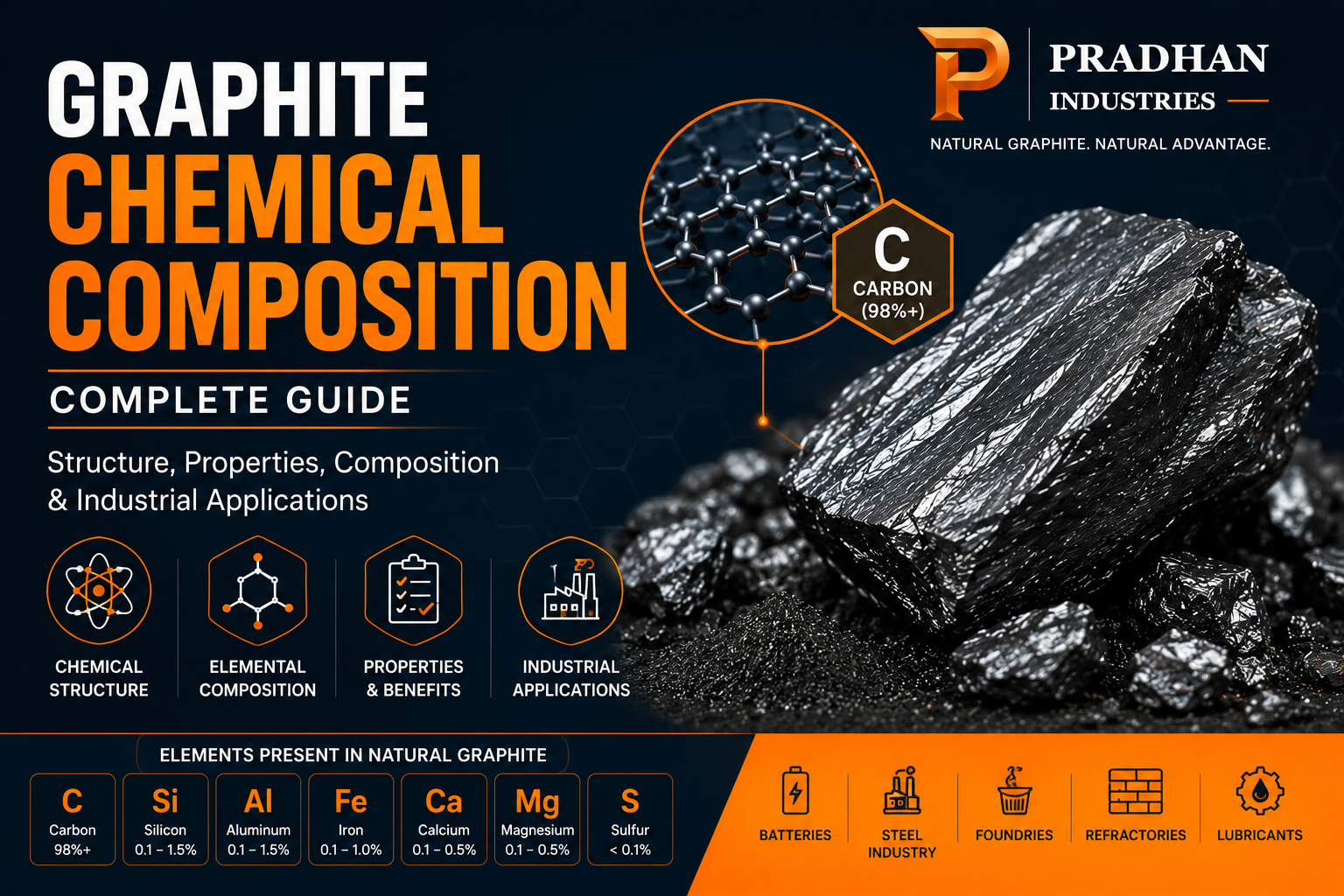
Chemically, graphite is an allotrope of carbon—one of the natural forms pure carbon can take, alongside diamond. Its chemical formula is simply C. There is no compound, no second element in the ideal crystal — just carbon atoms bonded to carbon atoms in a repeating hexagonal pattern.
Real-world graphite is another matter. Natural graphite forms inside rock, so mined and processed material always carries some of that rock with it. Commercial natural graphite contains anywhere from 85% to 99.9% carbon depending on the deposit and the degree of beneficiation. The remainder—called ash—is a mix of mineral impurities.
So when engineers discuss graphite composition, they are really discussing two things: the pure carbon crystal structure that gives graphite its properties, and the impurity package that dilutes those properties. Both halves of the story matter to buyers.
Chemical Formula & Atomic Structure of Graphite
The formula C hides remarkable architecture. In graphite, each carbon atom bonds covalently to three neighbors through sp² hybridization, forming flat sheets of hexagonal rings—like chicken wire made of carbon, stacked layer upon layer. Britannica’s entry on graphite attributes nearly all of graphite’s unusual behavior to this layered arrangement.
Carbon has four outer electrons. In graphite, only three go into bonds. The fourth becomes delocalized—free to move anywhere along its layer.
A simple analogy: picture each layer as a crowded office floor where three employees per desk are locked into meetings (the covalent bonds), while a fourth roams the whole floor delivering messages. Those roaming electrons carry electric current, which is why graphite conducts electricity while diamond—where every electron is locked in a meeting—does not.
The layers themselves are held together only by weak van der Waals forces. They slide over one another easily, which explains graphite’s slippery feel, its use as a lubricant, and why a pencil leaves a mark. Strong within layers, weak between them: that single structural fact drives graphite’s conductivity, lubricity, and anisotropic behavior all at once.
Typical Chemical Composition of Natural Graphite
Here is what a real certificate of analysis typically shows for natural crystalline graphite:
| Component | Typical Range |
|---|---|
| Carbon (C) — fixed carbon | 85–99.9% |
| Silica (SiO₂) | 0.1–8% |
| Alumina (Al₂O₃) | 0.1–4% |
| Iron oxide (Fe₂O₃) | 0.05–3% |
| Calcium oxide (CaO) | 0.05–1.5% |
| Magnesium oxide (MgO) | 0.05–1.5% |
| Other oxides (K₂O, Na₂O, TiO₂, etc.) | Trace–1% |
| Sulphur (S) | Trace–0.5% |
| Moisture | 0.1–0.5% (properly dried) |
| Total ash | 0.1–15% |
Important: these values vary widely with the ore deposit and the degree of beneficiation. Run-of-mine ore may contain only 5–20% graphite; flotation lifts it to 85–97%, and chemical or thermal purification pushes premium grades to 99.9%+. Never assume composition from a grade name—read the batch certificate.
The impurities are not random. They are fragments of the host rock: quartz contributes silica; feldspar and mica contribute alumina and alkalis; and iron-bearing minerals contribute Fe₂O₃. Knowing your application’s sensitivity to each—iron in batteries, sulfur in steel, and silica in refractories—is what separates careful buyers from expensive mistakes.
Factors Affecting Graphite Chemical Composition
Five factors decide the composition of the material in your warehouse:
- Ore deposit geology. Every deposit has its own mineral signature. Some ores are naturally low in iron; others carry sulfides that must be managed.
- Geological formation conditions. Deposits that experienced intense, prolonged metamorphism developed larger crystals and often higher natural carbon content.
- Mining selectivity. Careful grade control at the mine keeps waste rock dilution down before processing even begins.
- Beneficiation quality. Crushing, grinding, and multi-stage flotation determine how much ash is removed—andhether flake sremoved—and whetherjourney.
- Purification. For 99%+ grades, chemical leaching or thermal treatment removes the residual impurities flotation cannot reach.
The takeaway for buyers: composition is made twice—once by geology and once by processing. A skilled manufacturer can turn good ore into an excellent product; no one can turn poor processing into consistency.
Physical & Chemical Properties
Composition and structure together produce this property set:
| Property | Value / Behaviour |
|---|---|
| Chemical formula | C (elemental carbon) |
| Carbon content | 85–99.9% (grade dependent) |
| Colour | Steel grey to black, metallic lustre |
| Density | 2.09–2.26 g/cm³ |
| Hardness | 1–2 Mohs (very soft) |
| Electrical conductivity | ~10⁴–10⁵ S/m along crystal layers |
| Thermal conductivity | 25–470 W/m ·K depending on grade and orientation |
| Lubrication | Excellent—layers shear easily under load |
| Oxidation resistance | Stable in air to ~450°C; oxidizes above |
| Heat resistance | Sublimates ~3,600°C; usable to ~2,500°C in inert atmosphere |
| Chemical stability | Inert to most acids, alkalis, solvents, and molten metals |
The chemical identity matches the record maintained by PubChem: pure carbon. Every commercial performance difference traces back to purity and crystal structure, not to any difference in chemistry.
Why Chemical Composition Matters
Composition is not academic—it is money and performance:
- Conductivity. Ash minerals are insulators. Every impurity particle sits in the electron path, so conductivity rises directly with carbon percentage.
- Battery performance. Anodes demand 99.9%+ carbon with strict limits on iron and other metals, which cause self-discharge and safety issues in cells.
- Steel production. Recarburizer ash becomes slag; sulfur and phosphorus contaminate the melt. Steel plants specify low-ash, low-sulphur grades for a reason.
- Refractory quality. Silica and iron oxide in the graphite weaken magnesia-carbon bricks and accelerate slag attack.
- Lubrication. Abrasive impurities like quartz defeat the purpose of a lubricant—high purity means low wear.
- Expandable graphite. Only high carbon, large flake material intercalates properly for foils and flame retardants.
- High-temperature service. Impurities catalyze oxidation, so purer graphite survives longer at temperature.
Natural Graphite vs Synthetic Graphite Composition
Both materials are chemically carbon, but they arrive there by very different routes:
| Parameter | Natural Graphite | Synthetic Graphite |
|---|---|---|
| Source | Mined ore, beneficiated | Petroleum coke, graphitized at ~3,000°C |
| Carbon purity as supplied | 85–99.9% | 99%+ |
| Typical impurities | Rock minerals (SiO₂, Al₂O₃, Fe₂O₃) | Residual sulphur, metals from coke |
| Crystal quality | Large, geologically ordered flakes | Smaller crystallites |
| Manufacturing energy | Low (mining + flotation) | Very high (weeks at ~3,000°C) |
| Cost | Lower | Roughly 2–3× higher |
| Sustainability / CO₂ footprint | Lower | Significantly higher |
| Typical applications | Batteries, refractories, expandable graphite, lubricants, brushes | Arc-furnace electrodes, isostatic specialty parts |
For most applications, purified natural graphite matches synthetic performance at lower cost and footprint—the main reason battery supply chains increasingly favor natural materials.
Industrial Applications Based on Chemical Composition
Different industries buy different points on the composition spectrum. A tour of the major industrial graphite uses:
Lithium-Ion Batteries and Electric Vehicles
The most composition-sensitive application of all. Anode graphite must reach 99.9%+ carbon with parts-per-million limits on iron, copper, and other metals. The International Energy Agency lists graphite among the most critical minerals of the energy transition—each EV battery contains 50–70 kg.
Steel Industry
High-carbon graphite powder serves as a recarburizer. Buyers watch fixed carbon, sulfur, and ash closely, because everything that is not carbon ends up in the melt or the slag.
Refractories
Magnesia-carbon bricks and ladle linings use 94–97% carbon flake. Low ash means fewer weak points and better slag resistance, per demand patterns tracked by USGS graphite statistics.
Foundries
Crucibles and mold coatings tolerate slightly lower grades (90–96%), but abrasive silica must stay controlled for clean casting surfaces.
Carbon Brushes and Conductive Coatings
Electrical applications specify 96–99% carbon; ash directly raises electrical resistance and wear.
Lubricants, Fuel Cells, Electronics, and Renewables
High-temperature lubricants need low-abrasive purity. Fuel-cell plates, heat spreaders, and semiconductor components sit at the ultra-pure end, often 99.5%+, where even trace metals matter.
| Application | Typical Carbon Spec | Critical Impurity Limits |
|---|---|---|
| Battery anodes | 99.9%+ | Fe, Cu, other metals (ppm level) |
| Steel recarburizer | 90–99% | Sulphur, ash |
| Refractories | 94–97% | SiO₂, Fe₂O₃ |
| Foundry | 90–96% | Abrasive silica |
| Carbon brushes | 96–99% | Total ash |
| Expandable graphite | 94%+ large flake | Ash, flake integrity, |
| Electronics / semiconductors | 99.5%+ | Trace metals |
How Graphite Composition is Tested
A competent supplier verifies composition with a defined test battery:
| Test | What It Measures |
|---|---|
| Proximate analysis | Fixed carbon, ash, moisture, volatile matter |
| LOI (Loss on Ignition) | Combustible content; cross-checks carbon |
| Moisture analysis | Water content (target < 0.5%) |
| XRF (X-ray fluorescence) | Elemental composition of the ash—which oxides are present |
| XRD (X-ray diffraction) | Crystal structure and graphitization degree |
| ICP analysis | Trace metals at ppm level for battery and electronics grades |
| Sieve / laser PSD | Particle and flake size distribution |
Results appear on the batch certificate of analysis. Our own practice — and our advice to every buyer — is to verify one sample per new supplier at an independent laboratory, then spot-check periodically. Composition claims are only as good as the testing behind them.
How to Choose High-Quality Natural Graphite
A practical buyer checklist built around composition:
- Fix your carbon specification to the application. Batteries need 99.9%+; refractories usually perform at 94–97%; recarburizers from 90%. Over-specifying wastes money.
- Ask for ash chemistry, not just ash percentage. 3% ash that is mostly silica behaves differently from 3% ash rich in iron.
- Set moisture limits—under 0.5% for nearly all uses.
- Demand particle size distribution reports, not just a nominal mesh number.
- Compare certificates across several past lots. Consistency is the real test of a supplier.
- Check testing capability. A supplier without an in-house lab is guessing between shipments.
- Review experience and logistics. An established graphite exporter with export documentation removes friction for international buyers.
- Qualify in stages: sample → independent verification → trial lot → volume.
Why Industries Choose Pradhan Industries
Pradhan Industries supplies natural graphite to steel, refractory, foundry, battery, and export customers, with composition control at the center of everything we do:
- High-purity natural graphite in flake and powder forms, from standard grades to 99%+ carbon
- Advanced beneficiation — staged grinding and multi-stage flotation designed to strip ash while protecting flake size
- Composition verified on every batch—fixed carbon, ash, moisture, and particle size distribution tested in-house, with certificates supplied as standard
- Custom grades and mesh sizes matched to your composition and sizing requirements
- Reliable logistics and bulk supply, including full export documentation
- Straightforward technical support—we help you set the right specification before you order, because the right composition on paper is worthless if it is wrong for your process
That approach costs us the occasional quick sale and earns us long-term customers. We consider it a good trade.
Frequently Asked Questions About Graphite Chemical Composition
What is the chemical composition of graphite?
Pure graphite is 100% carbon arranged in layered hexagonal crystals. Commercial natural graphite contains 85–99.9% fixed carbon, with the remainder consisting of mineral impurities from the host rock—mainly silica, alumina, and iron oxide—plus small amounts of moisture. The exact composition depends on the deposit and degree of processing.
What is graphite made of?
Graphite is made entirely of carbon atoms — the same element as diamond and coal. The atoms bond into flat hexagonal sheets that stack in layers. In natural graphite, fragments of the surrounding rock (quartz, feldspar, and iron minerals) accompany the carbon until beneficiation removes them.
What is the chemical formula of graphite?
The chemical formula is simply C, because graphite is an allotrope of pure elemental carbon rather than a compound. What distinguishes graphite from diamond or amorphous carbon is not chemistry but structure: sp²-bonded carbon sheets stacked in weakly bonded layers.
Why is graphite conductive?
Each carbon atom bonds to only three neighbors, leaving its fourth outer electron delocalized—free to move along the layer. These mobile electrons carry electric current, making graphite one of the very few non-metallic conductors. Conductivity improves as purity rises, because impurities physically block the electron paths.
Does graphite contain impurities?
Natural graphite always does. Typical impurities include silica, alumina, iron oxide, calcium and magnesium oxides, trace sulfur, and moisture—collectively measured as ash. Flotation reduces ash to 3–15%, and chemical or thermal purification brings premium grades below 0.1% for battery and electronics use.
What affects graphite purity?
Three things: the geology of the ore deposit, the selectivity of mining, and the quality of beneficiation and purification. A deposit’s natural mineral signature sets the starting point; processing determines how much of the impurity package is removed and how consistently.
Is natural graphite better than synthetic graphite?
Neither is universally better. Natural graphite offers larger crystals, lower cost, and a smaller carbon footprint; synthetic offers uniform high purity straight from production. For batteries, refractories, and most industrial uses, purified natural graphite delivers comparable performance at a significantly lower cost, which is shifting demand toward natural materials.
How is graphite composition tested?
Proximate analysis measures fixed carbon, ash, moisture, and volatiles. XRF identifies which oxides make up the ash, XRD confirms crystal structure, and ICP detects trace metals at ppm levels for battery grades. Results are documented on batch-wise certificates of analysis that buyers should independently verify.
What industries use high-purity graphite?
Lithium-ion battery manufacturing leads demand for 99.9%+ material, followed by electronics, semiconductors, fuel cells, and nuclear applications. Steel, refractories, foundries, and lubricants use high carbon (90–98%) rather than ultra-pure grades, matching purity to performance requirements and cost.
Why is carbon percentage important?
Carbon percentage is the single best predictor of graphite performance. Everything that is not carbon is ash — non-conductive, often abrasive mineral matter that raises electrical resistance, weakens refractories, contaminates steel melts, and shortens component life. Higher carbon means fewer problems downstream.
Conclusion
Graphite’s chemical composition starts with the simplest formula in chemistry—C—and ends in the details that decide industrial success: fixed carbon percentage, ash chemistry, moisture, and the crystal structure that turns plain carbon into a conductor, lubricant, and heat-resistant workhorse. The material is chemically simple; buying it well is not. Reading certificates, understanding impurity effects, and verifying supplier claims are what keep composition problems out of your process.
If you are specifying natural graphite for batteries, steel, refractories, or any industrial application, start with the composition conversation. Contact Pradhan Industries with your requirements, and our technical team will recommend the right grade, purity, and mesh size—backed bybatchwise analysis, samples, and reliable bulk supply.