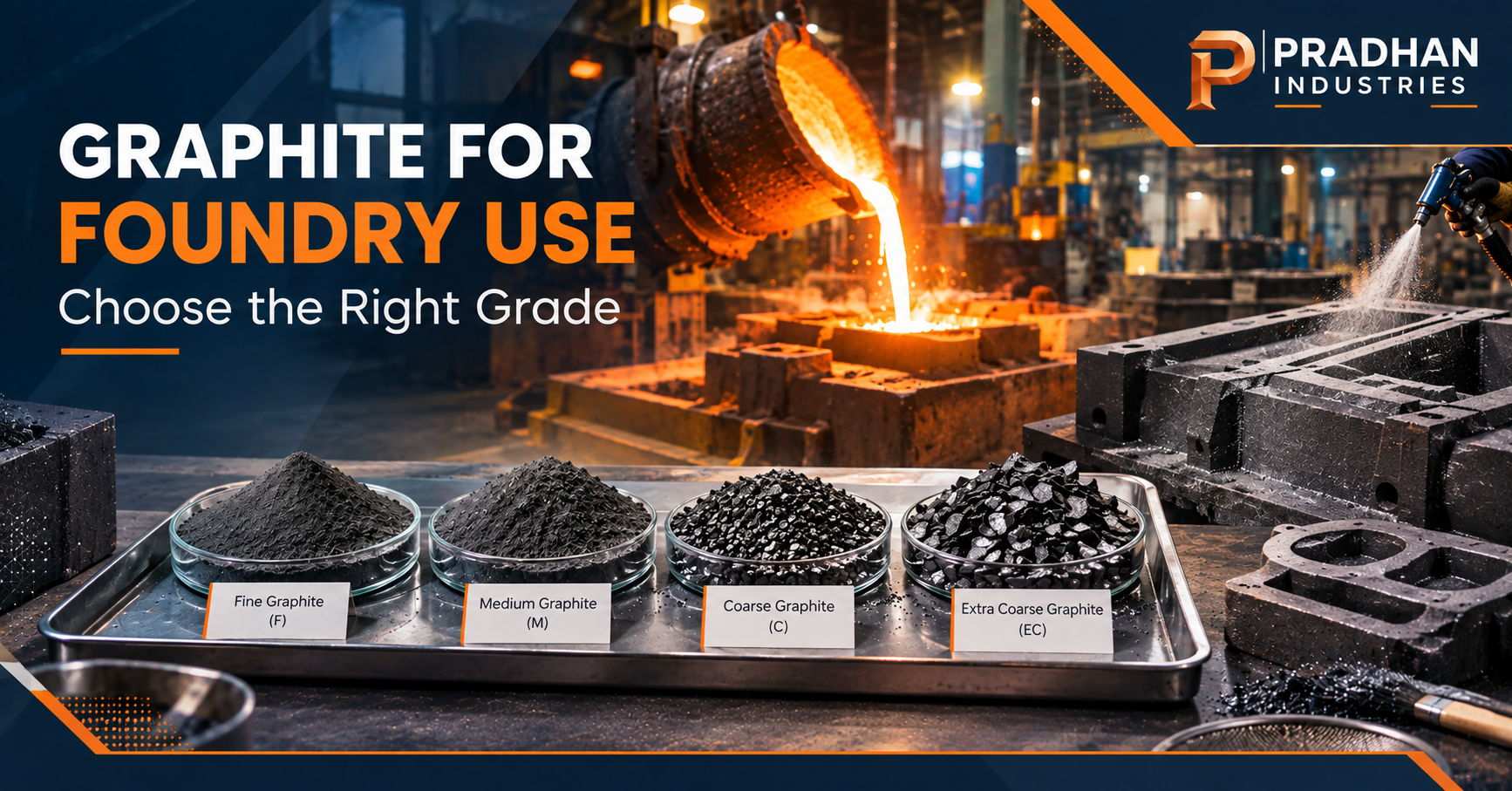
When selecting graphite for foundry use, it is easy to focus only on fixed carbon percentage. In practice, foundries need to look at several factors before choosing a graphite grade for mold coatings, mold washes, facings, or other casting applications.
Graphite can provide useful properties such as high-temperature stability, lubricity, thermal resistance, and resistance to wetting by certain molten metals. However, the performance of a graphite-based coating depends on more than the name “graphite” on a specification sheet.
Fixed carbon, ash, particle size, moisture, mesh distribution, and the casting process can affect material behavior.
For foundries buying graphite in bulk, understanding these specifications can help reduce trial-and-error during grade selection and make purchasing more consistent.
What Is Graphite Used for in Foundries?
Graphite is used in several foundry applications where its thermal and surface properties can be useful. One common application is as an ingredient in mold coatings and mold facings.
A graphite-based coating can be applied to a mold or core surface to create a controlled interface between the mold and molten metal. Depending on the formulation and casting process, the coating may help improve surface finish, reduce metal penetration, and support easier separation after solidification.
Graphite may also be used in formulations for:
- Sandmold coatings
- Core coatings
- Mould washes
- Foundry facings
- Release-related applications
- Refractory coating formulations
- Certain non-ferrous casting applications
The exact formulation varies according to the metal being cast, mold material, application method, and required casting finish.
This is why graphite for foundry use should be selected according to the application rather than simply choosing the highest fixed-carbon grade available.
Why Grade Selection Matters
Two graphite products can have similar fixed carbon values but behave differently in a coating because their particle-size distribution, ash content, moisture, and physical characteristics are different.
For example, a very fine graphite may provide a smooth coating surface, while a coarser material may behave differently during mixing and application. Similarly, excessive ash or unwanted mineral impurities can influence coating performance at elevated temperatures.
For bulk buyers, the important question is therefore not simply
“What is the highest-carbon graphite available?”
Instead, it should be:
“Which graphite specification matches my foundry process and coating formulation?”
That shift can make the purchasing process much more practical.
1. Fixed Carbon
Fixed carbon is one of the first specifications foundry buyers normally review.
Higher fixed carbon generally means a larger proportion of carbonaceous material in the product. However, the appropriate specification depends on the coating formulation and application.
For example, a foundry may have a target specification such as
- 90%+ fixed carbon
- 92% fixed carbon
- 94% fixed carbon
- 95% fixed carbon
The required value should be established according to the coating manufacturer’s formulation and casting requirements.
It is also important to understand how the fixed carbon value was measured. Results can vary depending on the testing method and whether the reported result is based on an as-received or dry basis.
When comparing suppliers, ask for a current Certificate of Analysis (COA) and confirm the testing basis.
For a deeper explanation, see our guide on what fixed carbon means in natural graphite.
2. Particle Size and Mesh
Particle size is another major consideration when selecting graphite for foundry use.
Graphite may be supplied in different mesh sizes depending on the application. Common specifications can include:
- 100 mesh
- 200 mesh
- 300 mesh
- Fine powder
- Custom particle-size distributions
A finer graphite powder can be useful where the coating requires a smooth and relatively uniform surface. However, finer does not automatically mean better.
The right particle size depends on factors such as:
- Coating thickness
- Application method
- Binder system
- Mixing process
- Required surface finish
- Type of mold or core
- Casting temperature
Instead of selecting a mesh size based solely on a standard catalogue grade, foundries should discuss the required particle-size distribution with the supplier.
You can also read our detailed guide on graphite mesh sizes and particle selection to understand how mesh specifications relate to graphite powder.
3. Ash Content and Mineral Impurities
Ash represents the non-carbon residue remaining after combustion or testing under the applicable method.
For foundry applications, ash can be an important specification because graphite is being used in a high-temperature environment.
The actual effect depends on the mineral composition and the coating formulation. Two products with similar ash percentages may not necessarily contain exactly the same mineral components.
Therefore, buyers should consider both:
Ash percentage + ash composition
rather than looking at the ash number alone.
A supplier COA should clearly identify the relevant chemical specifications so that the buyer can compare different lots consistently.
For more information, see our article on graphite ash content and why it matters.
4. Moisture Content
Moisture is another specification worth checking when purchasing graphite powder for industrial use.
Excess moisture can affect handling, storage, and mixing. Depending on the coating system, it can also influence the consistency of the final formulation.
This is particularly important for bulk graphite buyers because storage conditions, packaging, and transportation can affect the material before it reaches the foundry.
Ask suppliers about:
- Moisture specification
- Packaging
- Storage recommendations
- Batch consistency
- COA reporting
A properly controlled supply chain helps ensure that the material arriving at the plant is consistent with the approved specification.
5. Graphite Purity
Purity is often discussed together with fixed carbon, but buyers should not treat the two terms as interchangeable.
Fixed carbon indicates the carbon content according to the applicable test method. Purity considerations can also involve ash, sulfur, moisture, and other impurities relevant to the application.
For foundry coatings, the required purity level depends on the casting process.
A general industrial foundry application may have different requirements from a specialized casting process where surface finish, contamination control, or dimensional accuracy is particularly important.
This is why the specification should be built around the application instead of using one universal graphite grade for every foundry process.
How to Choose Graphite for Mould Coatings
When selecting graphite for foundry use, start with the coating itself.
Ask the following questions:
What metal is being cast?
Iron, steel, aluminum, and other alloys have different casting characteristics. The coating needs to withstand the thermal environment and interact appropriately with the molten metal and mold surface.
How is the coating applied?
Application may involve brushing, spraying, dipping, or another method. The required graphite particle size and formulation can change depending on the process.
What surface finish is required?
If the foundry is targeting a particular surface finish, graphite particle size and coating uniformity become especially important.
What binder is being used?
Graphite does not work independently. The coating formulation can include binders, carriers, and other refractory materials. Compatibility between graphite and the overall formulation should therefore be considered.
What is the required coating thickness?
The particle size and dispersion characteristics should be suitable for the intended coating thickness.
These questions help turn grade selection from a generic purchasing decision into an application-specific specification.
Natural Graphite vs. Other Carbon Materials
Foundries may encounter several carbonaceous materials during raw-material sourcing, including natural graphite, synthetic graphite, and other carbon products.
Natural graphite has a crystalline carbon structure and is valued for properties including lubricity and thermal stability. However, the choice between natural and other graphite or carbon materials depends on the formulation and technical requirements.
Buyers should compare materials based on measurable specifications rather than assuming that one material will perform identically across every coating system.
When checking a new supplier, it helps to ask for a sample. You can then run a controlled trial before making a larger purchase.
What Should Be Included in a Foundry Graphite Specification?
A practical purchasing specification for graphite for foundry use may include:
| Specification | Why It Matters |
|---|---|
| Fixed carbon | Indicates carbon content |
| Ash | Helps assess mineral residue |
| Moisture | Important for handling and formulation |
| Particle size | Influences coating behavior and finish |
| Mesh distribution | Helps control consistency |
| Sulfur | Relevant to applications with chemistry restrictions |
| Packaging | Protects material during transport and storage |
| COA | Provides batch-specific quality information |
Not every foundry needs the same limits for every parameter.
The specification should therefore be agreed upon between the foundry, coating formulator, and graphite supplier.
Why a COA Matters When Buying Graphite
A Certificate of Analysis provides batch-specific information about the supplied material.
For bulk buyers, the COA can help verify whether the delivered graphite meets the agreed specification.
A useful COA may include parameters such as
- Fixed carbon
- Ash
- Moisture
- Sulphur
- Particle size
- Test method
- Batch or lot number
Buyers should also confirm whether the reported values are typical values or actual batch results.
This distinction becomes particularly important when a foundry is trying to maintain consistent coating performance over repeated purchases.
Bulk Buying: Questions to Ask Your Graphite Supplier
Before placing a bulk order, ask the supplier a few straightforward questions:
- What fixed carbon range can you consistently supply?
- What particle-size or mesh distribution is available?
- Can you provide a batch-specific COA?
- What is the typical ash content?
- What moisture specification is maintained?
- Can you supply trial quantities?
- Is the material available in the required packaging?
- Can the grade be supplied consistently for repeat orders?
- Can you provide technical documentation for the material?
- Can the supplier customize the specification when required?
These questions can help identify whether a graphite supplier is equipped for regular industrial supply rather than only one-time orders.
For buyers looking for bulk natural graphite supply in India, consistency, documentation, and communication should be considered alongside price.
Testing Before Approving a New Grade
A laboratory specification alone cannot always predict how a graphite product will behave in a particular coating system.
For this reason, foundries and coating manufacturers may conduct controlled trials before approving a new grade.
A practical evaluation can compare:
- Current approved graphite
- Proposed replacement grade
- Fixed carbon
- Ash
- Particle size
- Moisture
- Coating consistency
- Application behavior
- Casting surface finish
- Metal penetration
- Ease of mold/core separation
The exact test procedure should be designed around the foundry’s existing process.
If the new material meets the specification and performs consistently during trials, it can then be considered for regular procurement.
Final Checklist for Choosing Graphite for Foundry Use
Before purchasing graphite for foundry use, check these key points:
1. Define the application.
Know whether the material is intended for mold coating, core coating, facing, or another foundry formulation.
2. Set the fixed carbon requirement.
Do not automatically select the highest number. Choose the specification appropriate to the application.
3. Specify particle size.
Confirm the required mesh and particle-size distribution.
4. Review ash and impurities.
Look beyond total ash when the application has tighter quality requirements.
5. Check moisture.
Make sure the supplied material is suitable for storage and formulation.
6. Request a COA
Use batch-specific documentation to verify the supplied grade.
7. Conduct trials
Evaluate the graphite in the actual coating or foundry process before committing to large volumes.
8. Check supply consistency
For continuous production, the ability to maintain the same specification from batch to batch is important.
Conclusion
Choosing graphite for foundry use is not simply a matter of selecting the highest fixed-carbon material. The right grade depends on the complete application, including the type of mold, coating formulation, casting metal, application method, and required surface finish.
Fixed carbon remains an important specification, but particle size, ash, moisture, impurities, and batch consistency should also be considered. A clear technical specification and batch-specific COA can make supplier comparison much easier.
For foundries purchasing graphite in bulk, the most practical approach is to define the required specification first, test suitable grades, and then establish a consistent supply relationship with a supplier capable of meeting those requirements.