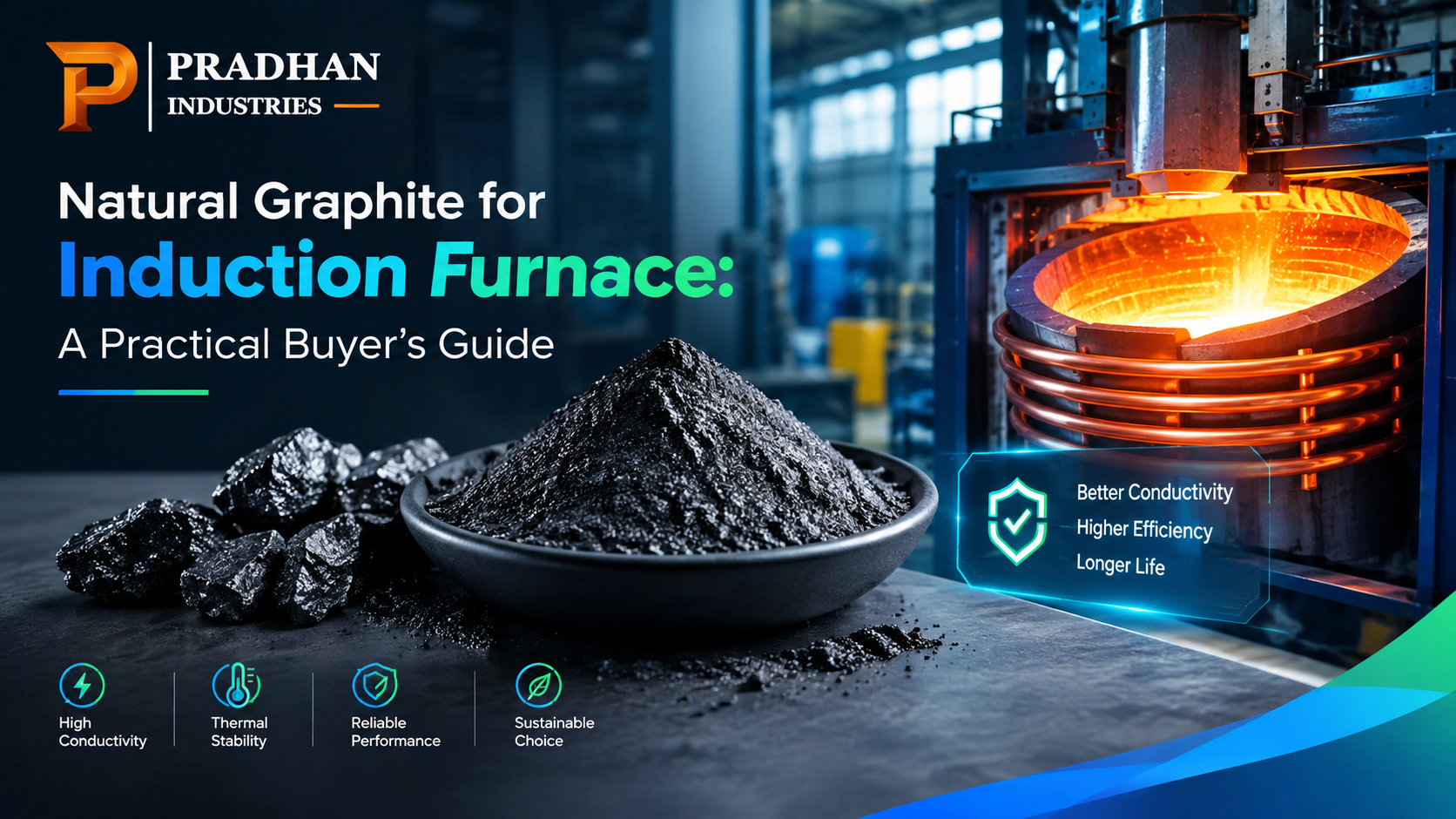
When buying natural graphite for induction furnace applications, choosing the right grade involves more than looking at fixed carbon. It is mainly used as a carbon additive. It is also used in high-temperature material systems. However, choosing the right graphite grade is not simply a matter of selecting the highest fixed-carbon content. Buyers also need to consider the metal or alloy, ash, moisture, particle size, impurity levels, application requirements and quantity needed.
When a foundry or metal manufacturer buys graphite for an induction-furnace process, one key question comes up.
Which graphite grade is right for my application?
The answer depends on how the graphite will be used. A foundry adding graphite to adjust carbon chemistry may require a different specification from a manufacturer using graphite in a refractory, mould coating or furnace component.
For this reason, graphite should be purchased according to the actual process requirement, rather than simply by product name or price per kilogram. This guide explains the key specifications buyers should check when selecting natural graphite for induction-furnace and foundry applications, including fixed carbon, ash, moisture, particle size, purity, packaging and supplier documentation.
What Is Natural Graphite Used For in an Induction Furnace?
Natural graphite is a naturally occurring crystalline form of carbon with properties such as thermal conductivity, electrical conductivity, lubricity and high-temperature resistance. The U.S. Geological Survey identifies graphite as an industrial material used across applications including refractories, friction materials, lubricants and other high-temperature uses.
In an induction-melting environment, graphite can be relevant in several ways.
The most important distinction is whether the graphite is being used as:
- A carbon additive
- A mould coating or foundry material
- A refractory ingredient
- A raw material for a graphite-containing furnace component
- A finished graphite or clay-graphite crucible
These are not interchangeable products.
For a carbon-addition application, the buyer is primarily purchasing a controlled chemical and physical raw material. For a crucible application, the buyer is purchasing an engineered furnace component.
This is why simply asking a supplier for “graphite for induction furnace” can lead to an unsuitable recommendation.
Natural Graphite vs. Graphite Crucible: What Is the Difference?
This is one of the most important points for buyers to understand.
Natural graphite powder and a graphite crucible are different products.
Natural graphite powder is normally specified using parameters such as:
- Fixed carbon
- Ash
- Moisture
- Particle size
- Particle-size distribution
- Sulphur
- Iron
- Other mineral impurities
A finished graphite or clay-graphite crucible has an entirely different specification.
The crucible must be designed around:
- Furnace frequency
- Furnace power
- Crucible dimensions
- Metal or alloy
- Working temperature
- Thermal cycling
- Chemical compatibility
- Electrical characteristics
- Mechanical strength
For example, Foseco’s Indux range is specifically designed as ceramic-bonded clay-graphite crucibles for medium-frequency induction furnaces. The manufacturer states that the range is designed for controlled graphite alignment and optimised electrical properties, with typical applications including copper alloys and precious metals.
Therefore, natural graphite powder should never be treated as a direct substitute for an engineered induction crucible.
If you need graphite powder for a metallurgical application, specify the powder.
If you need a crucible, provide the furnace and melting specifications to the crucible manufacturer.
Can Natural Graphite Be Used as a Carbon Additive?
Natural graphite for induction furnace applications can be used as a carbon source in suitable foundry and metallurgical processes. Yes. Natural graphite can be used as a carbon source in suitable foundry and metallurgical processes.
However, the correct grade depends on the target metal chemistry and operating method.
A buyer should tell the supplier:
- What metal or alloy is being melted?
- What is the starting carbon level?
- What final carbon level is required?
- How is the graphite added?
- What particle size is preferred?
- What fixed-carbon level is required?
- Are there limits on sulphur, iron, silica or other impurities?
This information is much more useful than simply asking for “high-purity graphite”.
A simple carbon calculation
Suppose a foundry is melting 1,000 kg of metal and needs an additional 0.5% carbon.
The theoretical carbon requirement is:
1,000 kg × 0.5% = 5 kg carbon
But 5 kg of carbon does not necessarily mean 5 kg of graphite.
If the graphite contains 95% fixed carbon, the theoretical graphite quantity before considering process recovery would be:
5 ÷ 0.95 = approximately 5.26 kg graphite
Actual consumption can be higher because carbon recovery depends on the material, charging method, furnace practice and process conditions.
Therefore, a theoretical calculation should not be treated as a universal dosing recommendation. Foundries should establish actual recovery through controlled plant trials.
Which Graphite Specifications Matter Most?
For most industrial buyers, four specifications should be checked first:
Fixed carbon, ash, moisture and particle size.
These parameters give a much better picture of the material than a product name alone.
| Specification | Why it matters |
|---|---|
| Fixed carbon | Indicates the carbon contribution of the graphite |
| Ash | Shows the non-carbon mineral fraction |
| Moisture | Important for storage, handling and consistent dosing |
| Particle size | Influences charging, dispersion and process behaviour |
| Sulphur | Important where melt chemistry is sensitive |
| Iron | May matter in specific non-ferrous applications |
| Silica/mineral impurities | Can affect residue and process chemistry |
| Bulk density | Useful for storage and feeding calculations |
| Packaging | Important for transport and moisture protection |
The required limits should always be established according to the application.
Why Fixed Carbon Matters When Buying Graphite
When evaluating natural graphite for induction furnace applications, fixed carbon is one of the first specifications buyers usually check.
Fixed carbon (FC) is one of the first numbers industrial buyers look at when comparing natural graphite grades.
A higher fixed-carbon percentage means a greater proportion of the material is carbon, while the remaining fraction consists primarily of ash and other constituents.
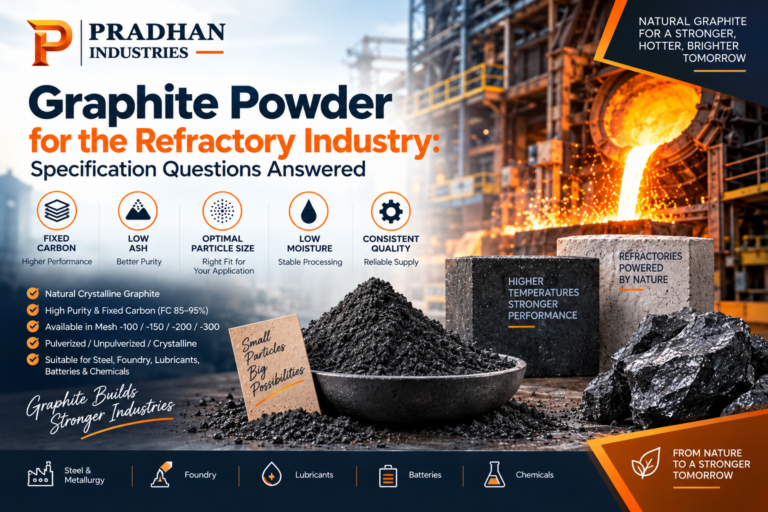
Pradhan Industries supplies crystalline graphite grades covering different fixed-carbon and mesh combinations, including 90–92% FC and 94–95% FC grades in pulverised and unpulverised forms.
However, fixed carbon should not be considered in isolation.
Two graphite products can both contain 95% fixed carbon while having different ash compositions and particle-size distributions.
That remaining fraction can matter considerably in a metallurgical process.
This is why buyers should request a Certificate of Analysis (COA) or technical datasheet rather than relying only on a headline purity figure.
For a deeper explanation of carbon grades, see:
High Carbon Crystalline Graphite: Grades & Uses Guide
How Does Ash Affect Graphite Performance?
Ash represents the non-carbon residue left after the carbonaceous material is burnt under the relevant test conditions.
For foundry applications, ash deserves close attention because the composition of that residue can be more important than the percentage alone.
For example, buyers may need to understand the presence of:
- Silica
- Alumina
- Iron-bearing minerals
- Calcium compounds
- Other mineral constituents
A graphite product with 95% fixed carbon is not automatically equivalent to every other 95% FC graphite.
The better procurement question is:
“What is the complete chemical specification of the graphite?”
That includes both fixed carbon and the composition of the ash.
What Mesh Size Is Best for Natural Graphite in Foundry Applications?
There is no single mesh size that is best for every induction-furnace or foundry application.
The required particle size depends on how the graphite is being used.
A carbon additive may require a particle size that provides an appropriate balance between:
- Charging behaviour
- Dispersion
- Dissolution
- Feeding
- Dust control
- Handling
A mould coating may require a different fineness because the graphite needs to form a consistent surface layer.
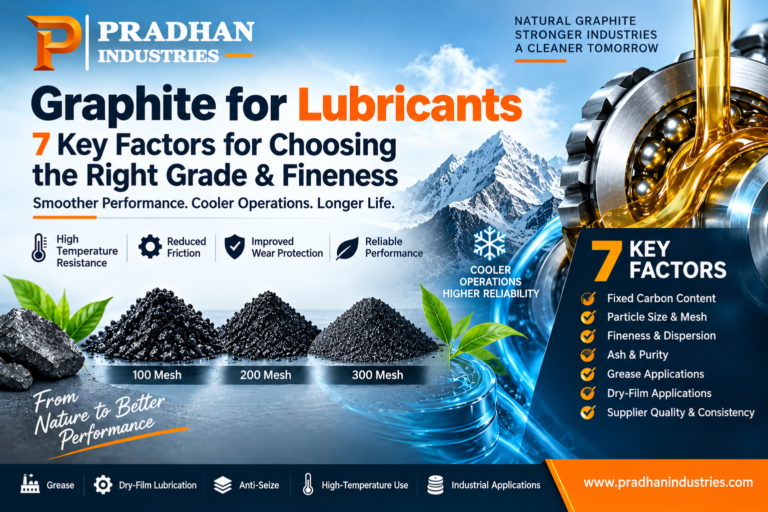
Pradhan Industries lists several crystalline graphite specifications, including 100 mesh, 200 mesh and 300 mesh grades across different fixed-carbon ranges.
This gives buyers more flexibility when matching the graphite to the application.
Mesh size is not the complete particle specification.
A common purchasing mistake is to specify only:
“200 mesh graphite”
A better specification should describe the required particle-size distribution.
Depending on the application, buyers may request:
- Percentage passing a particular sieve
- Percentage retained
- D50
- D90
- Complete particle-size distribution
This provides a more useful picture of the material than a single mesh number.
Fine Graphite vs. Coarse Graphite
Fine- and coarse-grained graphite behave differently during handling and processing.
Fine graphite
Fine graphite may be useful when the process requires:
- Rapid dispersion
- Fine coating coverage
- Controlled feeding
- More uniform distribution
However, fine powder can also create additional dust-handling considerations.
Coarser graphite
Coarser material can offer different handling and charging characteristics and may be more suitable for processes where extremely fine particles are unnecessary.
The right choice should therefore be based on the actual feeding and melting process.
There is no universal rule that says finer graphite is always better.
Is Crystalline Graphite Suitable for Foundry Applications?
Crystalline graphite can be used in several industrial applications where its carbon content and physical properties are useful.
The term “crystalline graphite” itself, however, does not tell a buyer everything required for procurement.
The supplier should still provide:
- Fixed carbon
- Ash
- Moisture
- Particle size
- Flake or morphology information where relevant
- Impurity data
- COA
- Packaging details
For buyers evaluating different grades, the grade and mesh combination is particularly important.
You can review the available graphite specifications here:
Pradhan Industries – Crystalline Graphite Grades
How Is Natural Graphite Processed Before Industrial Use?
Natural graphite does not necessarily go directly from mine to industrial customer.
Depending on the deposit and target grade, graphite ore can undergo processes such as crushing, grinding, flotation, dewatering, drying and classification.
The objective is to separate graphite from unwanted mineral matter and produce a material with the required chemical and physical characteristics.
Pradhan Industries describes a beneficiation route involving crushing and grinding, froth flotation, regrinding, dewatering/drying and classification to produce specified graphite grades.
This processing stage matters because the quality of the final graphite depends not only on the original ore but also on how effectively it is beneficiated and classified.
For buyers interested in the production side, see:
Graphite Beneficiation Process in Odisha
Why Particle-Size Consistency Matters
A supplier may meet the requested average mesh size while still delivering inconsistent material.
For industrial production, consistency between batches can be just as important as the nominal specification.
Consider a foundry that purchases graphite every month.
If one batch is predominantly fine while the next contains significantly more coarse material, the plant may see changes in:
- Feeding behaviour
- Dispersion
- Carbon recovery
- Dust generation
- Process repeatability
This is why buyers should ask suppliers about batch-to-batch particle-size consistency.
A technical datasheet tells you the target specification.
A COA helps show what was actually supplied.
Does Graphite Purity Always Need to Be as High as Possible?
No.
The correct graphite specification is the one that consistently meets the process requirement.
For some foundry applications, a commercially economical grade may provide the required carbon addition without requiring an extremely high-purity material.
For more sensitive applications, tighter limits on ash and trace impurities may be necessary.
The goal should be to avoid both:
Under-specification — material does not meet process requirements.
Over-specification — material costs more without providing measurable process benefits.
This is particularly important when comparing 90–92% FC, 94–95% FC and higher-purity materials.
The right question is not:
“Which graphite has the highest carbon?”
It is:
“Which specification consistently delivers the required result in our process?”
What Information Should You Give a Graphite Supplier?
A detailed enquiry makes it easier for a supplier to recommend an appropriate grade.
Instead of sending:
“Need graphite for induction furnace.”
Send a technical requirement such as:
Application: Carbon addition for foundry
Metal: Cast iron / steel / alloy
Furnace: Induction furnace
Monthly requirement: ___ MT
Fixed carbon: ___% minimum
Ash: ___% maximum
Moisture: ___% maximum
Particle size: ___ mesh / PSD
Sulphur: ___% maximum, if applicable
Packaging: 25 kg bags / jumbo bags / bulk
Delivery location: ___
COA: Required
This allows the supplier to evaluate the requirement rather than guessing the application.
What Should Be Included in an RFQ for Graphite?
A professional RFQ should contain enough information for suppliers to quote comparable materials.
Graphite powder RFQ checklist
| Buyer requirement | Information to provide |
|---|---|
| Application | Carbon addition, coating, refractory, etc. |
| Metal/alloy | Specific grade or material |
| Fixed carbon | Minimum required |
| Ash | Maximum required |
| Moisture | Maximum required |
| Particle size | Mesh or complete PSD |
| Sulphur | Maximum, where relevant |
| Iron | Maximum, where relevant |
| Quantity | Monthly/annual requirement |
| Packaging | Bag, jumbo bag or bulk |
| COA | Required/not required |
| Delivery | Destination and schedule |
For a graphite crucible, the RFQ should instead include:
- Furnace manufacturer/model
- Furnace frequency
- Rated power
- Melting capacity
- Metal/alloy
- Operating temperature
- Crucible shape
- Crucible dimensions
- Expected operating cycle
This distinction can prevent an unsuitable product from being quoted.
Does Induction Furnace Frequency Matter for Graphite Crucibles?
Yes.
Frequency can be an important consideration when selecting an induction crucible because the crucible forms part of the electromagnetic and thermal operating environment.
Foseco states that its Indux crucibles are designed for medium-frequency induction furnaces, with the range intended for systems from 1 kHz upward and many installations operating between 1 and 3 kHz. The manufacturer also lists controlled electrical resistivity and thermal conductivity among the performance characteristics.
This demonstrates why a crucible should not be selected from capacity alone.
Two induction furnaces with similar melting capacities can have different electrical and operating characteristics.
The crucible supplier should therefore receive the complete furnace specification before recommending a product.
What Metals Can Be Melted in Graphite Crucibles?
Graphite-containing crucibles are used for various non-ferrous and other metal-melting applications, but suitability depends on the complete crucible design and operating conditions.
Foseco’s Indux range, for example, is intended particularly for copper alloys and precious metals and specifies a typical casting-temperature range of 850°C–1600°C for that product family.
This does not mean every graphite crucible is suitable for every metal.
The buyer should consider:
- Metal chemistry
- Flux chemistry
- Operating temperature
- Holding time
- Furnace frequency
- Atmosphere
- Crucible construction
Always follow the crucible manufacturer’s application recommendations.
Can Graphite Oxidise at High Temperature?
Yes.
Graphite can oxidise when exposed to oxygen at elevated temperatures. This is one reason operating conditions and crucible construction matter.
A graphite product that performs well under one set of conditions may have different service behaviour under another.
For crucibles, manufacturers may use different material formulations, protective coatings or operating recommendations to manage oxidation and thermal wear.
For graphite powder, the main procurement focus is usually different: chemical composition, particle size, moisture, storage and handling.
The important point is that graphite purity alone does not determine high-temperature performance.
How Should Natural Graphite Powder Be Stored?
Natural graphite powder should be stored in a clean and dry environment with suitable protection from moisture and contamination.
For bulk industrial buyers, storage conditions should be considered when selecting packaging.
Common considerations include:
- Bag or bulk-bag format
- Moisture protection
- Warehouse conditions
- Storage duration
- Material handling system
- Dust-control requirements
Consistent storage is especially important when the same graphite grade is used repeatedly in production.
The objective is simple: the material supplied to the furnace should remain as close as possible to the condition specified on the purchase documents.
How Should Buyers Compare Natural Graphite Suppliers?
Price is important, but it should not be the only comparison point.
A better supplier evaluation considers the complete delivered specification.
| Supplier criterion | What to check |
|---|---|
| Fixed carbon | Guaranteed minimum |
| Ash | Maximum and chemical composition |
| Particle size | Complete PSD or agreed mesh specification |
| Moisture | Guaranteed maximum |
| Batch consistency | Previous COAs or test records |
| Documentation | TDS and COA |
| Packaging | Suitable for your handling system |
| Technical support | Ability to understand the application |
| Supply capacity | Ability to meet recurring demand |
| Lead time | Delivery consistency |
| Commercial value | Cost per useful carbon, not only price/kg |
A supplier that consistently delivers the agreed specification can reduce process variation and make production planning easier.
Why a Certificate of Analysis Matters
A Certificate of Analysis, or COA, gives the buyer batch-specific information about the material supplied.
Depending on the product, it may include:
- Fixed carbon
- Ash
- Moisture
- Particle size
- Sulphur
- Other relevant chemical parameters
For industrial procurement, this documentation is useful because it allows the buyer to compare the supplied batch with the agreed purchase specification.
Pradhan Industries states that its graphite products undergo laboratory testing and that COAs are provided for grade compliance.
For larger-volume buyers, retaining batch records can also help identify changes in process performance over time.
Common Mistakes Buyers Make When Purchasing Graphite
1. Buying only on price
A lower price per kilogram does not necessarily mean a lower process cost.
If the material contains less usable carbon or requires higher dosing, the apparent saving can change.
2. Comparing only fixed carbon
A 95% FC specification does not fully describe the material.
Ash chemistry, moisture and particle-size distribution should also be considered.
3. Asking only for “200 mesh”
Mesh alone may not describe the complete particle distribution.
4. Treating all natural graphite as interchangeable
Different graphite types and grades can behave differently depending on their morphology, purity and processing.
5. Confusing graphite powder with graphite crucibles
These are different products with different engineering requirements.
6. Not checking batch consistency
A material that performs well once may still create problems if subsequent batches vary significantly.
7. Giving the supplier incomplete information
The supplier cannot accurately recommend a grade if the application and process requirements are unknown.
How to Choose the Right Natural Graphite for an Induction Furnace
A practical selection process can be reduced to five steps.
Step 1: Define the application.
Decide whether the graphite is required for:
- Carbon addition
- Foundry coating
- Refractory
- Moulding application
- Crucible production
- Another industrial use
Step 2: Define the metal or alloy.
The impurity limits can change depending on the material being processed.
Step 3: Define the chemical specification.
Set requirements for:
- Fixed carbon
- Ash
- Moisture
- Sulphur
- Iron
- Other relevant impurities
Step 4: Define the physical specification.
Specify:
- Mesh size
- Particle-size distribution
- Flake/morphology requirement
- Bulk density where relevant
Step 5: Validate through testing
For significant volumes, conduct a controlled trial before moving to long-term supply.
This provides real process data instead of relying entirely on a datasheet.
Why Source and Processing Matter
The origin of natural graphite is relevant because ore characteristics influence the processing route and final product.
Pradhan Industries operates in Odisha and describes a mine-to-market model involving graphite mining, beneficiation, grading and distribution. The company states that it has been operating since 1976 and supplies natural crystalline graphite for industrial applications.
For buyers, the practical benefit of understanding the supply chain is traceability.
A reliable supplier should be able to explain:
Where the graphite comes from → how it is processed → how it is graded → how it is tested → how it is packed → how it reaches the customer.
That is much more useful than simply knowing the product name.
Why Odisha Matters for Natural Graphite Supply in India
India has established graphite resources and processing activity, while Odisha is an important mineral-producing state.
For industrial buyers, sourcing directly from a graphite mining and processing operation can provide a clearer connection between raw material, beneficiation and finished grade.
Pradhan Industries describes its operations in Odisha, including mining and beneficiation facilities, and supplies crystalline graphite in multiple fixed-carbon and mesh combinations.
For companies purchasing graphite in bulk, this type of integrated supply chain can also make it easier to discuss customised specifications and recurring requirements.
Frequently Asked Questions About Natural Graphite for Induction Furnaces
Can natural graphite be used in an induction furnace?
Yes, natural graphite can be used in suitable metallurgical applications, including as a carbon source in some foundry processes. The correct grade depends on the metal, target chemistry, dosing method and graphite specification.
What fixed carbon is suitable for induction-furnace applications?
There is no universal fixed-carbon requirement. The appropriate specification depends on the process. Industrial graphite is available in multiple fixed-carbon grades, so buyers should select the minimum specification that consistently meets their process requirements.
Is 95% fixed-carbon graphite suitable for foundry applications?
It can be suitable for certain applications, but fixed carbon alone is not enough to determine suitability. Buyers should also review ash composition, moisture, particle size and relevant impurities.
What mesh size of graphite is used in foundries?
Different foundry processes use different particle sizes. Common industrial specifications can include 100, 200 and 300 mesh grades, but the correct selection depends on the application and feeding method.
Can natural flake graphite be used as a carbon additive?
Natural graphite can be used as a carbon source in suitable metallurgical processes. The supplier should evaluate the required carbon level, fixed carbon, ash, particle size and impurity limits before recommending a grade.
Is graphite powder the same as a graphite crucible?
No. Graphite powder is a raw material specified mainly by chemical and particle characteristics. A graphite crucible is an engineered furnace component designed around furnace conditions, dimensions, temperature and metal compatibility.
Does induction frequency matter for a graphite crucible?
Yes. Crucible design can depend on the electrical and operating characteristics of the induction furnace. Furnace frequency, power, capacity and configuration should be supplied to the crucible manufacturer.
How do I compare two graphite suppliers?
Compare the complete specification rather than only price and fixed carbon. Check COA data, ash, moisture, particle-size distribution, batch consistency, packaging, delivery capability and technical support.
What should I ask for before purchasing natural graphite?
Request a technical datasheet and COA and confirm fixed carbon, ash, moisture, particle size and relevant impurities. Also provide your application, metal/alloy, quantity and delivery requirements.
Final Takeaway: Buy Graphite by Specification, Not by Name
The right natural graphite for an induction furnace is not just the one with the highest carbon content. It is also not simply the lowest-priced option.
It is the material whose chemical and physical properties match the actual process.
For a foundry carbon-addition application, focus on:
Fixed carbon + ash + moisture + particle size + impurity profile + consistency.
For an induction crucible, focus on:
Furnace frequency, power, dimensions, metal/alloy, temperature, crucible construction, and manufacturer recommendations.
The distinction can save buyers from one of the most common procurement mistakes: purchasing a graphite product that looks suitable on paper but was never specified for the actual process.
For industrial buyers looking for natural crystalline graphite from Odisha, Pradhan Industries provides multiple fixed-carbon and mesh specifications, including grades in the 90–92% and 94–95% FC ranges.
You can explore the company’s graphite information and specifications here:
Pradhan Industries – Graphite Manufacturer in India
For broader technical background on natural graphite, the U.S. Geological Survey maintains current graphite statistics, publications and mineral information.
U.S. Geological Survey – Graphite Statistics and Information
If you are asking for a quotation, please share the application. Mention the metal or alloy. State the required fixed carbon. Provide the ash limit. Tell us the mesh size. Share the quantity needed. Confirm the delivery location. A detailed specification gives the supplier a much better basis for recommending the appropriate graphite grade.