Steel mills have relied on natural graphite for over a century. Now EV battery makers need it too. That’s not a coincidence — it’s the same set of atomic properties doing two very different jobs.
The benefits of natural graphite come down to one thing: its crystal structure is already close to perfect when it comes out of the ground. Synthetic graphite has to be built from scratch at extreme temperatures to get there. Natural graphite mostly just needs cleaning up.
This guide breaks down exactly why natural graphite holds its ground against synthetic alternatives—on cost, on performance, and on environmental impact—and where it fits best across battery, refractory, and industrial applications.
Natural graphite has a unique crystalline structure that gives it excellent conductivity, thermal stability, lubrication, and chemical resistance. Learn more about the properties of natural crystalline graphite and its industrial applications.
What Is Natural Graphite?
Natural graphite is a crystalline form of carbon that forms underground over millions of years, under heat and pressure acting on organic carbon deposits. It comes in three main forms:
- Flake graphite — Distinct, plate-like crystals. Best crystallinity of the three. Preferred for batteries, lubricants, and high-spec industrial use.
- Vein (lump) graphite—Rare, extremely high purity at the source, found almost exclusively in Sri Lanka. Small global supply.
- Amorphous graphite — Fine-grained, lower crystallinity, lower carbon content at extraction (often 70-85% C). Used mainly in lower-spec industrial applications like foundry facings.
Flake is the one driving most of the current demand growth, especially with EV battery anode material needs climbing every year.
Top Core Benefits of Natural Graphite
1. Superior Natural Crystallinity & Electrical Conductivity
Graphite’s atomic structure is made of stacked carbon sheets, and how neatly those sheets align determines conductivity and performance. Natural flake graphite forms this layered lattice over geological time, which gives it high crystallinity right out of the ground.
Higher crystallinity means the following:
- Better electron flow through the material
- Lower internal resistance in a battery anode
- More consistent lithium-ion intercalation behavior during charge cycles
Synthetic graphite has to build this same lattice structure artificially through high-temperature graphitization. Natural graphite starts most of the way there already.
2. High Thermal Conductivity & Heat Dissipation
Graphite conducts heat extremely well — in some directions, better than copper or aluminum relative to weight. This matters in two very different industries at once.
In EV battery packs, heat buildup during fast charging is a real safety and performance issue. Graphite anode material helps pull heat away from the reaction zone, keeping cells within a safer temperature window.
In refractories and steelmaking, natural graphite-based crucibles and linings need to survive repeated exposure to molten metal at 1500°C or more without cracking from thermal shock. High thermal conductivity spreads heat evenly across the material instead of letting it concentrate and fracture the structure.
3. Cost Efficiency
This is one of the clearest, most practical benefits of natural graphite: it’s simply cheaper to produce.
Natural graphite processing involves mining, crushing, and froth flotation—mechanical and chemical separation at relatively moderate temperatures. Synthetic graphite requires graphitizing petroleum coke or pitch at 2800-3000°C in a furnace, which is far more energy- and capital-intensive.
Depending on grade and market conditions, synthetic graphite typically costs 2 to 3 times more to produce than natural graphite. That cost gap is a major reason battery makers try to maximize natural graphite content in anode blends wherever performance specs allow it.
4. Lower Carbon Footprint & Environmental Impact
Producing synthetic graphite means running furnaces at 2800-3000°C for extended periods—an enormous energy draw. Natural graphite processing skips that step almost entirely, relying on mechanical separation instead of thermal reconstruction.
Rough industry estimates put synthetic graphite’s production emissions notably higher per ton than natural graphite, largely because of that furnace energy load. For manufacturers under pressure to report supply chain carbon footprint numbers, natural graphite has a real advantage on paper before a single battery cell is even built.
That said, natural graphite mining and flotation still carry real environmental impact of graphite mining concerns—tailings management and water use need proper handling. It’s a lower footprint, not a zero footprint.
5. Exceptional Natural Lubricity and Chemical Inertness
Graphite’s layered structure lets sheets slide over each other easily, which is exactly why it’s been used as a dry lubricant for over a hundred years. This lubricity of natural graphite shows up in the following:
- Industrial lubricants and greases
- Gasket and seal materials
- Brake linings and friction components
It’s also chemically inert—resistant to acids, alkalis, and most solvents at normal operating conditions. That’s why it holds up well in corrosive industrial environments where metal components would degrade faster.
6. High Tap Density & Volumetric Energy Density
Once natural flake graphite is processed into spherical graphite (SPG) for battery anodes, its natural crystallinity translates into a real performance edge: higher tap density.
Higher tap density means more graphite packed into the same physical volume inside an anode. That directly supports better volumetric energy density — more usable energy stored per liter of battery pack, which matters a lot for EV range and consumer electronics form factors.
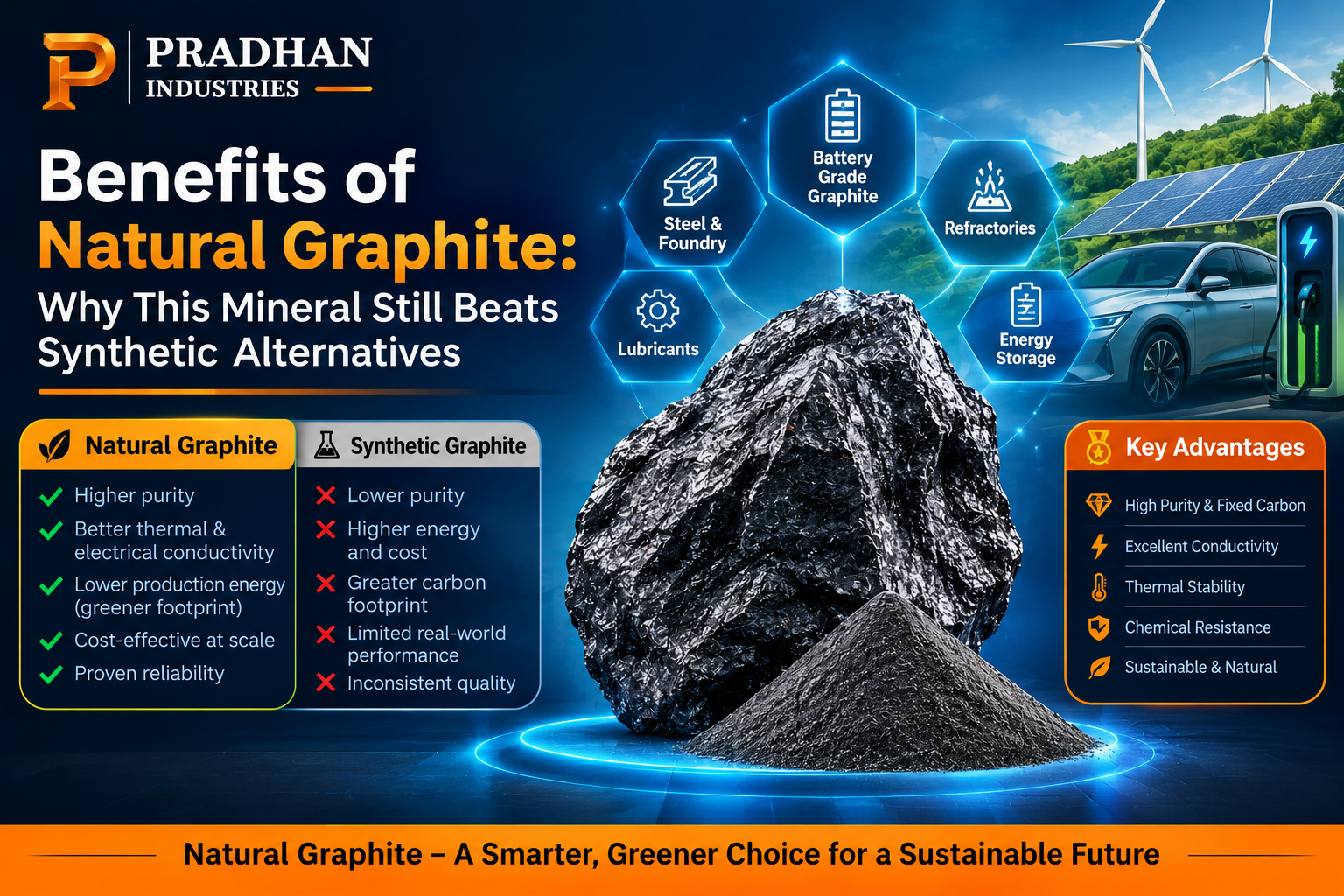
Natural Graphite vs. Synthetic Graphite: Comparison Table
| Parameter | Natural Graphite | Synthetic Graphite |
|---|---|---|
| Raw Source | Mined ore (flake, vein, amorphous) | Petroleum coke / coal tar pitch |
| Production Cost | Lower (baseline) | 2-3x higher |
| CO₂ Footprint | Lower (mechanical processing) | Higher (2800-3000°C furnace energy) |
| Crystallinity | High, naturally occurring | High, but artificially built |
| Fast-Charging Performance | Moderate | Strong, more consistent |
| Best Applications | Cost-sensitive batteries, refractories, lubricants, seals | High-performance/fast-charge batteries, aerospace-grade carbon parts |
Most battery manufacturers don’t pick one exclusively. They blend both to balance cost against performance.
      NATURAL GRAPHITE                    SYNTHETIC GRAPHITE
      -----------------                    -------------------
      Mine -> Crush -> Flotation           Petroleum Coke/Pitch
           |                                       |
      94-96% C Concentrate               Graphitization Furnace
           |                                    (2800-3000°C)
      Spheronization (SPG)                       |
           |                                Synthetic Graphite
      Purification (99.95%+ C)                   |
           |                              Purification/Coating
      Coating                                     |
           |                                       |
      Battery-Grade Natural SPG    <-- Blended -->  Battery-Grade Synthetic
Key Industrial Applications Benefiting from Natural Flake Graphite
Lithium-ion battery anodes (EVs & energy storage) Natural graphite remains the cost-effective carbon material of choice for anode blends, often mixed with synthetic graphite to balance price and fast-charge performance across EV battery packs and grid storage systems.
Refractories, crucibles, and steelmaking foundries High thermal conductivity and resistance to thermal shock make natural graphite the standard material for crucibles, ladle linings, and other high-heat metallurgical equipment.
Lubricants, coatings, and brake linings Natural lubricity and chemical inertness make graphite a reliable dry lubricant additive in high-temperature or high-pressure environments where oil-based lubricants break down.
Expandable/flexible graphite for fire retardants and seals When treated with intercalation chemicals and heated briefly, natural flake graphite expands dramatically in volume, making it useful for fire-retardant seals, gaskets, and industrial fireproofing products.
Strategic Sourcing & Future Outlook
Global graphite mining isn’t evenly distributed, and that’s shaping procurement strategy across the battery industry right now.
- India — Odisha holds significant natural crystalline graphite deposits, with a long-established mining and processing history serving both domestic industry and export markets.
- Africa—Mozambique, Tanzania, and Madagascar have become major flake graphite exporters over the past decade, drawing serious investment from battery supply chain players.
- Canada — Positioned as a strategic, lower-carbon-footprint alternative source for North American battery manufacturers looking to diversify away from Asian processing hubs.
- China—Still dominates global spherical graphite processing capacity, even when raw ore comes from elsewhere, creating an ongoing supply chain concentration risk.
Procurement managers are increasingly signing direct offtake agreements with mining operations outside the dominant processing hub, prioritizing supply security over marginal cost savings. Expect that trend to keep building as EV production volumes climb through the next several years.
Natural graphite is used across batteries, lubricants, refractories, steelmaking and other industrial applications, according to data from the U.S. Geological Survey.
Frequently Asked Questions
1. What are the main benefits of natural graphite over synthetic graphite?
Natural graphite costs roughly 2-3 times less to produce, carries a lower carbon footprint, and already has high crystallinity from natural formation. Synthetic graphite still wins on fast-charge consistency, which is why many manufacturers blend both.
2. Is natural graphite good for EV batteries?
Yes. Natural graphite, once processed into spherical graphite (SPG), is widely used as EV battery anode material and offers strong energy density and lower production cost compared to synthetic alternatives.
3. Why does natural graphite have a lower carbon footprint than synthetic graphite?
Synthetic graphite production requires furnace temperatures of 2800-3000°C to build crystal structure from petroleum coke, consuming huge amounts of energy. Natural graphite mainly needs mechanical processing like crushing and flotation, which uses far less energy overall.
4. What industries use natural graphite besides batteries?
Natural graphite is widely used in refractories and steelmaking crucibles, industrial lubricants, brake linings, and expandable graphite for fire-retardant seals. Its heat resistance and natural lubricity make it valuable across heavy industry well beyond batteries.
5. Where does most natural flake graphite come from?
Major sources include India (particularly Odisha), Mozambique, Madagascar, Tanzania, and China. However, most global spherical graphite processing capacity remains concentrated in China, regardless of where the raw ore is mined.
Final Takeaway
Natural graphite isn’t a lesser alternative to synthetic material—it’s the more efficient starting point for a lot of applications, battery anodes included. It costs less to produce, carries a smaller carbon footprint, and brings crystallinity that synthetic processes have to work hard to replicate.
The smartest supply chains aren’t choosing one over the other. They’re blending natural and synthetic graphite based on what each application actually needs, while locking in natural graphite supply from diversified mining regions before demand outpaces available processing capacity.