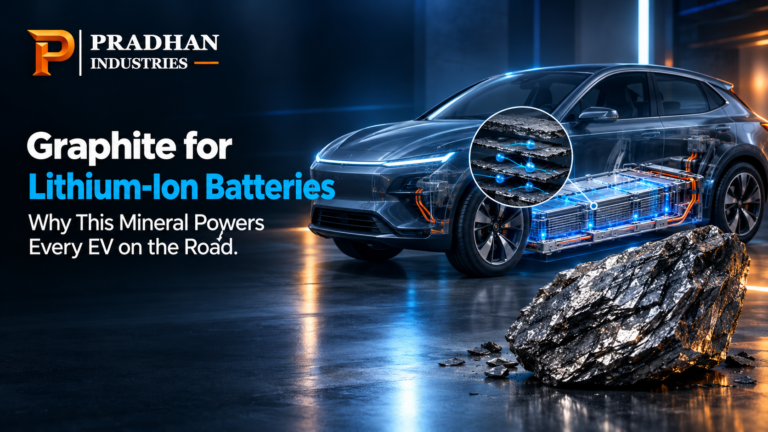
Graphite in EV Batteries is one of the most important topics in the electric vehicle industry today. While lithium often receives the spotlight, graphite is the dominant anode material used in modern lithium-ion batteries.
When people talk about electric vehicles, the conversation usually revolves around lithium, charging stations, battery range, and major EV manufacturers… Yet one of the most important materials inside every electric vehicle battery often remains unnoticed. That material is graphite. Without graphite, the modern electric vehicle industry would struggle to exist in its current form. While lithium often receives the spotlight, graphite actually represents the dominant material used in the anode section of lithium-ion batteries.
The global transition toward sustainable transportation has created unprecedented demand for battery materials. Governments worldwide are promoting cleaner mobility, automotive manufacturers are investing billions in EV production, and consumers are increasingly choosing electric vehicles over traditional internal combustion engine cars. Behind this transformation lies a growing need for reliable, high-performance battery materials. Graphite has emerged as one of the most critical components because it enables batteries to store and release energy efficiently.
Industry data shows that global EV battery demand exceeded 1 TWh in 2024 and continued growing strongly in 2025, driven by accelerating electric vehicle adoption worldwide. Graphite remains the dominant anode material in lithium-ion batteries and is expected to remain essential throughout the coming decade.
Understanding the Role of Graphite in EV Batteries
What Is Graphite?
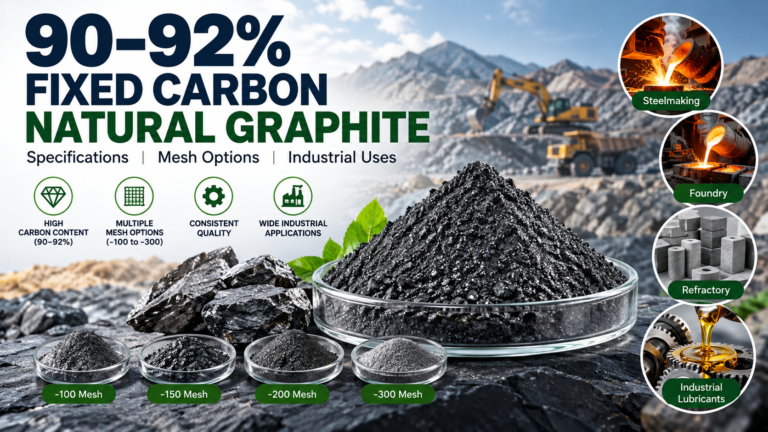
Graphite is a naturally occurring crystalline form of carbon known for its exceptional electrical conductivity, thermal stability, and layered structure. It is commonly found in metamorphic and igneous rocks and has been used for decades in industrial applications ranging from lubricants and steel manufacturing to electronics and refractories.
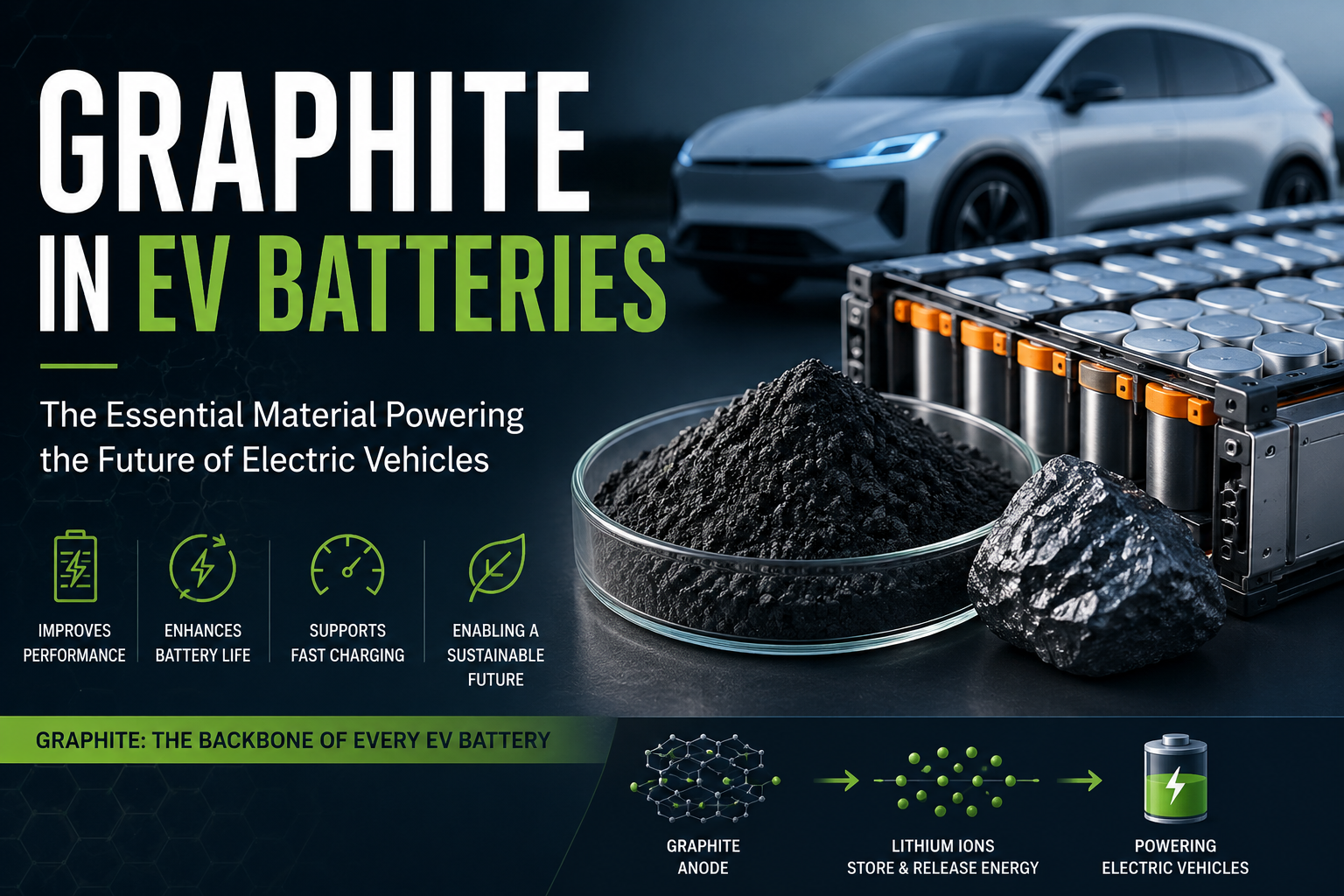
What makes graphite special for battery technology is its unique atomic arrangement. The carbon atoms are organized in layers that allow lithium ions to move in and out efficiently during charging and discharging cycles. Think of graphite as a parking garage for lithium ions. During charging, lithium ions enter the graphite structure and remain stored there. During discharge, they exit and generate the electricity needed to power the vehicle.
This simple yet effective mechanism has made graphite the preferred anode material for lithium-ion batteries. Despite ongoing research into alternatives, graphite continues to dominate because of its proven reliability, affordability, and performance.
Why Graphite in EV Batteries Matters
Every lithium-ion battery consists of several essential components, including a cathode, electrolyte, separator, and anode. Graphite is primarily used in the anode, where it plays a crucial role in storing lithium ions.
The ability of graphite to repeatedly absorb and release lithium ions without significant degradation makes it ideal for EV applications. Electric vehicle batteries must withstand thousands of charging cycles while maintaining performance. Graphite delivers this durability while supporting high energy density and stable operation.
Research and industry reports indicate that graphite accounts for nearly 95% of anode materials used in lithium-ion batteries today. This dominance is due to its combination of conductivity, cycle life, cost-effectiveness, and manufacturing maturity.
How Graphite Functions Inside an EV Battery
The Importance of the Anode
The anode serves as the battery’s energy storage center during charging. When an EV is plugged into a charger, lithium ions travel from the cathode through the electrolyte and become embedded within the graphite anode.
This process is known as intercalation. The layered structure of graphite allows lithium ions to insert themselves between carbon layers without causing significant structural damage. As a result, the battery can be charged and discharged repeatedly over many years.
The efficiency of this process directly influences battery performance. Faster charging, greater range, and longer lifespan all depend partly on how effectively the graphite anode manages lithium ions.
Lithium-Ion Movement and Energy Storage
Imagine thousands of microscopic lithium ions moving back and forth every time you drive or charge your electric vehicle. Graphite acts as a host material that facilitates this movement while maintaining structural stability.
When the battery discharges, lithium ions leave the graphite anode and travel back to the cathode, generating electricity that powers the vehicle’s motor. During charging, the ions return to the graphite structure.
Because this process occurs continuously throughout the battery’s life, the quality and purity of graphite significantly impact overall battery performance. High-quality battery-grade graphite helps improve efficiency, charging speed, and long-term durability.
Types of Graphite Used in EV Batteries
Battery manufacturers use both natural and synthetic graphite depending on performance requirements. High-quality graphite materials are essential for achieving better conductivity, battery efficiency, and longer service life.
Companies looking for premium graphite products can explore our range of Graphite Powder Manufacturer solutions, which are widely used across battery, refractory, and industrial applications.
Natural graphite, especially Crystalline Graphite, is increasingly preferred for battery applications because of its excellent purity and electrochemical properties.
As demand for EV batteries grows globally, businesses are also seeking reliable sources from a trusted Graphite Supplier in Gujarat to ensure a consistent supply of high-quality graphite materials.
Natural Graphite
Natural graphite is mined directly from the earth and then processed into battery-grade material. It is generally more environmentally friendly and less energy-intensive to produce than synthetic graphite.
Manufacturers convert natural graphite into spherical graphite, which is particularly suitable for battery applications. This processing improves density and electrochemical performance while making the material compatible with modern battery designs.
As EV production expands, natural graphite is becoming increasingly attractive due to its lower production costs and reduced environmental footprint.
Synthetic Graphite
Synthetic graphite is manufactured through high-temperature treatment of carbon-rich materials such as petroleum coke. Although production is more energy-intensive, synthetic graphite offers extremely high purity and consistent performance.
Many battery manufacturers favor synthetic graphite because it provides predictable quality and excellent conductivity. Synthetic graphite currently represents a significant share of the EV battery market due to these advantages.
Comparing Natural and Synthetic Graphite
| Feature | Natural Graphite | Synthetic Graphite |
|---|---|---|
| Source | Mined from natural deposits | Manufactured industrially |
| Cost | Generally lower | Higher |
| Purity | High after processing | Extremely high |
| Environmental Impact | Lower | Higher |
| Performance Consistency | Good | Excellent |
| EV Battery Use | Increasing rapidly | Widely used |
Battery manufacturers often choose between these materials based on performance requirements, cost considerations, and sustainability goals.
Why Graphite Is Critical for Electric Vehicles
High Conductivity and Performance
One of the primary reasons graphite dominates battery anodes is its excellent electrical conductivity. Efficient conductivity allows electrons to flow freely, improving battery efficiency and reducing energy losses.
For EV owners, this translates into practical benefits. Vehicles can achieve longer driving ranges, maintain consistent performance, and experience reduced energy waste. Graphite also performs well under varying temperatures, making it suitable for diverse climates and operating conditions.
Automakers continue investing heavily in graphite supply chains because even minor improvements in battery performance can significantly enhance vehicle competitiveness.
Battery Longevity and Safety
Durability is another major advantage. Electric vehicle batteries are expected to last many years while retaining a large percentage of their original capacity. Graphite’s stable structure supports this requirement by minimizing degradation during repeated charging cycles.
Safety is equally important. Battery materials must remain stable under demanding operating conditions. Graphite has demonstrated reliable performance across millions of vehicles worldwide, helping manufacturers meet stringent safety standards.
The proven track record of graphite reduces technical risks and supports the continued expansion of electric mobility.
Growing Demand for Graphite in EV Batteries
The rapid growth of electric vehicles is creating unprecedented demand for battery materials worldwide. According to the International Energy Agency (IEA), global EV battery demand surpassed 1 TWh and continues to grow as governments and manufacturers invest heavily in clean transportation technologies.
As reported by the U.S. Department of Energy, lithium-ion batteries remain the dominant technology powering modern electric vehicles, with graphite serving as the primary anode material responsible for storing lithium ions.
Industry research from BloombergNEF also indicates that demand for battery-grade graphite is expected to increase significantly over the coming decade as EV adoption accelerates globally. These trends highlight the strategic importance of securing reliable graphite supply chains for future battery production.
Sources:
- International Energy Agency (IEA): https://www.iea.org
- U.S. Department of Energy: https://www.energy.gov
- BloombergNEF: https://www.bloombergnef.com
Rising EV Adoption
The rapid growth of electric vehicles is driving extraordinary demand for graphite. According to recent energy industry data, EV battery demand surpassed 1 TWh in 2024 and reached approximately 1.2 TWh in 2025, reflecting nearly 30% annual growth.
Every new electric vehicle requires significant quantities of graphite. In many cases, an EV battery contains more graphite by weight than lithium. As EV adoption accelerates across North America, Europe, China, and emerging markets, graphite consumption is expected to increase substantially.
This trend is transforming graphite from a relatively specialized industrial mineral into a strategically important resource for the global energy transition.
Market Growth and Future Projections
Analysts expect sustained growth in graphite demand throughout the next decade. Battery demand is projected to exceed 3 TWh by 2030, creating enormous opportunities for graphite producers and processors.
The market is witnessing significant investments in mining projects, processing facilities, and battery material manufacturing plants. Major automotive companies are also entering long-term supply agreements to secure future graphite supplies and reduce dependence on limited sources.
Graphite Supply Chain Challenges
Dependence on China
One of the biggest challenges facing the EV industry is the concentration of graphite production and processing. China currently dominates global graphite refining and anode material manufacturing.
Recent international energy analyses indicate that China accounts for over 90% of anode active material production and more than 90% of graphite refining capacity. This concentration creates supply chain risks for manufacturers in other regions.
Governments and industry leaders increasingly view graphite as a strategic material due to its importance in energy security and industrial competitiveness.
Supply Security and Diversification
To reduce supply risks, countries are investing in domestic graphite production and alternative supply chains. Companies in North America, Europe, and Australia are developing new mining and processing projects aimed at supporting local battery manufacturing.
Recent industry agreements involving automakers and graphite suppliers demonstrate a broader trend toward supply diversification. These efforts seek to create resilient supply networks capable of supporting long-term EV growth.
Innovations in Graphite Battery Technology
Silicon-Graphite Anodes
While graphite remains dominant, researchers continue exploring ways to improve battery performance. One promising development involves combining graphite with silicon.
Silicon can store significantly more lithium ions than graphite, potentially increasing energy density and reducing charging times. However, silicon expands during charging, creating engineering challenges.
As a result, many next-generation batteries use silicon-graphite blends rather than replacing graphite entirely. These hybrid anodes combine the stability of graphite with the enhanced capacity of silicon. Research and industry developments suggest silicon-graphite technologies could play a major role in future EV batteries.
Recycling and Sustainability
Battery recycling is becoming increasingly important as EV adoption grows. Recovering graphite from end-of-life batteries can reduce dependence on virgin mining while improving sustainability.
Advanced recycling technologies are already demonstrating impressive recovery rates for battery materials, including graphite. This emerging circular economy approach may become a significant source of battery-grade materials in the future.
Future of Graphite in EV Batteries Technology
The future of graphite remains exceptionally strong. Although researchers continue investigating alternative materials, graphite’s combination of performance, affordability, safety, and manufacturing maturity gives it a substantial advantage.
Battery technologies will undoubtedly evolve. Silicon-enhanced anodes, advanced synthetic graphite production methods, and improved recycling systems will reshape the industry. Yet most experts expect graphite to remain a cornerstone of lithium-ion battery technology for many years.
As electric vehicle adoption accelerates worldwide, graphite demand is likely to grow alongside it. New supply chains, processing facilities, and technological innovations will help meet this demand while improving sustainability and supply security. The companies that successfully secure high-quality graphite resources today may become some of the most influential players in tomorrow’s clean energy economy.
Conclusion
Graphite in EV Batteries will remain essential as electric vehicle adoption continues to grow worldwide.Graphite is the unsung hero of the electric vehicle revolution. While lithium often dominates headlines, graphite performs the essential task of storing and releasing lithium ions inside battery anodes. Its unique structure, excellent conductivity, long cycle life, and proven reliability have made it the dominant anode material in modern EV batteries.
The rapid expansion of the electric vehicle market is creating unprecedented demand for graphite, transforming it into one of the world’s most strategically important battery minerals. At the same time, supply chain challenges, technological innovation, and sustainability concerns are driving significant investment throughout the graphite value chain.
As the world moves toward cleaner transportation and renewable energy, graphite will remain a critical building block of battery technology, helping power millions of electric vehicles on roads around the globe.
Frequently Asked Questions
1. Why is graphite used in EV batteries?
Graphite is used because it can efficiently store and release lithium ions during charging and discharging while maintaining stability over thousands of cycles.
2. Is graphite more important than lithium in EV batteries?
Both are essential, but EV batteries often contain more graphite by weight than lithium, making graphite one of the most important battery materials.
3. What type of graphite is used in EV batteries?
Both natural graphite and synthetic graphite are used. The choice depends on performance requirements, cost, and manufacturing preferences.
4. Can graphite be replaced in future batteries?
Alternative materials such as silicon are being developed, but most future battery designs are expected to include graphite rather than eliminate it completely.
5. Which country dominates graphite production for EV batteries?
China currently dominates graphite refining and anode material production, supplying the majority of the world’s battery-grade graphite.