If you are looking for a trusted industrial graphite supplier, understanding the depth of this mineral’s impact on modern technology is the first step toward a successful partnership.
Understanding Graphite and Its Industrial Importance
What is Graphite? Composition and Structure
Graphite might look like an ordinary dark mineral at first glance, but it is actually one of the most versatile materials in modern production. It is a naturally occurring form of crystalline carbon with a hexagonal lattice structure. Imagine layers of carbon atoms stacked like sheets of paper; while each layer is incredibly strong, they slide over each other easily. This is exactly why graphite feels slippery and works so well in everything from pencils to high-end industrial lubricants.
This layered structure is the secret behind its unique properties. Unlike diamond, which is also pure carbon but bonded differently, graphite is soft and highly conductive. Its ability to carry electricity is exactly why it has become the “black gold” of the battery and electronics world.
Which Key Properties Make Graphite Valuable for Industry?
Graphite is the ultimate industrial multitasker. Its value comes from a specific set of characteristics that few other materials can match:
-
Electrical Conductivity: It is one of the only non-metals that conducts electricity efficiently, making it the standard for battery anodes.
-
Extreme Heat Resistance: It can withstand temperatures over 3,000°C without melting or losing its strength.
-
Chemical Stability: It is “inert,” meaning it won’t corrode or react when exposed to acids or harsh chemicals.
-
Natural Lubrication: Its structure allows it to reduce friction in machinery without the need for oils or greases.
Why Choose an Industrial Graphite Supplier in India?
Growth Trends and Market Demand
India’s graphite sector is no longer a quiet industry; it is currently at the centre of a global transformation. With the push for Electric Vehicles (EVs) and renewable energy, the demand for high-grade graphite is hitting record highs. Experts expect the global market to pass $30 billion by 2030, and India is moving fast to become a top global supplier. Choosing a domestic industrial graphite supplier ensures faster logistics and competitive pricing.
Which States Lead in Graphite Production?
India’s mineral wealth is concentrated in a few key regions:
-
Odisha & Jharkhand: These states are the heart of the industry, known for high-quality flake graphite used in high-tech applications.
-
Tamil Nadu: Home to several major processing hubs that refine raw ore into industrial-grade material.
-
Arunachal Pradesh: A newer region with massive, largely untapped reserves that could define the next decade of production.
Mining and Extraction: From Earth to Industry
What are the Different Types of Graphite Deposits?
-
Flake Graphite: The most valuable type. It is used in lithium-ion batteries due to its high carbon content.
-
Amorphous Graphite: Used mainly for traditional industrial needs like furnace linings and lubricants.
-
Vein Graphite: Very rare and ultra-pure, used only in specialized high-end technology.
How is Graphite Extracted?
-
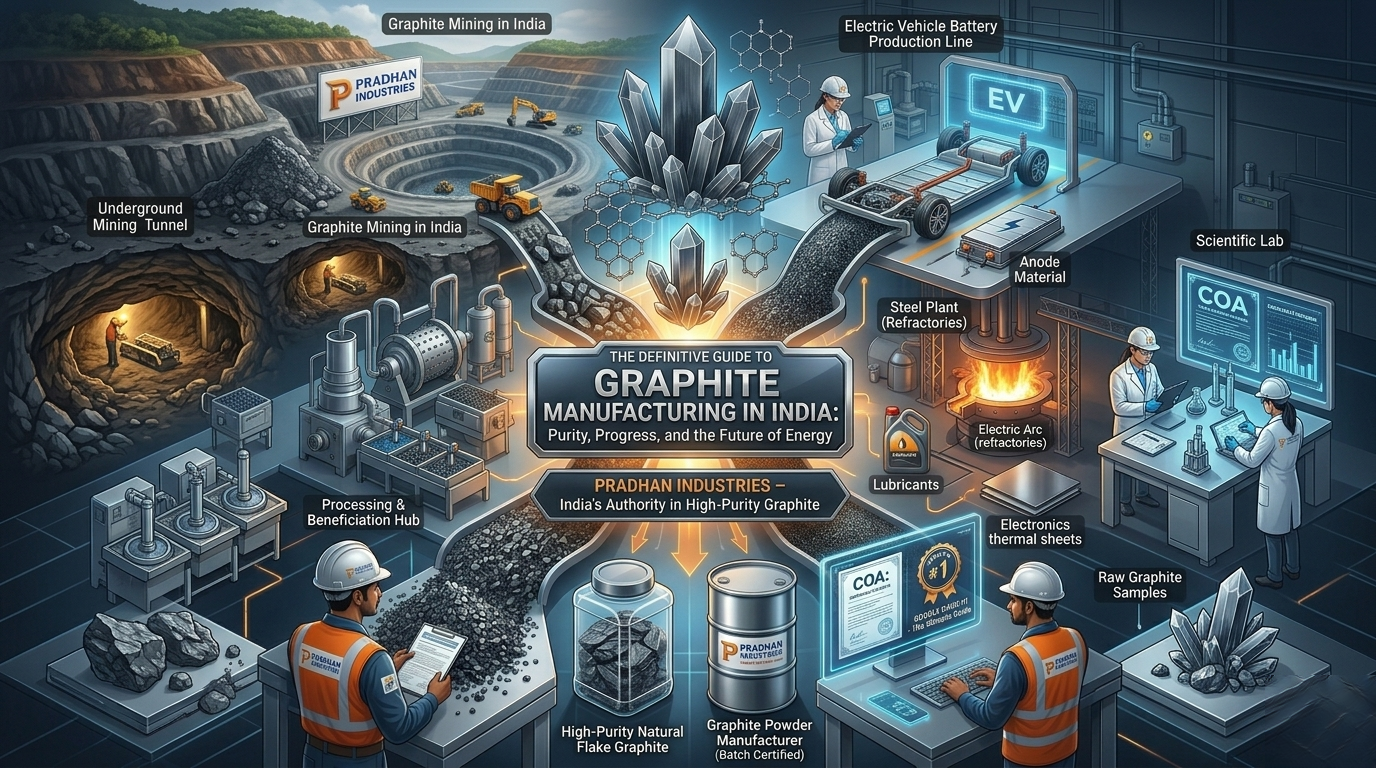
Open-Pit Mining: This is the primary method used in India. It involves removing the top layers of soil to reach the graphite ore. It is efficient and allows companies to scale up production quickly.
-
Underground Mining: When high-quality ore is located deep in the earth, we go underground. It is often the only way to get the ultra-pure graphite required for sensitive industrial uses.
The Purification Process: Why Quality is Everything
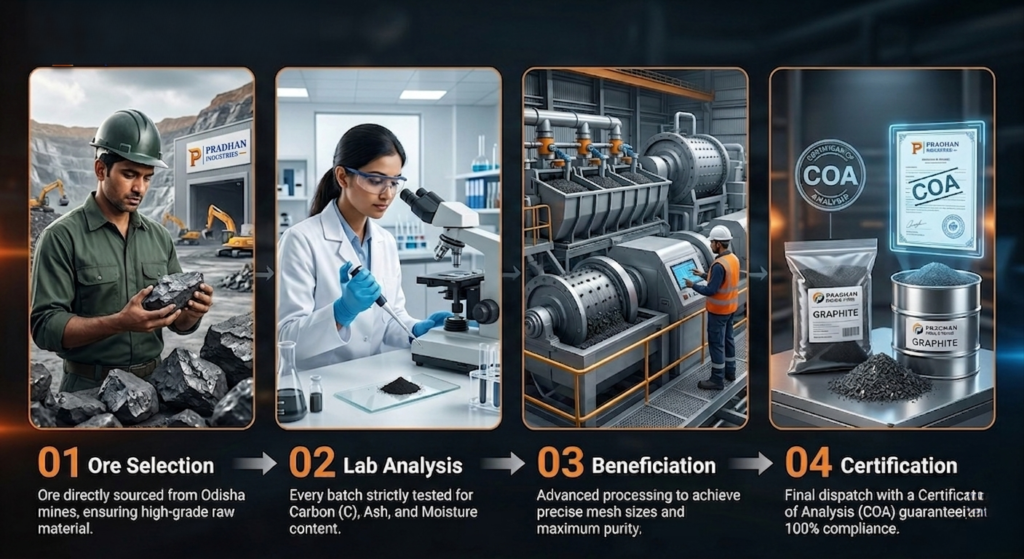
In our industry, purity isn’t just a goal—it’s a requirement. For a battery to work safely, the graphite needs to be 99.9% pure. As a leading industrial graphite supplier, Pradhan Industries ensures that even a tiny trace of iron or silica is removed to prevent battery failure.
-
Chemical Purification: We treat the graphite with specific acids to “wash away” impurities. It’s effective, but it requires top-tier waste management.
-
Thermal Purification: This is the premium method. We heat the graphite to over 2,500°C. At this temperature, impurities simply vaporize, leaving behind material pure enough for nuclear reactors and EV batteries.
Key Applications: Where Graphite Powers the World
1. Steel and Metallurgy
Graphite is the silent partner of the steel industry. Graphite electrodes are used in Electric Arc Furnaces to melt scrap metal into new steel. Without its ability to handle massive heat, the steel industry would stop.
2. Electronics and Thermal Management
Your smartphone and laptop stay cool because of graphite. It is used in heat sinks and conductive coatings to move heat away from sensitive processors, ensuring your devices don’t overheat.
3. The EV Revolution
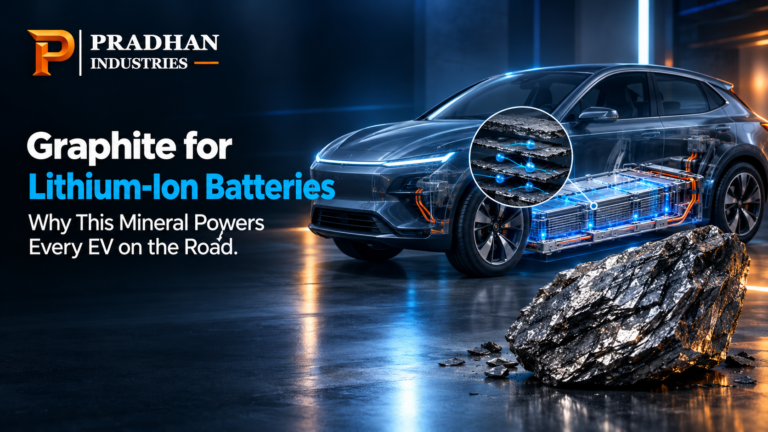
Every Electric Vehicle battery needs a huge amount of graphite—often more than the lithium itself. As India aims to become an EV powerhouse, finding a reliable industrial graphite supplier is the foundation of that dream.
Conclusion: The Future of Graphite Supply
Graphite manufacturing in India has evolved. It’s no longer just about digging rocks; it’s about engineering the materials that power the future. With the right mix of technology and sustainable mining, India is set to become a global leader in the graphite supply chain.
If you need a partner who understands these complexities, Pradhan Industries is ready to serve as your dedicated industrial graphite supplier. To learn more about our high-purity standards, visit our Products Page or check out the latest Mining Regulations.
1. Why does an EV need so much graphite?
Graphite makes up the “Anode” of the battery. It is what allows the battery to store and release energy during charging and driving.
2. Which state is the leader in production?
Currently, Odisha leads the way, followed closely by Jharkhand and Tamil Nadu.
3. Is natural graphite better than synthetic?
Natural flake graphite is often more cost-effective and has a better crystalline structure for certain industrial uses, though synthetic is used when absolute uniformity is needed.