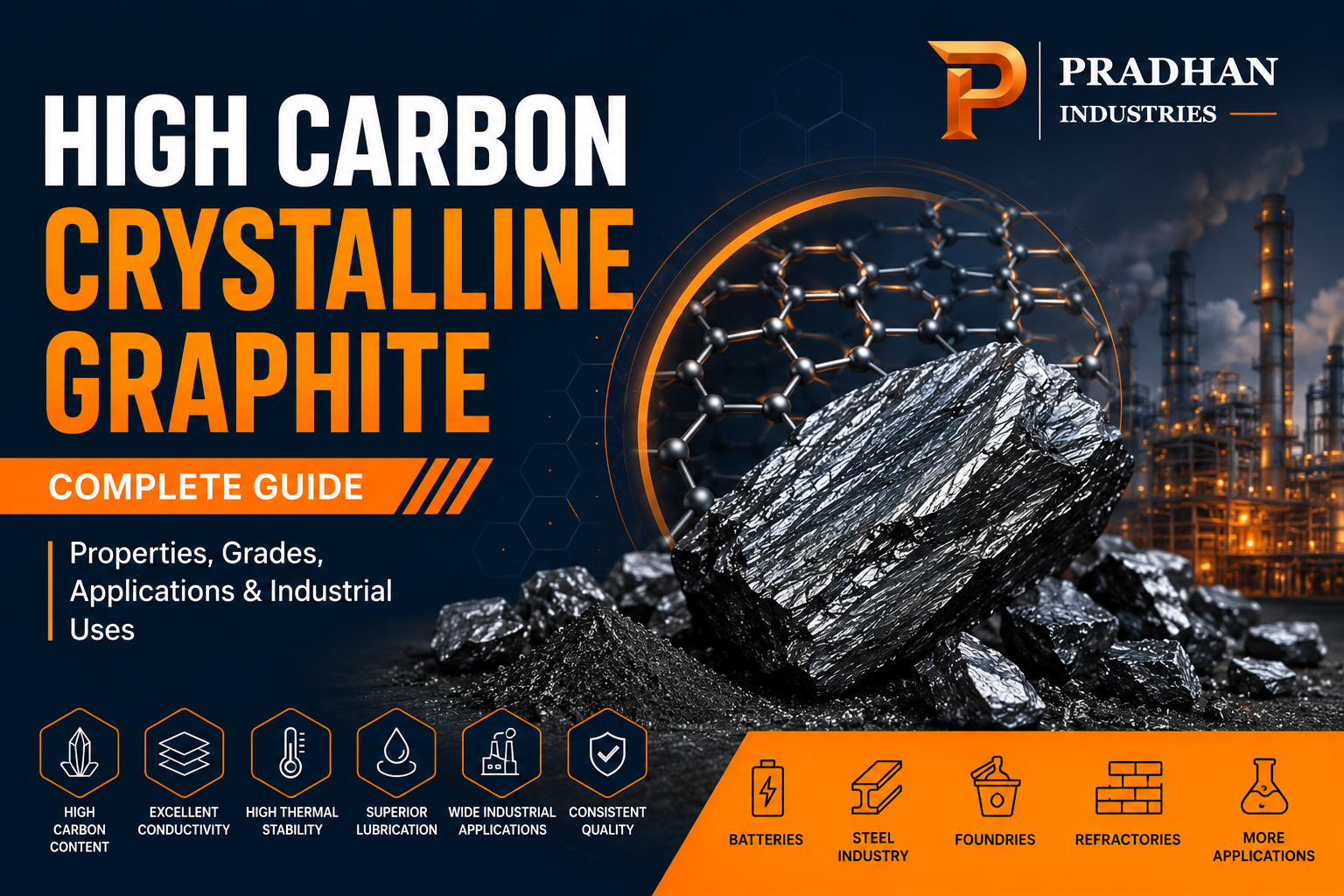
When industrial buyers specify graphite, one number matters before all others: carbon content. High carbon crystalline graphite — natural graphite with 90% or more fixed carbon in a well-ordered crystal structure — is the grade that batteries, steel plants, refractories, and advanced manufacturers reach for when performance cannot be compromised.
Global demand for this material is rising fast, driven by electric vehicles, energy storage, and steel production. Yet many buyers still purchase on price alone and discover the cost of impurities later, inside their own process. This guide explains what high carbon crystalline graphite is, how it is graded, where it performs best, and how to buy it correctly — written by Pradhan Industries, a natural graphite manufacturer in India that processes and tests this material daily.
Definition: High carbon crystalline graphite is natural graphite containing 90% or more fixed carbon, with visibly ordered flake or vein crystal structure. Its high purity and crystal order deliver superior electrical conductivity, thermal performance, and lubrication, making it the preferred grade for batteries, steel, refractories, and electrical applications.
What is High Carbon Crystalline Graphite?
Two words in the name carry all the meaning.
High carbon refers to fixed carbon content of 90% or above. Fixed carbon is what remains after moisture, volatile matter, and ash are accounted for — it is the useful part of the mineral. Anything below that fixed carbon percentage is impurity: silica, alumina, iron oxides, and other minerals that block conductivity, weaken refractories, and contaminate melts.
Crystalline refers to the structure. In crystalline graphite, carbon atoms sit in orderly, layered hexagonal sheets — visible as shiny flakes. This ordered structure is what gives graphite its famous conductivity and lubricity. Amorphous graphite, by contrast, has microscopic crystals and typically only 70–85% carbon.
Put the two together and you get the natural material industry values most: purity plus crystal order. It occurs naturally in metamorphic rock deposits and is concentrated through beneficiation to reach commercial grades of 90–99.9% carbon.
How High-Carbon Crystalline Graphite is Formed
Nature made this material the slow way. Carbon-rich sediments — the remains of ancient organic matter — were buried deep in the earth’s crust hundreds of millions of years ago. There, two forces transformed them:
- Heat, typically above 750°C, deep within metamorphic zones
- Pressure, from kilometres of overlying rock
Over geological time, this combination drove off hydrogen, oxygen, and volatile compounds and forced the remaining carbon atoms to recrystallize into ordered, layered sheets. The result sits today in metamorphic rocks such as schist, gneiss, and marble, as documented in Britannica’s overview of graphite.
The intensity and duration of metamorphism decide crystal size and natural purity. The best deposits — the ones that yield large flakes and naturally high carbon — cannot be replicated in any factory at reasonable cost. That is why high-grade natural graphite ore is classified as a critical mineral by governments worldwide.
Carbon Content Classification
Carbon percentage is the first line of every graphite specification. Here is how the industry classifies grades:
| Grade | Fixed Carbon % | Typical Ash % | Typical Uses |
|---|---|---|---|
| Low carbon | 70–80% | 20–30% | Foundry facings, budget applications |
| Medium carbon | 80–90% | 10–20% | Foundries, general lubricants, recarburizer |
| High carbon | 90–98% | 2–10% | Steel, refractories, batteries, brushes, expandable graphite |
| Ultra high carbon | 98–99.9% | < 2% | Battery anodes, electronics, semiconductors, nuclear |
Two practical notes from our testing lab:
- Carbon percentage alone is not the full story. Two 95% carbon lots can behave differently if their ash chemistry, flake size, or moisture differ. Always read the complete certificate.
- Do not over-specify. Paying for 99% carbon when your refractory recipe performs identically at 94% wastes money. Match the grade to the application.
Physical & Chemical Properties
| Property | High Carbon Crystalline Graphite |
|---|---|
| Fixed carbon | 90–99.9% |
| Ash content | 0.1–10% (grade dependent) |
| Moisture | < 0.5% (properly dried and packed) |
| Crystal structure | Hexagonal, layered sp² carbon sheets |
| Density | 2.09–2.26 g/cm³ |
| Hardness | 1–2 Mohs (soft, self-lubricating) |
| Electrical conductivity | ~10⁴–10⁵ S/m along crystal layers |
| Thermal conductivity | 25–470 W/m·K depending on grade and orientation |
| Heat resistance | Sublimates ~3,600°C; stable to ~2,500°C in inert atmosphere |
| Lubrication | Excellent — layers shear under load, no oil needed |
| Chemical stability | Inert to most acids, alkalis, molten metals; oxidizes in air above |
Chemically, the material is elemental carbon, identical in composition to the record maintained by PubChem. Every performance difference between grades comes from purity and crystal structure, not chemistry.
Advantages of High Carbon Crystalline Graphite
Why pay more for high carbon grades? Because the impurities you remove stop costing you downstream:
- Better conductivity. Ash minerals are insulators. Every point of purity gained is resistance removed — critical for batteries, brushes, and conductive coatings.
- Cleaner melts and stronger refractories. Low ash means less slag contamination in steel and fewer weak points in magnesia-carbon bricks.
- Superior thermal stability. Purer graphite withstands higher temperatures for longer before degrading.
- Excellent lubrication. Well-ordered crystal layers slide more freely than the jumbled structure of low-grade material.
- Longer service life. Crucibles, electrodes, and components made from high carbon graphite simply last longer between replacements.
- Lower total cost. The purchase price is higher, but reduced rejects, longer component life, and stable processing usually make high carbon material the cheaper choice per tonne of finished product.
Industrial Applications
The range of industrial graphite uses for high carbon grades keeps expanding. Here are the sectors that consume the most.
Lithium-Ion Batteries
Battery-grade graphite starts as high carbon natural flake, purified to 99.9%+, spheronized, and coated to become anode material. The International Energy Agency counts graphite among the most supply-critical minerals of the energy transition — each EV battery contains 50–70 kg of it.
Steel Manufacturing
Steel plants consume high carbon graphite powder as a recarburizer to fine-tune carbon levels in molten steel. High purity matters here: ash entering the melt becomes slag and defects.
Refractories
Magnesia-carbon bricks, ladle linings, and continuous-casting components blend high carbon flake graphite for thermal shock resistance and slag corrosion resistance. This remains one of the largest global end-uses, per USGS graphite data.
Foundries
Crucibles for melting non-ferrous metals, mould coatings, and facings rely on high carbon material for clean metal release and repeated thermal cycling.
Carbon Brushes and Electrical Components
Motors, alternators, and generators use high carbon graphite brushes that conduct current while self-lubricating against rotating surfaces.
Lubricants
High-temperature greases, forging compounds, and dry-film lubricants use high purity flake where oils burn off or contaminate.
Expandable Graphite and Fire Protection
Only high carbon large flake can be intercalated into expandable graphite, which swells hundreds of times in volume when heated — the basis of graphite foil, gaskets, and flame-retardant building products.
Emerging and Advanced Uses
Fuel-cell bipolar plates, conductive polymer coatings, heat spreaders in electronics and EVs, semiconductor crucibles, renewable energy components, and nuclear moderators (which demand ultra-high purity) all draw on high carbon crystalline material.
| Industry | Application | Typical Carbon Spec |
|---|---|---|
| Battery / EV | Anode material | 99.9%+ (purified) |
| Steel | Recarburizer | 90–99% |
| Refractory | MgO-C bricks, linings | 94–97% |
| Foundry | Crucibles, coatings | 90–96% |
| Electrical | Carbon brushes, coatings | 96–99% |
| Fire safety | Expandable graphite | 94%+ large flake |
| Lubricants | High-temp greases | 94–99% |
| Electronics / nuclear | Heat spreaders, moderators | 99%+ |
High Carbon Graphite vs Medium Carbon Graphite
| Parameter | High Carbon (90–98%+) | Medium Carbon (80–90%) |
|---|---|---|
| Ash content | 2–10% | 10–20% |
| Electrical conductivity | High | Moderate |
| Refractory performance | Excellent | Acceptable |
| Contamination risk in melts | Low | Higher |
| Suitability for purification to battery grade | Good | Poor economics |
| Price | Higher | Lower |
| Best for | Batteries, steel, refractories, electrical | Foundry facings, general lubricants |
High Carbon Natural Graphite vs Synthetic Graphite
| Parameter | High Carbon Natural Crystalline | Synthetic Graphite |
|---|---|---|
| Origin | Mined and beneficiated natural ore | Manufactured from petroleum coke at ~3,000°C |
| Crystal quality | Large, geologically ordered flakes | Smaller crystallites |
| Purity as supplied | 90–99.9% | 99%+ |
| Energy consumption | Low | Very high |
| Carbon footprint | Lower | Significantly higher |
| Cost | Lower | Roughly 2–3× higher |
| Typical strongholds | Batteries, refractories, expandable graphite, lubricants, brushes | Arc-furnace electrodes, isostatic specialty parts |
For most applications outside arc-furnace electrodes, high carbon natural graphite delivers equivalent performance at a fraction of the cost and carbon footprint — one reason battery supply chains are shifting toward natural material.
How High Carbon Graphite is Processed
Turning ore into a 90%+ carbon product is a disciplined, multi-stage operation:
- Mining. Graphite ore is extracted from open-pit or underground deposits, typically at 5–20% graphite content.
- Crushing. Ore is broken to liberate graphite flakes from host rock.
- Grinding. Staged, gentle grinding frees more graphite while protecting flake size — a broken flake never regains its value.
- Flotation. Graphite’s natural water repellence carries it up on air bubbles while gangue minerals sink. Repeated flotation stages lift carbon content to 90–97%.
- Purification (for ultra-high grades). Chemical or thermal treatment removes residual ash to reach 99–99.9% for battery and electronics grades.
- Drying. Product is dried to below 0.5% moisture.
- Classification. Screening separates precise mesh fractions for different applications.
- Quality control. Every batch is tested for fixed carbon, ash, moisture, volatiles, and particle size distribution.
- Packaging. Moisture-protected bags or bulk containers, labelled by grade and lot for full traceability.
How to Select High Carbon Crystalline Graphite
Use this checklist before you commit to volume:
- Fix your carbon specification honestly. Batteries and electronics need 99%+; refractories usually perform at 94–97%; recarburizer from 90%. Over-specifying wastes money; under-specifying costs quality.
- Read the full certificate, not the headline number. Ash percentage and ash chemistry matter as much as carbon.
- Specify mesh size and demand a particle size distribution report. A nominal mesh number hides the spread that actually affects your process.
- Set a moisture limit — under 0.5% for nearly all industrial uses.
- Compare certificates across multiple past lots. Consistency is the real test of a supplier, not one good sample.
- Check supply capacity and logistics. Confirm the supplier can hold your specification at your annual volume, with export documentation if you buy internationally from a graphite exporter.
- Qualify in stages. Sample first, then a trial lot, then contract volume.
Storage tip: keep graphite in sealed packaging in a dry area. The material itself is stable indefinitely, but absorbed moisture causes weighing errors, processing defects, and flotation of fines.
Why Industries Choose Pradhan Industries
Pradhan Industries supplies high carbon natural crystalline graphite to steel plants, refractory makers, foundries, battery supply chains, and export buyers. What our customers point to:
- Consistent carbon content — advanced multi-stage beneficiation designed to hold fixed carbon within tight tolerances, lot after lot
- Flake protection — grinding and flotation circuits set up to preserve flake size, because broken flakes are lost value
- Strict quality control — every batch tested in-house for carbon, ash, moisture, and particle size distribution, with certificates supplied as standard
- Custom grades and mesh sizes matched to your process rather than a fixed catalogue
- Bulk supply capability and reliable logistics, including complete export documentation for international shipments
- A technical team that answers real questions — grade selection, application troubleshooting, and specification advice before you spend anything
We would rather lose an order than ship material that will not perform in your process. That policy is why our oldest customers are still our customers.
Frequently Asked Questions About High Carbon Crystalline Graphite
What is high carbon crystalline graphite?
It is natural graphite containing 90% or more fixed carbon with a well-ordered, layered crystal structure — usually in flake form. The combination of high purity and crystal order delivers superior conductivity, heat resistance, and lubrication compared with medium carbon or amorphous grades.
What is its carbon percentage?
High carbon grades run from 90% to 98% fixed carbon, while ultra-high carbon grades reach 98–99.9% after chemical or thermal purification. The right percentage depends on your application: refractories typically use 94–97%, while battery anodes require 99.9%+.
Where is high carbon crystalline graphite used?
Major uses include lithium-ion battery anodes, steel recarburizing, magnesia-carbon refractories, foundry crucibles and coatings, carbon brushes, high-temperature lubricants, expandable graphite for fire protection, fuel cells, conductive coatings, and electronics heat management.
Is it suitable for batteries?
Yes — it is the starting material for most natural battery anodes. High carbon flake is purified to 99.9%+, shaped into spheres, and coated before use. Starting with naturally high carbon feedstock lowers purification cost, which is why battery processors specify it.
How is it different from synthetic graphite?
Both are crystalline carbon, but high carbon natural graphite is mined and beneficiated, while synthetic graphite is manufactured from petroleum coke at around 3,000°C. Natural material costs roughly one-half to one-third as much and carries a far smaller carbon footprint, with comparable performance in most applications.
Which industries use it most?
Refractories and steel remain the largest consumers by volume, with batteries the fastest-growing segment. Foundries, friction materials, lubricants, electrical components, fire-retardant products, and electronics make up the remainder of demand.
Why is purity so important?
Impurities are ash — non-conductive minerals that block electron flow, weaken refractories, contaminate steel melts, and shorten component life. Every percentage point of carbon gained is a percentage point of problems removed from your downstream process.
How should graphite be stored?
In sealed, moisture-protected packaging, off the floor, in a dry covered area. Graphite itself does not degrade, but moisture pickup causes weighing errors and processing defects. Keep lot labels intact for traceability and use stock on a first-in, first-out basis.
Does high carbon graphite conduct electricity better?
Yes. Conductivity rises with purity because ash minerals are insulators sitting in the electron path. A 97% carbon flake conducts measurably better than a 90% flake of the same size, which is why electrical and battery applications specify the highest practical grades.
How do I verify a supplier’s carbon claims?
Request batch-wise certificates of analysis showing fixed carbon, ash, moisture, and volatiles, then verify a sample at an independent laboratory using standard proximate analysis. Compare certificates across several past lots — consistency over time matters more than a single impressive number.
Conclusion
High carbon crystalline graphite is where nature’s crystal order meets the purity modern industry demands. With 90%+ fixed carbon in ordered flake structure, it delivers the conductivity batteries need, the cleanliness steel demands, the shock resistance refractories depend on, and the lubrication that keeps machinery running where oil cannot go. Grades, flake size, ash chemistry, and consistency decide how much of that performance reaches your process — which makes supplier selection as important as material selection.
If you are specifying high carbon crystalline graphite for batteries, steel, refractories, or any industrial application, talk to us before you finalize the spec. Contact Pradhan Industries with your application details, and our technical team will recommend the right grade and mesh size, backed by samples and full test certificates — no pressure, just accurate answers.