Understanding the Role of Graphite in EV Batteries
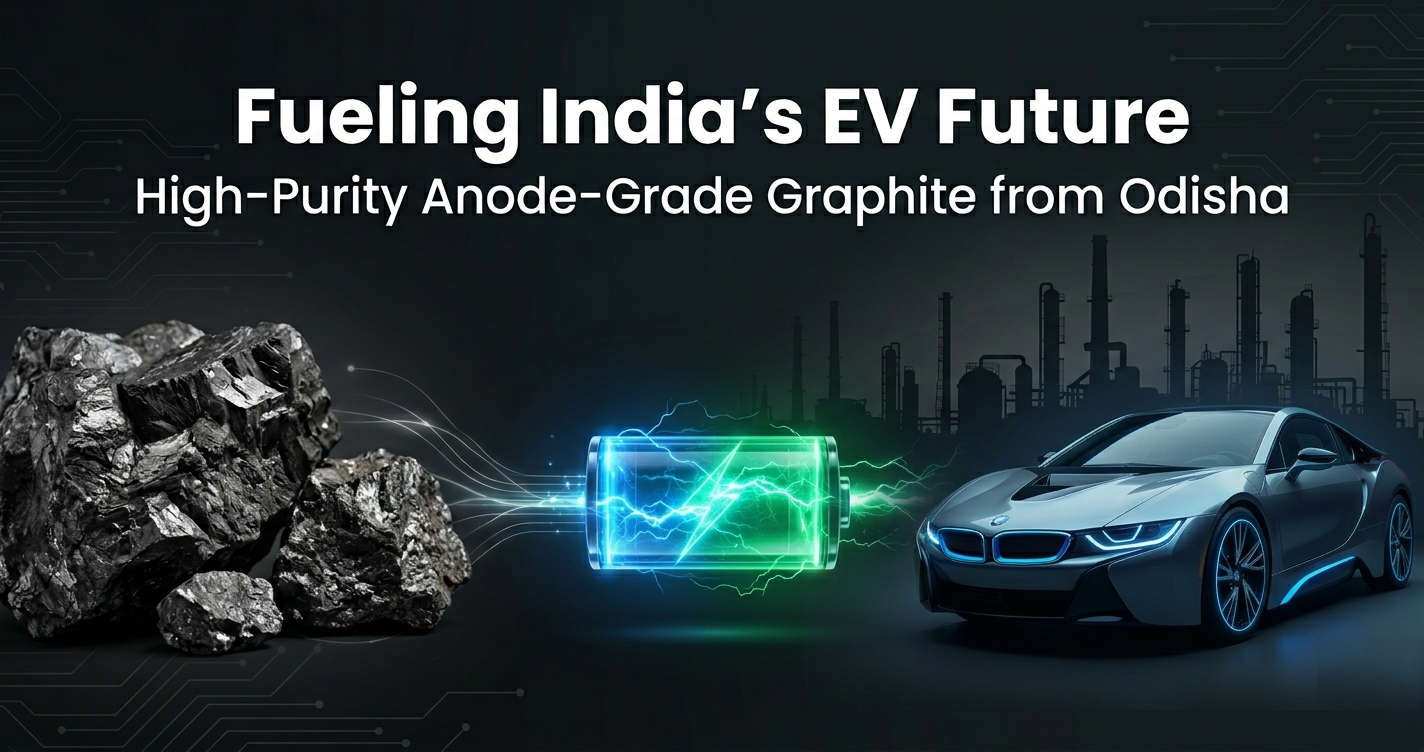
High-Purity Anode-Grade Graphite from Odisha is powering India’s fast-growing electric vehicle industry with advanced battery materials and sustainable energy solutions. As the demand for EVs and lithium-ion batteries continues to rise, Odisha is emerging as a major hub for graphite mining, battery-grade graphite processing, and clean energy innovation. High-Purity Anode-Grade Graphite from Odisha plays a critical role in improving battery efficiency, charging performance, energy density, and long-term energy storage for electric vehicles across India.
Electric vehicles may look sleek and futuristic on the outside, but their true power lies hidden inside the battery pack. Most consumers assume lithium is the primary ingredient that powers EV batteries, yet graphite actually plays a much larger structural role in lithium-ion battery technology. Graphite is used in the anode, the part of the battery responsible for storing and releasing energy during charging and discharging cycles. Without high-quality graphite, battery efficiency drops dramatically, charging slows down, and battery lifespan suffers significantly.
Think of a lithium-ion battery like a busy railway station. Lithium ions are the passengers moving back and forth, while graphite acts as the railway platform that safely accommodates them. If the platform is weak or poorly designed, the entire transportation system collapses. That is exactly why battery manufacturers prioritize high-purity graphite for advanced EV batteries and energy storage systems.
Industry analysts estimate that graphite-based anodes currently dominate nearly 75% of the EV battery anode market. Natural graphite, especially when purified to battery-grade quality, offers excellent conductivity, thermal stability, cost efficiency, and sustainability advantages. Compared to synthetic alternatives, natural graphite also supports cleaner and more environmentally responsible battery manufacturing when processed properly.
Why Graphite Matters More Than Lithium
Lithium gets media attention because it sounds futuristic, but graphite often represents a larger share of battery material by weight. A single EV battery can require significantly more graphite than lithium. This makes graphite one of the most strategically important minerals in the global clean energy transition.
As India pushes for domestic battery manufacturing, the demand for high-purity graphite is expected to surge. Reports indicate that anode materials already represent a significant percentage of battery material demand in India’s growing lithium-ion ecosystem.
How Anode Materials Influence Battery Performance
The quality of anode-grade graphite directly affects several performance metrics, including:
| Battery Feature | Impact of High-Purity Graphite |
|---|---|
| Charging Speed | Faster ion movement |
| Battery Life | Improved cycle durability |
| Energy Density | Higher storage capacity |
| Thermal Stability | Better heat resistance |
| Efficiency | Lower energy loss |
This is why global automakers and battery manufacturers are aggressively securing graphite supply chains. Whoever controls battery materials will influence the future of electric mobility.
Odisha’s Rich Natural Advantage
Odisha has long been known as one of India’s mineral-rich states. Iron ore, bauxite, coal, and chromite have powered industrial growth for decades. Now, graphite is stepping into the spotlight as the next strategic resource that could redefine the state’s economic future.
What makes Odisha especially attractive is not just the presence of graphite deposits, but the broader industrial ecosystem surrounding them. Ports, power infrastructure, manufacturing zones, and mineral processing expertise already exist. That means Odisha does not need to build an industrial foundation from scratch. Instead, it can adapt and expand its capabilities to support the EV battery supply chain.
The state is also witnessing increasing investments in battery-related manufacturing. Companies are building facilities connected to EV materials, battery foils, and advanced manufacturing infrastructure.
Graphite Deposits and Mineral Strength
Odisha’s geology provides strong potential for natural graphite mining and processing. Natural graphite extracted from mineral-rich regions can be upgraded into battery-grade graphite through advanced purification and shaping processes.
The growing interest in Odisha’s mineral ecosystem is tied closely to India’s goal of reducing dependence on imported battery materials. Currently, a substantial portion of India’s anode materials are still sourced internationally.
Industrial Ecosystem Supporting Battery Materials
One major advantage Odisha holds is integration. Manufacturing ecosystems work best when raw materials, logistics, power supply, and processing infrastructure are located close together. Odisha already supports large-scale metal and industrial operations, making it easier to expand into battery materials manufacturing.
Recent industrial developments in Odisha include battery-grade aluminium foil manufacturing facilities designed to support EV battery production. This creates a strong foundation for a localized EV battery ecosystem where multiple supply chain components operate within the same industrial corridor.
The Rising Demand for Anode-Grade Graphite in India
India’s EV market is no longer growing slowly — it is accelerating rapidly. Government incentives, rising fuel prices, consumer awareness, and environmental concerns are all driving adoption. Electric scooters and three-wheelers are particularly leading the transition because they offer lower operating costs and practical urban mobility solutions.
According to industry reports, India recorded nearly 1.95 million EV sales in 2024, averaging over 5,000 EVs sold daily. As EV production rises, battery demand rises alongside it, and every battery needs graphite.
India’s EV Growth Story
India’s EV market expansion resembles a snowball rolling downhill. At first, growth seemed gradual. Now momentum is building rapidly. Two-wheelers dominate the market, but passenger EVs and commercial electric fleets are also gaining traction.
This surge creates a massive opportunity for domestic battery material production. If India continues importing critical materials, the country risks replacing oil dependence with mineral dependence. That is why policymakers and manufacturers are prioritizing localized supply chains.
Battery Manufacturing Expansion Across India
Several companies are investing heavily in anode materials and battery manufacturing infrastructure. Indian firms are scaling synthetic graphite and advanced anode material production to reduce import reliance.
The broader battery materials market is also expanding rapidly, with EVs accounting for a majority of demand in India’s energy storage sector.
What Makes High-Purity Graphite Different
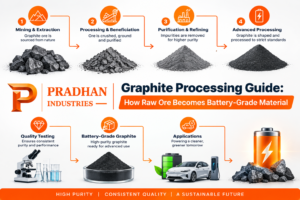
Not all graphite is suitable for EV batteries. Raw graphite extracted from mines cannot simply be inserted into a lithium-ion cell. It must undergo multiple processing stages before becoming battery-grade material.
This transformation is where the real technological challenge begins. Producing anode-grade graphite requires purification, micronization, spheronization, and coating processes that demand precision engineering and advanced manufacturing expertise.
Purification and Spheronization Processes
Battery-grade graphite must achieve extremely high purity levels because even tiny impurities can reduce battery performance. Advanced purification removes unwanted minerals and contaminants.
After purification, graphite particles are shaped into spherical forms to improve packing density and conductivity. This process is called spheronization. It may sound simple, but it requires sophisticated equipment and technical know-how.
Some companies are also developing environmentally friendlier purification technologies to reduce chemical waste and improve sustainability.
Performance Benefits in Lithium-Ion Batteries
High-purity graphite offers several key benefits:
- Improved battery charging efficiency
- Better thermal management
- Longer battery lifespan
- Higher energy density
- Reduced degradation over time
For EV manufacturers, these advantages translate directly into better driving range, safer batteries, and stronger consumer confidence.
Odisha’s Opportunity in the Global Battery Supply Chain
The global battery supply chain is undergoing a dramatic transformation. Countries are scrambling to secure critical minerals and reduce dependence on concentrated supply sources. China currently dominates much of the graphite processing industry, creating supply chain vulnerabilities for manufacturers worldwide.
India now has a rare opportunity to position itself as an alternative source for high-purity graphite and advanced battery materials.
Reducing India’s Dependence on Imports
India still imports a significant portion of its battery-grade anode materials. Developing domestic graphite processing facilities in Odisha could strengthen national energy security while reducing trade vulnerabilities.
This is similar to building a local food supply chain instead of relying entirely on imported grain. Domestic control improves resilience, pricing stability, and long-term sustainability.
Competing with China in Critical Minerals
Global concerns around concentrated mineral supply chains are encouraging countries to diversify sourcing strategies. Discussions around graphite export restrictions and trade tensions have increased international interest in alternative suppliers.
Odisha could become a strategic player in this transition if India successfully scales battery-grade graphite processing capabilities.
Government Policies Driving the Industry
Government policy plays a huge role in shaping emerging industries. India’s EV and battery manufacturing ecosystem is receiving strong support through incentives, subsidies, and industrial development schemes.
PLI Schemes and EV Incentives
India’s Production Linked Incentive (PLI) schemes are encouraging domestic advanced chemistry cell manufacturing and EV ecosystem development. These policies aim to attract investments, reduce imports, and build local supply chains for critical battery components.
The government’s push toward electric mobility is also driving demand for locally sourced battery materials.
Odisha’s Industrial Policies
Odisha has consistently promoted industrial investment through infrastructure development, port connectivity, and manufacturing support. The state’s growing role in battery material infrastructure suggests strong long-term potential for EV-related manufacturing expansion.
Challenges in Scaling Anode-Grade Graphite Production
Despite the opportunities, building a domestic anode-grade graphite industry is not easy. The journey involves technological, environmental, and financial challenges.
Technology and Processing Barriers
Producing battery-grade graphite requires advanced purification technology, specialized machinery, and technical expertise. Many processing technologies remain concentrated in a few countries, creating barriers for new entrants.
Reports indicate that India’s anode material production ecosystem is still in an early development phase.
Environmental and Sustainability Concerns
Mining and graphite processing must also address sustainability concerns. Water use, chemical waste, and energy consumption require responsible management. Companies investing in cleaner purification technologies may gain long-term competitive advantages.
Sustainability is becoming just as important as production capacity in the global EV supply chain.
Investment and Business Opportunities
The graphite opportunity extends beyond mining companies. Entire ecosystems can emerge around battery materials, processing technology, logistics, recycling, and advanced manufacturing.
Startups and Emerging Players
Indian companies are increasingly entering the anode material sector. Investments worth thousands of crores are being announced for synthetic graphite and advanced battery material facilities.
This creates opportunities for:
- Mineral processing companies
- EV battery manufacturers
- Industrial equipment suppliers
- Recycling startups
- Export-focused businesses
Export Potential for Indian Graphite
If India develops large-scale high-purity graphite production, the country could eventually become an exporter of battery materials. Global EV demand continues rising, and manufacturers are actively searching for diversified supply chains.
Odisha’s ports and industrial infrastructure could support international exports of processed graphite materials to battery manufacturers worldwide.
Future Outlook for Odisha’s Graphite Industry
The next decade could redefine Odisha’s role in India’s industrial economy. Traditionally associated with metals and mining, the state now has the opportunity to become a strategic hub for advanced energy materials.
The future of electric mobility depends not just on vehicle manufacturing but on secure access to critical battery materials. Graphite sits at the center of this transformation. As India accelerates EV adoption, domestic battery manufacturing will require enormous volumes of high-purity graphite.
Odisha’s combination of mineral wealth, industrial infrastructure, government support, and strategic location positions it strongly within this evolving landscape. The state has the potential to move beyond raw mineral extraction and become a value-added processing hub for advanced battery materials.
The transition will not happen overnight. It requires investment, technology transfer, sustainability practices, and long-term planning. Yet the momentum is undeniable. India’s EV revolution is already underway, and Odisha’s graphite resources may become one of the silent forces powering that journey.
Conclusion
Electric vehicles represent far more than a transportation trend. They symbolize a shift toward cleaner energy, technological independence, and industrial transformation. At the heart of this shift lies an often-overlooked material — graphite.
High-purity anode-grade graphite is essential for lithium-ion batteries, and Odisha has the potential to become one of India’s most important supply centers for this critical resource. With growing EV adoption, battery manufacturing expansion, and supportive government policies, the demand for advanced graphite materials is set to rise dramatically.
The road ahead includes challenges involving technology, sustainability, and global competition. Still, Odisha’s natural resources and industrial ecosystem provide a strong foundation for growth. If India successfully develops a domestic battery materials supply chain, Odisha could play a defining role in powering the nation’s electric future.