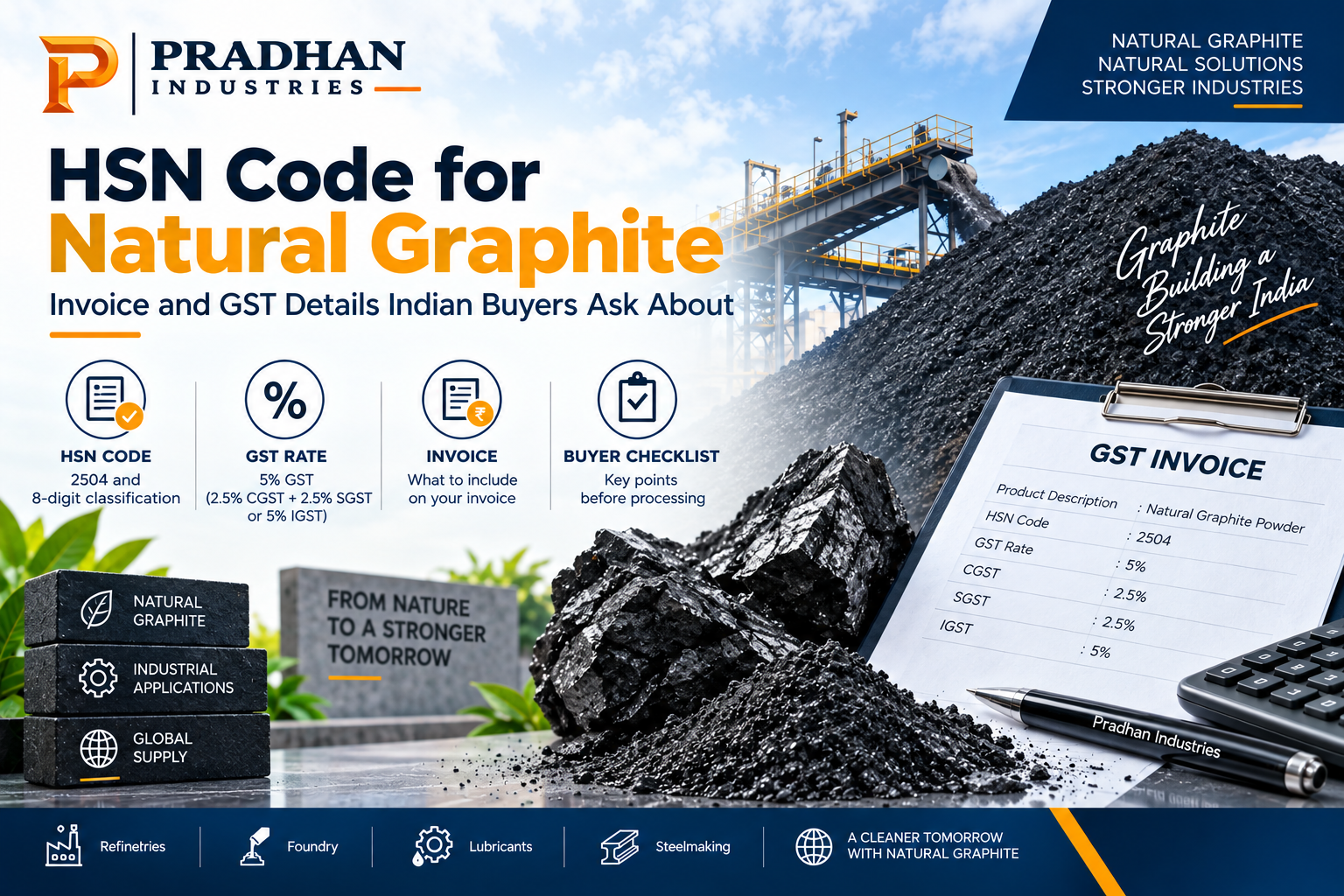
If you buy or sell natural graphite in India, one of the first questions that comes up is, “What is the HSN code for natural graphite?”
The primary HSN heading for natural graphite is 2504. Under the current CBIC GST rate schedule, natural graphite under heading 2504 is listed at 5% GST, comprising 2.5% CGST and 2.5% SGST/UTGST for applicable intra-state supplies, or 5% IGST for applicable inter-state supplies.
However, graphite comes in different forms.
These include natural crystalline graphite, flake graphite, amorphous graphite, graphite powder, and micronized graphite. Therefore, the exact 6-digit or 8-digit classification should be checked against the actual product and applicable tariff description.
Hoc dux explicat codicem HSN graphiti naturalis in India, et rates GST.
Explicat etiam communes classificationes HSN, et descriptiones in cautionibus.
Explicat rationes cautionum electronicarum et graphitum naturale contra artificiale.
Ostendit etiam quae examina emptores et suppeditatores Indi facere debeant.
Haec fiunt antequam cautionem graphiti tractent.
Important: HSN classification and GST treatment can depend on the exact product, form, processing and applicable tariff provisions. Always check the current classification in the official GST or CBIC system.You can also confirm it with a qualified tax professional before issuing a high-value or unusual invoice.
What Is the HSN Code for Natural Graphite in India?
The primary HSN heading for natural graphite is
HSN 2504 – Natural Graphite
Heading 2504 falls under Chapter 25 of the tariff structure, covering mineral products.
For Indian businesses buying or selling natural graphite, 2504 is the primary heading to check. However, the complete HSN may require a more detailed classification depending on the type and form of graphite being supplied.
The GST portal provides an official Search HSN Code facility that allows taxpayers to search by HSN number or by trade, commercial, or technical product description. The system has been designed to help users identify the relevant technical HSN description from commonly used product descriptions.
Therefore, businesses should not select an 8-digit HSN simply because another supplier uses the same code.
What Is the GST Rate on Natural Graphite?
The current CBIC GST rate schedule lists:
HSN 2504 – Natural graphite – 5% GST
The schedule specifies:
- CGST: 2.5%
- SGST/UTGST: 2.5%
- IGST: 5%
Natural Graphite GST Rate
| Supply Type | GST Treatment |
|---|---|
| Intra-state supply | 2.5% CGST + 2.5% SGST/UTGST |
| Inter-state supply | 5% IGST |
| Natural graphite heading | 2504 |
| Total GST rate | 5% |
The actual tax treatment depends on the nature and place of supply and the classification applicable to the product.
GST Calculation Example for Natural Graphite
Suppose the taxable value of a qualifying natural graphite order is ₹100,000.
Intra-State Sale
- Taxable value: ₹100,000
- CGST @ 2.5%: ₹2,500
- SGST @ 2.5%: ₹2,500
- Total GST: ₹5,000
- Total invoice value: ₹105,000
Inter-State Sale
- Taxable value: ₹100,000
- IGST @ 5%: ₹5,000
- Total invoice value: ₹105,000
These examples assume the product qualifies for the applicable 5% GST treatment under heading 2504.
What Is HSN 250410 for Natural Graphite?
HSN 250410 relates to natural graphite in powder or flakes.
This classification is particularly relevant for businesses supplying:
- Natural graphite powder
- Natural flake graphite
- Crystalline graphite powder
- Amorphous graphite powder
- Other natural graphite in powder/flakes
The more detailed tariff classification should be checked against the actual product.
For a better understanding of different graphite grades, you can also explore Pradhan Industries’ Crystalline Graphite Grades article.
This is a useful internal link. Buyers researching HSN classifications may also want to understand differences in crystalline graphite grades.
What Is HSN 25041010 for Graphite?
HSN 25041010 is listed for:
Graphite, crystalline
This classification can be relevant to qualifying natural crystalline graphite supplied in powder or flake form.
Natural crystalline or flake graphite is used in a range of industrial applications, including:
- Refractory formulations
- Foundry materials
- Lubricants
- Carbon-containing formulations
- Industrial applications requiring graphite’s thermal or lubricating properties
A supplier should verify that the actual material corresponds to the tariff description before using the 8-digit classification on an invoice.
What Is HSN 25041020 for Graphite?
HSN 25041020 is listed for:
Graphite, amorphous
Natural amorphous graphite has different characteristics from crystalline flake graphite and can be supplied for applications such as
- Refractories
- Foundry materials
- Lubricants
- Carbon additives
- Industrial coatings
- Other industrial formulations
For invoicing purposes, a description such as
Natural Amorphous Graphite Powder
is more informative than simply:
Graphite Powder
The invoice description should always reflect the actual material supplied.
What Is HSN 25041090?
HSN 25041090 covers:
Other natural graphite in powder or flakes
This classification may be relevant where a natural graphite product in powder/flakes does not fall under the more specific crystalline or amorphous entries.
The supplier should determine the classification from the actual product rather than choosing the code based only on convenience or a previous invoice.
What Is HSN 25049010 for Micronized Graphite?
Another HSN classification encountered in the natural graphite trade is
25049010 – Graphite, micronized
Micronized graphite should not automatically be treated as identical to every product commercially described as “graphite powder.”
This distinction is important because the tariff structure separately identifies micronized graphite.
Therefore, if a supplier manufactures or sells micronized natural graphite, the applicable tariff description should be checked before finalizing the invoice.
Natural Graphite vs Artificial Graphite: Why the HSN Is Different
One of the most important distinctions in graphite classification is whether the product is natural graphite or artificial graphite.
Natural graphite is covered under:
HSN heading 2504
Artificial graphite is separately covered under:
HSN heading 3801
The current CBIC GST schedule lists natural graphite under heading 2504 at 5% and separately lists heading 3801, covering artificial graphite and specified graphite/carbon preparations, at 18%.
Natural vs. Artificial Graphite
| Product | HSN Heading | GST Rate |
|---|---|---|
| Natural graphite | 2504 | 5% |
| Artificial graphite | 3801 | 18% |
| Graphite-based preparation | Depends on product | Verify |
| Finished graphite article | Depends on the article | Verify |
Therefore, a buyer should not classify every product called “graphite” under HSN 2504.
Is Graphite Powder Automatically HSN 2504?
No.
The commercial term “graphite powder” alone does not establish the complete tariff classification.
Before selecting the HSN, consider:
- Is the graphite natural or artificial?
- Is it crystalline or amorphous?
- Is it powder or flakes?
- Is it micronized?
- Has it undergone additional processing?
- Is it a graphite preparation?
- Is it a finished graphite product?
- Does another tariff heading specifically describe the product?
The official GST HSN search functionality allows taxpayers to search using either an HSN number or a trade/commercial/technical description.
Does Graphite Purity Change the HSN Code?
Not automatically.
Graphite suppliers may offer different grades based on technical parameters such as
- Fixed carbon
- Ash
- Moisture
- Volatile matter
- Particle size
- Flake size
A change from 90% to 95% or 98% fixed carbon does not, by itself, automatically create a different HSN classification.
The tariff classification should instead be evaluated against the actual product and applicable tariff description.
For buyers interested in graphite processing and quality, you can naturally link to the Graphite Beneficiation Process in Odisha.
This provides additional technical context without interrupting the tax-related discussion.
Does Mesh Size Change the HSN Code?
Not necessarily.
Natural graphite can be supplied in different particle sizes, including
- 50 mesh
- 100 mesh
- 200 mesh
- 325 mesh
- Fine graphite powder
- Micronized graphite
Changing particle size does not automatically mean that the HSN changes.
However, because micronized graphite has a specific tariff entry, suppliers should distinguish between ordinary powder/flakes and products that meet the applicable micronized description.
The exact classification should be verified before invoicing.
What HSN Code Should Be Printed on a Natural Graphite Invoice?
The HSN printed on the invoice should correspond to the actual product being supplied.
For example:
| Description | HSN | Quantity | GST |
|---|---|---|---|
| Natural Crystalline Graphite Powder | 25041010* | 1,000 kg | 5% |
*The supplier should verify that this is the correct classification for the actual product.
If the material is natural amorphous graphite, a different classification may apply.
If it is micronized graphite, the applicable tariff entry should also be checked.
What Product Description Should Be Used on a Graphite Invoice?
A clear invoice description makes the product easier to identify.
Instead of:
Graphite
Consider:
Natural Crystalline Graphite Powder – Fixed Carbon 95%
or:
Natural Amorphous Graphite Powder
or:
Natural Flake Graphite – Industrial Grade
or:
Natural Micronised Graphite
The description should match the actual product specification and supporting documentation.
For industrial B2B sales, additional information may include:
- Product grade
- Fixed carbon
- Particle size
- Mesh size
- Quantity
- Packaging
- Batch or lot number
Detailed technical properties can be supplied separately through a Certificate of Analysis (COA) or Technical Data Sheet.
What Is the Difference Between HSN and GST Rate?
HSN and GST rates are related, but they are not the same thing.
HSN identifies the product classification.
The GST rate determines the tax treatment applicable to that classification.
For example:
2504 → Natural graphite → 5% GST
while:
3801 → Artificial graphite and specified graphite/carbon preparations → 18% GST
The classification should therefore be established first and the applicable tax treatment then verified.
Can Natural Graphite Buyers Claim Input Tax Credit?
A GST-registered business may generally be eligible to claim Input Tax Credit on eligible business purchases, subject to the applicable conditions and restrictions under GST law.
For example, a manufacturer purchasing natural graphite as a raw material may potentially claim an eligible input tax credit.
However, ITC eligibility is not determined by HSN alone.
Businesses should maintain appropriate documentation, including:
- Tax invoice
- Correct HSN
- Supplier GSTIN
- Buyer GSTIN
- Tax amount
- Proof of receipt
- Accounting records
- Applicable e-invoice/e-way bill documentation
The specific ITC position should be verified with a qualified GST professional for the transaction.
How Can You Verify the HSN Code for Natural Graphite?
The GST portal provides an official Search HSN Code functionality.
The revamped facility allows taxpayers to search using:
- HSN number
- Trade description
- Commercial description
- Technical description
The GST guidance states that the search can be performed using the description of goods or services and can return relevant HSN codes and descriptions.
This is particularly useful when:
- Launching a new graphite product
- Changing product specifications
- Introducing micronized graphite
- Preparing a new invoice
- A buyer requests an 8-digit HSN
- An old HSN needs verification
For another HSN lookup option, the IRIS IRP HSN/SAC Finder allows users to search using an HSN/SAC number or description and supports 2-, 4-, 6-, and 8-digit searches.
What Documents Should a Natural Graphite Supplier Provide?
A professional B2B graphite transaction may require more than a tax invoice.
Tax Invoice
The invoice should clearly identify the seller, buyer, product, quantity, value, HSN, and applicable GST.
Certificate of Analysis
A COA can provide technical information such as
- Fixed carbon
- Ash
- Moisture
- Volatile matter
- Particle size
- Flake size
- Relevant impurities
Technical Data Sheet
A TDS can include:
- Product type
- Typical chemical analysis
- Physical properties
- Particle-size information
- Recommended applications
- Packaging information
For customers interested in how natural graphite is processed before reaching industrial applications, the Graphite Beneficiation Process in Odisha page provides useful additional information.
E-Invoice
Where applicable, suppliers must follow the prevailing e-invoicing requirements.
What About E-Invoicing for Natural Graphite?
E-invoicing is a separate compliance issue from HSN classification.
Where a supplier is covered by applicable e-invoicing requirements, the required invoice information must be reported through the authorized system.
The GST ecosystem provides HSN search and validation tools, while the IRP system provides HSN/SAC search functionality.
Before generating an e-invoice, businesses should check:
- Product description
- HSN
- Quantity
- Taxable value
- GST rate
- GSTIN
- Nature of supply
This helps reduce avoidable classification and reconciliation issues.
Does the Application of Natural Graphite Change Its HSN?
The intended end use alone does not automatically determine the HSN.
Natural graphite may be sold for:
- Refractory applications
- Foundry materials
- Lubricants
- Crucibles
- Friction materials
- Carbon additives
- Industrial coatings
If the product remains classifiable as natural graphite under heading 2504, its intended application does not automatically create a different HSN.
However, if graphite is processed into a different manufactured product or preparation, another tariff heading may apply.
This is why buyers should distinguish between:
Natural graphite raw material
and
Manufactured graphite-based products.
Common HSN Mistakes Made by Graphite Buyers and Sellers
Mistake 1: Using HSN 3801 for Natural Graphite
Natural graphite is covered under heading 2504, while artificial graphite is separately covered under heading 3801.
Mistake 2: Writing Only “Graphite” on the Invoice
A generic description can make the actual product difficult to identify.
Mistake 3: Assuming Every Graphite Powder Uses the Same 8-Digit HSN
Crystalline, amorphous, other powder/flakes, and micronized graphite have different tariff descriptions.
Mistake 4: Ignoring Micronized Graphite
Micronized graphite should be checked against its specific tariff description rather than automatically being treated as ordinary graphite powder.
Mistake 5: Reusing an Old HSN Without Verification
HSN databases and GST reporting systems can be updated. The GST portal provides current HSN search and validation functionality.
Mistake 6: Confusing HSN With GST Rate
HSN identifies the product; GST provisions determine the tax treatment.
Mistake 7: Assuming Fixed Carbon Determines HSN
Fixed carbon is a technical specification. It does not, by itself, establish the tariff classification.
Natural Graphite HSN Code: Quick Reference
| HSN Code | Description | GST* |
|---|---|---|
| 2504 | Natural graphite | 5% |
| 250410 | Natural graphite in powder or flakes | 5% |
| 25041010 | Graphite, crystalline | 5% |
| 25041020 | Graphite, amorphous | 5% |
| 25041090 | Other natural graphite in powder/flakes | 5% |
| 25049010 | Graphite, micronized | 5% |
| 25049090 | Other natural graphite | 5% |
*The 5% GST treatment shown for heading 2504 follows the current CBIC GST rate schedule. The exact classification and tax treatment should always be verified for the specific product and transaction.
Practical HSN Checklist for Natural Graphite Suppliers
Before issuing an invoice, check:
| Check | Question |
|---|---|
| 1 | Is the material natural or artificial graphite? |
| 2 | Is it powder, flakes, or another form? |
| 3 | Is it crystalline or amorphous? |
| 4 | Is it micronized? |
| 5 | Which HSN matches the actual product? |
| 6 | Is the current GST treatment applicable? |
| 7 | Is the transaction intra-state or inter-state? |
| 8 | Should CGST/SGST or IGST apply? |
| 9 | Are the supplier and buyer GSTINs correct? |
| 10 | Is the product description clear? |
| 11 | Is e-invoicing applicable? |
| 12 | Does the buyer require a COA or TDS? |
The GST portal also provides an HSN master/product functionality that can help taxpayers maintain product-related HSN information for reporting.
Natural Graphite Invoice Example
Suppose an Indian supplier sells 1,000 kg of qualifying natural crystalline graphite powder to a customer in another Indian state.
A simplified invoice could look like this:
| Particular | Details |
|---|---|
| Product | Natural Crystalline Graphite Powder |
| HSN | 25041010* |
| Quantity | 1,000 kg |
| Rate | ₹50/kg |
| Taxable Value | ₹50,000 |
| IGST | 5% |
| IGST Amount | ₹2,500 |
| Total Invoice Value | ₹52,500 |
*The supplier should verify that 25041010 is the correct classification for the actual product before invoicing.
For an applicable intra-state transaction, the 5% GST would generally be divided into 2.5% CGST and 2.5% SGST/UTGST under the current schedule.
Why Correct HSN Classification Matters for Graphite Businesses
Correct HSN classification helps businesses maintain consistency across:
Purchase Order → Tax Invoice → GST Reporting → E-Invoice → Accounting → Logistics → Customs Documentation
This becomes particularly important for graphite suppliers handling multiple grades and product forms.
A supplier may sell:
- Natural crystalline graphite
- Natural amorphous graphite
- Natural flake graphite
- Graphite powder
- Micronized graphite
These products should not automatically receive the same 8-digit HSN simply because they are all commercially called graphite.
A standardized product master can make the process easier.
Recommended Product Master Fields
- Product name
- Product grade
- Natural/artificial classification
- Physical form
- Fixed carbon
- Particle size
- HSN
- GST rate
- Standard invoice description
- Packaging
- UQC
This can reduce avoidable errors between sales, accounts, and dispatch teams.
What Should Indian Buyers Check on a Graphite Invoice?
Before accepting a natural graphite invoice, the purchasing or accounts team can check:
Product Description
Does the invoice accurately describe the graphite supplied?
HSN
Does the HSN correspond to the actual product?
GST Rate
Is the applicable GST treatment correct?
GSTIN
Are the supplier and buyer GSTIN details correct?
Quantity
Does the quantity match the purchase order and delivery documentation?
Price
Does the basic price match the agreed quotation?
Tax
Are CGST/SGST or IGST calculations correct?
Technical Documentation
Is the COA available where required?
These simple checks can help reduce avoidable invoice and reconciliation problems.
Natural Graphite HSN vs. Artificial Graphite HSN
The distinction can be summarized as follows:
| Feature | Natural Graphite | Artificial Graphite |
|---|---|---|
| Main HSN heading | 2504 | 3801 |
| Material | Naturally occurring graphite | Artificial/manufactured graphite |
| Common forms | Powder, flakes, and other natural forms | Various manufactured forms/preparations |
| GST rate in current CBIC schedule | 5% | 18% |
| Classification | Based on the applicable natural graphite tariff item | Based on applicable artificial graphite/preparation tariff item |
CBIC’s current GST rate schedule separately lists heading 2504 and heading 3801.
Conclusion: HSN Code for Natural Graphite in India
The key HSN heading for natural graphite in India is 2504.
The current CBIC GST schedule lists natural graphite under heading 2504 at 5% GST, with applicable intra-state supplies generally involving 2.5% CGST + 2.5% SGST/UTGST and applicable inter-state supplies involving 5% IGST.
For more detailed classification, natural graphite products can fall under different tariff items depending on their form and characteristics. Examples include crystalline, amorphous, and other natural graphite in powder/flakes and micronized graphite.
The most important point for Indian buyers, suppliers, and accounts teams is
Do not determine an HSN code from the word “graphite” alone.
First identify whether the material is natural or artificial, determine its physical form and processing, review the applicable tariff description, and verify the current HSN through the official GST system.
For B2B graphite transactions, maintaining a standardized product master containing the product name, technical grade, HSN, GST rate, and invoice description can make invoicing easier and reduce avoidable classification errors.
Frequently Asked Questions
What is the HSN code for natural graphite in India?
The primary HSN heading is 2504 – Natural graphite. More specific tariff classifications apply depending on the type and form of the natural graphite.
What is the GST rate on natural graphite?
The current CBIC GST schedule lists natural graphite under heading 2504 at 5% GST.
What is HSN 25041010?
HSN 25041010 is the tariff classification for graphite, crystalline, under natural graphite in powder or flakes.
What is HSN 25041020?
HSN 25041020 is the tariff classification for graphite, amorphous, under natural graphite in powder or flakes.
What is HSN 25049010?
HSN 25049010 is the tariff classification for graphite, micronized.
Is artificial graphite covered under HSN 2504?
No. Natural graphite is under heading 2504, while artificial graphite is separately covered under 3801. The current CBIC schedule lists heading 3801 at 18%.
Does 95% fixed carbon automatically determine the HSN?
No. Fixed carbon is a technical product specification and does not, by itself, determine the complete HSN classification.
Does graphite mesh size automatically change the HSN?
No. Particle size alone does not automatically determine the HSN, although specific tariff descriptions such as “micronized graphite” should be considered.
Where can I verify an HSN code?
The GST portal provides an official Search HSN Code facility that allows taxpayers to search using an HSN number or product description.