Introduction
Walk into any well-run procurement office — whether it belongs to a steel plant, a battery manufacturer, or a specialty foundry — and you’ll find that graphite is rarely a single line item. There are grades, particle sizes, purity levels, and sourcing considerations that can mean the difference between a process that runs cleanly and one that causes headaches for months.
Yet graphite selection is surprisingly easy to get wrong. Many buyers default to the cheapest available option, or simply reorder what their predecessor specified without understanding why. This guide cuts through the noise and explains what actually separates one graphite grade from another — and which applications each is genuinely suited for.
Whether you’re sourcing industrial graphite grades for a refractories line, evaluating natural vs synthetic graphite for a battery anode, or simply trying to get more value out of your graphite spend, this article will help you make a more informed decision.
What Are Industrial Graphite Grades and Why Do They Matter?
Graphite is a naturally occurring form of carbon, but the way it’s formed — or manufactured — produces dramatically different structures, and those structures determine performance. A coarse amorphous graphite that works perfectly as a refractory coating would be completely wrong for an EDM electrode. A high-purity synthetic grade that excels in lithium-ion batteries would be wasteful overkill for a basic lubricant application.
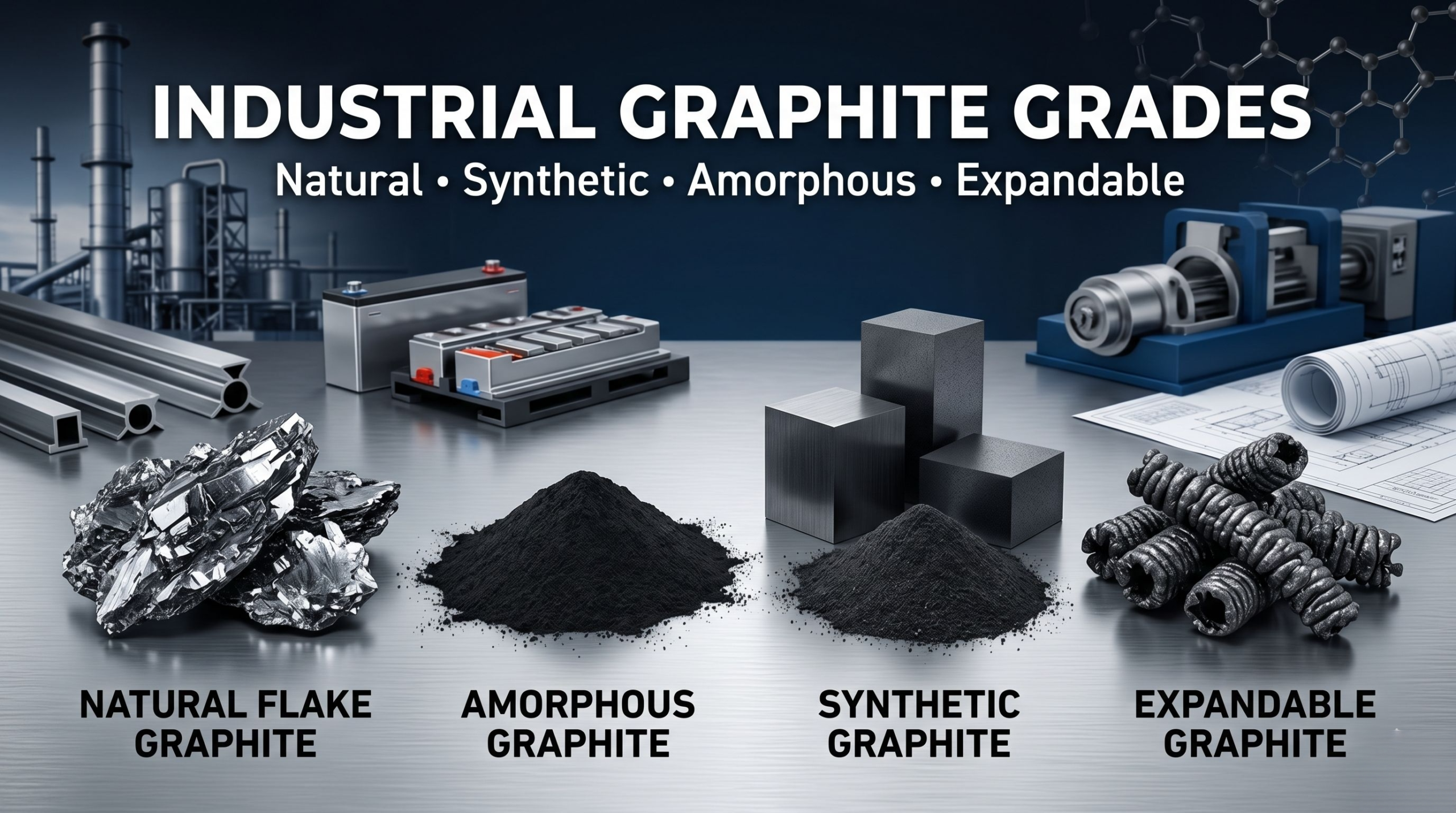
The major graphite grades in industrial use today are:
- Natural Graphite (Flake)
- Amorphous Graphite
- Synthetic Graphite
- Expandable Graphite
Each has a distinct manufacturing origin, microstructure, and set of properties. Understanding these differences is the foundation of intelligent sourcing.
Natural Graphite
What Is It?
Natural graphite is mined directly from the earth, where carbon has crystallized over millions of years under intense heat and pressure. It comes in three main forms based on deposit type: flake, amorphous (microcrystalline), and vein (lump). Flake and amorphous are by far the most commercially significant.
Flake Graphite
Flake graphite is the most widely recognized natural grade. It forms as plate-like crystals within metamorphic rock and is liberated through crushing and flotation. The result is a layered, lamellar particle with a high degree of crystallinity.
Key Properties:
- Carbon content: 85–98% (purified grades up to 99.9%)
- Particle sizes range from fine (-100 mesh) to large flake (+50 mesh)
- Excellent lubricity due to layered crystal structure
- High thermal and electrical conductivity
- Good natural flexibility and compressibility
Advantages:
- Superior lubricity without additives
- Naturally compressible, ideal for gaskets and seals
- Responds well to chemical purification and intercalation (for expandable grades)
- Widely available from major producing countries including China, Mozambique, Madagascar, and India
Industrial Applications:
- Lithium-ion battery anodes (the largest and fastest-growing use)
- Flexible graphite sheets and gaskets
- Lubricants and greases for high-load bearings
- Refractory materials for steelmaking (MgO-C bricks, ladle liners)
- Brake linings and friction materials
Industries: Battery manufacturers, steel plants, automotive OEMs, sealing product manufacturers.
Amorphous Graphite
Despite the name, amorphous graphite does have a crystalline structure — it’s simply much finer and less ordered than flake. It forms from coal seams that have been metamorphosed and is mined in a granular or powdery form.
Key Properties:
- Carbon content: typically 70–85%, lower than flake grades
- Very fine particle size, often sub-micron
- Softer and more porous than flake graphite
- Lower thermal and electrical conductivity than flake or synthetic grades
Advantages:
- Lower cost than flake or synthetic grades
- Good coverage and mixing properties in coating applications
- Adequate lubricity for moderate-duty applications
- Widely available from India, Mexico, and China
Industrial Applications:
- Foundry coatings and mold release agents
- Pencil manufacturing
- Battery carbon black blends (as a partial carbon additive)
- Rubber and plastic compounding for conductivity
- Soil amendment in agriculture
Industries: Foundries, rubber compounders, pencil manufacturers, general industrial lubricant producers.
Synthetic Graphite
What Is It?
Synthetic graphite is manufactured, not mined. It’s produced by graphitizing petroleum coke or coal tar pitch at temperatures exceeding 2,800 °C in a process called the Acheson process. At these temperatures, carbon atoms rearrange into a highly ordered graphitic crystal structure.
Key Properties:
- Carbon content: typically 99–99.9%
- Very fine, controllable particle size
- Highly isotropic structure (in powder/milled forms)
- Superior thermal conductivity: 100–200 W/m·K and higher for specialized grades
- Low electrical resistivity
- Excellent chemical purity with minimal ash content
Advantages:
- Consistent, reproducible quality — critical for battery and semiconductor applications
- High purity eliminates contamination concerns in food-grade, pharmaceutical, and electronic applications
- Available in precise particle size distributions
- Performs at extreme temperatures in inert atmospheres (up to 3,000+ °C)
- Can be produced as powder, granules, blocks, or machined components
Industrial Applications:
- Lithium-ion battery anodes (alongside natural graphite, or as the primary anode material in premium cells)
- EDM (electrical discharge machining) electrodes
- Furnace electrodes for electric arc steelmaking
- Nuclear reactor moderators
- Semiconductor crystal growing equipment
- High-performance crucibles and hot-press molds
Industries: Battery manufacturers, steel plants (EAF operations), semiconductor fabs, aerospace, nuclear energy.
Expandable Graphite
What Is It?
Expandable graphite starts as purified flake graphite that has been intercalated — meaning chemical species (typically sulfuric acid) are inserted between the graphene layers. When heated rapidly (usually above 150–300 °C), the intercalant vaporizes and the graphite expands dramatically along its c-axis, sometimes by a factor of 100–300×.
Key Properties:
- Expansion ratio: 100–300× original volume depending on grade
- Carbon content: 85–99% (varies by starting flake quality)
- Worm-like expanded structure with very low density
- Excellent fire-retardant behavior — absorbs heat endothermically on expansion
- Can be compressed back into flexible graphite sheets without binders
Advantages:
- Acts as an intumescent flame retardant without halogens
- Can be formed into flexible, conformable sealing materials without adhesives
- High surface area after expansion; useful for rapid thermal management
- Compatible with polymer matrices for flame-retardant composites
Industrial Applications:
- Flame-retardant additives in polyurethane foam, coatings, and plastics
- Flexible graphite gaskets, seals, and packing (after expansion and rolling)
- Fire protection materials for cable trays, joints, and construction
- Thermal interface materials in electronics
Industries: Construction, fire safety, chemical processing, electronics, automotive fire protection.
Industrial Graphite Grades Comparison Table
| Grade | Carbon Content | Particle Size | Thermal Conductivity | Typical Cost | Key Applications |
|---|---|---|---|---|---|
| Flake Graphite | 85–98% | 10 µm – 2 mm | High | Moderate | Batteries, refractories, gaskets |
| Amorphous Graphite | 70–85% | Fine powder | Low–Moderate | Low | Foundry coatings, lubricants |
| Synthetic Graphite | 99–99.9% | Controlled | Very High | High | Battery anodes, EDM, EAF electrodes |
| Expandable Graphite | 85–99% | Flake-based | Varies | Moderate | Flame retardants, flexible seals |
How to Select the Right Industrial Graphite Grade
Choosing a graphite grade isn’t just a matter of finding the cheapest option that roughly fits. Here are the factors that experienced procurement managers evaluate:
Carbon Content and Purity
Higher carbon content generally means better electrical and thermal performance and lower contamination risk. For battery anodes and semiconductor applications, 99.9%+ purity is non-negotiable. For refractory coatings, an 85% amorphous grade may be perfectly adequate and more cost-effective.
Particle Size Distribution
Particle size affects surface area, packing density, and processing behaviour. Large flake graphite gives better lubricity and compressibility. Fine synthetic powder gives better mixing uniformity in electrode slurries. Specify the d50 and d90 — not just “fine” or “coarse.”
Thermal Conductivity
Critical for furnace components, heat exchangers, and thermal management applications. Synthetic grades and pyrolytic graphite sit at the top of this scale. Amorphous graphite is toward the bottom.
Electrical Conductivity
Closely related to crystallinity. High-crystallinity synthetic and large-flake natural graphite are the right choices for electrode applications. Lower-crystallinity amorphous grades are often sufficient for modest anti-static or conductivity-enhancement applications.
Operating Temperature
Graphite doesn’t melt, but it oxidizes in air above ~450 °C. For high-temperature applications, ensure either an inert atmosphere or select a grade with appropriate oxidation protection. In a vacuum or inert gas, high-purity synthetic graphite can operate above 3,000 °C.
Cost-Effectiveness
There is almost always a gap between the grade you technically need and the best-performing grade available. Match the specification to the application rather than defaulting to the premium option. Amorphous graphite for a foundry wash doesn’t need to be battery-grade. Synthetic graphite for a battery anode shouldn’t be swapped for amorphous to save cost.
Common Mistakes Buyers Make When Selecting Graphite
Specifying by grade name alone, not by parameters. “Flake graphite” describes a morphology, not a performance specification. Two flake graphite products from different suppliers can have vastly different carbon content, particle size distributions, and ash levels. Always request a technical data sheet with tested values.
Overlooking particle size for functional applications. Battery anode performance, lubricant film formation, and slurry mixing behavior are all highly sensitive to particle size. Buyers who focus only on carbon content and miss the particle size spec often end up with a product that technically passes chemistry but fails in process.
Treating all natural graphite as equivalent to synthetic. Natural and synthetic graphite have different crystallite structures, surface chemistries, and impurity profiles. Substituting one for the other in battery applications, for example, can significantly affect capacity, first-cycle efficiency, and cycle life.
Choosing on price without total cost of ownership. A cheaper amorphous grade used in a refractory application may lead to higher wear rates and shorter lining life — ultimately costing more per heat than a moderate-grade flake product would have.
Not verifying supplier quality systems. For regulated industries (batteries, nuclear, food-grade), graphite traceability and consistent quality management are as important as the material specification itself. A low-cost supplier without ISO certification or consistent lot-to-lot testing creates downstream risk.
Industry Resources
For additional information on graphite production, battery materials, and industrial mineral markets, readers can explore:
- U.S. Geological Survey (USGS) for graphite market data and mineral reports.
- International Energy Agency (IEA) for battery and energy storage industry insights.
- World Steel Association for information on steel manufacturing applications of graphite.
Conclusion
Graphite is not a commodity in the way that buyers sometimes treat it. The range from amorphous foundry-coat material to high-purity synthetic battery-grade anode powder represents enormous differences in structure, performance, and value. Getting this decision right requires understanding what you’re actually buying — not just the name on the bag.
The information in this guide gives you a foundation, but every industrial application has specific constraints around temperature, conductivity, purity, and particle morphology that deserve expert review.
If you’re evaluating graphite grades for a new application or looking to optimize an existing specification, consult with a knowledgeable graphite supplier who can provide technical data sheets, application support, and consistent quality assurance. A supplier with deep experience across natural and synthetic grades, and a clear understanding of your end-use requirements, is an asset that goes well beyond the transaction.
As a trusted graphite supplier, we help industries select the right graphite grade based on their performance and application requirements.
Frequently Asked Questions (FAQ)
Q1: What is the difference between natural graphite and synthetic graphite?
Natural graphite is mined and occurs in three forms — flake, amorphous, and vein. Synthetic graphite is manufactured by graphitizing petroleum coke at temperatures above 2,800 °C. Synthetic grades typically offer higher purity (99%+) and more consistent particle size, while natural flake grades offer good lubricity and are more cost-effective for many applications.
Q2: Which graphite grade is best for lithium-ion battery anodes?
Both natural flake graphite (after spheroidization and purification) and synthetic graphite are used as anode materials. Natural graphite offers higher energy density, while synthetic graphite provides better rate capability and cycle life. Many battery manufacturers blend both grades to balance cost and performance.
Q3: What does carbon content tell you about graphite quality?
Carbon content is a primary quality indicator — it reflects the level of non-carbon impurities (ash) in the material. Higher carbon content generally means better electrical and thermal conductivity and lower contamination risk. However, carbon content alone doesn’t tell you about crystallinity, particle size, or surface chemistry, so it should always be evaluated alongside other parameters.
Q4: Can amorphous graphite be used in place of flake graphite?
Not interchangeably. Amorphous graphite has lower carbon content, lower crystallinity, and different surface properties. It works well for foundry coatings, lubricants, and low-demand conductive applications, but it is not suitable for battery anodes, high-performance refractories, or precision electrical applications where flake or synthetic grades are required.
Q5: How do I find a reliable graphite supplier in India?
India is a significant producer of both natural (amorphous) graphite and a growing supplier of processed graphite products. Look for suppliers with ISO 9001 certification, published technical data sheets with tested lot values, clear traceability documentation, and experience supplying your specific industry. Request samples and third-party test reports before committing to volume orders.