Choosing an industrial graphite supplier is one of the most important sourcing decisions a procurement team can make. Graphite sits inside almost everything modern industry produces. Foundries need it for crucibles. Battery makers need it for anodes. Steel plants need it for carbon raisers and refractories.
Yet not all suppliers deliver the same quality. Purity levels vary. Particle sizes drift between shipments. Delivery timelines slip. As a result, a poor supplier choice can shut down a production line for days.
This guide gives you a complete framework for evaluating any industrial graphite supplier. You will learn which grades matter, which certifications to demand, and which red flags to avoid. By the end, you will know exactly how to source graphite with confidence.
What Does an Industrial Graphite Supplier Actually Do?
An industrial graphite supplier sources, processes, grades, and delivers graphite for manufacturing use. Most suppliers handle natural graphite, synthetic graphite, or both. Natural graphite is mined from crystalline deposits, then crushed, purified, and screened into precise particle sizes.
According to the U.S. Geological Survey (USGS), global natural graphite production exceeds 1.6 million tonnes per year, with demand rising sharply due to battery manufacturing. )
A dependable supplier does far more than move material. Specifically, a quality partner will:
- Test every batch for fixed carbon content and purity
- Screen material into consistent mesh sizes
- Provide certificates of analysis (CoA) with each shipment
- Maintain buffer stock to protect your production schedule
- Offer technical guidance on grade selection
In short, the right supplier becomes an extension of your quality department.
Why Graphite Quality Matters for Your Operations
Graphite is prized for a rare combination of properties. It conducts electricity like a metal, yet it resists heat like a ceramic. It withstands temperatures above 3,000°C in inert atmospheres. Moreover, it lubricates without oil and resists most chemical attack.
PubChem documents graphite as a crystalline form of carbon with a layered hexagonal structure, which explains its lubricity and conductivity.
However, these properties depend heavily on purity and crystal structure. Low-grade graphite with high ash content can ruin a refractory mix. Inconsistent particle size can destabilize a battery anode slurry. Therefore, quality verification is not optional — it is essential.
[Internal Link: Crystalline Graphite Grades] — Place this link on the phrase “crystal structure” in the paragraph above.
Types of Graphite an Industrial Graphite Supplier Should Offer
A capable industrial graphite supplier stocks several distinct product families. Each serves different applications, so understanding the differences protects your budget.
1. Flake Graphite
Flake graphite forms in flat, plate-like crystals. It offers excellent conductivity and lubricity. Consequently, it dominates in batteries, brake linings, and expandable graphite production.
2. Amorphous Graphite
Despite the name, amorphous graphite is microcrystalline rather than truly amorphous. It costs less and works well in foundry facings, pencils, and lower-grade lubricants.
3. Crystalline Vein Graphite
Vein graphite delivers the highest natural purity, often above 90% carbon straight from the mine. It suits demanding electrical and friction applications.
4. Synthetic Graphite
Synthetic graphite is manufactured from petroleum coke at extreme temperatures. It provides ultra-high purity and consistency, though at a higher price point.
The Encyclopaedia Britannica offers an excellent overview of how these graphite forms occur and differ geologically.
Comparison Table: Graphite Types at a Glance
| Property | Flake | Amorphous | Vein | Synthetic |
|---|---|---|---|---|
| Typical Carbon % | 85–97% | 70–85% | 90–99% | 99%+ |
| Relative Cost | Medium | Low | High | Highest |
| Conductivity | High | Moderate | Very High | Very High |
| Best For | Batteries, lubricants | Foundries, pencils | Electrical, friction | Electrodes, anodes |
| Availability | Wide | Wide | Limited | Wide |
How to Evaluate an Industrial Graphite Supplier
Key Criteria Every Industrial Graphite Supplier Must Meet
Use these criteria as your evaluation baseline. Score each potential partner before requesting samples.
- Purity documentation. Demand a certificate of analysis showing fixed carbon, ash, moisture, and volatile content for every lot.
- Particle size control. Ask for sieve analysis reports. Consistency between shipments matters more than a single perfect batch.
- Production capacity. Verify the supplier can scale with your growth without quality drift.
- Quality certifications. ISO 9001 is the minimum. Battery-grade buyers should also ask about IATF or customer-specific audits.
- Traceability. The supplier should trace material back to the mine or production lot.
- Logistics reliability. Check packaging standards, lead times, and on-time delivery history.
- Technical support. Strong suppliers help you match grades to applications, which reduces trial-and-error costs.
Questions to Ask Before You Sign
- What is your fixed carbon guarantee, and what happens if a lot fails?
- Can you provide references from customers in my industry?
- How much buffer inventory do you hold for contract customers?
- What is your rejection and replacement policy?
- Do you offer custom milling or purification?
Clear answers signal a mature operation. Vague answers signal risk.
Pricing Factors: What Drives Graphite Costs?
Graphite pricing moves with several forces. Understanding them helps you negotiate from strength.
- Carbon content. Higher purity commands higher prices, often exponentially above 99%.
- Mesh size. Fine milling and tight size distributions add processing cost.
- Flake size. Large flakes (+50 mesh) are scarcer and pricier than fine flakes.
- Demand cycles. Battery demand has reshaped the market. The International Energy Agency (IEA) projects graphite demand for clean energy technologies could grow severalfold by 2040.
- Origin and logistics. Freight, duties, and export policies affect landed cost significantly.
India has emerged as a strategic sourcing hub, with graphite reserves and production tracked by the Ministry of Mines, Government of India.
Buyer’s Checklist: Sourcing Graphite the Right Way
Print this checklist and use it for every new supplier evaluation:
- Certificate of analysis received for sample lot
- Fixed carbon percentage meets specification
- Ash and moisture content within tolerance
- Sieve analysis matches required mesh range
- ISO 9001 (or better) certification verified
- Mine or production source traceable
- Sample tested in your actual process
- Lead times and buffer stock confirmed in writing
- Rejection and replacement terms agreed
- Pricing benchmarked against at least two alternatives
Common Mistakes When Choosing a Graphite Supplier
Avoid these frequent — and expensive — errors:
- Buying on price alone. Cheap graphite with high ash content costs more in rejected product and downtime.
- Skipping sample trials. Lab specs never fully predict performance in your process. Always run a production trial.
- Ignoring particle size distribution. Two lots with the same “average” mesh can behave completely differently.
- Accepting verbal quality promises. If it is not on a certificate of analysis, it does not exist.
- Single-sourcing critical material. One supply disruption can halt your entire line. Qualify a backup.
- Overlooking packaging. Moisture ingress during shipping degrades graphite performance. Confirm moisture-barrier packaging.
Expert Tips for Working With Your Supplier
- Lock specifications into contracts. Attach the agreed CoA parameters as a contract annex, not an email.
- Audit annually. A site visit reveals more than a hundred emails. Look at their lab, not just their warehouse.
- Share your application details. Suppliers who understand your end use can recommend grade changes that cut costs.
- Track lot-to-lot variation. Plot fixed carbon and mesh data over time. Rising variance is an early warning sign.
- Negotiate index-linked pricing. For long contracts, tie prices to a published benchmark to keep both sides honest.
- Order a retention sample. Keep a sealed sample from each lot for dispute resolution.
Key Takeaways
- An industrial graphite supplier should provide documented purity, consistent particle sizing, and full traceability.
- Flake, amorphous, vein, and synthetic graphite serve different applications at very different price points.
- Certificates of analysis, ISO certification, and production trials are non-negotiable before contracting.
- Battery-driven demand is tightening supply, so qualified backup suppliers are now essential.
- Price should be evaluated on landed cost and performance, never on quote price alone.
Frequently Asked Questions (FAQ)
1. What does an industrial graphite supplier provide? A supplier sources, purifies, grades, and delivers graphite in specified mesh sizes and purity levels, backed by certificates of analysis and technical support.
2. What purity should industrial graphite have? It depends on the application. Foundry grades often run 80–90% fixed carbon, while battery and electrical grades typically require 95–99.9%.
3. What is the difference between natural and synthetic graphite? Natural graphite is mined and purified. Synthetic graphite is manufactured from petroleum coke at high temperatures. Synthetic offers higher consistency but costs more.
4. How is graphite quality tested? Standard tests measure fixed carbon, ash, moisture, volatile matter, and particle size distribution. Reputable suppliers issue a certificate of analysis with every lot.
5. Which industries buy the most graphite? Batteries, steelmaking, foundries, refractories, lubricants, brake linings, and expandable graphite products lead global demand.
6. How do I compare quotes from different graphite suppliers? Compare landed cost per usable tonne, not quote price. Factor in purity, rejection rates, freight, and the cost of production disruptions.
7. What mesh sizes are common for industrial graphite? Common ranges span +50 mesh large flake down to -325 mesh fine powder. Your application dictates the correct range.
8. Can graphite be stored long term? Yes. Graphite is chemically stable, but it must stay dry. Store it in sealed, moisture-barrier packaging away from humidity.
9. Why are graphite prices rising? Electric vehicle battery demand has surged, and anode production consumes large volumes of both flake and synthetic graphite, tightening global supply.
10. How do I qualify a new industrial graphite supplier quickly? Request a certified sample, run it through a production trial, verify ISO certification, and check customer references — all before signing a volume contract.
Conclusion: Partner With a Proven Industrial Graphite Supplier
Selecting the right industrial graphite supplier protects your quality, your schedule, and your margins. Focus on documented purity, consistent sizing, traceability, and responsive technical support. Then verify everything with a production trial before you commit.
The graphite market is tightening, and dependable partners are becoming harder to find. Act now, qualify carefully, and build a relationship that supports your growth for years.
Ready to Source Premium Industrial Graphite?
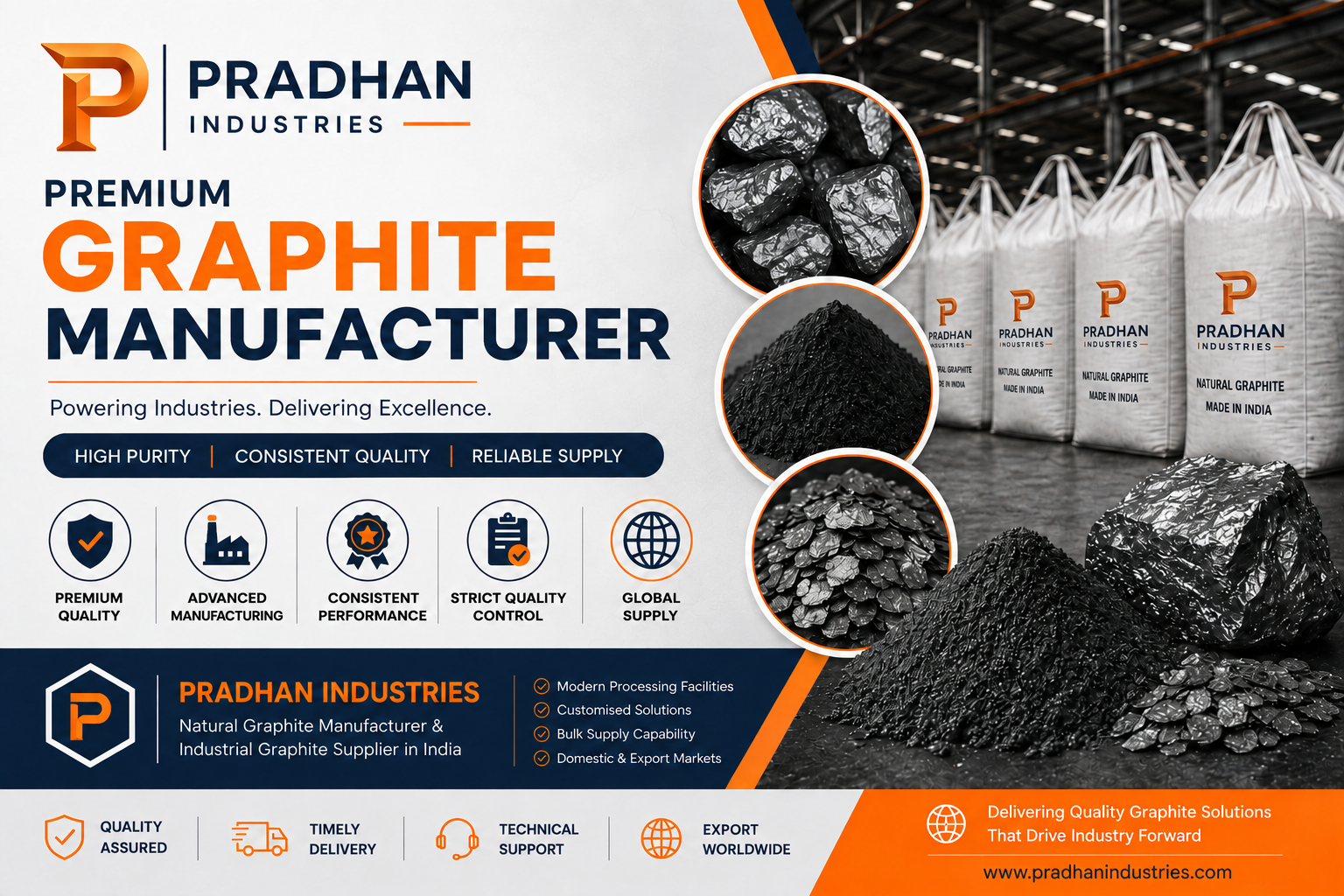
Partner with Pradhan Industries for high-purity natural and crystalline graphite manufactured to meet demanding industrial applications. We offer custom graphite grades, consistent quality, Certificates of Analysis (COA), and dependable delivery to customers across India and international markets.
Request a free sample and personalized quotation today to discover how a trusted graphite supply partner can support your business with reliable products and responsive service.