Before you buy graphite powder, look past the price and study one thing first: consistency. A foundry can adapt to 92% carbon or 95% carbon. What it cannot adapt to is 95% this month and 89% the next. The same rule applies to a battery plant qualifying feedstock or a coatings formulator chasing a stable dispersion. Graphite powder looks identical in every bag. In service, the gap between the right grade and the almost-right grade shows up as casting defects, rejected batches, and downtime that costs far more than the material ever did.
This guide explains what graphite powder is, how the main grades differ, what really drives the price, and how to check a supplier before placing a bulk order. It is written for procurement teams who need the material to perform, not just arrive on time.
1. Why Buy Graphite Powder from a Manufacturer Instead of a Trader?
The graphite trade has many middlemen, and for a one-off spot purchase, they serve a purpose. For any recurring industrial requirement, buying directly from a manufacturer changes both the economics and the risk.
Price is the visible benefit—removing a margin layer saves real money on bulk contracts. The hidden benefits matter more over time. A manufacturer controls its ore source and milling settings, so lot 30 behaves like lot 3. A trader’s material changes whenever their source changes. A manufacturer can mill to your particle-size curve, blend to a target carbon level, and adjust packaging. A trader sells whatever sits in the warehouse this week.
Supply security follows the same pattern. Since China placed export licensing on graphite products in December 2023, the market has tightened more than once. In tight markets, manufacturers protect their contracted buyers first. Traders sell to whoever pays the day’s price.
2. What Is Graphite Powder?
Graphite is a natural crystalline form of carbon built from stacked layers that slide over one another. That layered structure explains its lubricity, and it also makes graphite conduct heat and electricity while surviving extreme temperatures. Britannica’s entry on graphite covers the mineralogy clearly, and its full chemical profile is documented on PubChem.
Commercial powder starts as mined ore. The ore is crushed, then beneficiated—usually by froth flotation—to remove host rock and raise the fixed carbon content. The concentrate is dried, milled, and classified into defined size fractions, from coarse 100 mesh material down to micronized powders below 10 microns. Extra chemical or thermal treatment produces the highest purities.
Two numbers define any graphite powder: fixed carbon percentage (commercial grades run from about 75% up to 99%+) and particle size distribution. Everything else on the datasheet follows from those two or describes handling conditions. Demand keeps rising worldwide — the US Geological Survey estimated global natural graphite production at roughly 1.8 million tonnes in 2025, with battery demand leading the growth.
3. Types of Graphite Powder You Can Buy
| Grade | Typical Fixed Carbon | Typical Particle Size | Best Suited For |
|---|---|---|---|
| Natural Graphite Powder | 75–95% | 100–325 mesh | Foundry facings, paints, pencils, general industry |
| Crystalline Graphite Powder | 80–95% | Varies by cut | Lubricants, brake linings, conductive fillers |
| High-Carbon Graphite Powder | 95–99% | Per specification | Batteries, carbon brushes, specialty lubricants |
| Fine Graphite Powder | 85–97% | 200–400 mesh | Coatings, dry lubrication, powder metallurgy |
| Micronized Graphite Powder | 90–99% | 2–20 microns | Polymer compounds, precision coatings |
| Expandable Graphite Powder | 90–99% | +50 to +80 mesh | Flame retardants, gaskets, thermal materials |
Natural graphite powder is the workhorse — economical, versatile, and available across wide mesh ranges. Crystalline grades carry stronger lubricity for friction and lubricant work; Pradhan Industries publishes its crystalline graphite grades with complete specifications. High carbon powder at 95% and above serves work where ash directly harms performance, such as battery feedstock and electrical components. Micronized powder is a precision product—a narrow distribution at D50 of 5 microns behaves nothing like a broad one with the same median.
One caution: never buy a finer or purer grade than the application needs. Over-specifying is the quietest way to overpay.
4. Industrial Applications of Graphite Powder
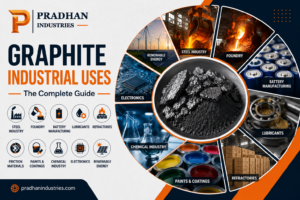
Steel plants add graphite powder as a recarburizer to hit target carbon in molten metal. Foundries suspend it in facings and washes that release castings cleanly with smooth surfaces. Refractory makers blend it into carbon-bonded bricks and crucibles built for repeated thermal shock.
Battery manufacturing has become the demand engine. Natural graphite, refined and shaped, forms the anode of most lithium-ion cells—a shift the IEA tracks in its critical minerals research. Lubricant makers turn to graphite where oils burn off: hot forging dies, open gears, chain drives, and dry-film coatings. Brake pad and clutch producers blend it in for fade resistance. Paint and coating formulators use fine grades for conductivity and corrosion protection, while chemical and conductive product manufacturers buy high-purity powder for electrodes, seals, and thermal management parts.
No single bag of powder serves all of these. That is exactly why the next section matters.
5. How to Choose the Right Grade Before You Buy Graphite Powder
Work through these parameters in order, and write every one of them into your purchase contract:
- Carbon percentage. Match it to the job—80–90% covers most foundry work, 85–94% suits refractories, and batteries or electrical uses need 95%+. Confirm dry-basis reporting with the test method named.
- Particle size distribution. Ask for full sieve analysis or laser diffraction data (D10, D50, and D90), never a single mesh number. Distribution tails cause most dispersion and sieving problems.
- Ash content. The mirror of purity—verify it independently.
- Moisture. Set a maximum of 0.5% for fine grades. Wet powder cakes, distorts shipped weight, and clogs feeders.
- Packaging. Lined 25 kg or 50 kg PP bags, or lined jumbo bags for bulk, are always palletized. Fine powder finds every unprotected seam.
- Certificates. A lot-specific certificate of analysis with every shipment—not a typical-values sheet printed once a year.
- Consistency evidence. Request certificates from five or six recent lots before ordering. Scatter on paper predicts scatter in your plant.
- Customization. For a non-standard curve or blend, confirm in-house milling and ask for a trial lot report.
Then run a pre-shipment sample through your own process. Laboratories confirm chemistry. Only your production line confirms performance.
6. Graphite Powder Price: What Actually Moves the Number
Carbon content is the biggest lever—each step from 85% toward 99% adds processing cost, steeply so above 96%. Particle size comes second: micronizing consumes energy and time, so a 5-micron powder costs far more than a 200 mesh cut of identical chemistry. Ore quality at the mine sets the floor for both.
Beyond the material, volume brings genuine economies; packaging choices add real cost that honest suppliers itemize; and freight varies widely by destination because graphite ships dense and heavy. Customization carries a setup cost on small runs that fades at volume.
The practical rule: never compare quotes on price per tonne alone. Compare landed cost per ton at your written specification, packaging and documentation included. A cheaper quote against a looser specification is not cheaper.
7. How to Evaluate a Graphite Powder Supplier
Run this checklist before any bulk or long-term commitment:
- Manufacturing capability. Do they mine or control their ore source and mill in their own plant, or resell third-party material?
- Quality testing. On-site laboratory, methods named on certificates, and easy acceptance of third-party inspection by SGS or Bureau Veritas.
- Track record. Which industries, which export markets, and how many years? Ask for references in your region and call them.
- Lead times. Realistic production-plus-transit schedules in writing, with a named contact when things slip.
- Packaging discipline. Specific answers about liners, pallets, and moisture protection. Vague answers predict damaged cargo.
- Communication. Response speed at the inquiry stage is the best preview of post-order behavior you will ever get.
- Product range. A supplier with a complete graphite product range can consolidate several grades under one quality system instead of three vendors and three sets of paperwork.
No single weak answer disqualifies a supplier. A pattern of vague ones does.
8. Common Mistakes When Buyers Purchase Graphite Powder
Buying on price alone tops the list. The cheapest ton that fails specification becomes the most expensive ton in your history once scrap, downtime, and air-freighted replacement are counted.
Accepting typical values instead of lot-specific analysis runs close behind, along with never verifying ash independently. Skipping document checks invites customs holds that cost more than the paperwork error itself—review drafts line by line before the vessel sails. Staying with an inconsistent supplier because switching feels like work is a slow leak that compounds every quarter. And tolerating poor communication before the order guarantees worse after the deposit clears.
Every one of these has the same cure: specify precisely, demand evidence, test samples, and treat supplier selection as an engineering decision rather than a purchasing formality.
9. Why Buyers Choose Pradhan Industries
Pradhan Industries manufactures graphite powder from its own sourcing base—ore to milled product—under one quality system, with every lot tested for carbon, ash, moisture, and particle size before bagging. That structure delivers the two things this guide keeps returning to: lot-to-lot consistency and full traceability.
Custom work is routine here, not exceptional. Buyers in the foundry, steel, battery, lubricant, refractory, coatings, and friction-material industries receive powder milled to their specifications, packed in lined export-grade bags, and shipped with complete documentation for smooth customs clearance. Technical questions—grade selection, dispersion behavior, sieve disputes—get answered by people who handle the material daily. Most of the company’s volume comes from repeat contracts, which says more than any certificate on a wall.
10. Frequently Asked Questions
What carbon percentage should I buy for foundry use?
Most foundry facings and washes perform well on 80–90% fixed carbon. Paying for 97% purity in this application buys nothing the process can use.
What is the difference between mesh size and micron size?
Mesh counts sieve openings (higher mesh = finer powder), and microns measure particle diameter. 325 mesh equals roughly 44 microns. Micronized grades are specified in microns because sieves cannot resolve them.
Is graphite powder hazardous to ship?
No. Natural graphite is non-hazardous cargo under HS heading 2504, though customs authorities and most buyers still require an SDS.
What moisture level should I specify?
A maximum of 0.5% for fine grades. Above that, expect caking, weight disputes, and feeder blockages.
How is bulk graphite powder packed for export?
Lined 25 kg or 50 kg woven PP bags on shrink-wrapped pallets, or lined 500–1,000 kg jumbo bags, with container lining for moisture-sensitive fine grades.
Can I order a custom particle size?
Yes, from manufacturers with in-house milling. Send your target D10/D50/D90 and request a trial lot report before committing to volume.
Why do two quotes for “95% graphite powder” differ so much?
Usually particle size, ash tolerance, packaging inclusions, or Incoterms. Compare landed cost against the full written specification, never the headline number.
Which documents should come with every shipment?
A lot-specific certificate of analysis, packing list, certificate of origin, and SDS at minimum—plus independent inspection reports on larger contracts.
Is natural graphite powder suitable for batteries?
High carbon natural powder feeds battery-material supply chains, though spheronization and coating happen downstream. Confirm which processing stage your specification needs.
How do I check quality before paying for a full container?
Order a pre-shipment sample, run it through your actual process, and match results against the lot certificate. For bulk orders, add independent inspection at loading.
11. Final Thoughts
Four habits separate buyers who get consistent material from buyers who collect cautionary tales: write the full specification into the contract, demand lot-specific evidence instead of typical values, test samples in your own process before scaling, and rate a supplier’s consistency record above their lowest quote.
When you are ready to buy graphite powder—natural, crystalline, high carbon, micronized, or a custom grade—contact Pradhan Industries with your specification. You will receive a graded sample, recent lot analyses, and a firm quotation: exactly the evidence this guide tells you to demand.