Few minerals earn their keep in as many places as graphite. The list of graphite industrial uses runs from the inside of an electric arc furnace to the anode of the battery in your phone, from the brake pads on a truck to the coating inside a casting mold. One mineral is used in many industries. It is needed when a material must conduct electricity like metal. It must also withstand heat like ceramic. It must also lubricate like oil.
That combination is not marketing language; it comes from the crystal itself. Graphite is carbon arranged in flat, stacked layers. Within a layer, atoms bond tightly, which gives strength, conductivity, and heat resistance. Between layers, the bonds are weak, so the sheets slide — which gives lubricity. No other industrial mineral offers this pairing, which is why global demand keeps climbing: the US Geological Survey estimated world natural graphite production at roughly 1.8 million tonnes in 2025, with battery demand growing fastest on top of the long-standing steel, foundry, and refractory base.
This guide works through graphite industrial uses sector by sector, explains which grade suits each job, compares natural against synthetic material, and closes with the purchasing considerations that separate a good sourcing decision from an expensive one.
1. Why Graphite Matters in Modern Industry
Every application in this guide traces back to a short list of physical properties:
- Thermal conductivity and heat resistance. Graphite conducts heat efficiently along its layers yet remains stable at temperatures that destroy most materials—it does not melt at atmospheric pressure but sublimes at extreme temperatures, which is why it lines furnaces and forms crucibles.
- Electrical conductivity. Free electrons within the carbon layers carry current, making graphite the rare nonmetal that conducts—the basis of its battery, electrode, and conductive-coating roles.
- Lubricity. The layers shear easily, so graphite lubricates under loads and temperatures where oils burn off.
- Chemical inertness. Graphite resists acids, alkalis, and most corrosive media, which the chemical industry relies on for seals and linings.
- Low density with real strength. It is light for what it withstands, which matters in friction materials and machined components.
Britannica’s entry on graphite covers the mineralogy in more depth, and the full chemical profile is on PubChem. For a buyer, the practical point is simpler: which of these properties your application depends on determines which grade you should buy.
2. Types of Graphite Used in Industry
| Grade | Typical Fixed Carbon | Typical Particle Size | Main Industrial Uses | Key Advantage |
|---|---|---|---|---|
| Natural Flake Graphite | 85–97% | +50 to –200 mesh | Refractories, crucibles, battery feedstock, expandable stock | Flake size set by geology—cannot be manufactured |
| Crystalline Graphite | 80–95% | Varies by cut | Lubricants, foundry facings, brake linings | Strong lubricity and conductivity |
| Graphite Powder | 75–95% | 100–325 mesh | Paints, coatings, foundry washes, general industry | Versatile and economical |
| Micronized Graphite | 90–99% | 2–20 microns | Polymer compounds, precision coatings, dispersions | Tightly controlled fine distribution |
| High-Carbon Graphite | 95–99% | Per specification | Batteries, carbon brushes, specialty lubricants | Low ash for demanding service |
| Expandable Graphite | 90–99% | +50 to +80 mesh | Flame retardants, gaskets, thermal foils | Expands many times its volume under heat |
Crystalline material deserves a special note for friction and lubricant buyers—its structure delivers the strongest lubricity per rupee spent, and Pradhan Industries publishes its crystalline graphite grades with complete specifications.
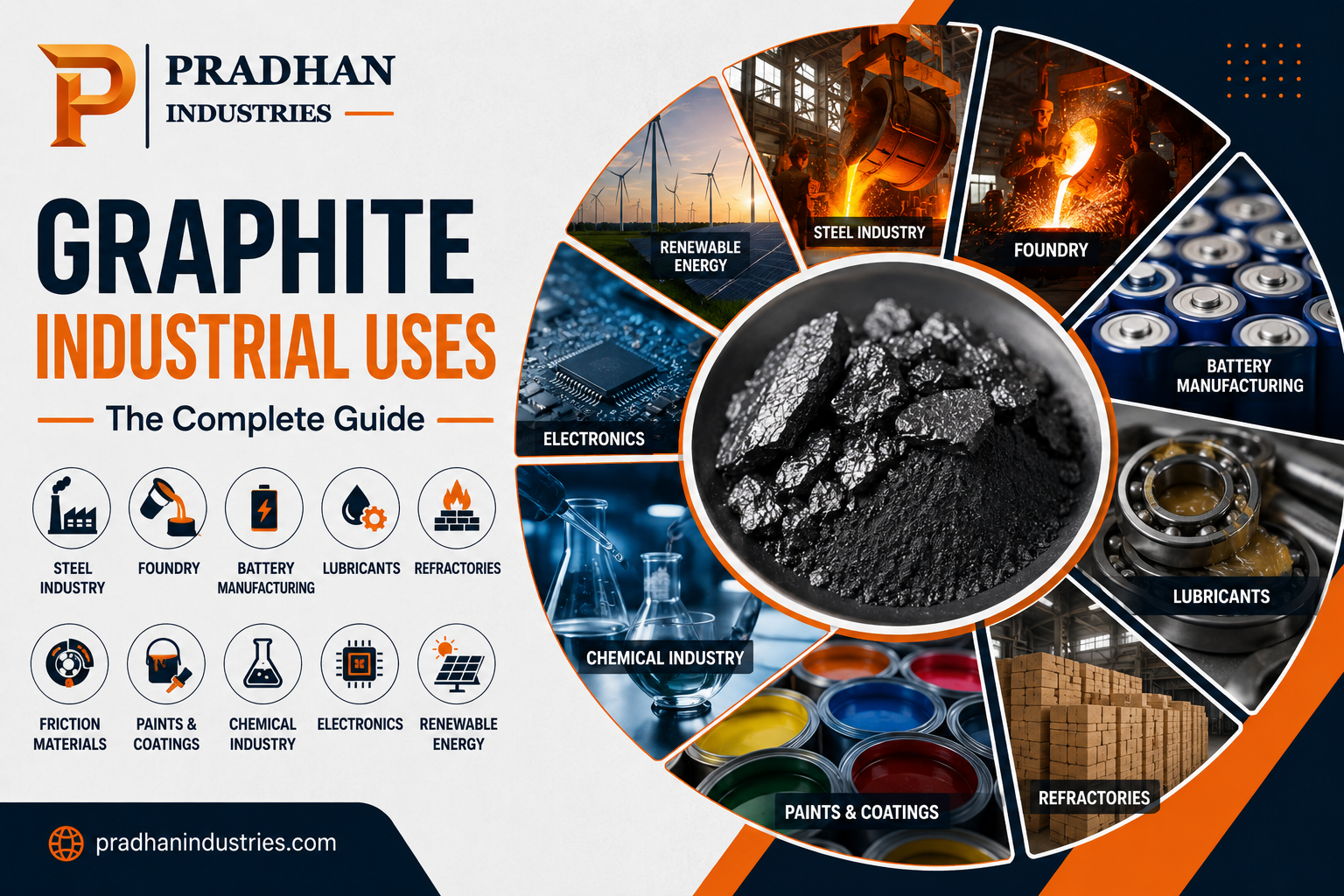
3. Graphite Industrial Uses Across Different Sectors
Graphite Industrial Uses in the Steel Industry
Steelmakers add graphite as a recarburizer—a controlled carbon addition that brings molten steel to its target carbon content. It also appears throughout the plant in magnesia-carbon refractory bricks lining electric arc furnaces and ladles. Recommended grades: amorphous or fine flake for recarburizing, flake graphite for refractory brick.
Graphite Industrial Uses in Foundries
Foundries suspend graphite in facings and washes applied to molds and cores. The coating stops molten metal from penetrating the sand, releases the casting cleanly, and leaves a smooth surface. Crystalline graphite and graphite powder in the 100–200 mesh range dominate this work.
Battery Manufacturing
The anode of nearly every lithium-ion cell is graphite—purified natural flake, shaped into spherical particles, or its synthetic equivalent. The IEA’s critical minerals research tracks how anode demand has become the fastest-growing pull on graphite supply worldwide. Feedstock starts at high carbon flake (94–95%+) and moves through downstream purification.
Electric Vehicles
Each EV battery pack contains tens of kilograms of graphite — typically more graphite by weight than lithium. As EV production scales, so does the requirement for consistent, traceable anode feedstock, which is reshaping how battery makers qualify suppliers.
Refractory Industry
Refractory producers remain among the largest tonnage consumers of natural graphite. Flake graphite bonds into bricks, crucibles, stopper rods, and continuous-casting components that survive repeated thermal shock at steel and glass temperatures. Coarse and medium flake at 85–94% carbon is the standard feed.
Lubricants
Where oils oxidize or burn—hot forging dies, open gears, kiln chains, threaded connections—graphite keeps working. It performs as dry-film powder, in greases, and in water- or oil-based dispersions. Crystalline and fine flake grades suit most lubricant formulations.
Friction Materials
Brake pads and clutch facings blend graphite in for fade resistance, quiet operation, and stable friction across temperature swings. Crystalline graphite and controlled powder grades are the usual choice, with particle distribution affecting noise behavior directly.
Paints and Coatings
Fine graphite powder gives coatings electrical conductivity, corrosion protection, and heat resistance—from anti-static floor systems to protective primers on steel structures. Formulators typically specify 200–325 mesh or micronized grades, where distribution tails decide dispersion quality.
Chemical Industry
Graphite’s inertness makes it the material of choice for gaskets, seals, packing, and linings in corrosive service. Expandable graphite, processed into flexible foil, dominates modern sealing applications.
Electronics and Conductive Materials
High-purity graphite serves in carbon brushes for motors, electrodes, conductive fillers for polymers, and thermal-management components that spread heat away from processors and power electronics.
Renewable Energy and Energy Storage
Beyond EV batteries, grid-scale storage installations use graphite in their lithium-ion cells, and fuel-cell bipolar plates rely on graphite composites. The US Department of Energy classifies graphite among critical materials for energy technology — a status that reflects how central it has become to the energy transition.
Nuclear Applications
Nuclear-grade graphite, manufactured to extreme purity, has served as a neutron moderator in certain reactor designs since the industry began. This is a specialized synthetic product rather than standard commercial supply, but it illustrates how far graphite’s industrial reach extends.
Industrial Machinery
Across general industry, graphite appears in self-lubricating bearings, seal rings, casting dies, and heat-treatment fixtures—anywhere machinery needs a material that handles load, heat, and friction without external lubrication.
4. Natural vs Synthetic Graphite for Industrial Applications
| Factor | Natural Graphite | Synthetic Graphite |
|---|---|---|
| Source | Mined ore, beneficiated and milled | Manufactured from petroleum coke at ~3,000°C |
| Cost | Significantly lower per tonne | Considerably higher |
| Purity ceiling | Up to ~99% with treatment | 99.9%+ achievable |
| Crystallinity & lubricity | Excellent — natural flake structure | Good, but generally lower lubricity |
| Energy & environmental footprint | Lower — no high-temperature synthesis | High energy consumption in production |
| Typical applications | Refractories, foundry, lubricants, friction, coatings, battery feedstock | Electrodes, ultra-high-purity components, some battery anodes |
The practical split: natural graphite wins on cost, lubricity, and footprint for the great majority of industrial graphite uses; synthetic earns its premium only where extreme purity or specific electrode properties demand it. Battery makers increasingly blend both.
5. How to Choose the Right Graphite Grade
Match the grade to the property your application actually depends on, then specify it in writing:
- Fixed carbon—80–90% covers most foundry work; 85–94% suits refractories, batteries, and electrical service needs 95%+. Confirm dry-basis reporting with the test method named.
- Particle size distribution — full sieve or laser-diffraction data (D10, D50, D90), never a single mesh number.
- Ash content — verified independently, since ash is what degrades high-temperature and electrical performance.
- Moisture — capped at 0.5% for fine grades to prevent caking and feeder problems.
- Consistency evidence — certificates from five or six recent lots before committing to volume.
- Lot-specific certificates of analysis with every shipment, tied to batch traceability.
And always run a pre-shipment sample through your own process. Laboratories confirm chemistry; only production confirms performance.
6. What Industrial Buyers Should Check Before Purchasing
Grade selection is half the decision; the supplier is the other half. Confirm whether the supplier controls its own ore source and mills in-house or resells third-party material—integrated manufacturers deliver the batch consistency this whole guide depends on. Check laboratory capability, willingness to accept third-party inspection, customization ability backed by trial lot reports, packaging built for your logistics, and complete export documentation under HS heading 2504. A supplier with a full graphite product range also lets you consolidate several grades under one quality system rather than managing three vendors with three sets of paperwork. Response speed and precision during the inquiry stage remain the best preview of post-order support you will ever get.
7. Future Demand for Graphite
Every serious forecast points the same direction. Electric vehicles are the primary driver—each battery pack needs substantial graphite, and anode demand has already reshaped trade flows since 2020. Grid-scale energy storage adds a second battery-driven pull. Renewable energy hardware, fuel cells, and industrial automation broaden the base, while traditional steel, foundry, and refractory demand continues its steady consumption underneath.
Supply is responding but remains concentrated, and China’s export licensing on graphite products—in place since December 2023—pushed buyers everywhere to qualify additional origins. For industrial purchasers, the strategic conclusion is straightforward: secure reliable long-term suppliers now, while qualification timelines are still measured in months rather than allocation queues.
8. Why Global Buyers Choose Pradhan Industries
Pradhan Industries manufactures natural graphite from its own sourcing base—ore to finished grade—under one quality system, with every lot tested for carbon, ash, moisture, and particle size before dispatch. Buyers across steel, foundry, battery, refractory, lubricant, friction, coatings, and chemical industries receive flake, crystalline, powder, and high carbon grades milled to their specification, packed in lined export-grade bags, and shipped with complete documentation for clean customs clearance.
Custom particle curves are routine work rather than special requests, and technical questions—grade selection for a new application, dispersion behavior, sieve disputes—get answered by people who handle the material daily. Most of the company’s volume comes from repeat contracts, which says more about reliability than any brochure could.
9. Frequently Asked Questions
What are the main graphite industrial uses today?
The largest by tonnage are refractories, steelmaking, foundry work, and battery anodes, followed by lubricants, friction materials, coatings, sealing products, and conductive applications.
Which industry consumes the most graphite?
Refractories and steel have historically led consumption, but battery manufacturing is the fastest-growing sector and is expected to dominate demand growth through the decade.
Why is graphite used in lithium-ion batteries?
Its layered structure stores lithium ions between the carbon sheets during charging, combining good capacity with stability and reasonable cost — no commercial substitute matches that balance yet.
Is natural or synthetic graphite better for industrial use?
Natural graphite wins on cost, lubricity, and environmental footprint for most applications; synthetic justifies its premium only where ultra-high purity or specific electrode properties are required.
What grade suits foundry applications?
Crystalline graphite or graphite powder at 80–90% fixed carbon, typically 100–200 mesh, covers most facings and washes.
Why does graphite work as a lubricant at high temperatures?
Its carbon layers slide over each other without any oil phase, so it keeps lubricating at temperatures where conventional lubricants oxidize and burn off.
What is expandable graphite used for?
Flake graphite treated with intercalation compounds, under heat, expands many times its volume, which makes it the base of flame retardants, flexible gasket foil, and thermal-protection materials.
What carbon content do battery applications need?
Feedstock generally starts at 94–95% fixed carbon and is purified further downstream. Confirm which processing stage your specification covers.
Does graphite conduct electricity like a metal?
Along its layers, yes — free electrons carry current, which is why graphite serves in electrodes, carbon brushes, and conductive coatings despite being a non-metal.
How do I choose between flake, powder, and micronized grades?
Match the particle form to the process: flake for refractories and expandable stock; powder for coatings and foundry washes; micronized for polymer compounds and precision dispersions—then confirm the full size distribution, not just a mesh number.
10. Final Thoughts
The range of graphite industrial uses keeps widening, but the buying logic behind every one of them stays constant: identify which property your application depends on, choose the grade that delivers it without paying for purity you cannot use, and source from a supplier whose consistency you have verified with lot-level evidence rather than a polished sample. Applications differ; that discipline does not.
If you need to match a graphite grade for a new application, contact Pradhan Industries. If your current supplier’s batches have started to drift, share your requirements. The technical team will recommend a grade, send a tested sample with recent lot analyses, and quote firm terms for trial and bulk volumes.