Ask why a foundry crucible, a furnace electrode, and a rocket nozzle can all be made from the same mineral, and the answer starts with one number. The graphite melting point sits higher than that of any metal — higher than tungsten, higher than steel by a factor of more than two — and that single property explains why graphite appears wherever industry pushes temperatures past the limits of everything else.
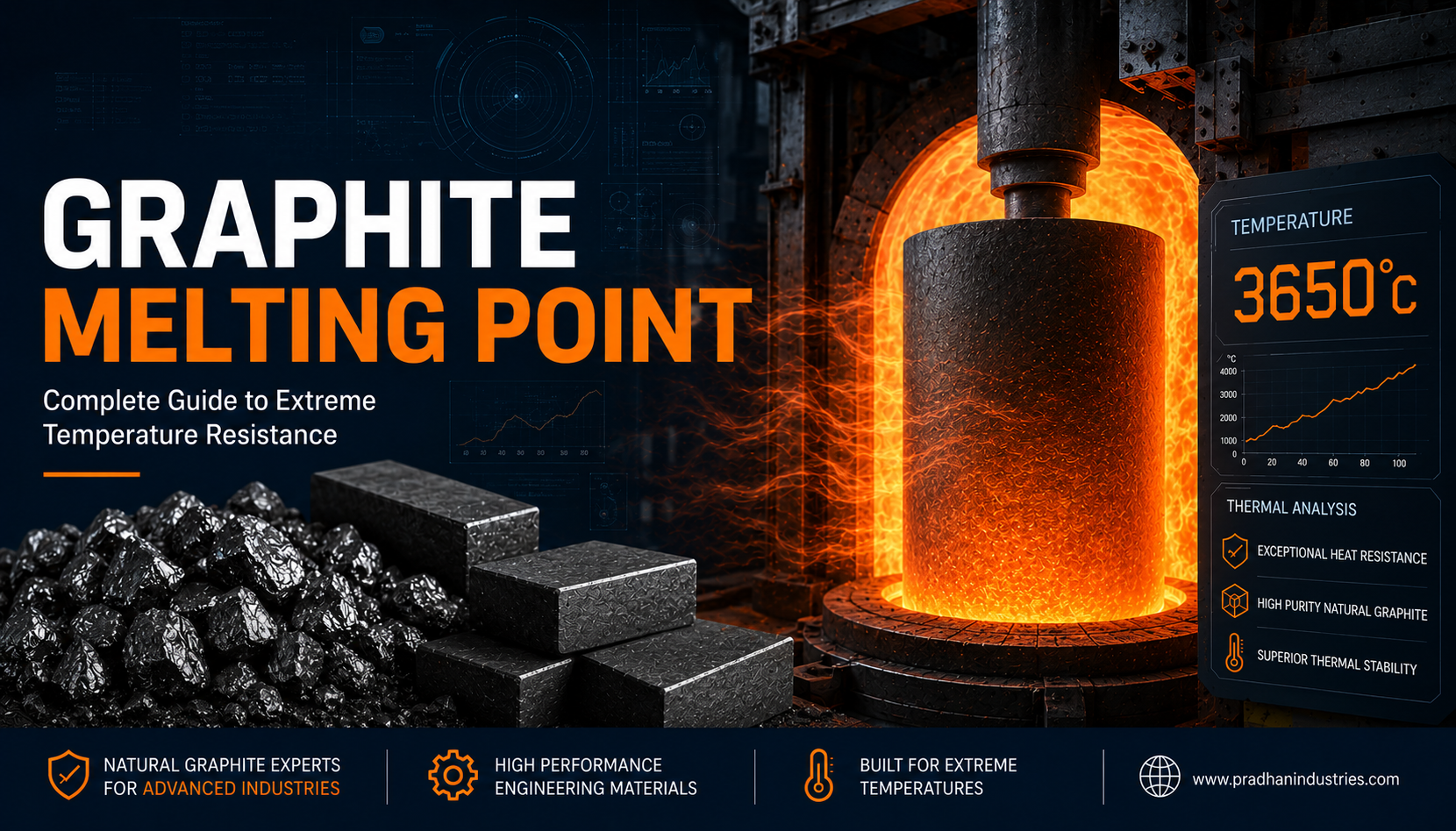
The number comes with a twist, though, and the twist matters to anyone specifying material for high-temperature service. Under normal atmospheric pressure, graphite never actually melts. It skips the liquid phase entirely and sublimes — passes directly from solid to gas — at roughly 3,600°C. True melting, at approximately 3,650°C (6,602°F), happens only under high pressure. Engineers who understand this distinction design better equipment; buyers who understand it ask better questions of their suppliers.
This guide covers the science in plain terms, compares graphite against the materials it competes with, works through the factors that decide real-world thermal performance, and maps the industries that depend on it — ending with the purity and grade questions that determine what you should actually buy.
1. Graphite Melting Point: Understanding the Basics
Start with the commonly cited figures, then the explanation behind them:
- Sublimation temperature: approximately 3,600°C (6,512°F) at atmospheric pressure — the point where solid graphite converts directly to carbon vapor.
- Melting point: approximately 3,650°C (6,602°F), but only under elevated pressure (research places graphite’s solid–liquid–vapor triple point at high pressure, far above anything in ordinary industrial service).
- Boiling point: often quoted around 4,200°C, though the figure is somewhat academic — liquid carbon exists only under pressure conditions no furnace operates in.
Why the strange behavior? Most solids melt because heat loosens the bonds holding their structure together, letting atoms flow as a liquid. In graphite, the carbon–carbon bonds within each layer are so strong that by the time enough energy arrives to break them, atoms escape straight into the gas phase. There is no intermediate temperature at atmospheric pressure where graphite softens or flows.
For industrial purposes, the practical consequence is what counts: graphite holds its shape and strength at temperatures that turn every common metal into liquid. A steel ladle fails near 1,500°C. A tungsten element melts at 3,422°C. A graphite crucible at those temperatures is still doing its job — and unusually, graphite actually gains mechanical strength as temperature rises, roughly doubling by around 2,500°C before declining. Almost no other engineering material behaves this way.
One important caveat that separates informed buyers from disappointed ones: these figures apply in inert or reducing atmospheres. In open air, graphite begins to oxidize — slowly from around 450–500°C, significantly above 700°C — because oxygen attacks the carbon. High-temperature graphite service therefore means vacuum, inert gas, or protective design. Reputable suppliers raise this point unprompted.
2. Why Does Graphite Have Such a High Melting Point?
The answer sits in the crystal structure. Graphite is pure carbon arranged in flat hexagonal sheets — think of chicken wire made of atoms, stacked in layers. Within each sheet, every carbon atom bonds covalently to three neighbors, and carbon–carbon covalent bonds are among the strongest in chemistry, with bond energies far exceeding the metallic bonds that hold steel, copper, or aluminium together.
Breaking down a solid requires overcoming its bonds. Metals melt at moderate temperatures because metallic bonding, while useful, is comparatively easy to disrupt. Graphite’s in-plane covalent network demands enormous energy to break — which is precisely why the material outlasts every metal as temperatures climb. Britannica’s entry on graphite covers the crystallography in more depth, and the compound’s full physical data sheet is on PubChem.
The layered arrangement adds a bonus. Between the sheets, bonding is weak — the layers slide over one another, giving graphite its famous lubricity. So one structure delivers two industrial gifts at once: extreme heat resistance from the strong bonds within layers, and natural lubrication from the weak bonds between them. Engineers rarely get both properties in one material, which is why graphite keeps appearing in applications that seem unrelated until you look at the physics.
3. Thermal Properties of Graphite
The melting point headlines the datasheet, but four supporting properties decide how graphite performs in actual service:
- Thermal conductivity. Graphite conducts heat well along its layers — natural crystalline material can reach conductivity in the range of copper along the basal plane, though commercial grades typically run lower and vary with direction, density, and purity. In furnace parts, this spreads heat evenly and prevents hot spots.
- Low thermal expansion. Graphite expands very little when heated — a small fraction of what metals do. Components hold their dimensions across enormous temperature swings, which is why graphite dies and fixtures keep tolerances that metal tooling cannot.
- Thermal shock resistance. The combination of high conductivity and low expansion means graphite tolerates sudden temperature changes that crack ceramics. A crucible can go from ambient to molten-metal temperature repeatedly without failing — the property foundries prize most.
- Specific heat capacity. Around 0.7 J/g·K at room temperature and rising with temperature, graphite absorbs substantial heat energy, useful in heat-sink and thermal-management roles.
Put together: graphite survives extreme heat, spreads it evenly, barely changes shape, and shrugs off thermal cycling. That package — not the melting point alone — is what industries are really buying.
4. Graphite Melting Point Compared With Other Materials
| Material | Approximate Melting Point | Industrial Relevance |
|---|---|---|
| Graphite | ~3,650°C (sublimes ~3,600°C at 1 atm) | Crucibles, electrodes, furnace parts — outlasts all metals |
| Diamond | ~3,550°C (converts to graphite first) | Cutting tools; impractical for bulk thermal service |
| Tungsten | 3,422°C | Highest-melting metal; filaments, welding electrodes |
| Steel | ~1,370–1,540°C (by grade) | Structural workhorse; the temperature graphite equipment must contain |
| Copper | 1,085°C | Electrical conductor; melts in routine foundry service |
| Aluminium | 660°C | Lightweight metal; among the easiest to melt in graphite crucibles |
Read the table from the bottom up and the industrial logic writes itself. Aluminium and copper melt at temperatures graphite barely notices — which is why graphite crucibles dominate non-ferrous melting. Steel melts around 1,500°C, and the electrodes that melt it in electric arc furnaces are graphite, operating with comfortable margin. Even tungsten, the champion among metals, gives up more than 200 degrees to graphite — and costs many times more per kilogram.
Diamond deserves its footnote: chemically identical carbon, nominally similar melting behavior, but at high temperature and ambient pressure diamond converts back into graphite. Nature itself defaults to graphite when things get hot.
5. Factors Affecting Graphite Thermal Performance
Two graphite lots with the same headline melting point can behave very differently in service. These are the variables that decide real performance — and they map directly onto what buyers should specify:
- Purity. Impurities and ash act as weak points and oxidation catalysts. Higher fixed carbon means better high-temperature endurance, which is why demanding service starts at 95%+ carbon.
- Crystalline structure. Well-ordered natural flake and crystalline graphite conduct heat better and resist thermal stress better than poorly ordered material.
- Density. Denser material means fewer pores for oxidizing gases to attack and better strength retention at temperature.
- Grain and flake size. Coarser structures generally deliver better thermal shock resistance; finer structures machine to better finishes. The right answer depends on the component.
- Manufacturing and processing. How the material was beneficiated, formed, and (for shaped products) baked determines its consistency far more than the ore alone.
- Operating atmosphere. The decisive external factor. Inert or reducing conditions let graphite approach its theoretical limits; oxygen exposure sets a much lower practical ceiling.
The purchasing translation: never buy high-temperature graphite on a melting-point claim, because every supplier’s graphite “withstands 3,000°C” on paper. Buy on fixed carbon, ash, structure, and lot-to-lot consistency — the parameters that actually vary between suppliers.
6. Applications of Graphite at Extremely High Temperatures
Metallurgy and Foundries
Foundries live inside graphite’s comfort zone. Crucibles melt aluminium, copper, brass, bronze, and precious metals; graphite-based facings and washes coat molds so castings release cleanly; recarburizers adjust carbon in molten iron and steel. Recommended material: crystalline graphite and flake grades at 85–94% carbon, with thermal shock resistance the deciding property.
Refractory Materials
Refractory producers are among the largest consumers of natural flake graphite worldwide. Flake bonds into magnesia-carbon bricks lining steel converters and ladles, alumina-graphite stopper rods, and continuous-casting nozzles — components that face molten steel and slag for hours at a stretch. Flake graphite at 85–94% carbon, with flake size mattering as much as purity.
Electric Arc Furnaces
The electrodes that carry tens of thousands of amps into an arc furnace are graphite, operating above the melting point of the very steel they produce. Electrode manufacture is a specialized synthetic-graphite industry, but it illustrates the same physics every buyer relies on: nothing else conducts that much current while surviving that much heat.
Crucibles and Melting Equipment
Beyond foundries, laboratories, jewelers, and specialty metal producers all depend on graphite and clay-graphite crucibles. The selection logic is constant: high thermal conductivity for fast, even melts; low expansion for dimensional stability; shock resistance for repeated cycles.
Aerospace Components
Rocket nozzle throats, re-entry components, and high-temperature structural parts use graphite and carbon-carbon composites because they hold strength where superalloys fail. This sector runs on engineered synthetic products, but its existence is why “graphite” and “extreme temperature” belong in the same sentence.
Semiconductor Manufacturing
Crystal-growing furnaces that produce silicon ingots use high purity graphite heaters, susceptors, and crucible supports — service where both temperature capability and ultra-low impurity levels are non-negotiable, since contamination ruins the silicon.
Battery and Energy Storage Industry
Battery applications use graphite for a different property — lithium storage between its layers — but thermal stability still matters for anode safety and performance. High carbon natural graphite at 94–95%+ feeds this supply chain, and the IEA’s critical minerals research tracks how battery demand has become the fastest-growing pull on graphite worldwide. The US Department of Energy likewise lists graphite among critical materials for energy technology.
Nuclear Applications
Nuclear-grade graphite has served as a neutron moderator in certain reactor designs since the earliest days of the industry — a role built on its thermal stability and nuclear properties. This is a highly specialized, extreme-purity synthetic product rather than commercial supply, but it marks the outer edge of what the material can do.
7. Natural Graphite vs Synthetic Graphite: Thermal Performance
Natural graphite is mined, beneficiated, and milled. Its geological crystallization produces excellent structural order — often better crystallinity than synthetic material — which translates into strong thermal conductivity and lubricity per unit cost. It anchors refractories, crucible manufacture, foundry products, lubricants, friction materials, and a growing share of battery feedstock.
Synthetic graphite is manufactured from petroleum coke at around 3,000°C. The process is energy-intensive and expensive, but it delivers purities above 99.9% and engineered uniformity. It owns the applications where those traits are mandatory: arc-furnace electrodes, semiconductor components, nuclear grades, aerospace composites.
The thermal headline — the melting and sublimation behavior — is identical for both, because both are carbon. What differs is cost, purity ceiling, and structure. The practical split: natural graphite wins on economics and crystallinity for the broad base of high-temperature industry; synthetic earns its premium only where extreme purity or engineered shapes demand it. Many battery makers now blend the two.
8. Role of Graphite Purity in High Temperature Applications
Purity is where the melting-point discussion becomes a purchasing decision:
- 80–90% fixed carbon serves foundry facings, washes, and general metallurgical work — applications where modest ash is tolerable and cost matters.
- 90–95% carbon covers most refractory and crucible feed, where higher purity extends component life against slag and oxidation.
- 95–99% high carbon graphite enters battery feedstock, carbon brushes, specialty lubricants, and demanding electrical service — ash directly degrades performance here.
- 99%+ purity, achieved through additional chemical or thermal treatment, serves semiconductor, nuclear, and analytical applications where trace impurities are the whole specification.
The engineering reason is simple: impurities are the weak links. Ash minerals melt, react, or catalyze oxidation long before the carbon itself is threatened, so a 99% material genuinely outlasts a 90% material at temperature even though both “have the same melting point.” Buyers should match purity to the application honestly — paying for 99% carbon in a foundry wash wastes money, while running 85% material in battery feedstock wastes the batch.
9. How Graphite Is Used in Industrial Furnaces
Walk through a high-temperature plant and graphite appears at every station. Crucibles hold the melt itself — graphite and clay-graphite vessels dominate non-ferrous melting because they combine containment, conductivity, and shock resistance in one part. Furnace linings incorporate flake graphite in carbon-bonded refractory brick, where the graphite phase provides slag resistance and thermal conductivity that plain ceramic lacks. Electrodes carry power into arc and ladle furnaces, running continuously above steel’s melting temperature. Heat exchangers built from impervious graphite handle corrosive hot fluids in chemical plants, exploiting the combination of conductivity and chemical inertness that no metal offers.
A practical example ties it together: a single brass foundry might buy flake graphite for its refractory patching, crystalline graphite for mold facings, and graphite crucibles for melting — three different grades, one supplier relationship if that supplier carries a full graphite product range. Consolidating grades under one quality system is quieter advice than any melting-point figure, but it saves more money.
For friction, lubricant, and foundry buyers specifically, crystalline material offers the best lubricity-to-cost ratio at temperature; Pradhan Industries publishes its crystalline graphite grades with complete specifications.
10. Frequently Asked Questions
What is the melting point of graphite? Approximately 3,650°C (6,602°F) — but only under high pressure. At normal atmospheric pressure, graphite sublimes (turns directly to gas) at roughly 3,600°C without ever becoming liquid.
Does graphite melt or sublime? At atmospheric pressure it sublimes. True melting into liquid carbon requires elevated pressure that ordinary industrial equipment never reaches.
Why does graphite have such a high melting point? Carbon atoms within each graphite layer are joined by covalent bonds among the strongest in chemistry. Breaking that network demands far more energy than disrupting the metallic bonds in steel, copper, or tungsten.
Is graphite heat resistant? Exceptionally — it outperforms every metal and gains strength as temperature rises up to around 2,500°C. The caveat: in open air it oxidizes from roughly 450–500°C, so extreme-temperature service requires inert or protective atmospheres.
What temperature can graphite withstand? In inert atmosphere or vacuum: continuous service well above 2,500°C and short exposure approaching its sublimation point. In air: practical limits fall to several hundred degrees due to oxidation.
What is the boiling point of graphite? Commonly cited around 4,200°C, though the figure is largely theoretical — liquid carbon exists only under high pressure, so industrial practice never encounters graphite “boiling.”
Is graphite better than metal for high temperatures? Above roughly 1,500°C in protected atmospheres, yes — graphite outlasts steel by more than 2,000 degrees and even exceeds tungsten while costing far less. Metals win where oxygen exposure or ductility requirements rule graphite out.
Which industries use high-temperature graphite? Steel, foundry, refractories, electric arc furnace operation, semiconductor crystal growing, aerospace, battery manufacturing, chemical processing, and nuclear technology.Graphite Melting Point
What is the difference between natural and synthetic graphite at temperature? Their melting and sublimation behavior is identical — both are carbon. Natural graphite offers better crystallinity and cost; synthetic offers higher purity ceilings. Application requirements, not thermal limits, decide between them.
Where can I buy industrial-grade graphite for high-temperature applications? From an integrated manufacturer with its own sourcing, lot-wise testing for carbon and ash, and documented consistency — such as Pradhan Industries, which supplies flake, crystalline, powder, and high carbon grades with lot-specific certificates.
11. Conclusion
The graphite melting point — 3,650°C under pressure, sublimation near 3,600°C in ordinary conditions — is the headline, but the working story runs deeper: strength that grows with temperature, conductivity that spreads heat evenly, expansion low enough to hold tolerances, and shock resistance that survives thousands of thermal cycles. No metal matches the package, which is why graphite sits at the heart of every industry that works hot.
For buyers, the melting point itself should never be the purchasing criterion — every graphite lot on earth shares it. What varies between suppliers is purity, structure, ash, and consistency from one lot to the next, and those are the numbers that decide how long a crucible lasts or whether a battery batch qualifies.
Pradhan Industries supplies high-quality natural graphite with consistent specifications, reliable quality control, and customized grades for industrial applications. Contact us today for graphite samples and technical consultation — our team will match a grade to your temperature, atmosphere, and process requirements and back it with lot-specific analysis.