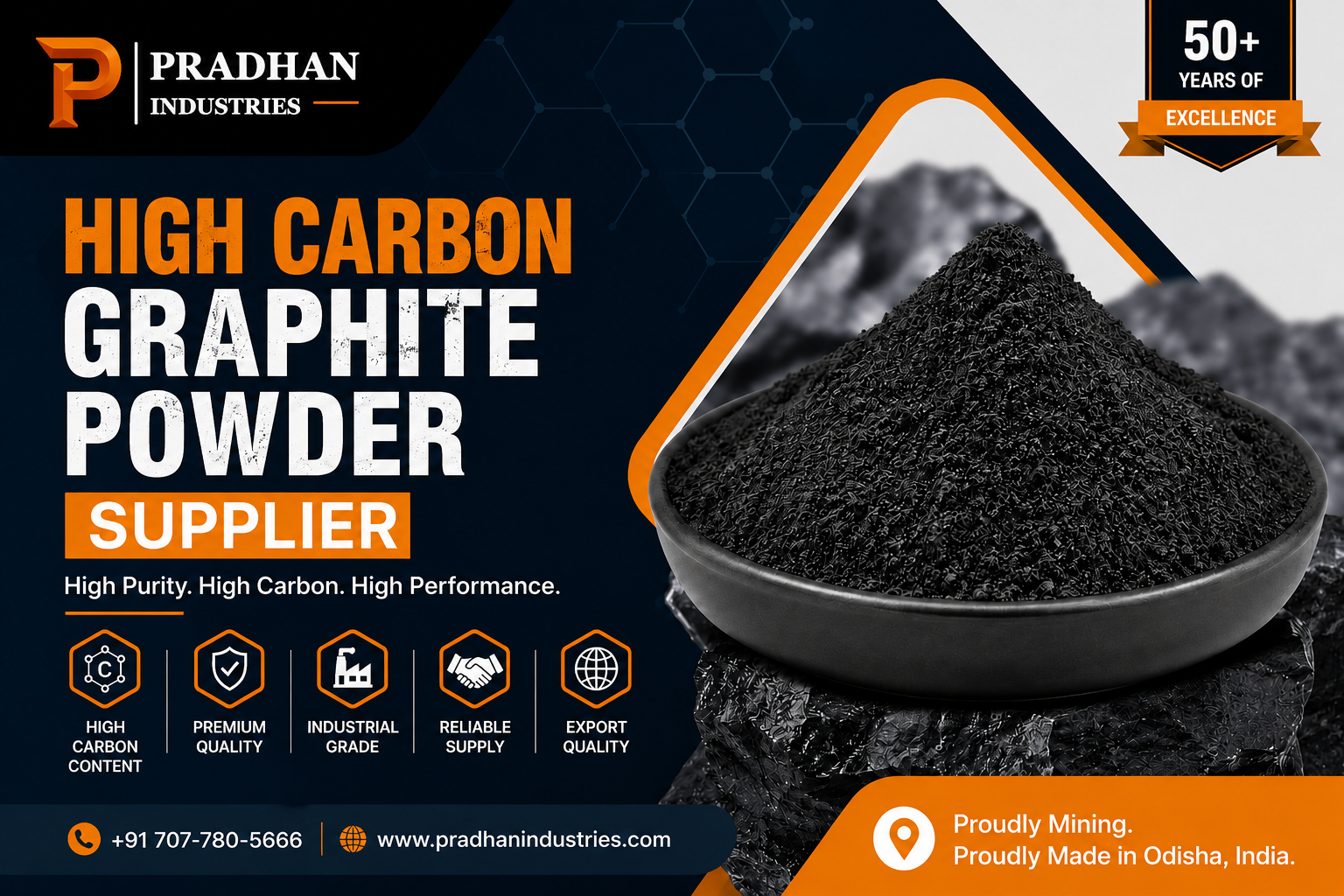
Finding a dependable high-carbon graphite powder supplier is one of those decisions that quietly shape the performance of everything downstream—furnace linings, brake compounds, casting quality, and even battery consistency. Get it wrong, and procurement teams end up firefighting inconsistent carbon content, unpredictable ash levels, or shipments that never quite match the sample that was approved. Get it right, and graphite becomes a non-issue: a raw material that simply performs, batch after batch.
This is the challenge most industrial buyers face when sourcing graphite powder. There’s no shortage of suppliers claiming “high purity” or “export quality,” but far fewer who can back that up with consistent mining sources, in-house testing, and a manufacturing history long enough to prove it. That’s where Pradhan Industries comes in — a natural graphite manufacturer operating out of Odisha, India, with over five decades of mining and processing experience behind it.
This guide walks through what high carbon graphite powder actually is, how it’s made, where it’s used, and what separates a genuinely reliable supplier from one that just sounds reliable on a website.
What is high-carbon graphite powder?
High-carbon graphite powder is natural crystalline graphite that has been mined, beneficiated, and processed until its fixed carbon content reaches a high threshold—typically anywhere from 80% to 98%, depending on the ore source and refining process. Unlike synthetic graphite, which is manufactured from petroleum coke through energy-intensive graphitization, natural high carbon graphite retains the layered crystalline structure formed over geological time, giving it inherent lubricity, conductivity, and thermal resistance.
The purity of the powder depends heavily on the beneficiation process — the stage where impurities like silica, mica, and other gangue minerals are separated from the carbon flakes. A supplier with strong beneficiation capability can consistently deliver higher carbon percentages with lower ash content, which directly affects how the material performs in furnaces, foundries, and friction applications.
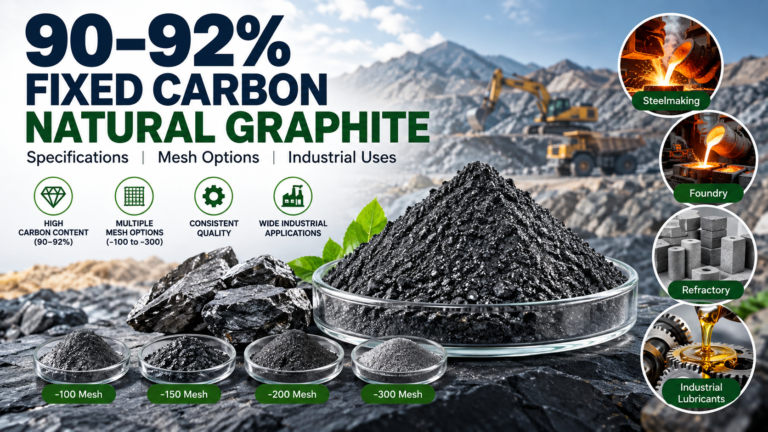
Particle size and mesh distribution matter just as much as carbon percentage. A refractory manufacturer might need coarser flake sizes for structural integrity, while a battery or lubricant application often calls for finer, more uniform particles. This is why customization—not just purity—is a defining trait of a good high-carbon graphite powder manufacturer.
Key Features of High-Quality Graphite Powder
A genuinely high-grade product should demonstrate the following characteristics:
- High Carbon Content — the core indicator of quality, directly influencing conductivity and thermal performance.
- Excellent Lubrication—Natural crystalline structure allows layers to slide against each other, reducing friction in mechanical applications.
- Superior Conductivity — critical for electrical and battery-related uses where consistent current flow matters.
- Thermal Stability — graphite withstands extreme furnace temperatures without breaking down, making it essential for refractory linings.
- Chemical Resistance — resists reaction with most acids and alkalis, which is why it holds up well in harsh industrial environments.
- Low Ash Content—fewer impurities mean cleaner combustion and fewer residues in high-temperature processes.
- Uniform Particle Size—ensures predictable behavior batch to batch, especially important for foundry and lubricant formulations.
- High Purity — the cumulative result of careful mining, beneficiation, and quality testing.
Manufacturing Process: From Ore to Finished Powder
Producing consistent High Purity Graphite powder is a multi-stage process, and each step affects the final product’s quality:
- Mining — Graphite ore is extracted from deposits, in Pradhan Industries’ case from Odisha’s natural graphite belt.
- Crushing — Raw ore is reduced to manageable fragments for further processing.
- Beneficiation — Impurities are separated from carbon flakes using flotation and mechanical separation techniques.
- Purification — Further refining increases the fixed carbon percentage and reduces ash content.
- Grinding — Material is milled down to the required particle size.
- Screening — Powder is sorted into specific mesh sizes to match customer specifications.
- Quality Testing — Samples are tested for carbon percentage, moisture, ash, and particle distribution.
- Packaging — The finished product is packed according to shipment and storage requirements, whether for domestic delivery or export.
Skipping or rushing any one of these stages is usually where inconsistency creeps in—which is why buyers evaluating a crystalline graphite powder source should always ask about the specific beneficiation and testing protocols in place, not just the final spec sheet.
Industrial Applications of High-Carbon Graphite Powder
High-carbon graphite powder isn’t a niche material—it’s a workhorse input across a surprising range of industries.
Steel Industry: Used as a carbon raiser to adjust carbon content in molten steel, improving hardness and strength.
Foundry: Applied as a mold coating and facing material, reducing metal penetration and improving surface finish on castings.
Refractory: A core component in magnesia-carbon bricks and refractory linings, valued for its thermal shock resistance.
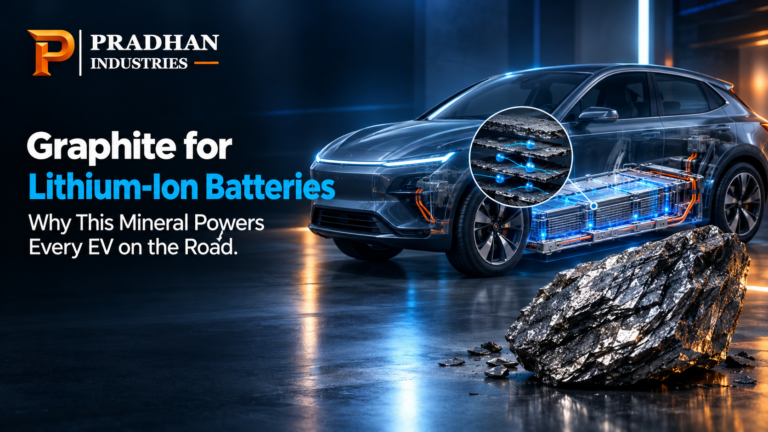
Battery Manufacturing: Used in anode materials, particularly in applications where cost-effective conductivity is prioritized.
Lubricants: Functions as a dry lubricant in high-temperature or high-load environments where oil-based lubricants break down.
Carbon Brushes: Provides the conductive, self-lubricating properties needed for electrical motor brushes.
Friction Materials: Used in brake linings and clutch facings to manage heat and wear.
Paints and Coatings: Adds conductivity and corrosion resistance to specialty industrial coatings.
Chemicals: Serves as a raw material or additive in various chemical processing applications.
Electrical Industry: Valued for its conductivity in electrodes, contacts, and other conductive components.
Why Carbon Percentage Matters: Comparing Grades
Not every application needs the highest possible carbon percentage—matching the grade to the use case is what actually saves money and improves performance.
| Carbon Content | Typical Suitability |
|---|---|
| 80% | Foundry facings, lower-cost refractory blends, general industrial use |
| 85% | Steel carbon raisers, standard refractory applications |
| 90% | Higher-grade refractory linings, friction materials |
| 95% | Lubricants, carbon brushes, precision friction applications |
| 98% | Battery components, high-conductivity electrical applications |
A bulk graphite powder supplier that understands these distinctions will guide buyers toward the right grade rather than simply upselling the highest carbon percentage available—a sign of genuine technical expertise versus pure sales pressure.
How to Choose the Best High-Carbon Graphite Powder Supplier
Selecting a supplier isn’t just about comparing price sheets. Consider these factors carefully:
- Experience — A long operating history usually signals consistent process control and industry relationships.
- Mining Source — Ownership of or direct access to mining operations reduces supply chain risk and quality variability.
- Manufacturing Capacity — Confirm the supplier can meet your volume requirements without compromising consistency.
- Quality Testing — In-house laboratory testing for carbon, ash, and moisture content is non-negotiable for serious buyers.
- Customization — Ability to produce specific mesh sizes and carbon grades tailored to your application.
- Packaging — Proper moisture-resistant packaging protects product integrity during transit and storage.
- Delivery — Reliable lead times and logistics coordination, especially for time-sensitive production schedules.
- Export Capability — Documentation, compliance, and shipping experience for international buyers.
- Customer Support — Responsive technical support for specification queries and after-sales issues.
- Certifications — Relevant quality and compliance certifications that validate manufacturing standards.
Why Buyers Choose Pradhan Industries
Pradhan Industries has built its reputation on consistency rather than claims. With over 50 years of experience in natural graphite mining and processing in Odisha, the company has direct access to graphite deposits, which reduces dependency on third-party ore sourcing — a common weak point for many suppliers.
Buyers across steel, foundry, and refractory sectors work with Pradhan Industries because of:
- Direct mining access in Odisha’s established graphite belt
- Modern beneficiation and processing infrastructure
- Bulk supply capability for large industrial orders
- Custom mesh sizes tailored to specific applications
- Competitive, transparent pricing
- Export-ready documentation and logistics support
- Consistent quality across repeat orders
- A track record built on long-term customer relationships
Rather than positioning itself as the cheapest option, Pradhan Industries focuses on being the most consistent one — which, for procurement teams managing production lines, tends to matter more in the long run.
Product Specifications
| Parameter | Typical Range |
|---|---|
| Carbon (%) | 80% – 98% |
| Ash (%) | 2% – 15% (grade dependent) |
| Moisture (%) | Below 1% |
| Particle Size | Customizable per requirement |
| Mesh | 80 to 300 mesh (customizable) |
| Packaging | Moisture-resistant bags, bulk options available |
| Applications | Steel, Foundry, Refractory, Lubricants, Batteries, Carbon Brushes, Friction Materials, Paints, Chemicals |
Specifications vary by grade and are confirmed against buyer requirements before dispatch.
Quality Control: What Happens Before Dispatch
Every batch that leaves the facility goes through a structured testing process:
- Particle Size Analysis — Ensures the powder matches the required mesh specification.
- Carbon Testing — Confirms fixed carbon percentage meets the ordered grade.
- Moisture Testing — Verifies moisture content stays within acceptable limits to prevent degradation.
- Ash Testing — Checks impurity levels against the specification sheet.
- Consistency Checks — Compares the batch against previous shipments to catch any drift in quality.
- Packaging Inspection — Confirms bags and containers are properly sealed and labeled before dispatch.
Industries Served
- Steel Manufacturing
- Foundries and Casting Units
- Refractory Producers
- Battery Manufacturers
- Lubricant Formulators
- Electrical Component Manufacturers
- Friction Material Producers
- Paint and Coating Manufacturers
- Chemical Processing Plants
Frequently Asked Questions
1. What is the difference between natural and synthetic high-carbon graphite powder? Natural graphite is mined and processed from crystalline ore deposits, retaining its natural layered structure. Synthetic graphite is manufactured from petroleum coke through high-temperature graphitization, which is more energy-intensive and typically costlier.
2. What carbon percentage should I choose for foundry applications? Foundry facings commonly use 80–90% carbon grades, though the exact choice depends on the casting process and desired surface finish.
3. Can Pradhan Industries customize mesh sizes for specific applications? Yes, mesh sizes can be customized based on the application, ranging from coarser grades for refractory use to finer powders for lubricants and battery components.
4. What is the minimum order quantity for bulk supply? Minimum order quantities vary by grade and packaging requirements. It’s best to reach out directly with your specifications for an accurate quote.
5. Does Pradhan Industries export graphite powder internationally? Yes, Pradhan Industries has export-ready documentation and logistics support for international bulk orders.
6. How is graphite powder quality tested before dispatch? Each batch undergoes carbon, ash, moisture, and particle size testing, along with consistency checks against previous shipments.
7. What packaging options are available for bulk shipments? Graphite powder is typically packed in moisture-resistant bags, with bulk packaging options available for larger orders.
8. Is high-carbon graphite powder suitable for battery applications? Higher purity grades, generally 95% and above, are commonly used in battery-related applications where conductivity is critical.
9. How does ash content affect graphite powder performance? Lower ash content generally means fewer impurities, resulting in cleaner high-temperature performance and more predictable material behavior.
10. How can I request a sample before placing a bulk order? Buyers can contact Pradhan Industries directly through the website’s contact page to request samples and discuss specifications before committing to a bulk order.
Conclusion
Choosing a high-carbon graphite powder supplier isn’t a decision to make on price alone. Carbon percentage, ash content, particle consistency, and a supplier’s ability to test and prove quality batch after batch all determine how well the material performs once it reaches your production line. With over 50 years of mining and processing experience in Odisha, Pradhan Industries offers the kind of consistency and technical guidance that industrial buyers across steel, foundry, refractory, and allied sectors have come to rely on.
If you’re sourcing high-carbon graphite powder in bulk, reach out to Pradhan Industries to discuss your specifications, request samples, or get a quote tailored to your application.