Graphite” is not one product. Buying graphite without specifying a grade is like ordering “steel” and expecting the supplier to guess whether you need rebar or a surgical scalpel blade.
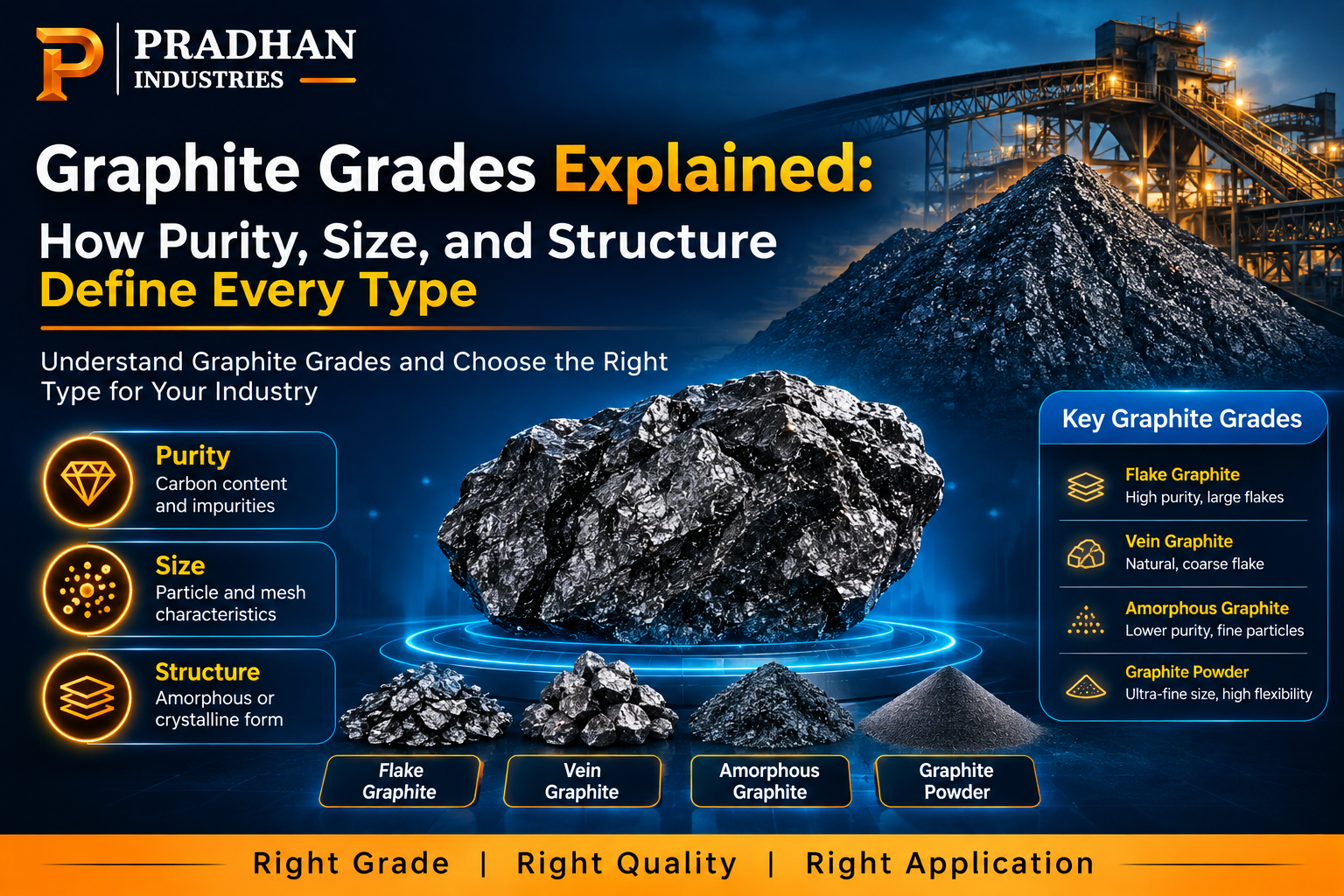
Every graphite grade gets defined by three things working together: how pure it is, how big the particles are, and how it’s structurally built. A 150-micron flake at 96% carbon behaves nothing like a 15-micron spherical particle at 99.95% carbon, even though both start as “graphite” on a spec sheet.
This guide breaks graphite grades down into the three pillars that actually matter for procurement and engineering decisions, then maps specific grades to specific applications—from foundry facings to lithium-ion battery anodes.
The 3 Core Pillars of Graphite Grading
Before looking at individual grades, it helps to understand what’s actually being measured. Every graphite classification system comes back to these three variables.
1. Carbon Purity / Fixed Carbon Content
Measured as fixed carbon percentage, often reported alongside Loss on Ignition (LOI) testing. This tells you how much of the material is actual carbon versus residual ash, moisture, and mineral impurities.
- Commercial grade — 80-93% C
- High purity — 94-97% C
- Ultra-high purity / battery grade — 99.9-99.95%+ C
2. Particle / Flake Size
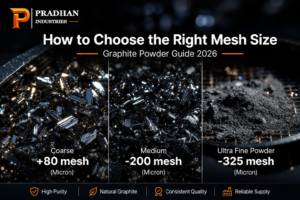
Measured using mesh screens — the number refers to openings per linear inch in the screen. A higher mesh number means smaller particles. A “+80 mesh” designation means the material is retained on an 80-mesh screen (i.e., it’s larger than that screen’s opening size).
- Jumbo Flake — +50 mesh
- Large Flake — +80 mesh
- Medium Flake — +100 mesh
- Fine/Powder—-100 mesh
3. Structural Form
This covers how the graphite is physically built or shaped:
- Natural flake — mined, retains natural crystal plate structure
- Amorphous — fine-grained, naturally lower crystallinity
- Synthetic (isostatic, molded, extruded) — manufactured from petroleum coke or pitch precursor through graphitization
A full grade specification combines all three. “Large flake, 94% C, natural” tells a buyer something completely different than “isostatic, ultra-fine grain, synthetic.”
Natural Flake Graphite Grades by Size & Mesh
Flake size is one of the biggest price drivers in the natural graphite market. Bigger flakes generally cost more because they’re rarer in nature and offer better structural integrity for certain applications.
MESH SIZE SCALE (larger flake -> finer powder)
+50 mesh   >300 microns   JUMBO FLAKE     $$$$ (highest value)
+80 mesh   180-300 microns LARGE FLAKE    $$$
+100 mesh  150-180 microns MEDIUM FLAKE   $$
-100 mesh  <150 microns    FINE/POWDER    $ (lowest value per ton)
Jumbo Flake (+50 Mesh, >300 microns)
The largest and rarest natural flake size. Commands premium pricing because so little of a typical ore deposit yields flake this large without breaking during mining and processing.
Best for: Expandable graphite production, where flake size directly determines how much the material can expand when heated (used in fire seals, gaskets, and fireproofing products).
Large Flake (+80 Mesh, 180-300 microns)
It’s still large enough for expandable graphite applications and a strong feedstock choice for spheronization into battery-grade SPG since bigger starting flakes give processors more material to shape.
Best for: Battery anode feedstock (pre-spheronization), premium lubricants, some expandable graphite grades.
Medium Flake (+100 Mesh, 150-180 microns)
A workhorse size. Common in general industrial applications where flake size matters less than carbon purity.
Best for: Refractory products, foundry facings, general lubricant blends.
Fine / Powder Flake (-100 Mesh, <150 microns)
The most abundant and cheapest flake size, often a byproduct of processing larger flake grades. Also the natural output size from micronization steps in spherical graphite production.
Best for: battery conductive additives, coatings, foundry dressings, and carbon brake components.
Carbon Purity Classifications Explained
Purity determines what industry a graphite grade can realistically serve. Jumping from one purity tier to the next isn’t cheap — it usually requires a completely different processing step (like acid leaching or thermal purification).
Low/Medium Carbon (80% – 93% C)
This is commercial-grade material, straight or lightly processed flotation concentrate on the lower end.
Typical uses:
- Foundry facings and mold washes
- Brake pad friction components
- General industrial coatings
High Carbon (94% – 97% C)
Standard flotation concentrate purity for most flake graphite operations. Good enough for demanding industrial use, not quite battery-spec.
Typical uses:
- Refractory bricks and crucibles for steelmaking
- Industrial lubricants
- Gasket and seal material
Ultra-High Purity (99.9% – 99.95%+ C)
Reaching this tier requires additional purification—either acid leaching or high-temperature thermal treatment (2800°C+). This is genuinely a different product from standard flotation concentrate, not just a cleaner version of it.
Typical uses:
- EV lithium-ion battery anodes (spherical graphite / SPG)
- Nuclear reactor moderators (extremely tight impurity tolerances)
- Semiconductor thermal management components
Synthetic Graphite Grades by Manufacturing Method
Synthetic graphite isn’t classified by mesh and mining purity the way natural flake is. Instead, it’s classified by grain structure and manufacturing process, since it’s built from petroleum coke or pitch through graphitization at 2800-3000°C.
Isostatic Graphite
Made by cold isostatic pressing of fine coke powder, then graphitized. This produces an extremely fine, uniform grain structure with isotropic properties—meaning it performs the same in every direction, unlike coarser synthetic grades.
Best for: EDM (electrical discharge machining) electrodes, semiconductor components, high-precision molds. This is the most expensive synthetic grade due to tight grain control.
Molded / Die-Pressed Graphite
Made by pressing coke and pitch binder into molds before graphitization. Medium grain size, good mechanical strength, moderate cost.
Best for: General industrial electrodes, mechanical seals, bushings.
Extruded & Vibrated Graphite
Made through extrusion or vibration molding, producing a coarser grain structure. Cheapest synthetic manufacturing method, well suited to large-format parts.
Best for: Steel electrode manufacturing (electric arc furnace electrodes) and large industrial components where fine grain isn’t necessary.
Master Comparison Table
| Grade Name | Particle Size / Mesh | Carbon Purity (%) | Primary Applications | Price Band |
|---|---|---|---|---|
| Jumbo Flake | +50 mesh, >300 microns | 94-97% | Expandable graphite, fire seals | Highest |
| Large Flake | +80 mesh, 180-300 microns | 94-97% | Battery feedstock, premium lubricants | High |
| Medium Flake | +100 mesh, 150-180 microns | 90-96% | Refractories, foundry facings | Moderate |
| Fine/Powder Flake | -100 mesh, <150 microns | 85-95% | Coatings, conductive additives | Low |
| High-Purity SPG | 15-20 microns (D50) | 99.9-99.95%+ | Li-ion battery anodes | Very High |
| Amorphous Graphite | Fine, irregular | 70-85% | Foundry dressings, low-spec industrial | Lowest |
| Isostatic Graphite | Ultra-fine grain (synthetic) | 99.9%+ | EDM electrodes, semiconductors | Very High |
| Molded Graphite | Medium grain (synthetic) | 99%+ | Industrial seals, bushings | Moderate-High |
| Extruded Graphite | Coarse grain (synthetic) | 98-99% | Steel electrodes, large components | Moderate |
How to Choose the Right Graphite Grade
Procurement and engineering teams can walk through this four-step framework before requesting quotes.
Step 1: Define the performance requirement first, not the budget. Does the application need electrical conductivity, thermal resistance, lubricity, or chemical inertness? This narrows the field before purity or size even comes into play.
Step 2: Set the minimum acceptable carbon purity. Battery anodes need 99.9%+ C. Refractories can often run on 94-97% C. Don’t overpay for purity a foundry application doesn’t need.
Step 3: Match particle size / mesh to the manufacturing process. Expandable graphite needs large or jumbo flakes. Coatings and additives work fine with fine powder. Battery anode processors need a specific pre-spheronization flake size to hit their target particle size distribution downstream.
Step 4: Decide natural vs. synthetic based on cost and consistency needs. Natural graphite costs less and has a lower carbon footprint. Synthetic graphite offers more batch-to-batch consistency and better fast-charge or high-precision performance where that consistency matters more than cost.
Frequently Asked Questions
1. What does mesh size mean in graphite grading? Mesh size refers to the number of openings per linear inch in a screen used to sort particles by size. A “+80 mesh” designation means the graphite particles are larger than an 80-mesh screen opening, so higher mesh numbers actually mean smaller particles.
2. What carbon purity is required for battery-grade graphite? Battery-grade graphite for lithium-ion anodes typically requires 99.9% to 99.95%+ fixed carbon content. Reaching this level requires additional purification beyond standard flotation, usually through acid leaching or high-temperature thermal treatment.
3. What is the difference between natural flake graphite grades and amorphous graphite grades? Natural flake graphite has a distinct plate-like crystal structure and higher natural crystallinity, making it suitable for batteries and premium lubricants. Amorphous graphite has a finer, less-ordered structure and lower natural carbon content, so it’s generally used in lower-spec industrial applications.
4. Why does jumbo flake graphite cost more than fine powder graphite? Jumbo flakes are rarer in nature since large, intact flakes are harder to preserve through mining and processing without breaking. It’s also required for specific high-value applications like expandable graphite, which drives its price well above fine powder grades.
5. What is isostatic graphite used for? Isostatic graphite is a synthetic grade with extremely fine, uniform grain structure and isotropic properties, meaning it performs consistently in every direction. It’s used mainly in EDM electrodes, semiconductor manufacturing, and precision mold applications where grain consistency is critical.
Final Takeaway
Graphite grades aren’t arbitrary labels—they’re the direct result of measurable purity, particle size, and structural form, each tied to a specific manufacturing process and cost. A buyer who understands mesh sizing and purity tiers can spec exactly what an application needs instead of overpaying for battery-grade purity on a foundry job or underspeccing a battery anode with commercial-grade flake.
Getting the grade right up front saves money and prevents performance failures downstream — whether that’s a cracked crucible, a weak expandable seal, or a battery that can’t hit its rated cycle life.