Global buyers looking to diversify their graphite supply outside of China keep arriving at the same strategic conclusion: India. And it’s not just marketing talk—it’s geology and logistics working perfectly together.
Partnering with a reliable graphite exporter in India gives you access to rich natural flake reserves, established port infrastructure, and a cost-competitiveness that is increasingly hard to match on the global stage. Whether you are a procurement head managing EV battery supply chains, running a foundry, or buying for industrial applications, single-source dependency has become a genuine business risk.
Here is everything international buyers need to know to confidently source natural flake graphite from India—covering reserve regions, technical specs, shipping logistics, and a bulletproof vetting checklist.
Why Global Supply Chains are Pivoting to Indian Graphite
Rich Geological Reserves
India boasts natural graphite deposits across several key states, each offering distinct grade characteristics:
-
Odisha: A long-established crystalline graphite mining region with over five decades of operating history. It is highly regarded for consistent flake quality and reliable export-grade output.
-
Jharkhand: Holds significant flake graphite reserves that support both heavy domestic industrial demand and growing export volumes.
-
Tamil Nadu: An established southern graphite mining belt known for excellent flake recovery rates.
-
Andhra Pradesh & Rajasthan: Additional, robust reserve regions that contribute heavily to India’s overall natural graphite output.
High Natural Crystallinity and Large Flake Recovery
Indian flake graphite deposits are celebrated for their solid crystallinity. This structural integrity supports a much better recovery of large and jumbo flake sizes—the exact grades that command premium pricing in the expandable graphite and EV battery feedstock markets.
Mitigating Single-Source Risk
A massive share of global graphite processing capacity currently sits in just one country. Buyers focused on long-term supply security are actively signing contracts with Indian graphite suppliers to reduce concentration risk, building resilient, multi-vendor supply chains.
Major Graphite Product Grades Exported from India
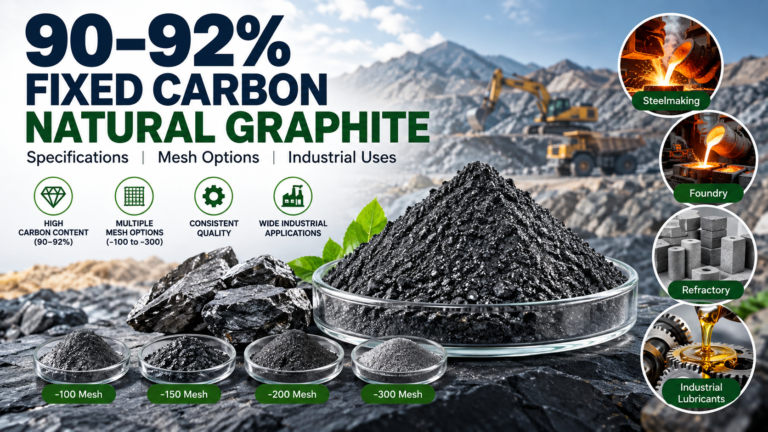
Depending on the processing level, Indian exporters offer natural flake graphite sorted by mesh size and carbon purity (ranging from 85% to 98% C).
-
Jumbo Flake (+50 mesh): Premium pricing. The go-to feedstock for expandable graphite and battery applications.
-
Large Flake (+80 mesh): A highly sought-after feedstock choice for spheronization and premium industrial lubricants.
-
Medium Flake (+100 mesh): The standard for general industrial use, high-heat refractories, and foundry facings.
-
Fine Flake / Micronized Powder (-100 mesh): Milled down to fine particle sizes for specialty coatings, carbon brushes, and conductive additives.
-
Expandable / Intercalated Graphite: Treated large or jumbo flake that expands in volume when heated, which is essential for thermal management components and fire-retardant seals.
-
High-Purity Spherical Graphite (SPG) Precursors: Processed and shaped for spheronization into battery-grade material. India is rapidly building capacity in this sector to serve the EV market directly.
Technical Specifications & Export Quality
Exact specifications will vary by supplier and the specific deposit. Always request a Certificate of Analysis (COA) tied to your specific shipment lot, rather than relying on a generic marketing sheet.
| Grade / Product | Mesh / Particle Size | Carbon Purity (C%) | Moisture / Ash Max | Primary Application |
| Jumbo Flake | +50 mesh (>300 microns) | 94-98% | Moisture < 0.5%, Ash < 6% | Expandable graphite, battery feedstock |
| Large Flake | +80 mesh (180-300 microns) | 94-97% | Moisture < 0.5%, Ash < 6% | Battery feedstock, premium lubricants |
| Medium Flake | +100 mesh (150-180 microns) | 90-96% | Moisture <1%, Ash <8% | Refractories, foundry facings |
| Fine Flake/Powder | -100 mesh (<150 microns) | 85-95% | Moisture <1%, Ash <10% | Coatings, conductive additives |
| Amorphous | Fine, irregular | 75-90% | Moisture < 2%, Ash < 12% | Foundry dressings, low-spec industrial |
| SPG Precursor | 15-20 microns | 96-99%+ | Moisture <0.3%, Ash <3% | Li-ion battery anode processing |
Quality Assurance & Testing Standards
Reputable Indian exporters don’t guess—they test every single batch against rigorous parameters to ensure consistent SEO and downstream product performance:
-
Fixed Carbon & LOI: Loss on Ignition (LOI) confirms the core carbon content by measuring weight loss upon combustion, usually following ASTM C561 standards.
-
Sieve Analysis (PSD): Confirms that the actual particle size distribution matches the claimed grade (jumbo vs. medium). If you need expandable graphite, demand the full sieve breakdown.
-
Third-Party Inspections: Most trusted suppliers will gladly accommodate independent pre-shipment inspections from global agencies like SGS, Bureau Veritas, or Intertek.
Export Logistics & Shipping Infrastructure
India’s port network handles massive bulk mineral export volumes daily, making international shipping highly dependable.
-
Paradip Port (Odisha) & Visakhapatnam Port (AP): These handle a massive share of eastern India’s mineral export volume due to their proximity to the Odisha and Andhra Pradesh mines.
-
Chennai Port (TN) & JNPT (Mumbai): JNPT is the powerhouse for containerized cargo, while Chennai efficiently serves the southern Tamil Nadu reserves.
Packaging Standards:
For smaller lots or sample orders, 25kg moisture-proof PP bags are standard. For bulk orders, material is packed into 1 MT / 1.2 MT UV-treated jumbo bags, which are palletized and fumigated to meet destination country import regulations.
The 5-Step Sourcing Checklist
Use this framework to vet an Indian graphite supplier before signing any contracts.
Frequently Asked Questions
1. Which Indian states are major sources for graphite export?
Odisha, Jharkhand, Tamil Nadu, Andhra Pradesh, and Rajasthan hold India’s primary natural graphite reserves. Odisha has a particularly long-established mining history supporting consistent export-grade flake production.
2. What certifications should I look for in an Indian graphite supplier?
Look for ISO certification, batch-specific Certificates of Analysis (COA), and a documented willingness to accommodate third-party inspection from global agencies like SGS or Bureau Veritas.
3. What carbon purity range is available from Indian exporters?
Indian exporters typically offer natural flake graphite ranging from 85% to 98% carbon purity, depending on flake size. High-purity SPG precursor material can reach 96-99%+ for demanding battery anode applications.
The Bottom Line
Sourcing from a graphite exporter in India comes down to verifying three core pillars: legitimate mining/processing origins, batch-tested lab documentation, and proven export logistics. For procurement teams serious about building supply chain resilience, Indian natural graphite is a highly viable, scalable alternative to single-source markets. Change the first line to: “Sourcing from a graphite exporter India comes down to verifying three core pillars