Ask five suppliers for “graphite rate per tonne,” and you may receive five numbers that cannot be compared. One is quoting 90% fixed carbon at 200 mesh, ex-works. Another is quoting a lower grade in loose bags, delivered to your plant. The cheaper figure looks attractive on paper, but it may not suit your process.
A natural graphite bulk quote is only as useful as the specification behind it. Fixed carbon, particle size, quantity, packaging, testing, and delivery terms all change the final figure. This guide explains what to share with a supplier, what drives bulk graphite pricing, how to evaluate a natural graphite manufacturer in India, and how to request a quotation you can use for a real purchase decision, for a steel plant, a foundry, a refractory unit, or a distributor’s stock.
What Is a Natural Graphite Bulk Quote?
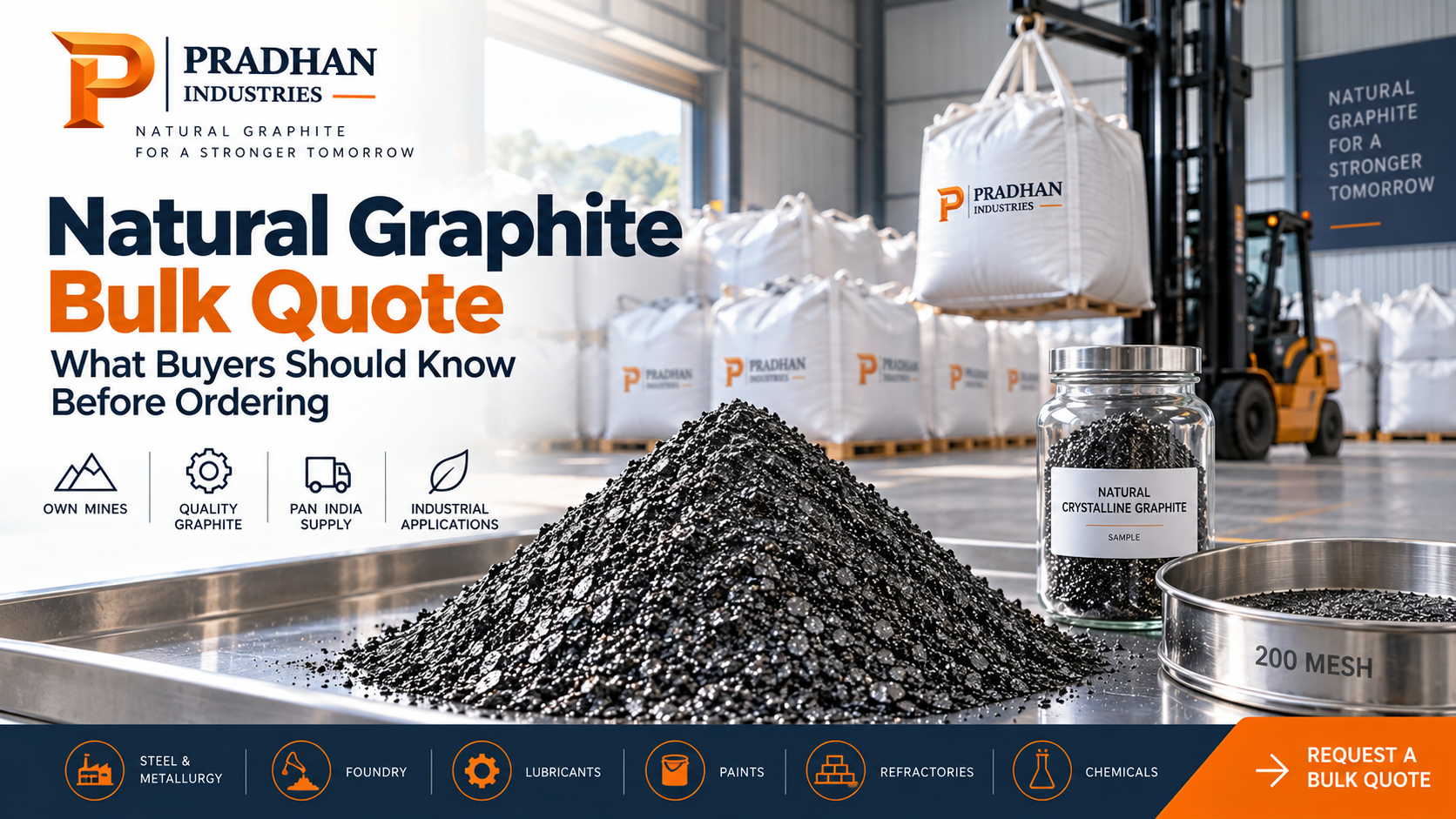
A natural graphite bulk quote is a supplier’s written commercial offer for a defined quantity of graphite, usually priced per metric tonne. A complete graphite quotation states the grade, fixed carbon range, mesh size, price basis, packaging, taxes, freight terms, validity period, delivery schedule, and payment terms.
The important word is defined. Natural graphite does not have one market rate. A 60–65% fixed carbon product and a 94–95% product go through different levels of processing and serve different purposes. A quotation without a stated specification is an estimate, not an offer.
What Information Should You Provide When Requesting a Graphite Quote?
A precise enquiry gets a faster and more accurate reply. Keep these details ready:
- Fixed carbon grade: the minimum or range you need, such as 90–92% FC.
- Mesh / particle size: the mesh number and whether material should pass through the sieve (−200 mesh) or be retained on it (+100 mesh).
- Quantity: a trial lot, a one-time order, or a monthly requirement.
- Application: steel, foundry, refractory, friction, lubricant, or another use.
- Packaging: bag size and type, and any handling constraints at your unloading point.
- Delivery location: the plant address and whether you want an ex-works or delivered price.
- Testing / COA requirements: the parameters you want reported, such as fixed carbon, ash, moisture, volatile matter, and sieve analysis.
Why not simply ask for the price? Because the supplier then has to guess your requirement. If they assume a higher grade than you need, you overpay. If they assume a lower one, the material may fail your incoming inspection. A rejected truckload costs far more than an extra day spent writing a clear specification.
What Factors Affect the Price of Natural Graphite in Bulk?
Graphite prices move with ore availability, demand, and freight costs, so any figure printed in an article goes stale quickly. For a wider view of global supply and demand, the USGS graphite statistics page is a useful reference. For your own purchase, it is more practical to understand what goes into the number.
Fixed carbon and grade. Raising fixed carbon means removing more ash-forming minerals during beneficiation. Higher grades need more processing and give lower yield from the same ore, so they generally cost more.
Mesh size. Finer material needs extra grinding and classification. A tight particle size range also needs closer control than a broad one.
Quantity. Large and recurring volumes allow better production and freight planning. A 2-tonne trial and a 100-tonne annual contract are rarely priced the same per tonne.
Processing and packaging. Drying, screening, blending, or custom sizing add steps. Standard bags, jumbo bags, and lined packaging each carry different costs.
Transportation and delivery location. Material moving from Odisha to a foundry cluster in Punjab carries a different freight cost from a delivery within eastern India. Always confirm whether the rate is ex-works or delivered.
Quality and testing requirements. A COA is part of routine supply. Third-party testing, additional parameters, or pre-despatch sampling may be quoted separately.
Why Graphite Grade and Fixed Carbon Matter
Fixed carbon is the carbon left after moisture, volatile matter, and ash are accounted for: roughly FC = 100 − (ash + volatile matter + moisture). The ash consists of silica, alumina, iron oxide, and other minerals carried over from the host rock. This is why natural graphite ore is beneficiated before it reaches buyers, as described in the Indian Minerals Yearbook graphite review published by the Indian Bureau of Mines.
Lower grades such as 60–65% FC contain more ash. They can be economical where the process tolerates mineral content. Higher grades such as 90–92% and 94–95% FC carry less ash per tonne, which matters where impurities affect the process or where a formulation is built around a specific carbon level.
The practical rule is to buy the grade your process needs, as confirmed by your technical team or past trials. Over-specifying adds cost without benefit, and under-specifying risks rejection. Our guide to graphite chemical composition explains impurities in more detail, and our product range lists the available grade and mesh combinations.
Why Particle Size Matters When Buying Graphite
Mesh is the number of sieve openings per linear inch. The higher the mesh number, the finer the powder. The openings of a 100-mesh sieve are about 150 microns, a 200-mesh sieve about 75 microns, and a 300-mesh sieve roughly 45–53 microns, depending on the sieve standard.
The sign in front of the number matters. “−200 mesh” means the material passes through a 200 mesh sieve. “+100 mesh” means it stays on top of a 100-mesh sieve. Confusing the two is one of the most common errors in graphite inquiries.
Particle size affects how graphite disperses in a mix, spreads in a coating, and flows during handling. A coating formulator and a foundry buyer will look at mesh very differently, so state your process requirement and ask for sieve analysis on the COA.
How to Choose a Natural Graphite Supplier in India
Price is only one line on the evaluation sheet. When comparing crystalline graphite suppliers, check the following:
Source and processing. Does the supplier have direct access to graphite deposits and its own mining, beneficiation, and processing facilities, or does it trade material bought from others? Grade consistency and testing. Ask for COAs from several past batches, not a single sample report, and find out how and at what stage each batch is tested before dispatch. COA and packaging. Confirm that every consignment comes with a COA, and ask how bags are packed and marked. Bulk supply and logistics. Check whether the supplier can meet your monthly volume and who arranges transport. Communication and technical input. A supplier that asks about your application before quoting is thinking about your process, not just the sale.
Pradhan Industries has been in business since 1976 and is a natural crystalline graphite manufacturer based in Odisha, with mining, beneficiation, processing, and supply operations. Graphite is sourced directly from Odisha deposits, a COA is provided, and bulk supply is available across India. Buyers can check these points against the checklist above and ask for the documents relevant to their own order.
Industrial Applications of Natural Graphite
In steel and metallurgy, graphite is used as a carbon source where carbon content needs adjustment. Foundries use it in mold and core coatings and as a carbon additive. In friction materials, it is a common ingredient in brake linings, pads, and clutch facings. Refractory manufacturers use it in carbon-bearing products such as magnesia-carbon bricks and crucibles. Its layered structure makes it useful in lubricants, including greases and dry lubricant formulations. These end uses are also reflected in the USGS Mineral Commodity Summaries on natural graphite. Other industrial uses include paints and coatings, conductive fillers, and rubber compounds.
Battery anode applications usually call for purified material with carbon content well above standard industrial grades, so battery-related buyers should state their exact purity requirement up front. For any application, the preferred grade and mesh vary, which is why your enquiry should always say what the graphite will be used for.
How to Request a Natural Graphite Bulk Quote
- Define the application and what the graphite must do in your process.
- Fix the specification: fixed carbon range, mesh size, and ash and moisture limits.
- Estimate the quantity for the trial, the first order, and the monthly consumption.
- Decide on packaging, keeping your unloading and storage conditions in mind.
- Share the delivery address and the price basis you want (ex-works or delivered).
- List your COA and testing parameters.
- Request a sample or technical data sheet before committing to bulk.
- Compare quotations on the same basis: grade, mesh, packing, freight, taxes, validity, and payment terms.
Questions to Ask Before Placing a Bulk Graphite Order
Is the price ex-works or delivered to my site? This single term can explain most of the gap between two quotes.
What tolerance applies to fixed carbon and mesh? Agree on acceptable ranges in writing.
Will each lot come with a COA? Batch-wise documentation helps your quality team clear material faster.
How long is the quotation valid? Freight and raw material costs change, so note the validity date.
Are taxes shown separately? Confirm how GST is presented so you can compare quotes accurately.
What happens if a lot does not match the specification? Agree on the sampling method, testing laboratory, and resolution process before the order is placed.
Request a Natural Graphite Bulk Quote from Pradhan Industries
If you are planning to buy natural graphite in bulk, the Pradhan Industries team can prepare a quotation based on your actual requirement. To help us respond accurately, please share:
- Required quantity
- Fixed carbon requirement
- Mesh size
- Application
- Packaging requirement
- Delivery location
- Any testing or COA requirement
Email your details to info@pradhanindustries.com or call +91 707-780-5666. You can also reach us through our Contact Us page.
Frequently Asked Questions
How do I get an accurate natural graphite price quotation?
Share the fixed carbon grade, mesh size, quantity, application, packaging, delivery location, and testing needs. A quote built on these details can be compared reliably with other offers.
Why do graphite quotes from different suppliers vary so much?
Suppliers may be quoting different grades, mesh sizes, packaging, or freight terms. Compare offers only after putting them on the same basis.
What is fixed carbon in graphite?
Fixed carbon is the carbon remaining after moisture, volatile matter, and ash are accounted for. It is the main figure used to describe graphite grade.
What is the difference between 100, 200, and 300 mesh graphite?
The higher the mesh number, the finer the powder. The openings of a 100-mesh sieve are about 150 microns, compared with about 75 microns for 200 mesh and roughly 45–53 microns for 300 mesh.
Does Pradhan Industries provide a COA with graphite supply?
Yes, Pradhan Industries provides a Certificate of Analysis so buyers can check the grade against their order specification.
Can Pradhan Industries supply natural graphite in bulk across India?
Yes. Pradhan Industries sources graphite from Odisha deposits and offers bulk supply across India.