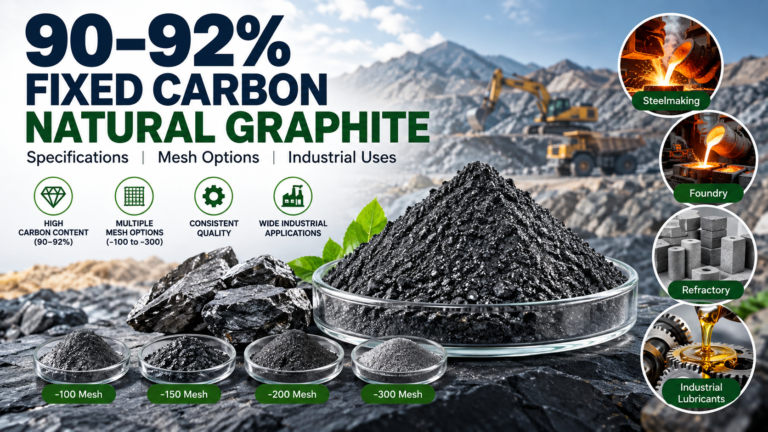
Buying graphite in bulk is an important decision for manufacturers, foundries, refractory producers, and other industrial businesses. The quality of graphite used in production can affect product performance, manufacturing costs, and consistency.
Before placing a large order, we need to make sure the graphite meets the required technical specifications. Graphite quality testing helps us understand the purity, particle size, moisture level, and other properties of the material before it reaches the production line.
Different graphite grades have different characteristics. A grade suitable for foundry applications may not meet the requirements of refractory manufacturing or battery material production. This is why checking the material carefully before bulk purchasing is essential.
At Pradhan Industries, we understand the importance of selecting graphite according to the specific needs of industrial applications. In this guide, we explain how to check graphite quality, which laboratory tests matter, and what buyers should verify before choosing a graphite supplier.
What Is Graphite Quality Testing?
Graphite quality testing is the process of examining the chemical composition, physical properties, and consistency of graphite to determine whether it meets the required industrial specifications.
Natural graphite contains carbon along with varying amounts of mineral impurities, depending on its geological source and processing.
Testing helps buyers understand the actual characteristics of the material instead of relying only on the supplier’s grade description.
The main parameters evaluated during graphite quality testing include:
-
Fixed carbon content
-
Ash content and impurities
-
Moisture content
-
Volatile matter
-
Particle size distribution
-
Flake size and structure
-
Batch-to-batch consistency
These parameters help manufacturers select graphite that suits their production requirements.
For example, a refractory manufacturer may focus on carbon content, ash, and flake characteristics, while a buyer of fine graphite powder may pay closer attention to particle size and distribution.
The correct graphite grade is the one that meets the technical requirements of the intended application, not necessarily the one with the highest carbon percentage or lowest price.
1. Check Fixed Carbon Content Before Buying Graphite
Fixed carbon content is one of the first parameters we should check when purchasing graphite in bulk.
It indicates the percentage of carbon remaining after accounting for moisture, volatile matter, and ash, according to the applicable analytical method.
In general, graphite with higher fixed carbon content contains a greater proportion of carbon and less non-carbon material. However, fixed carbon alone does not provide a complete picture of graphite quality.
Why Is Fixed Carbon Important?
Fixed carbon content can influence the suitability of graphite for industrial processes that require specific carbon levels.
It is particularly relevant in foundries, refractory production, industrial lubricants, and other applications where carbon content is part of the material specification.
Before ordering, we should confirm:
-
The minimum fixed carbon percentage required.
-
Whether the result is reported on a dry or as-received basis.
-
The laboratory method used for testing.
-
Whether the reported result corresponds to the actual production batch.
How Is Fixed Carbon Calculated?
For analytical methods that determine fixed carbon by difference, the following formula may be used:
Fixed Carbon (%) = 100 − Moisture (%) − Volatile Matter (%) − Ash (%)
For example, if a graphite sample contains 1% moisture, 2% volatile matter, and 5% ash, the calculated fixed carbon content is 92%.
This calculation assumes that the values are measured on compatible reporting bases and that the selected method defines fixed carbon by difference.
We should always compare laboratory results using the same reporting basis to avoid misleading comparisons between suppliers.
2. Test Ash Content to Check Graphite Purity
Ash content is another important parameter in graphite quality testing.
Ash refers to the inorganic residue remaining after graphite is subjected to a specified oxidation or combustion procedure. It can include mineral residues associated with the natural graphite deposit and its processing.
The amount and composition of ash vary depending on the source of graphite and the beneficiation or purification process.
How Does Ash Content Affect Graphite Quality?
High ash content may indicate a greater proportion of inorganic material in the graphite sample.
Depending on the application, these impurities can influence processing behavior, product consistency, and the suitability of the material for high-purity requirements.
ASTM International provides a standard test method, ASTM C561-23, for determining ash in graphite samples. The method gives a practical estimate of non-burnable residue and helps compare the purity of commercial graphite grades.
However, ash content does not identify every individual impurity.
For applications requiring strict chemical purity, we should also request elemental analysis for relevant impurities, such as iron, silica-related elements, and other application-specific contaminants.
How to Verify Ash Content
Before approving a bulk graphite order, we should:
-
Request a laboratory report showing the actual ash percentage.
-
Check the maximum ash limit specified in the purchase order.
-
Confirm the testing method and reporting basis.
-
Request additional elemental analysis if required.
-
Compare the results with the approved graphite sample.
Lower ash content can be an important quality requirement, but the acceptable limit depends on the intended application and the relevant technical specification.
3. Check Graphite Moisture Content
Moisture content is important when purchasing graphite in bags, bulk packaging, or large industrial consignments.
Graphite may be exposed to moisture during storage, transportation, or handling. Moisture can also be retained by fine particles or associated impurities.
Excessive moisture can affect the actual dry quantity delivered and create handling or processing problems.
Why Should Buyers Check Moisture?
When graphite is purchased by weight, moisture affects the amount of dry material received.
For example, a shipment weighing 1,000 kg with 2% moisture contains approximately 980 kg of dry material, assuming the moisture percentage is measured on an as-received basis.
This is why buyers should agree on acceptable moisture levels and the method for reporting them.
Moisture testing is generally carried out by weighing a representative sample, drying it under specified laboratory conditions, and measuring the loss in mass.
We should also inspect packaging for water damage and ensure the graphite is stored in suitable conditions.
4. Verify Graphite Particle Size and Distribution
Particle size is an important physical property that affects how graphite behaves during industrial processing.
Graphite is available in different particle sizes, from coarse flakes to fine powders. Each size may be suitable for different manufacturing requirements.
Before placing an order, we should confirm that the graphite meets the required particle size specification.
Common Particle Size Testing Methods
Sieve Analysis
Sieve analysis is commonly used for graphite grades with particles suitable for screening.
The sample is passed through a series of sieves with specified openings to determine the proportion of material within different size ranges.
This method is useful when the purchase specification is based on mesh size.
Laser Diffraction
Laser diffraction is used to measure particle size distribution, particularly for many fine graphite powders.
The report may include D10, D50, and D90 values.
|
Parameter |
Meaning |
|---|---|
|
D10 |
10% of the measured distribution is below this particle diameter. |
|
D50 |
Median particle diameter of the measured distribution. |
|
D90 |
90% of the measured distribution is below this particle diameter. |
These values provide more information than a single mesh size.
When comparing graphite suppliers, we should confirm that particle size results are reported using compatible measurement methods and distribution bases.
5. Examine Flake Size and Graphite Structure
For crystalline flake graphite, flake size and structural characteristics can be important quality parameters.
Natural flake graphite has a layered structure, and its flakes may become smaller during grinding, beneficiation, or handling.
Two graphite samples with similar fixed carbon content may therefore have different physical characteristics.
What Should We Check in Flake Graphite?
Flake size: Confirm whether the material meets the required coarse, medium, or fine flake specification.
Flake integrity: Check whether the graphite contains excessive broken flakes or fines.
Particle distribution: Examine the proportion of different particle sizes.
Consistency: Compare the characteristics of the approved sample with subsequent production batches.
Microscopic examination and particle size analysis can help assess the physical characteristics of flake graphite.
The required flake size should be specified clearly in the purchase order, especially when it is important to the performance of the finished product.
6. Request a Certificate of Analysis (COA)
A Certificate of Analysis is an important document when purchasing graphite in bulk.
It provides analytical information about a material or production batch and helps buyers compare actual test results with agreed specifications.
A general product brochure may describe the available graphite grades, but a batch-specific COA provides more relevant information about the material being supplied.
What Should a Graphite COA Include?
|
Quality Parameter |
Information to Check |
|---|---|
|
Fixed carbon |
Actual percentage and required minimum |
|
Ash content |
Actual percentage and maximum limit |
|
Moisture |
Measured percentage and reporting basis |
|
Volatile matter |
Actual test result |
|
Particle size |
Mesh size or particle size distribution |
|
Flake size |
Specified grade, where applicable |
|
Test method |
Analytical method or standard used |
|
Batch number |
Identification of the production lot |
|
Laboratory details |
Laboratory name and report identification |
We should make sure that the COA corresponds to the actual batch being purchased.
For specialized applications, we may also require additional chemical analysis or independent laboratory verification.
A Safety Data Sheet (SDS) should also be requested where appropriate. However, an SDS provides safety and handling information; it is not a substitute for a COA or laboratory quality report.
7. Conduct Independent Graphite Laboratory Testing
Supplier documentation is useful, but independent testing can provide additional confidence before a large purchase.
This is especially relevant when working with a new supplier, buying a large consignment, or purchasing graphite for a process with strict quality requirements.
Which Tests Should Be Included?
For Indian industrial buyers, it is also useful to review relevant material standards before selecting a graphite grade. For example, Indian Standard IS 11321:1985 covers graphite used in graphite crucibles. It gives specifications for graphite used in crucibles. We should check whether a particular standard applies to our intended use before including it in the purchase specification. Following relevant technical standards and verifying laboratory results can help us maintain consistent graphite quality.
The testing program should be based on the intended application.
For many industrial graphite grades, the initial testing requirements may include:
-
Fixed carbon content
-
Ash content
-
Moisture content
-
Volatile matter
-
Particle size distribution
-
Relevant elemental impurities
Additional tests may be needed for specialized applications, including electrical conductivity, thermal characteristics, or other performance-related properties.
We should collect representative samples and use a qualified laboratory with suitable testing capabilities.
The sample should represent the actual material being purchased, rather than an unrelated sample prepared only for demonstration.
For large consignments, sampling from multiple bags or different portions of the shipment may help identify variations.
Independent testing is particularly useful when the cost of inconsistent raw material could affect an entire production batch.
8. Check Batch Consistency Before Bulk Ordering
A graphite sample may meet every required specification, but that does not automatically mean future shipments will have identical properties.
Batch consistency is an important factor when selecting a long-term graphite supplier.
Variations in raw material, processing conditions, grinding, and handling can affect the finished product.
Before confirming a recurring supply arrangement, we should compare COAs from multiple production batches.
The comparison should include fixed carbon, ash, moisture, particle size, and any other critical specifications.
We should also agree on acceptable tolerances and procedures for handling material that does not meet the purchase requirements.
Maintaining batch records helps us identify quality variations and improve purchasing decisions over time.
9. Inspect Graphite Packaging and Storage
Packaging and transportation conditions can affect the quality of graphite delivered to the buyer.
Damaged packaging may expose graphite to moisture, contamination, or material loss.
Before accepting a shipment, we should check:
-
Packaging for tears, damage, or leakage.
-
Product labels and batch identification.
-
Net weight and shipment documentation.
-
Signs of moisture exposure.
-
Suitability of packaging for the graphite grade.
Graphite should be stored in a clean, dry environment and handled according to the supplier’s safety instructions.
Proper storage and shipment traceability help maintain material quality between delivery and production.
10. Choose a Graphite Supplier Based on Quality and Consistency
Selecting a graphite supplier involves more than comparing prices.
A reliable supply arrangement depends on the manufacturer’s ability to provide material that consistently meets the agreed specifications.
Before placing an order, we should evaluate the supplier’s production capabilities, quality control procedures, technical documentation, and delivery capacity.
Graphite Supplier Evaluation Checklist
|
Factor |
What to Evaluate |
|---|---|
|
Product specifications |
Availability of the required grade and carbon content |
|
Quality control |
Testing procedures and production monitoring |
|
Documentation |
COAs, specifications, and relevant laboratory reports |
|
Sample approval |
Whether the supplied sample meets requirements |
|
Batch consistency |
Quality records from multiple batches |
|
Production capacity |
Ability to meet the required quantity |
|
Communication |
Technical support and response to quality concerns |
For recurring purchases, we should document inspection procedures, shipment requirements, and quality acceptance criteria in the purchase agreement.
At Pradhan Industries, our focus is on natural graphite solutions for industrial requirements. Buyers should identify their application-specific specifications and confirm that the selected graphite grade meets those requirements before placing a bulk order.
Graphite Quality Testing Checklist Before Bulk Purchase
Use this checklist when evaluating graphite samples and supplier quotations.
Bulk Purchase Inspection Checklist
Frequently Asked Questions About Graphite Quality Testing
1. What is the most important test for graphite quality?
Fixed carbon content is one of the main parameters used to evaluate graphite quality. However, ash content, moisture, particle size, and relevant impurities should also be checked according to the intended application.
2. How do we check graphite purity before bulk purchasing?
We can evaluate graphite purity by reviewing fixed carbon and ash content, checking relevant elemental impurities, and requesting a laboratory Certificate of Analysis. Independent laboratory testing can provide additional verification.
3. What is the difference between fixed carbon and ash content?
Fixed carbon represents the carbon content determined using the applicable analytical method. Ash content represents the inorganic residue remaining after a specified oxidation or combustion procedure. Both parameters help assess graphite quality, but they measure different characteristics.
4. Why is particle size important in graphite?
Particle size affects graphite handling, mixing, dispersion, and suitability for different industrial processes. The required size depends on the application and should be specified before purchasing.
5. What documents should we request from a graphite manufacturer?
We should request a technical specification sheet, batch-specific COA, relevant laboratory reports, and an SDS where applicable. Additional documentation may be required for specialized applications.
6. How can we ensure consistent graphite quality in regular orders?
We should establish written specifications, compare batch-specific COAs, use representative sampling, and define quality acceptance criteria. Periodic independent testing can help verify consistency.
Conclusion: Check Graphite Quality Before Confirming a Bulk Order
Graphite quality testing helps industrial buyers know what they are buying. It also helps them check whether the graphite meets the required specifications.
By checking fixed carbon content, ash, moisture, particle size, flake characteristics, and batch consistency, we can reduce the risk of receiving unsuitable material.
A proper procurement process should include laboratory testing, batch-specific COAs, representative sampling, and clear quality requirements.
At Pradhan Industries, we recognize the importance of selecting natural graphite according to industrial application requirements. We encourage buyers to evaluate the relevant technical specifications and verify material quality before confirming large orders.
Looking for natural graphite for your industrial requirements? Contact Pradhan Industries to discuss your graphite specifications, application, and bulk material requirements.