Graphite for lubricants is used in a wide range of industrial applications where solid lubrication, friction reduction and temperature resistance are important. Natural graphite can be incorporated into grease, dry-film lubricant systems, anti-seize formulations and other industrial lubrication products.
But selecting the right graphite is not as simple as choosing the highest fixed-carbon percentage.
For lubricant manufacturers and industrial buyers, factors such as fixed carbon, particle size, mesh, fineness, ash, moisture, purity and dispersion can all influence how graphite behaves in the final formulation.
The right specification therefore depends on the application.
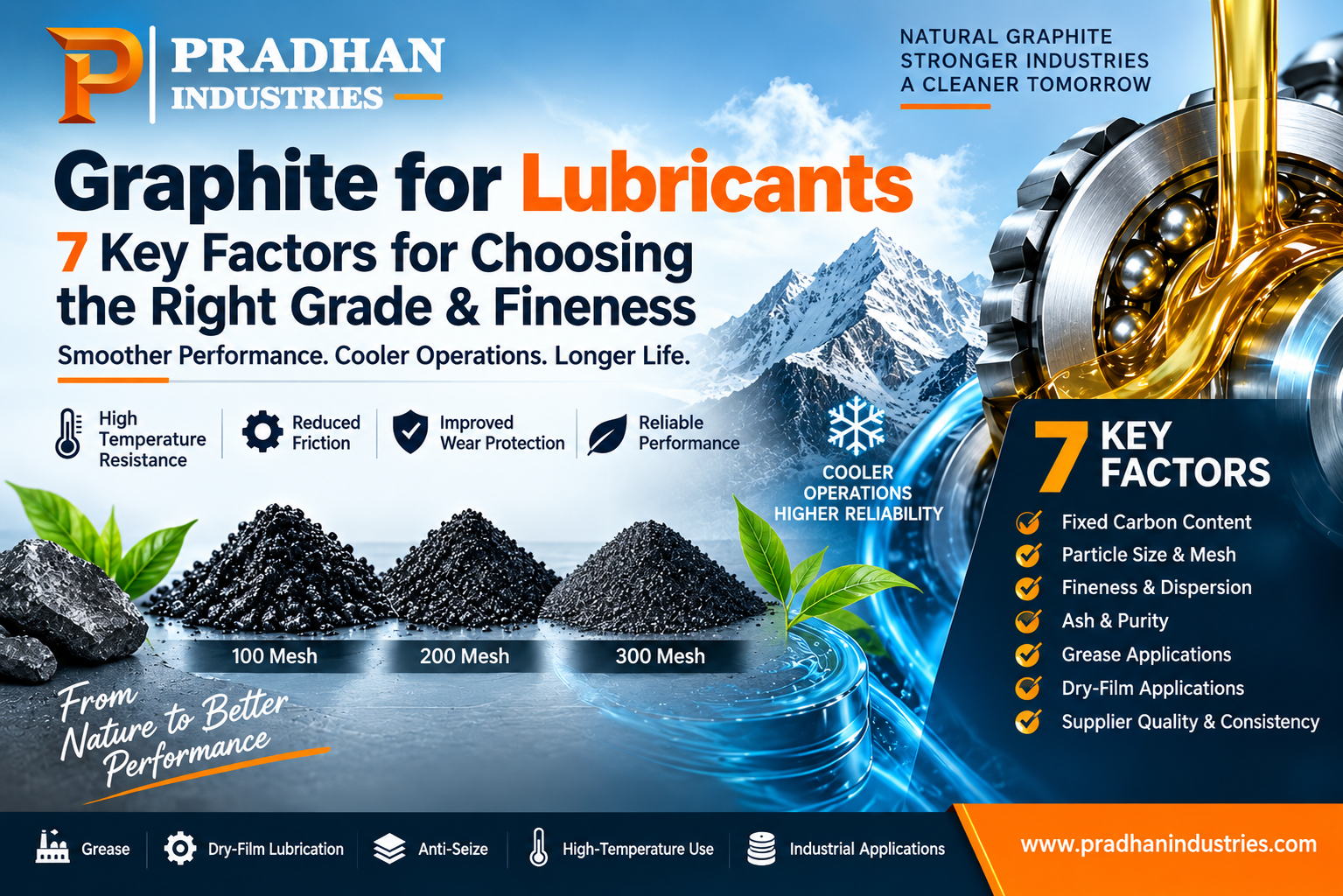
In this guide, we explain 7 key factors for choosing graphite for lubricants, with a focus on grease and dry-film applications.
What Makes Graphite Useful for Lubricants?
Graphite has a layered crystal structure in which the carbon atoms are arranged in sheets. Under suitable conditions, these layers can shear relative to one another, giving graphite useful solid-lubricating properties.
NASA’s technical literature identifies graphite as one of the most widely used inorganic solid lubricants and discusses its use in different solid-lubrication systems.
This is why graphite for lubricants can be considered for applications where conventional liquid lubrication is insufficient or where a solid lubricant is required.
Depending on the formulation, graphite may be used in:
- Industrial greases
- Dry lubricants
- Dry-film lubricant systems
- Anti-seize compounds
- High-temperature lubrication
- Sliding-contact applications
- Industrial coatings
- Specialised lubrication formulations
However, graphite does not perform identically in every application. The grade and particle size need to be matched to the formulation and operating conditions.
7 Key Factors When Choosing Graphite for Lubricants
1. Fixed Carbon Content
Fixed carbon, commonly abbreviated as FC, is one of the first specifications buyers consider when sourcing graphite.
A higher fixed-carbon percentage generally indicates a greater concentration of carbon and less mineral matter. However, choosing the highest FC grade is not automatically the correct decision for every lubricant formulation.
For example, a manufacturer may require 90–92% FC graphite for a particular formulation, while another application may justify a 94–95% FC grade.
The important question is not simply:
“What is the highest FC available?”
Instead, ask:
“What FC specification is appropriate for my application?”
Pradhan Industries lists natural crystalline graphite grades ranging from 60–65% FC through 94–95% FC, with different mesh sizes available.
For buyers evaluating graphite for lubricants, this range allows the material specification to be matched more closely to the intended application and formulation.
You can review the available natural crystalline graphite grades and specifications from Pradhan Industries.
2. Particle Size and Mesh
Particle size is one of the most important considerations when selecting graphite for lubricants.
Graphite is commonly described by mesh sizes such as:
- 100 mesh
- 200 mesh
- 300 mesh
In general, a higher mesh number represents a finer powder. However, mesh size alone does not provide the complete particle-size distribution.
Two graphite products described as 200 mesh can still have differences in particle distribution and processing characteristics.
For this reason, industrial buyers should request detailed specifications from the supplier when particle-size control is important.
Pradhan Industries currently publishes 100, 200 and 300 mesh options across several fixed-carbon grades.
For lubricant manufacturers, the appropriate particle size should be established through actual formulation trials rather than selecting the finest powder simply because it has a higher mesh number.
3. Fineness and Dispersion
Fineness is closely related to particle size but should be considered separately when developing a lubricant formulation.
A finer graphite powder may provide useful dispersion characteristics and a greater particle surface area. However, extremely fine material can also create practical challenges during handling, mixing and processing.
When evaluating graphite for lubricants, manufacturers should check:
- How easily the powder disperses
- Whether agglomeration occurs
- Mixing time
- Final formulation consistency
- Storage stability
- Dust-handling requirements
The objective is not necessarily to select the finest graphite available.
The objective is to select the fineness that gives the desired performance and processing behaviour.
4. Ash and Mineral Impurities
Fixed carbon does not tell the entire quality story.
Ash represents the inorganic residue remaining after a specified combustion or testing procedure. Excessive mineral matter may affect the behaviour of a lubricant formulation, particularly where controlled purity is important.
When purchasing graphite for lubricants, buyers should therefore review:
- Fixed carbon
- Ash
- Moisture
- Sulphur where relevant
- Other mineral impurities
- Particle-size distribution
A supplier should be able to provide a Certificate of Analysis (COA) for the supplied material.
Pradhan Industries states that its graphite products undergo laboratory testing and that COA documentation is provided for grade compliance.
This documentation can help lubricant manufacturers compare incoming material against the agreed purchasing specification.
5. Graphite Compatibility With Grease
Graphite used in grease must work with the complete formulation, not simply perform well as an isolated powder.
The behaviour of graphite for lubricants used in grease can depend on factors such as:
- Base oil
- Thickener type
- Graphite concentration
- Particle size
- Mixing conditions
- Operating temperature
- Load
- Sliding conditions
NASA research has specifically examined graphite dispersed in mineral oil under boundary-lubrication conditions. The study observed graphite distribution around a lubricated contact and noted that the results depended on the specific test geometry and conditions.
This is an important consideration for lubricant manufacturers: laboratory results from one formulation or test configuration should not automatically be treated as universal performance data.
The selected graphite should be evaluated in the actual grease formulation.
6. Requirements for Dry-Film Lubrication
Graphite for lubricants used in dry-film applications needs to be selected with additional attention to particle size, coating method, binder compatibility and operating environment.
Dry-film lubrication differs from grease because the solid lubricant can form part of the lubricating layer rather than simply being dispersed throughout a semi-solid base.
NASA research on solid lubrication identifies graphite among the materials used for high-temperature solid-lubrication applications and discusses the importance of environmental and operating conditions.
For a dry-film formulation, buyers may need to consider:
- Graphite particle size
- Coating thickness
- Binder system
- Surface preparation
- Application method
- Operating temperature
- Atmospheric conditions
- Load and sliding speed
Therefore, graphite for lubricants intended for dry-film systems should be qualified against the actual coating formulation and operating conditions.
7. Batch Consistency and Supplier Quality
A technically suitable graphite grade is only useful if the supplier can deliver it consistently.
For industrial lubricant manufacturers, variation in raw material can affect formulation consistency and production results.
Before purchasing bulk graphite for lubricants, ask the supplier about:
- Fixed-carbon range
- Mesh specification
- Particle-size distribution
- Ash
- Moisture
- COA availability
- Packaging
- Batch-to-batch consistency
- Minimum order quantity
- Bulk supply capability
Pradhan Industries publishes a range of natural crystalline graphite grades and states that its products are laboratory tested for grade compliance.
You can also explore the company’s graphite products and technical specifications before requesting a quotation.
Graphite for Grease: Which Grade Should You Choose?
There is no single graphite grade that is ideal for every grease.
The selection should begin with the formulation and application.
For example, consider:
Base grease: What oil and thickener system are being used?
Operating conditions: What temperature, load and sliding conditions will the grease experience?
Particle size: Does the graphite need to disperse easily through the formulation?
Purity: What level of ash and mineral impurities can the formulation tolerate?
FC: What fixed-carbon range is appropriate for the required performance and commercial specification?
For this reason, lubricant manufacturers should compare suitable grades in controlled formulation trials before committing to large-volume purchases.
Graphite for Dry Lubricants: Why Fineness Matters
Dry lubrication places greater emphasis on the relationship between graphite particle size and the application method.
A graphite powder may be:
- Applied directly as a dry powder
- Burnished onto a surface
- Incorporated into a binder
- Formulated into a dry-film coating
- Used as part of a composite solid lubricant
The appropriate fineness can vary between these applications.
NASA research on graphite lubrication has examined graphite under different contact conditions, demonstrating that the behaviour of graphite can depend on the lubrication system and test environment.
This means that choosing graphite for lubricants should always involve application-specific testing.
100 Mesh vs 200 Mesh vs 300 Mesh Graphite
One common question from industrial buyers is which mesh size should be selected.
There is no universal answer.
100 Mesh Graphite
A comparatively coarser material that may be suitable for applications where very fine powder is not required.
200 Mesh Graphite
A commonly used intermediate fineness that may be considered for various industrial formulations, depending on the application.
300 Mesh Graphite
A finer powder that may be useful where finer particle distribution is required.
These descriptions are general. The correct mesh should be established from the formulation, process and required performance.
Pradhan Industries lists 100, 200 and 300 mesh options across several FC grades, allowing buyers to evaluate different combinations.
Is Higher Fixed Carbon Always Better?
No.
A 94–95% FC graphite contains more fixed carbon than a 90–92% FC grade, but that does not automatically mean it will produce better results in every lubricant.
The final result depends on the entire material specification and formulation.
For example, a lubricant manufacturer may prioritise:
- Dispersion
- Cost-performance balance
- Particle size
- Ash
- Batch consistency
- Processing behaviour
- Operating conditions
Therefore, graphite for lubricants should be selected based on application requirements rather than FC alone.
Common Mistakes When Buying Graphite for Lubricants
Buying only on fixed carbon
FC is important, but it is not the complete specification.
Choosing the finest powder automatically
Finer does not always mean better. Processing and dispersion need to be considered.
Ignoring ash
Mineral impurities can matter in applications requiring controlled purity.
Buying without a COA
A COA provides useful information for verifying the supplied grade.
Not testing the graphite in the final formulation
A graphite powder that performs well in one system may behave differently in another.
Changing suppliers without checking specification equivalence
Two products with the same nominal FC and mesh may not necessarily have identical particle-size distribution or processing characteristics.
How to Select Graphite for Lubricants: A Simple Checklist
Before placing a bulk order, confirm these seven points:
- Application – grease, dry film, anti-seize or another system?
- Fixed carbon – what FC range is required?
- Mesh size – 100, 200, 300 or another specification?
- Fineness – does the powder disperse correctly?
- Purity – what ash and impurity limits apply?
- Documentation – is a COA available for each batch?
- Consistency – can the supplier maintain the specification for repeat orders?
This approach makes the purchasing process more technical and reduces the risk of selecting graphite based on one specification alone.
Why Source Natural Graphite From an Experienced Supplier?
For industrial applications, the supplier’s ability to provide consistent material can be just as important as the initial grade selection.
Pradhan Industries supplies natural crystalline graphite from Odisha and publishes multiple combinations of fixed-carbon grades and mesh sizes. Its current published specifications include 80–85%, 90–92% and 94–95% FC grades in 100, 200 and 300 mesh options.
The company also states that its graphite products are laboratory tested and supplied with COA documentation for grade compliance.
For manufacturers evaluating graphite for lubricants, this type of documented specification can make it easier to compare samples and establish a repeatable raw-material standard.
Explore Pradhan Industries’ natural crystalline graphite range or review its graphite technical specifications before requesting a bulk quotation.
Frequently Asked Questions About Graphite for Lubricants
What is graphite for lubricants used for?
Graphite for lubricants can be used as a solid lubricant or lubricant additive in applications such as grease, dry-film systems, anti-seize formulations and certain high-temperature lubrication systems.
Which graphite is best for grease?
There is no single best grade for every grease. The suitable graphite depends on the base oil, thickener, particle size, FC, purity, concentration and operating conditions.
Is 200 mesh graphite suitable for lubrication?
200 mesh graphite can be considered for certain lubrication applications, but suitability depends on the formulation and required performance. The material should be tested in the final system.
Is finer graphite better for lubricants?
Not necessarily. Finer graphite can affect dispersion and surface interaction, but the optimum fineness depends on the application and processing requirements.
What fixed carbon is suitable for graphite lubricants?
The required FC depends on the application. Commercial natural crystalline graphite is available in several FC ranges, including 90–92% and 94–95% grades.
What should I ask a graphite supplier?
Ask for fixed carbon, mesh size, particle-size distribution, ash, moisture, COA, packaging information and batch consistency. For specialised applications, also discuss the intended formulation with the supplier.
Conclusion
Choosing graphite for lubricants requires more than selecting the highest fixed-carbon grade.
For grease applications, dispersion, particle size, purity and compatibility with the formulation are important. For dry-film lubrication, particle size, binder compatibility, coating method and operating environment may become more significant.
The most reliable approach is to define the application first and then select the appropriate combination of fixed carbon, fineness, mesh size and purity.
If you are looking for natural crystalline graphite for lubricants in bulk quantities, reviewing the supplier’s technical specifications and testing the material in your formulation can help establish the right grade for your process.
Need help selecting a graphite grade? Contact Pradhan Industries with your required application, fixed-carbon range, mesh size and quantity to discuss available natural crystalline graphite options.