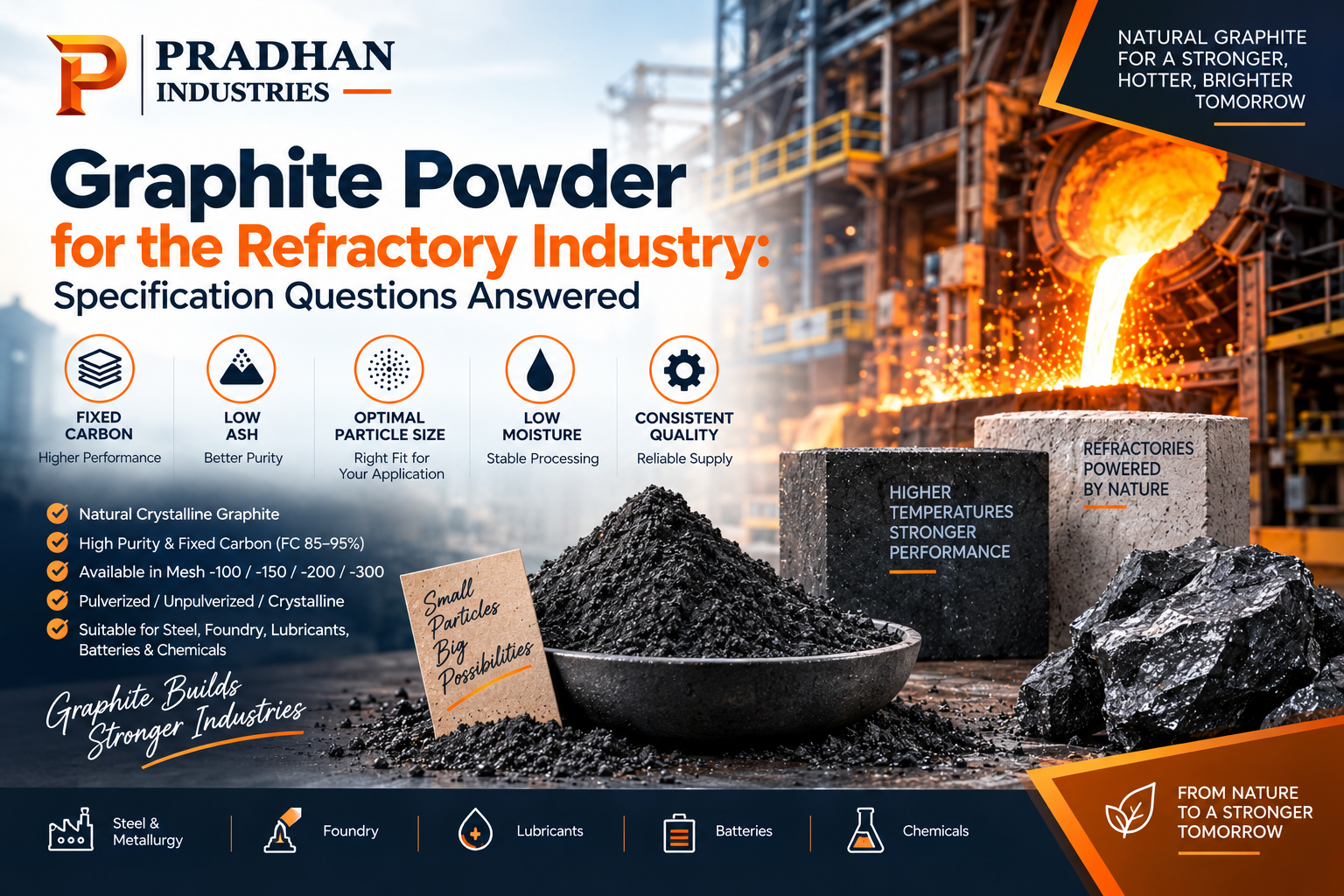
Graphite powder is an important carbon-bearing raw material used in several refractory applications, particularly where materials must withstand high temperatures, thermal cycling, slag interaction, and demanding operating conditions.
But buying graphite powder for refractory industry applications is not as simple as asking for a particular fixed carbon percentage.
A refractory manufacturer may need to consider graphite type, fixed carbon, ash, ash chemistry, particle-size distribution, flake size, moisture, volatile matter, sulphur, iron, and other impurities. The right combination depends on the formulation and the performance requirements of the finished refractory product.
Natural graphite is very important in magnesia-carbon (MgO-C) bricks. It can contribute to thermal conductivity and thermal-shock resistance, while its low thermal expansion and non-wetting characteristics can also be valuable in demanding refractory environments. Graphite is also used in other carbon-containing refractory systems, depending on the formulation and intended application.
The U.S. Geological Survey identifies refractory applications and steelmaking among the established industrial uses of natural graphite and describes graphite as a material with useful thermal, chemical, and structural properties.
For refractory manufacturers, the key question is therefore not simply “Which graphite has the highest carbon content?” Instead, the focus should be on whether the selected graphite grade provides the right combination of purity, particle size, flake morphology, ash chemistry, moisture control, and batch consistency for the intended refractory product.
In the sections below, we examine the most important graphite powder specifications, explain why each parameter matters, and outline the questions buyers should ask before selecting a graphite supplier for refractory manufacturing.
1. What Is Graphite Powder Used for in the Refractory Industry?
Graphite powder is used as a carbon-containing component in refractory formulations where its physical and thermal properties can contribute to high-temperature performance.
One of the best-known applications is the manufacture of magnesia-carbon (MgO-C) bricks used in steelmaking environments.
These refractories combine magnesia with graphite, binders, and other formulation components. Graphite can contribute:
- High thermal conductivity
- Low thermal expansion
- Thermal-shock resistance
- Reduced slag wetting
- Carbon content within the refractory matrix
- Resistance to certain high-temperature interactions
Natural graphite occurs in different forms, including amorphous graphite and crystalline flake graphite. These forms have different morphology and characteristics, so they should not automatically be treated as interchangeable. USGS classifies natural graphite into amorphous, crystalline flake, and vein/lump forms.
For refractory manufacturers, the important question is therefore
Does the graphite grade match the formulation and service conditions of the finished refractory?
That question is more useful than simply asking which graphite has the highest carbon content.
2. Why Is Natural Flake Graphite Important for Refractory Applications?
Natural flake graphite has a layered crystalline structure that gives it characteristics useful in high-temperature applications.
It is widely associated with MgO-C refractory brick production, particularly for demanding steelmaking applications.
The flake structure can influence:
- Thermal conductivity
- Thermal expansion behavior
- Thermal-shock response
- Graphite distribution within the matrix
- Slag interaction
- Microstructural characteristics
However, not every refractory application requires the same flake size or graphite purity.
A refractory manufacturer producing a premium MgO-C brick may have very different graphite requirements from a manufacturer producing another carbon-containing refractory formulation.
This is why purchasing specifications should identify the type and morphology of graphite, rather than simply stating:
“Graphite powder required.”
3. Natural Flake Graphite vs Amorphous Graphite: What Is the Difference?
The two materials can have different physical structures and therefore different application suitability.
Natural Flake Graphite
Natural flake graphite consists of distinct graphite flakes and is commonly selected for applications where its morphology and thermal properties are important.
It is particularly relevant to MgO-C refractory formulations.
Amorphous Graphite
Amorphous graphite is very fine-grained natural graphite. The term does not mean that the carbon has no crystal structure; rather, it refers to its very small crystal size.
USGS describes amorphous and crystalline flake graphite as different natural graphite types with different geological characteristics.
For buyers, the key lesson is simple:
Do not specify graphite only by its carbon percentage. Specify the graphite type as well.
For example:
Natural flake graphite powder for refractory manufacturing, with controlled fixed carbon, ash and particle-size distribution.
That gives a supplier much more useful information.
4. What Does Fixed Carbon Mean in Graphite Powder?
Fixed carbon (FC) is one of the most commonly requested specifications when purchasing graphite powder.
In practical purchasing terms, it indicates the carbon fraction determined by the applicable test method after accounting for other measured components such as moisture, volatile matter, and mineral residue.
A higher fixed-carbon value generally means that the material contains a greater proportion of carbon and less non-carbon material.
However, higher fixed carbon does not automatically mean better performance for every refractory formulation.
For example, a refractory manufacturer may have a formulation designed around a defined graphite grade. Increasing purity beyond the formulation requirement may increase material cost without producing a proportional improvement in finished-product performance.
The correct specification should therefore be based on:
Fixed carbon + ash + ash chemistry + particle size + flake morphology + application requirements.
5. What Fixed Carbon Level Should Refractory Graphite Have?
There is no single fixed-carbon percentage that is correct for every refractory product.
Commercial natural graphite grades are available across different carbon ranges, and the appropriate grade depends on the application and supplier specification.
Instead of asking:
“What is the highest fixed-carbon graphite available?”
A better technical question is
“What minimum fixed carbon does our refractory formulation require?”
For example, a purchase specification might state:
Fixed Carbon: Minimum X%
The actual value should be established by the refractory manufacturer’s formulation and quality-control requirements.
This approach avoids unnecessary over-specification while ensuring that the selected graphite meets the technical needs of the product.
6. Why Is Ash Content Important?
Ash is one of the most important specifications when purchasing graphite powder for refractory applications.
Ash represents the mineral residue associated with the graphite. Its amount and chemical composition can influence the behavior of graphite inside a refractory system.
Two graphite products can have similar fixed-carbon values but different ash chemistry.
For example:
- Graphite A: 95% fixed carbon
- Graphite B: 95% fixed carbon
They may still behave differently if their remaining mineral components have different compositions.
For refractory applications, buyers may therefore need information about:
- SiO₂
- CaO
- Fe₂O₃
- Al₂O₃
- MgO
- Other relevant mineral impurities
The importance of these components depends on the refractory formulation and operating conditions.
Suggested internal link
For readers who want to understand how natural graphite is processed before becoming a usable industrial product, link the phrase “graphite beneficiation process” to Graphite Beneficiation Process in Odisha.
7. Why Should Buyers Check Ash Chemistry, Not Just Ash Percentage?
Ash percentage tells you how much mineral residue is present.
Ash chemistry tells you what that residue contains.
That distinction can be important in high-temperature refractory systems.
In a MgO-C formulation, mineral impurities associated with graphite may participate in reactions at elevated temperatures. Therefore, two graphite grades with the same total ash level may not necessarily have the same effect on the refractory.
This is why a technical buyer should consider requesting a chemical analysis in addition to the headline ash value.
A useful specification may therefore include:
| Parameter | The buyer should specify |
|---|---|
| Fixed Carbon | Minimum % |
| Ash | Maximum % |
| Moisture | Maximum % |
| Volatile Matter | Maximum % |
| SiO₂ | Maximum where relevant |
| CaO | Maximum where relevant |
| Fe₂O₃ / Iron | Maximum where relevant |
| Sulfur | Maximum where relevant |
| Particle Size | Defined distribution |
| Flake Size | Defined range where applicable |
The actual limits should be agreed upon according to the refractory formulation.
8. Why Does Particle Size Matter in Refractory Graphite?
Particle size can have a significant influence on the way graphite behaves during refractory production.
Graphite particles are incorporated into a matrix containing other raw materials. Their size and distribution can influence:
- Packing
- Dispersion
- Mixing behavior
- Surface area
- Porosity
- Matrix structure
- Final physical properties
For this reason, a specification such as “200 mesh graphite” may not provide enough information.
A better specification describes the particle-size distribution.
For example:
- Percentage passing a specified sieve
- Percentage retained on a specified sieve
- D50 where relevant
- Maximum particle size
- Fine-particle percentage
- Oversize percentage
This gives the refractory manufacturer a much clearer understanding of what will arrive at the plant.
9. Mesh Size vs. Micron Size: What Should Buyers Specify?
Mesh and micron measurements are different ways of describing particle size.
Mesh generally relates to sieve classification, while microns describe particle dimensions.
Therefore, a buyer should not assume that a nominal mesh value represents one exact particle size across every product.
A supplier might provide information such as
- +50 mesh
- -100 mesh
- -200 mesh
- -325 mesh
- Specific micron ranges
- D50 values
For technical purchasing, the test method and complete distribution are often more useful than a single mesh number.
This is especially important when graphite is blended with magnesia, alumina, binders, antioxidants, or other refractory raw materials.
10. Does Flake Size Matter in MgO-C Bricks?
Yes.
Flake size and morphology can influence the way graphite behaves inside a refractory matrix.
Natural flake graphite is particularly relevant in MgO-C bricks because its structure contributes characteristics that are useful in demanding thermal environments.
However, larger flakes are not automatically better.
The optimum graphite distribution depends on factors such as
- Refractory grade
- Graphite percentage
- Magnesia quality
- Particle-size distribution
- Pressing conditions
- Binder system
- Antioxidant package
- Intended service conditions
For this reason, manufacturers should define a flake-size distribution where it is technically relevant instead of relying on descriptions such as “large flake” or “fine flake.”
11. What Graphite Is Commonly Used in MgO-C Bricks?
Natural flake graphite is commonly associated with MgO-C brick production.
MgO-C bricks are used in demanding steelmaking environments, where refractories can be exposed to high temperatures, thermal cycling, and contact with molten metal and slag.
The graphite raw material and the finished refractory brick should not be confused.
For example:
Graphite raw material:
A specified fixed-carbon and particle-size grade.
Finished MgO-C brick:
A formulated refractory containing a defined percentage of graphite/carbon along with magnesia, binder, and other components.
Therefore, a graphite supplier should understand the intended refractory application before recommending a grade.
Recommended internal link
When discussing graphite grades, naturally link “crystalline graphite grades” to “crystalline graphite grades.”
12. How Does Graphite Contribute to Thermal Conductivity?
Graphite has useful thermal-conductivity characteristics, which are one reason it is valuable in refractory systems.
USGS describes graphite as having high thermal conductivity and thermal stability, among other properties that support its industrial applications.
In a refractory lining, temperature gradients can generate thermal stresses. The thermal behavior of the graphite-containing system can influence how heat moves through the material.
However, it would be incorrect to evaluate thermal performance based on graphite alone.
The finished refractory also depends on:
- Magnesia quality
- Graphite content
- Graphite morphology
- Porosity
- Density
- Bonding system
- Antioxidants
- Manufacturing conditions
Graphite is one part of an engineered refractory system.
13. How Can Graphite Support Thermal-Shock Resistance?
Thermal shock occurs when a refractory experiences rapid temperature changes that create internal stresses.
Graphite can contribute to thermal-shock behavior through its thermal properties and low thermal expansion characteristics.
This is particularly relevant in applications where refractory linings repeatedly experience significant temperature changes.
However, the presence of graphite does not by itself guarantee thermal-shock resistance.
The final performance depends on the entire refractory formulation and manufacturing process.
Therefore, graphite should be selected as part of the complete refractory design, not as an isolated raw material.
14. Why Is Moisture an Important Graphite Specification?
Moisture can affect powder handling, batching, and mixing consistency.
For refractory manufacturers, excessive or inconsistent moisture may influence:
- Powder flow
- Weighing accuracy
- Mixing behavior
- Binder interaction
- Storage stability
- Batch consistency
A graphite specification should therefore include a maximum moisture value where required.
For example:
Moisture: Maximum X%
The actual limit should reflect the manufacturing process.
Storage is also important. Even a low-moisture graphite product can be exposed to humidity after delivery if packaging or warehouse conditions are inadequate.
Therefore, packaging and storage should form part of the overall quality-control system.
15. Should Volatile Matter Be Included in the Graphite Specification?
Yes, where it is relevant to the application.
Volatile matter is normally reported as part of the technical analysis of carbonaceous raw materials.
For refractory manufacturing, controlling volatile matter can help improve consistency during processing and heating.
A purchase specification can state:
Volatile Matter: Maximum X%
As with fixed carbon and ash, the appropriate limit should be established according to the formulation and testing method.
The important point is consistency: suppliers and buyers should use clearly defined test procedures so that reported values can be compared meaningfully.
16. Can Graphite Purity Affect Slag Resistance?
Graphite has properties that can be useful in refractory systems exposed to slags, but the overall behavior depends on the complete formulation.
Graphite purity can matter because mineral impurities may participate in high-temperature reactions.
This is why ash chemistry and trace impurities can be relevant when evaluating graphite for high-performance refractory products.
A buyer should therefore avoid evaluating graphite only by a single number such as
“96% fixed carbon.”
A better technical evaluation includes:
Fixed carbon + ash + chemical analysis + particle size + flake morphology.
That gives a much more complete picture of the material.
17. Is Higher-Purity Graphite Always Better?
No.
Higher purity can be technically useful when impurity control is critical, but the most appropriate graphite is the one that meets the requirements of the specific refractory formulation.
There is little value in specifying a significantly more expensive grade if the finished refractory does not require those additional properties.
A technical team should therefore determine:
- Required fixed carbon
- Maximum ash
- Critical ash components
- Required particle-size distribution
- Required flake morphology
- Relevant trace-element limits
- Required batch consistency
Only then should purchasing compare prices.
This creates a more meaningful technical-commercial comparison.
18. What About Iron, Sulphur, and Other Trace Impurities?
Trace impurities may become important when they interact with the chemistry of the finished refractory.
Depending on the application, buyers may request limits for:
- Iron
- Sulphur
- Silicon
- Calcium
- Aluminum
- Magnesium
- Moisture
- Volatile matter
Not every refractory product needs the same limits.
For example, a high-performance formulation may require tighter impurity control than a general-purpose refractory.
The best practice is therefore to identify the impurities that could affect the specific formulation and include only technically meaningful limits in the purchase specification.
19. What Should a Refractory Manufacturer Ask a Graphite Supplier?
A professional RFQ should provide enough information for a supplier to quote the correct grade.
Ask for:
- Graphite type – natural flake, amorphous, or another form.
- Fixed carbon – minimum guaranteed value.
- Ash – maximum guaranteed value.
- Moisture – maximum value.
- Volatile matter – maximum value.
- Particle-size distribution—mesh or micron data.
- Flake-size distribution—where applicable.
- Chemical analysis – relevant impurity levels.
- Testing method—method used for each parameter.
- COA – availability with each shipment.
- Packaging—bags, jumbo bags, or other agreed format.
- Batch consistency—expected variation between lots.
- Supply capacity – ability to support regular production.
- Sample availability – technical evaluation before commercial supply.
This allows the technical and procurement teams to compare suppliers on a like-for-like basis.
20. What Should a Graphite Powder Technical Data Sheet Contain?
A good technical data sheet should give enough information. This helps the buyer decide if the graphite is suitable. It should match the intended application.
Example Graphite Powder Specification
| Specification | Typical Buyer Requirement |
|---|---|
| Product | Natural Graphite Powder |
| Application | Refractory Manufacturing |
| Graphite Type | Natural Flake / As Agreed |
| Fixed Carbon | Minimum specified value |
| Ash | Maximum specified value |
| Moisture | Maximum specified value |
| Volatile Matter | Maximum specified value |
| Particle Size | Defined mesh/micron distribution |
| Flake Size | Defined where applicable |
| Sulfur | Maximum where relevant |
| Iron | Maximum where relevant |
| Other Impurities | Application-specific |
| Test Method | Clearly stated |
| COA | Available per batch |
| Packaging | Customer requirement |
The numerical limits should be agreed between the refractory manufacturer and graphite supplier.
21. How Should Refractory Manufacturers Compare Graphite Suppliers?
Price per tonne is only one part of the purchasing decision.
A more complete supplier evaluation should consider:
Technical quality + consistency + documentation + supply reliability + packaging + commercial terms.
Before approving a supplier, ask:
- Is the specification guaranteed?
- Are quoted values typical or guaranteed?
- Is a COA provided with every shipment?
- Is the particle-size distribution controlled?
- Is flake morphology consistent?
- Can the supplier maintain the same grade over repeated orders?
- Is the packaging suitable for storage?
- Can the supplier support the required volume?
- Is technical documentation available?
- Can samples be evaluated before commercial supply?
This is particularly important for manufacturers running continuous or high-volume refractory production.
22. Why Batch Consistency Matters More Than a Single Good Sample
A sample can meet a specification while subsequent batches vary.
For refractory manufacturers, this can create production problems if raw-material characteristics change significantly between deliveries.
Batch consistency should therefore be considered alongside the initial product analysis.
Useful quality-control documents include:
- Certificate of Analysis
- Batch number
- Production date where applicable
- Test results
- Particle-size results
- Chemical analysis
- Packaging information
- Traceability information
A supplier’s ability to provide consistent documentation can make incoming quality control much easier.
23. Common Mistakes When Buying Graphite Powder for Refractories
Mistake 1: Buying Only on Fixed Carbon
A 95% fixed-carbon graphite product is not necessarily equivalent to every other 95% graphite product.
Ash chemistry, moisture, particle size, and morphology may differ.
Mistake 2: Specifying Only Mesh Size
“200 mesh graphite” does not fully describe the particle-size distribution.
Mistake 3: Ignoring Graphite Type
Natural flake graphite and amorphous graphite have different structures and should not automatically be substituted.
Mistake 4: Accepting Typical Values as Guaranteed
Always determine whether a supplier’s specification is
Typical or Guaranteed.
Mistake 5: Not Requesting a COA
A Certificate of Analysis provides documented information about the supplied batch.
Mistake 6: Automatically Selecting the Highest Purity
The highest-purity product may not be necessary for every refractory formulation.
Mistake 7: Ignoring Storage Conditions
Moisture pickup and contamination can affect the material after delivery.
Mistake 8: Comparing Only Price per Tonne
The cheaper material is not necessarily the lower-cost solution if inconsistent raw material causes production variation or additional quality-control work.
24. Final Graphite Specification Checklist for Refractory Buyers
Before placing an order, confirm the following:
| Question | Why It Matters |
|---|---|
| Is it natural flake or amorphous graphite? | Identifies graphite morphology |
| What is the minimum fixed carbon? | Defines carbon contribution |
| What is the maximum ash? | Controls mineral residue |
| What is the ash chemistry? | Helps evaluate high-temperature interactions |
| What is the moisture limit? | Supports processing consistency |
| What is the volatile-matter limit? | Supports predictable heating behavior |
| What is the particle-size distribution? | Influences dispersion and packing |
| What is the flake-size distribution? | Important for flake graphite applications |
| Are iron and sulfur controlled? | Relevant to specific formulations |
| Is a COA supplied? | Supports batch verification |
| Are values typical or guaranteed? | Clarifies contractual expectations |
| Is the packaging suitable? | Helps protect material during storage |
| Can the supplier maintain batch consistency? | Supports repeat production |
| Is technical documentation available? | Helps quality-control teams |
The goal is not to create the longest possible specification.
The goal is to create a specification that controls the properties that actually matter to the finished refractory.
25. How to Choose a Graphite Supplier for Refractory Manufacturing
Selecting the right supplier involves more than checking a product catalogue.
A refractory manufacturer should evaluate the supplier’s ability to consistently deliver the required:
- Graphite type
- Fixed carbon
- Ash level
- Ash chemistry
- Particle-size distribution
- Flake morphology
- Moisture
- Trace impurities
- Packaging
- Documentation
- Supply volume
The supplier should also be able to communicate clearly about the material’s testing and quality-control process.
For buyers evaluating natural graphite grades, it is useful to understand how graphite characteristics and processing influence the final material. You can explore Pradhan Industries’ information on crystalline graphite grades and the graphite beneficiation process in Odisha.
For a broader background on natural graphite types, properties, and industrial applications, the U.S. Geological Survey graphite information is a useful technical reference. USGS identifies refractory applications and steelmaking among established uses of natural graphite.
26. Frequently Asked Questions About Graphite Powder for Refractories
1. What graphite powder is commonly used in refractory manufacturing?
Natural flake graphite is widely associated with MgO-C refractory products. Other natural graphite forms can also be used depending on the formulation and application.
2. What fixed carbon percentage should refractory graphite have?
There is no universal fixed-carbon value. The required minimum should be established according to the refractory formulation, impurity requirements, and performance targets.
3. Why is ash important in graphite powder?
Ash represents mineral residue in graphite. Both the amount and chemical composition of ash can be relevant to high-temperature refractory behavior.
4. Does particle size affect refractory performance?
Yes. Particle-size distribution can influence dispersion, packing, mixing, and the resulting refractory microstructure and properties.
5. Does flake size matter for MgO-C bricks?
Yes. Flake morphology can influence how graphite behaves within the refractory matrix. The required flake distribution depends on the specific formulation.
6. Should graphite buyers request a COA?
Yes. A Certificate of Analysis can help buyers verify the characteristics of each supplied batch against the agreed specification.
7. Is higher-purity graphite always better?
No. The appropriate grade is the one that meets the technical requirements of the application. Higher purity may not provide additional value if the formulation does not require it.
8. What should be included in a graphite powder specification?
At minimum, consider graphite type, fixed carbon, ash, moisture, volatile matter, particle-size distribution, and relevant impurity limits. For flake graphite applications, flake-size distribution may also be important.
9. What is the difference between graphite powder and graphite flakes?
Graphite powder describes the physical form or size range of the supplied material, while flake graphite refers to graphite with a particular crystalline morphology. Flake graphite can be supplied in different particle-size ranges.
10. How can I request a graphite quotation for refractory production?
Provide the intended application, graphite type, required fixed carbon, ash limit, particle-size distribution, quantity, and any other technical requirements. You can then request a quote from Pradhan Industries for the required natural graphite grade.
Conclusion: Specify Graphite for the Application, Not Just the Commodity
Graphite powder is an important raw material in refractory manufacturing, particularly in MgO-C bricks and other carbon-containing refractory systems.
Its value comes from a combination of properties rather than one specification alone.
For buyers, the most important parameters can include:
Fixed carbon → Ash → Ash chemistry → Particle size → Flake size → Moisture → Volatile matter → Trace impurities → Batch consistency.
The correct graphite grade is therefore not necessarily the material with the highest carbon percentage or the lowest price.
It is the material that consistently meets the technical requirements of the refractory formulation while providing an appropriate balance of performance, quality, availability, and cost.
A well-defined specification also makes supplier comparisons easier, improves incoming-quality control, and reduces the risk of receiving a graphite grade that looks suitable on paper but behaves differently during production.
For refractory manufacturers checking natural graphite, start by defining the finished-product need first.
Then work backwards to set the raw-material specification.