High-Carbon Graphite Market Trends are reshaping the global industrial minerals market faster than ever before. Rising electric vehicle production, battery manufacturing, export restrictions, and supply chain disruptions have transformed graphite from a common industrial mineral into a strategic raw material. Industrial buyers must now understand graphite market dynamics, pricing trends, purity specifications, and supplier capabilities before making procurement decisions.
Whether you manufacture refractories, brake linings, lubricants, crucibles, steel products, or battery materials, understanding High-Carbon Graphite Market Trends will help reduce procurement risks, improve production efficiency, and secure long-term supply.
High-Carbon Graphite Market Trends and Global Supply Chains
Graphite sits on nearly every critical-minerals list published by a major economy. That designation is not academic; it reflects a genuine concentration risk.
China refines the overwhelming majority of the world’s battery-grade graphite and remains the dominant force in natural flake and amorphous supply. When Beijing introduced export permit requirements on select graphite products, lead times stretched and buyers scrambled for alternatives almost overnight.
Several structural forces are now redrawing the procurement map:
- Export licensing friction: Permit-based export regimes add weeks of administrative lead time and inject uncertainty into delivery schedules, even when material ultimately ships.
- Battery demand competition: EV anode producers absorb growing volumes of high-purity material, pulling supply away from traditional refractory, foundry, and lubricant buyers.
- New origin diversification: Projects in India, Madagascar, Mozambique, Brazil, and Tanzania are scaling, but qualification cycles mean their output takes time to reach industrial buyers at consistent quality.
- Freight and logistics volatility: Red Sea rerouting, container imbalances, and port congestion continue to add cost and unpredictability to landed prices.
- Quality stratification: As high-purity material commands premiums, the gap between certified high-carbon grades and loosely specified “industrial grade” lots keeps widening.
The practical takeaway is simple. High-carbon mineral supply is tightening at the top of the quality curve, and specification discipline is now a commercial weapon, not just a technical formality.
Why Fixed Carbon Percentage Defines Value
Fixed Carbon (F.C) is the single most important number on a graphite specification sheet. It expresses the proportion of pure carbon remaining after moisture, volatile matter, and ash are accounted for.
Higher F.C means fewer impurities, better thermal and electrical performance, and more predictable behaviour in your process. It also means a higher price — so overbuying purity is as costly a mistake as underbuying it.
60–65% F.C: The Workhorse Range
Lower-carbon grades serve applications where bulk carbon addition matters more than purity. Think foundry facings, certain refractory mixes, and carbon-raising duties in steelmaking where ash tolerance is generous.
Buyers in this range should focus on consistency of ash chemistry rather than chasing higher F.C numbers they do not need.
80–92% F.C: The Industrial Sweet Spot
This band covers most crucible, brake lining, lubricant, and premium refractory applications. Impurity levels are low enough for reliable thermal performance, while pricing remains materially below battery-adjacent grades.
Within this range, the difference between 80–85% and 90–92% F.C often determines product lifespan in high-temperature service. A crucible manufacturer, for example, will see measurably better oxidation resistance at 90%+ F.C.
94–95% F.C and Above: The Premium Tier
At 94–95% F.C, graphite competes for the same feedstock pool that battery and specialty markets want. These grades deliver superior conductivity, lubricity, and purity for demanding applications — expanded graphite feedstock, high-end lubricants, powder metallurgy, and conductive compounds.
This is also where allocation risk concentrates. If your process depends on 94%+ material, supplier redundancy is not optional.
Mesh Size: The Overlooked Efficiency Variable
Particle size distribution quietly determines how graphite behaves in your plant. Mesh values with a minus sign (for example, -200 Mesh) indicate that particles pass through that screen size — the higher the number, the finer the powder.
Choosing the wrong mesh is one of the most common and most avoidable procurement errors in this market.
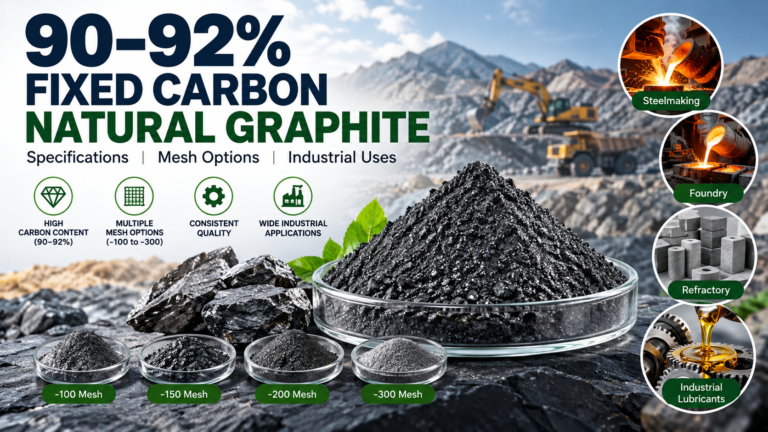
-100 Mesh: Coarse and Flowable
Coarser material suits applications where flake structure adds value or where dust control matters. It handles well in bulk systems, feeds predictably, and preserves flake integrity for downstream processing.
-200 Mesh: The Versatile Standard
The -200 Mesh cut balances surface area with handleability, which is why it dominates general industrial demand. It disperses well in coatings and lubricants, blends evenly in refractory bodies, and suits most crucible and foundry formulations.
-300 Mesh: Fine Powder for Performance Applications
Finer powders maximise surface area and dispersion quality. That translates into smoother lubricant films, denser compacts in powder metallurgy, and better conductivity in coatings — at the cost of tougher dust management and higher processing charges.
The efficiency logic is straightforward: match mesh to mechanism. Paying for -300 Mesh fineness in a bulk carbon-raising application wastes money, while forcing -100 Mesh into a precision lubricant degrades product quality.
Pulverised vs Unpulverised: Why Processing State Matters
Processing state is the third leg of the specification triangle, and it interacts directly with both purity and mesh.
Unpulverised graphite arrives closer to its run-of-mine or beneficiated condition. Buyers with in-house milling choose it to control their own particle size distribution, reduce per-tonne cost, and preserve flake structure until the last possible processing step.
Pulverised graphite has been mechanically reduced to a controlled fineness before shipment. It offers plug-and-play consistency for manufacturers without milling capacity, tighter batch-to-batch particle distribution, and faster incorporation into production.
The decision usually comes down to three questions:
- Do you operate milling and classification equipment, and is its capacity a bottleneck?
- Does your application depend on preserved flake morphology, which aggressive pre-pulverising can damage?
- Is batch-to-batch consistency more valuable to you than the raw-material discount on unpulverised lots?
Manufacturers of brake linings and refractories often prefer pulverised supply for its consistency. Processors making expanded graphite or specialty flake products frequently buy unpulverised to protect flake structure.
Technical Specifications & Grades
The matrix below reflects the crystalline graphite grades most commonly specified by industrial buyers, combining fixed carbon range, mesh size, and processing state.
Crystalline Graphite Grades — Available Specifications & Processing Types
| # | Grade (% Carbon) | Mesh Size | Processing State |
|---|---|---|---|
| 1 | 60 – 65% F.C | -200 Mesh | Pulverised |
| 2 | 80 – 85% F.C | -100 Mesh | Unpulverised |
| 3 | 80 – 85% F.C | -200 Mesh | Pulverised |
| 4 | 90 – 92% F.C | -100 Mesh | Unpulverised |
| 5 | 90 – 92% F.C | -200 Mesh | Pulverised |
| 6 | 90 – 92% F.C | -300 Mesh | Pulverised |
| 7 | 94 – 95% F.C | -100 Mesh | Unpulverised |
| 8 | 94 – 95% F.C | -200 Mesh | Pulverised |
| 9 | 94 – 95% F.C | -300 Mesh | Pulverised |
Read the table as a decision tool. Purity governs performance ceiling, mesh governs process behaviour, and processing state governs how much particle-size control you retain in-house.
Graphite Price Trends and Volatility Drivers
Graphite price trends have decoupled from the smooth, demand-led curves buyers enjoyed a decade ago. Pricing now moves on policy announcements as much as on tonnage.
Several dynamics dominate the current pricing environment:
- Policy-driven spikes: Export control announcements trigger short, sharp rallies as buyers rush to secure material ahead of permit bottlenecks.
- Purity premium expansion: The spread between 85% F.C and 94–95% F.C material has widened as battery and specialty demand competes for high-grade feedstock.
- Synthetic substitution pressure: When natural graphite tightens, some buyers pivot to synthetic alternatives, capping natural-grade rallies but adding a second market to monitor.
- Energy cost pass-through: Beneficiation, drying, and pulverising are energy-intensive, so power price swings in producing regions flow directly into offers.
- Currency and freight noise: Landed cost variance between quarters increasingly comes from logistics and FX rather than mine-gate pricing.
For procurement teams, the implication is that spot buying has become a volatility bet. Structured contracts with indexed pricing, defined specification bands, and agreed force-majeure language now outperform quarter-to-quarter spot strategies for most industrial consumers.
How to Evaluate a High-Carbon Graphite Supplier
Not every trader with a warehouse is a genuine high-carbon graphite supplier. The difference reveals itself under stress — during permit delays, quality disputes, or sudden demand surges — and by then it is expensive to discover.
Serious buyers audit five capabilities before committing volume:
- Certified testing discipline: Every lot should ship with F.C, ash, moisture, and volatile-matter results from a recognised laboratory method — not a generic typical-values sheet.
- Specification range, not single grades: A supplier offering the full 60–95% F.C spectrum across -100 to -300 Mesh can move with your product roadmap instead of forcing requalification.
- Both processing states: Access to pulverised and unpulverised material lets you shift make-versus-buy decisions on milling without changing supplier.
- Origin transparency: Traceable sourcing protects you from export-control surprises and supports the ESG documentation your own customers increasingly demand.
- Allocation behaviour in tight markets: Ask for references from customers the supplier served through the recent export-permit disruptions. Past allocation behaviour predicts future allocation behaviour.
Price matters, but in this market, certainty of supply at a verified specification is the commodity in shortest supply.
Graphite Market Outlook: Positioning for the Next Cycle
The medium-term graphite market outlook points in one direction: structurally higher demand for high-purity material, set against a supply base that diversifies slowly.
Battery demand will keep pulling 94%+ F.C feedstock out of industrial channels. New non-Chinese capacity will ease concentration risk over time, but qualification timelines mean the adjustment plays out in years, not quarters.
Three moves position industrial buyers well for that environment:
- Qualify a second origin now, while requalification can happen on your schedule rather than during a supply emergency.
- Lock specification bands into contracts, including F.C floors, ash ceilings, and mesh tolerances, so quality drift becomes a commercial remedy rather than a production crisis.
- Right-size purity and fineness, auditing whether each application genuinely needs the grade it currently consumes. Many plants discover meaningful savings by stepping one grade down where performance allows.
Why High-Carbon Graphite Market Trends Matter
Understanding High-Carbon Graphite Market Trends allows industrial buyers to make informed sourcing decisions, negotiate better supplier contracts, minimise production risks, and optimise procurement costs. Businesses that continuously monitor market movements are better positioned to secure premium graphite grades while maintaining operational efficiency.
Conclusion: Specification Discipline Is the New Procurement Edge
High-Carbon Graphite Market Trends continue to evolve as demand from electric vehicles, renewable energy, steelmaking, refractories, lubricants, and advanced manufacturing grows worldwide. Companies that understand purity levels, mesh sizes, supplier reliability, and global supply chain developments will be better prepared to navigate future market changes.
Working with an experienced natural graphite manufacturer like Pradhan Industries ensures access to consistent quality, certified graphite grades, reliable deliveries, and technical expertise that supports long-term industrial success.
Frequently Asked Questions
What fixed carbon percentage should I specify for my application?
Match purity to performance requirements, not habit. Carbon-raising and general foundry duties run well on 60–85% F.C, high-temperature refractories and crucibles benefit from 90–92% F.C, and conductive, lubricant, or expandable-graphite applications typically justify 94–95% F.C. Requesting certified test results for each lot matters more than the headline number.
Should I buy pulverised or unpulverised graphite?
Buy unpulverised if you operate your own milling and need to control particle size distribution or preserve flake structure. Buy pulverised if you value batch-to-batch consistency, lack milling capacity, or want material that integrates into production immediately. Many buyers split volumes across both states to keep flexibility.
How can I protect my business from graphite price volatility?
Move core volumes onto structured contracts with defined specification bands and indexed pricing, qualify at least two supply origins, and hold strategic inventory of your most allocation-sensitive grades — typically 94%+ F.C material. Suppliers with multi-origin sourcing and transparent testing give you the most resilience per procurement dollar.