Natural graphite manufacturer in India is a search term used by industrial buyers who are looking for more than just a trading company. They need a dependable source of natural graphite with consistent carbon content, suitable particle size, reliable documentation, and the ability to supply material in bulk.
For industries such as steel, foundries, refractories, lubricants, friction materials, and other carbon-based applications, graphite quality can directly affect production performance. Choosing the right manufacturer therefore requires looking beyond price.
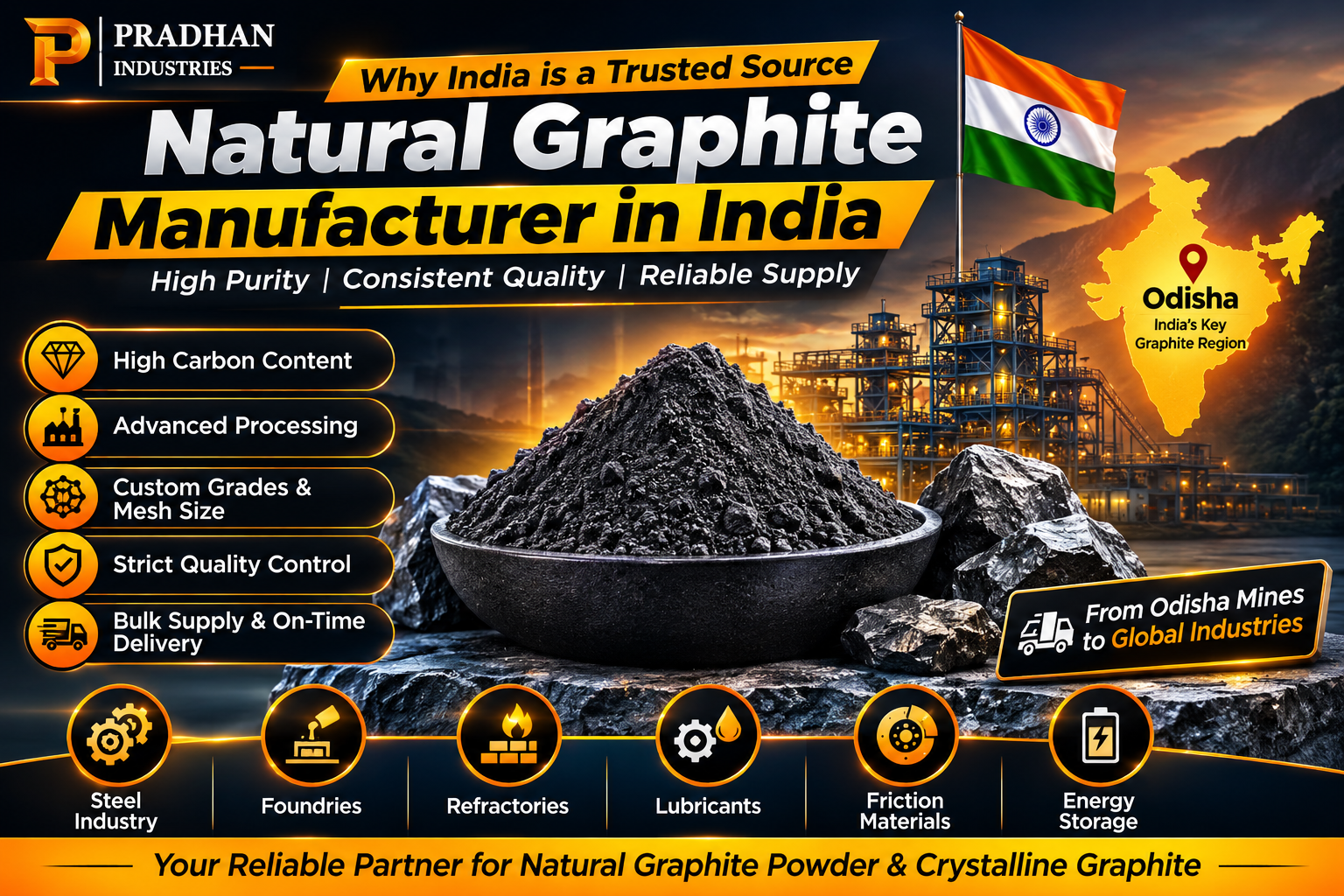
India has an established graphite industry, and Odisha is one of the important graphite-producing states. Indian Minerals Yearbook data records graphite production from Odisha, including production from Rayagada and other districts.
This guide explains what industrial buyers should look for when choosing a natural graphite manufacturer in India, how graphite is processed, which specifications matter, and why direct sourcing can make a difference.
What Is Natural Graphite?
Natural graphite is a naturally occurring form of carbon with a layered crystalline structure. Unlike synthetic graphite, which is manufactured through high-temperature industrial processes, natural graphite is extracted from geological deposits and then processed to meet industrial requirements.
The properties that make graphite valuable include:
- High carbon content
- Excellent thermal stability
- Electrical conductivity
- Natural lubricity
- Resistance to thermal shock
- Chemical stability
- Low friction
- Good performance at high temperatures
Natural graphite is commonly available in crystalline or flake forms, as well as other commercial varieties. The final performance depends not only on the type of graphite but also on its carbon content, particle size, ash level, moisture and processing quality.
The U.S. Geological Survey notes that crystalline flake graphite is mined from carbonaceous metamorphic rocks and that natural graphite is used across applications including refractories, lubricants, steelmaking and batteries.
Why India Is an Important Source of Natural Graphite
India has domestic graphite resources and an established mining and processing sector. Odisha is particularly relevant for industrial buyers because of its graphite deposits and production activity.
Government mineral data shows graphite production from Odisha, while Indian Minerals Yearbook data has documented graphite production from districts including Rayagada.
This creates an opportunity for manufacturers and bulk buyers to source graphite closer to the mine and processing facilities rather than depending entirely on imported material.
For Indian industries, domestic sourcing can offer practical advantages such as:
- Shorter supply chains
- Easier communication
- Faster technical discussions
- Better coordination of bulk orders
- Potentially shorter delivery times
- Easier sample evaluation
- Local logistics support
However, being based in India is not enough to make a supplier reliable. The manufacturer should also be able to demonstrate consistent quality, proper processing and dependable supply.
What Does a Natural Graphite Manufacturer Actually Do?
A genuine manufacturer is involved in more than simply buying and reselling graphite.
The process generally begins with graphite ore obtained from a mining operation. The ore contains graphite along with other minerals and must be processed to increase the concentration of graphitic carbon.
The basic process can include:
1. Mining
Graphite-bearing ore is extracted from the deposit using suitable mining methods.
2. Crushing
The mined ore is reduced to a manageable size for further processing.
3. Grinding
Controlled grinding helps liberate graphite particles from the surrounding minerals.
4. Beneficiation
The graphite is concentrated using beneficiation methods such as flotation. This stage is important because it separates graphite from unwanted gangue minerals.
5. Drying
The concentrate is dried to achieve the required moisture specification.
6. Screening and Classification
The material is separated according to particle size and mesh requirements.
7. Pulverisation
Where required, graphite is further processed into controlled powder sizes for specific industrial applications.
8. Quality Testing
The finished material is tested against the required specifications before dispatch.
This mine-to-product approach gives manufacturers greater control over the final material.
If you want to understand this process in greater detail, you can naturally link the phrase graphite beneficiation process to your dedicated beneficiation article.
Why Fixed Carbon Matters in Natural Graphite
One of the first specifications an industrial buyer should check is fixed carbon (F.C.).
Fixed carbon represents the carbon content of the graphite after accounting for other components such as ash and moisture.
A higher fixed-carbon level is often desirable for applications where impurities can interfere with performance.
But the highest available carbon percentage is not automatically the best choice for every application.
For example, a manufacturer may require:
- 80–85% F.C.
- 90–92% F.C.
- 94–95% F.C.
depending on the application.
The right grade should be selected according to the actual production requirement.
For this reason, buyers should ask for a technical specification rather than purchasing a product simply described as “high purity graphite.”
Graphite Mesh Size Is Equally Important
Carbon percentage is only one part of the specification.
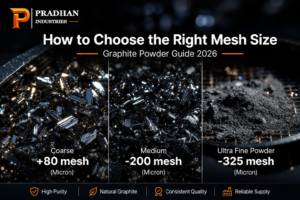
Mesh size determines how fine or coarse the graphite powder is.
Different industrial applications require different particle sizes.
For example, a buyer may need:
- -100 Mesh
- -200 Mesh
- -300 Mesh
The appropriate size depends on how the graphite will be used.
Particle size can influence:
- Mixing
- Dispersion
- Lubrication
- Surface coverage
- Packing
- Flow characteristics
- Processing behaviour
A good natural graphite manufacturer in India should therefore be able to discuss both carbon content and particle size with the buyer.
The objective is not simply to sell the highest grade. It is to supply the grade that fits the process.
Natural Graphite Applications Across Indian Industries
Natural graphite has a surprisingly wide range of industrial uses.
Steel Manufacturing
Graphite can be used as a carbon additive or recarburising material in steel and iron production.
The carbon content and impurity levels are important because manufacturers need predictable results during melting and refining.
Foundries
Foundries use graphite in applications such as mould coatings, release materials and other processes where thermal stability and lubricity are important.
Graphite can help reduce metal adhesion and contribute to smoother casting surfaces.
Refractories
Graphite is an important raw material in refractory products that operate under severe thermal conditions.
Its thermal stability and resistance to thermal shock make it valuable in products used around furnaces and molten metals.
Lubricants
The layered structure of graphite allows the particles to slide over each other, giving graphite natural lubricating properties.
This makes graphite useful where conventional liquid lubricants may not perform effectively.
Friction Materials
Graphite can also be incorporated into brake and clutch materials because of its thermal and friction-related properties.
Energy Storage
Natural graphite has become increasingly important in battery supply chains, particularly as a feedstock for lithium-ion battery anode materials.
The growing demand for graphite is also reflected in international mineral-market research. The USGS identifies graphite as an important material for batteries and other industrial uses.
How to Choose the Best Natural Graphite Manufacturer in India
Choosing a supplier should not be based only on the quotation.
Before placing a bulk order, ask the manufacturer the following questions.
1. Where is the graphite sourced?
Find out whether the supplier owns or operates mining assets or purchases material from third parties.
2. Where is the graphite processed?
Mining and processing location can tell you a lot about supply-chain control.
3. What fixed-carbon grades are available?
Ask for the exact F.C. percentage rather than a general claim such as “premium quality.”
4. What mesh sizes are available?
Confirm whether the manufacturer can supply the particle size your process requires.
5. Is the product pulverised or unpulverised?
This distinction can be important for industrial buyers.
6. Can the supplier provide a sample?
Always evaluate a representative sample before committing to a large order where possible.
7. Is a Certificate of Analysis available?
A batch-specific Certificate of Analysis (COA) provides useful information about the material supplied.
8. Can the manufacturer handle repeat orders?
A supplier that can provide one successful shipment but cannot maintain volume or quality is not a reliable long-term partner.
Why Direct Mine-to-Market Sourcing Can Be Better
There can be a significant difference between purchasing from a manufacturer and purchasing through several layers of intermediaries.
With direct sourcing, buyers can potentially communicate directly with the people responsible for:
- Mining
- Beneficiation
- Processing
- Quality control
- Packaging
- Logistics
This can make technical discussions easier.
It can also provide greater visibility into where the material comes from and how it is processed.
For an industrial buyer purchasing several tonnes regularly, that transparency can be more valuable than a small difference in the initial quotation.
Pradhan Industries: Natural Graphite Manufacturer in India
Pradhan Industries operates in Odisha and focuses on natural crystalline graphite, with mining, beneficiation and processing capabilities. The company’s website states that it supplies high-purity natural crystalline graphite from Odisha and provides grades ranging from 60–65% to 94–95% fixed carbon in different mesh and processing formats.
The company also describes its operations as a direct mine-to-market supply model and highlights laboratory testing and Certificate of Analysis support for its graphite products.
For industrial buyers, the important point is not simply the supplier’s location. It is whether the available graphite specification matches the actual production requirement.
Pradhan Industries can be approached with details such as:
- Required fixed carbon
- Required mesh size
- Monthly quantity
- Application
- Packaging requirement
- Delivery location
This allows the manufacturer to identify a suitable graphite grade rather than simply quoting the highest-carbon material.
You can link crystalline graphite here to your Crystalline Graphite product page.
What Specifications Should You Request Before Buying?
Before requesting a quotation, prepare a simple specification sheet.
Recommended buyer checklist
Product: Natural Graphite / Crystalline Graphite
Fixed Carbon: Required percentage
Mesh Size: Required mesh or micron range
Ash: Maximum acceptable level
Moisture: Maximum acceptable level
Processing: Pulverised or unpulverised
Quantity: Monthly or annual requirement
Packaging: Bag / jumbo bag / other
Application: Steel / foundry / refractory / lubricant / friction / other
Documentation: TDS and COA required
Giving the supplier this information can save time and reduce the chance of receiving an unsuitable quotation.
Natural Graphite Manufacturer vs Graphite Trader
This is an important distinction for bulk buyers.
A trader may source graphite from one or more manufacturers and resell it.
A manufacturer has greater involvement in mining, beneficiation or processing.
Neither model is automatically good or bad, but buyers who need consistent specifications should understand exactly where their material originates.
Ask:
“Are you the manufacturer, processor, mine owner, or trader?”
Then ask where the material is processed.
The answers can help you understand how much control the supplier has over quality and availability.
Why Quality Consistency Matters More Than a Single Good Sample
A sample can tell you whether a material is suitable for a trial.
It does not necessarily tell you whether the next ten shipments will have identical characteristics.
For long-term industrial sourcing, consistency matters.
A reliable manufacturer should have processes for monitoring:
- Fixed carbon
- Ash
- Moisture
- Particle size
- Production batches
- Packaging
- Dispatch documentation
This is especially important for industries where raw-material variation can affect the final product.
Questions to Ask Before Placing a Bulk Graphite Order
Before signing a purchase order, ask:
- What is the exact fixed-carbon specification?
- What mesh sizes are available?
- What is the expected ash level?
- What is the moisture specification?
- Is the material natural crystalline graphite?
- Where is the graphite mined?
- Where is it beneficiated?
- Can you provide a sample?
- Can you provide a TDS?
- Can you provide a batch-wise COA?
- What is the minimum order quantity?
- What is your monthly supply capacity?
- What packaging is available?
- What is the expected delivery time?
- Can you support regular bulk requirements?
A supplier who answers these questions clearly is easier to evaluate than one who focuses only on price.
Why Odisha Is Important for Graphite Sourcing
Odisha has an established graphite mining and processing ecosystem, making it an important sourcing region for Indian buyers.
Government data continues to record graphite production from the state, while historical Indian Minerals Yearbook data shows production from Rayagada and other Odisha districts.
For buyers looking for a natural graphite manufacturer in India, Odisha can therefore be an important region to consider.
The advantage becomes stronger when mining, beneficiation, processing and logistics are coordinated within the same supply chain.
How to Get a Quote From a Natural Graphite Manufacturer
Instead of sending a message that simply says:
“Send graphite price.”
Give the manufacturer enough information to provide a meaningful quotation.
For example:
We require natural crystalline graphite for industrial use with 90–92% fixed carbon, -200 Mesh, pulverised form, and a monthly requirement of 20 tonnes. Please share your technical specification, COA/sample availability, packaging options and bulk quotation.
This type of enquiry helps the supplier understand your requirement immediately.
If you need a quotation from Pradhan Industries, its official contact page provides a technical enquiry form and direct contact details for graphite requirements.
Final Thoughts
Finding a natural graphite manufacturer in India is only the first step.
The real objective is finding a supplier that can provide the right graphite specification consistently and support your business as your requirement grows.
Look beyond the price per kilogram.
Check the source of the graphite, processing capability, fixed carbon, mesh size, ash, moisture, quality-control system, documentation, production capacity and delivery capability.
For industrial buyers, a reliable graphite supply chain starts with a clear specification and a supplier who understands the application.
India’s domestic graphite industry provides buyers with opportunities to source natural graphite closer to home, while Odisha remains an important graphite-producing region.
If you are looking for natural crystalline graphite for steel, foundry, refractory, lubricant, friction or other industrial applications, discuss your required carbon grade, mesh size and quantity with a manufacturer before making a bulk purchase.
Frequently Asked Questions
Who is a natural graphite manufacturer in India?
A natural graphite manufacturer in India is a company involved in mining, processing, beneficiation, grading or manufacturing natural graphite products for industrial buyers. The level of direct involvement can vary, so buyers should verify the supplier’s actual manufacturing and processing capabilities.
Which state is important for graphite production in India?
Odisha is an important graphite-producing state in India, with government and Indian Minerals Yearbook data recording graphite production from the state.
What is the difference between natural and synthetic graphite?
Natural graphite is extracted from naturally occurring geological deposits and processed for industrial use. Synthetic graphite is manufactured through industrial processes involving carbonaceous raw materials and high temperatures.
What graphite grade should I buy?
The correct grade depends on your application. Fixed carbon, mesh size, ash, moisture and processing form should all be considered rather than choosing a grade based only on the highest carbon percentage.
Can natural graphite be supplied in different mesh sizes?
Yes. Natural graphite can be processed and classified into different particle sizes depending on the product and application. Always confirm the exact mesh specification with the manufacturer before ordering.
Should I request a graphite sample?
Yes. A sample allows your technical or quality team to evaluate the material before making a larger purchase.