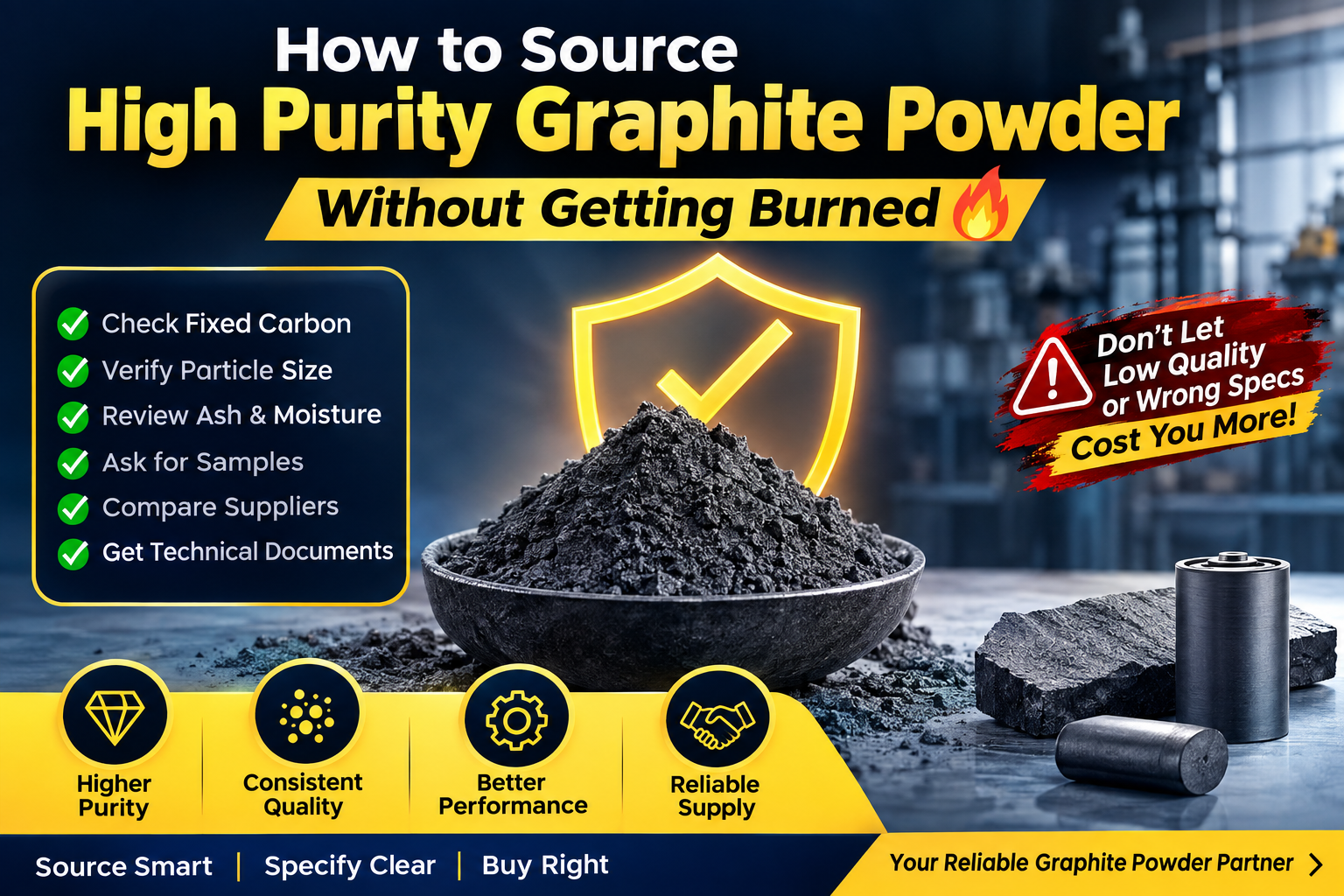
Buying high-purity graphite powder sounds simple: find a supplier, compare prices, place an order, and wait for delivery.
In practice, it is rarely that easy.
Two graphite powders can look almost identical while performing very differently in an industrial process. One may have the required fixed carbon but the wrong particle size. Another may meet the advertised purity but have inconsistent moisture or ash. A third may be inexpensive but fail to deliver the same specification from one batch to the next.
For manufacturers, that can mean more than a disappointing purchase. The wrong graphite powder can affect production quality, increase material consumption, create processing problems, and force expensive rework.
That is why sourcing graphite powder should be treated as a technical procurement decision, not simply a price comparison.
This guide explains what industrial buyers should check before purchasing high-purity graphite powder, how to compare suppliers, which specifications matter most, and how to avoid common sourcing mistakes.
What Is High-Purity Graphite Powder?
High-purity graphite powder is processed graphite with a high concentration of fixed carbon and controlled levels of impurities.
The exact specification required depends on the application. A material suitable for a refractory or foundry process may not be suitable for an advanced electrical or battery-related application.
Important specifications can include:
- Fixed carbon percentage
- Ash content
- Moisture
- Particle size
- Mesh size
- Flake characteristics
- Volatile matter
- Bulk density
- Packaging
- Batch consistency
The term “high purity” should therefore never be accepted without a technical specification sheet.
A supplier should clearly state what purity means for its particular product and provide measurable values that a buyer can verify.
Why Buying Graphite Powder on Price Alone Can Backfire
Price is important in industrial purchasing, but the lowest quotation is not necessarily the lowest-cost option.
Suppose one supplier offers a lower price but delivers material with inconsistent carbon content or particle size. If that variation affects your production process, the apparent saving can disappear quickly.
You may face:
- Higher material consumption
- Poorer product performance
- Production delays
- Additional processing
- Rejected batches
- Increased quality-control costs
- Difficulties maintaining consistent output
The better question is not
“Who sells graphite powder cheapest?”
It is:
“Which supplier can consistently provide the specification my process actually needs?”
That change in mindset can make a major difference to long-term procurement.
1. Start With Your Application, Not the Supplier
Before contacting graphite manufacturers, define exactly what the powder needs to do.
Graphite powder is used across a wide range of industrial applications, including:
- Refractories
- Foundries
- Lubricants
- Crucibles
- Steelmaking
- Friction materials
- Conductive applications
- Powder metallurgy
- Thermal-management products
- Battery-related applications
The required grade can be completely different from one application to another.
For example, a lubricant manufacturer may care strongly about particle size and dispersion, while a refractory manufacturer may place greater emphasis on fixed carbon, flake characteristics, ash, and thermal performance.
Start by writing down your actual requirements.
Your basic graphite specification should include:
Application: What will the graphite be used for?
Fixed carbon: What minimum percentage is required?
Particle size: What mesh or micron range is required?
Moisture: What maximum level is acceptable?
Ash: What is the maximum permitted level?
Form: Do you need pulverized powder or another form?
Quantity: How much do you consume per month or year?
Packaging: Bags, jumbo bags, or another format?
Once these requirements are clear, supplier comparison becomes much easier.
2. Never Buy “High Purity” Without Checking Fixed Carbon
One of the first numbers you should look for on a graphite specification sheet is fixed carbon (F.C.).
Fixed carbon indicates the carbon content of the material after accounting for other components.
A higher fixed-carbon level can be important in applications where mineral impurities may interfere with performance.
However, don’t make the mistake of assuming:
Higher carbon = automatically better product.
That isn’t always true.
If your process requires 90% F.C. material with a particular particle size, buying a significantly more expensive 99% material may provide little practical benefit.
The right grade is the one that meets your application’s technical requirements.
3. Particle Size Matters More Than Many Buyers Realise
Fixed carbon gets most of the attention, but particle size can be equally important.
Graphite powder can be supplied in different mesh or micron sizes depending on the application.
Particle size can influence:
- Dispersion
- Surface coverage
- Mixing behaviour
- Flow characteristics
- Lubrication performance
- Reaction behaviour
- Packing density
- Handling
- Dust generation
For example, a very fine powder may provide excellent dispersion in one formulation but create unnecessary dust or handling challenges in another.
This is why you should never order graphite simply by saying
“I need high-purity graphite powder.”
Instead, specify something closer to:
“I require natural graphite powder with a specified fixed-carbon level and controlled particle size for my particular application.”
If you are unsure about the correct mesh, ask the supplier for technical guidance based on your process.
4. Ask for a Complete Technical Specification Sheet
A professional graphite powder supplier should be able to provide a clear technical specification.
At minimum, ask about:
| Parameter | Why It Matters |
|---|---|
| Fixed Carbon | Indicates carbon concentration |
| Ash | Helps identify non-carbon mineral content |
| Moisture | Affects handling and processing |
| Particle Size | Influences application performance |
| Mesh | Defines powder fineness |
| Volatile Matter | Important for selected high-temperature uses |
| Bulk Density | Relevant to handling and formulation |
| Packaging | Important for storage and transportation |
Do not rely only on a product description such as the following:
“Premium high-purity graphite powder.”
Ask for numbers.
A specification sheet gives you something measurable to compare between suppliers.
5. Ask for a Sample Before Ordering in Bulk
This is one of the simplest ways to reduce procurement risk.
If you are considering a new supplier, request a representative sample before committing to a large order.
The sample should be tested against the requirements of your application.
Depending on the use, your quality team may evaluate the following:
- Fixed carbon
- Ash
- Moisture
- Particle-size distribution
- Flake characteristics
- Dispersion
- Lubricating behaviour
- Thermal performance
- Electrical properties
A sample is not merely a formality.
It gives your technical team an opportunity to determine whether the material actually works in your process.
6. Compare Batch Consistency, Not Just One Sample
A good sample is encouraging.
But one good sample does not prove that every future shipment will be identical.
This is one of the most important points in industrial graphite procurement.
Ask your supplier:
How is batch quality controlled?
Find out whether the supplier:
- Tests each production batch
- Maintains retained samples
- Provides test certificates
- Controls particle size
- Monitors fixed carbon
- Tracks moisture
- Maintains production records
If your factory depends on consistent raw materials, repeatability is often more valuable than an impressive one-time sample.
7. Understand Natural Graphite vs Synthetic Graphite
Not every graphite powder is natural graphite.
Graphite powder can originate from different production routes, and the choice depends heavily on the application.
Natural graphite is mined from naturally occurring graphite deposits and then processed, beneficiated, sized, and/or pulverized.
Synthetic graphite is manufactured through industrial processes using carbon-containing feedstocks.
The two materials can have different properties, costs, structures, and application advantages.
If your specification calls for natural graphite powder, confirm the material’s origin with the supplier rather than assuming it from the product name.
8. Ask Where the Graphite Comes From
Supply-chain transparency is becoming increasingly important for industrial minerals.
When evaluating a supplier, ask:
- Where is the graphite mined?
- Where is it processed?
- Is beneficiation performed in-house?
- Where does pulverization take place?
- What quality-control process is used?
- Is the product sourced from multiple suppliers?
- Can the supplier maintain supply during market disruptions?
Understanding the journey from mine to finished graphite powder can help you assess both quality and supply reliability.
The International Energy Agency continues to highlight graphite as an important energy-transition mineral and points to the concentration of graphite mining and refining supply chains.
External link: Link the words “International Energy Agency” to the IEA’s graphite analysis.
9. Don’t Ignore Ash and Moisture
Two specifications that often receive less attention than fixed carbon are ash and moisture.
Ash represents the non-carbon residue remaining after combustion or testing under the relevant method.
For applications where mineral impurities matter, excessive ash can affect performance.
Moisture can also influence:
- Weight
- Handling
- Storage
- Mixing
- Transportation
- Process consistency
A supplier that clearly reports these values gives buyers a better understanding of what they are actually purchasing.
10. Check Whether the Supplier Can Meet Your Mesh Requirement
Imagine you need a specific fine graphite powder for a production process.
The supplier offers the right fixed carbon but cannot consistently maintain the required particle-size distribution.
That can create problems even if the carbon number looks perfect.
Before placing an order, confirm:
Required mesh:
Actual mesh supplied:
Particle-size tolerance:
Testing method:
Batch variation:
If particle size is critical to your process, request the relevant test data.
11. Ask for a Certificate of Analysis
For regular industrial purchases, a Certificate of Analysis (CoA) can be extremely useful.
A CoA provides test results for a specific batch and allows the buyer to compare actual material against the agreed-upon specifications.
Depending on the product, the document may include values for:
- Fixed carbon
- Ash
- Moisture
- Particle size
- Volatile matter
- Other application-specific parameters
Don’t hesitate to ask:
“Can you provide a batch-wise Certificate of Analysis with the shipment?”
A professional supplier should be able to explain its testing and documentation process.
12. Evaluate the Supplier, Not Just the Product
A high-quality graphite product is only useful if the supplier can deliver it consistently.
Before selecting a long-term supplier, look at:
Production capability
Can the supplier handle your required monthly volume?
Processing capability
Can it produce the required mesh and grade consistently?
Quality control
Does it have a defined testing process?
Supply reliability
Can it support repeat orders?
Packaging
Can it supply the material in packaging appropriate for your plant?
Communication
Does the supplier answer technical questions clearly?
Documentation
Can it provide specifications, test reports, and other relevant documents?
These factors are particularly important when graphite is a regular production input rather than a one-time purchase.
13. Be Careful With Unrealistically Low Prices
An unusually low quotation deserves questions.
Before accepting it, ask whether the quoted price includes:
- Required purity
- Required mesh
- Packaging
- Testing
- Transportation
- Taxes
- Loading
- Documentation
Sometimes two quotations look different simply because they describe different products.
For example:
Supplier A: 90% F.C., -200 mesh
Supplier B: 95% F.C., -200 mesh
These are not necessarily equivalent products.
Always compare like with like.
14. Calculate the Real Cost, Not Just the Price per Kilogram
A better purchasing calculation is:
Effective Cost = Purchase Price + Processing Cost + Transport + Quality Loss + Rejection Risk
A slightly higher-priced graphite that performs consistently may actually cost less over the entire production cycle.
For large manufacturers, even a small variation in raw-material quality can become expensive when multiplied across hundreds of tonnes.
This is why technical procurement and quality control should work together when evaluating graphite suppliers.
15. Consider Long-Term Supply Agreements
If graphite is a critical raw material for your business, depending entirely on spot purchases can create unnecessary risk.
Once you qualify a reliable supplier, consider discussing the following:
- Monthly supply quantities
- Delivery schedules
- Agreed specifications
- Quality tolerances
- Packaging
- Testing requirements
- Price-review mechanisms
- Emergency supply arrangements
The goal is not simply to buy graphite cheaply.
The goal is to maintain stable access to the right graphite specification.
What Should You Ask a Graphite Powder Supplier?
Before requesting a quotation, send the supplier a clear specification.
You can use this checklist:
- What is the fixed carbon percentage?
- What is the maximum ash content?
- What is the moisture level?
- What particle size or mesh is available?
- Is the graphite natural or synthetic?
- Is the material pulverized?
- What is the country and location of origin?
- Is beneficiation performed in-house?
- Can you provide a technical data sheet?
- Can you provide a Certificate of Analysis?
- Can you provide a sample?
- What is the minimum order quantity?
- What packaging options are available?
- What is your monthly production capacity?
- Can you support repeat bulk orders?
- What quality-control checks are performed?
If a supplier cannot clearly answer basic technical questions, think carefully before committing to a large order.
A Simple Graphite Powder Buying Checklist
Before placing your purchase order, confirm all of these:
-
The application has been clearly defined
-
The fixed carbon requirement is confirmed
-
Particle size/mesh is confirmed
-
The ash limit is confirmed
-
Moisture specification is confirmed
-
Natural or synthetic origin is confirmed
-
The sample has been evaluated
-
Technical specifications have been reviewed
-
Certificate of Analysis is available
-
Supplier production capacity has been checked
-
Packaging has been agreed upon.
-
Delivery terms are clear
-
Long-term supply capability has been discussed
Why Indian Graphite Can Be an Important Sourcing Option
India has established graphite resources and an active domestic processing industry.
For manufacturers purchasing graphite in India, working with a domestic supplier can offer practical advantages in areas such as communication, logistics, lead times, and ongoing supply coordination.
However, location alone should never be the deciding factor.
The supplier still needs to demonstrate the following:
consistent quality + suitable specifications + reliable production + dependable delivery.
For industrial buyers, the best sourcing decision comes from combining these factors rather than choosing a supplier based only on geography or price.
Why Pradhan Industries Can Be Considered for Bulk Graphite Requirements
When sourcing graphite powder for industrial applications, buyers need more than a product name. They need clear specifications and a supplier that understands the importance of consistency.
Pradhan Industries supplies natural and crystalline graphite from Odisha for industrial requirements, with graphite products available for different applications and specifications.
For buyers evaluating graphite powder manufacturers, the important step is to discuss the required fixed carbon, mesh size, application, quantity, and delivery requirements before selecting a grade.
If you are purchasing graphite in bulk, share your technical specification with the supplier and ask for the appropriate grade rather than simply requesting the highest-purity material available.
Final Thoughts: Buy the Specification, Not the Sales Pitch
Sourcing high-purity graphite powder does not have to be complicated.
The safest approach is to focus on measurable specifications and supplier consistency.
Start with your application. Define the required fixed carbon and particle size. Check ash and moisture. Request a sample. Review the technical specification. Ask for batch-level testing. Then evaluate whether the supplier can maintain the same quality over repeated deliveries.
Most importantly, don’t let the phrase “high purity” make the purchasing decision for you.
The right graphite powder is not necessarily the most expensive or the highest-carbon product.
It is the material that matches your process, performs consistently, and can be supplied reliably at the scale your business requires.
If you are looking for a dependable graphite powder manufacturer in India, Pradhan Industries can discuss your required grade, fixed carbon, mesh size, application, and bulk quantity to help identify a suitable graphite specification.
In the supply chain section, link the International Energy Agency to its dedicated graphite analysis. The IEA’s 2025 graphite outlook covers demand, supply, mining, and refining concentration, making it a strong, authoritative reference for the supply chain discussion.
IEA — Graphite: Outlook for Key Energy Transition Minerals
Frequently Asked Questions About High-Purity Graphite Powder
What is high-purity graphite powder?
High-purity graphite powder is processed graphite containing a high percentage of fixed carbon with controlled levels of impurities such as ash and moisture. The required purity depends on the intended application.
How do I choose the right graphite powder?
Start with your application and determine the required fixed carbon, particle size, ash, moisture, and other technical specifications. Then compare suppliers based on their ability to consistently meet those requirements.
Is higher fixed carbon always better?
No. Higher fixed carbon can be beneficial for certain applications, but the most suitable grade depends on the complete application. Particle size, ash, moisture, flake characteristics, and cost also matter.
What is the difference between graphite powder and graphite flakes?
Graphite flakes are naturally occurring graphite particles with a recognizable flake structure. Graphite powder generally refers to graphite that has been processed into a controlled powder or particle-size range. The exact form depends on the processing method and specification.
What mesh size is best for graphite powder?
There is no single best mesh size. The appropriate particle size depends on the application, mixing process, dispersion requirements, and desired performance.
Should I request a graphite sample before bulk purchase?
Yes. Testing a representative sample before committing to a large order can help confirm that the material meets your technical and performance requirements.
What documents should a graphite supplier provide?
Depending on the application, buyers may request a technical data sheet, certificate of analysis, product specification, safety documentation, and other quality or shipping documents.
How can I avoid poor-quality graphite powder?
Avoid buying solely on price or marketing claims. Verify fixed carbon, ash, moisture, particle size, origin, batch consistency, testing procedures, and supplier production capability before placing a large order.