A steel plant running an electric arc furnace, a foundry pouring brass castings, and an EV battery plant coating anode powder don’t seem to have much in common. Yet, all three depend heavily on the exact same mineral to keep their production lines moving: natural graphite.
It’s a material we’ve mined for centuries, yet it remains so critical that even decades of synthetic engineering haven’t managed to replace it everywhere. Its true power comes down to a very narrow, highly specific set of properties: it survives heat that would melt most metals, conducts both heat and electricity, lubricates without a drop of oil, and laughs off chemical corrosion.
If you’re sourcing materials for heavy industry, understanding exactly how natural graphite works—and how to buy the right grade—is essential. Let’s break down the practical benefits, see how it stacks up against synthetic alternatives, and look at what you should actually check before signing off on a bulk order.
To understand how graphite moves from mined ore to a finished industrial material, it is also useful to explore the graphite beneficiation process and the stages involved in improving its quality and consistency.
What Exactly is Natural Graphite?
In simple terms, natural graphite is a crystalline form of carbon. Over millions of years, carbon-bearing rocks deep in the earth’s crust are subjected to intense heat and pressure. This forces the carbon atoms to arrange themselves into flat, hexagonal sheets.
Because these sheets are held together by relatively weak forces, they can easily slide over one another. That sliding action gives graphite its famous slippery, lubricating quality, while the strong bonds within the sheets make it an excellent conductor.
In the commercial world, you’ll mostly encounter two forms:
-
Flake Graphite: Highly prized for its larger, well-formed crystals and superior conductivity.
-
Amorphous Graphite: Made of finer, less-ordered particles, typically with a slightly lower carbon content.
Unlike synthetic graphite (which is baked from petroleum coke in a high-temperature lab), natural graphite is pulled directly from the earth and upgraded.
9 Undeniable Benefits of Natural Graphite
Why hasn’t heavy industry moved on from this mined mineral? Because finding another material that does all of this at scale is nearly impossible:
-
Extreme Heat Resistance: Graphite doesn’t melt under standard industrial conditions. It only sublimes (turns to gas) at incredibly high temperatures. This is why it’s the backbone of furnace linings and refractory bricks.
-
Thermal Conductivity: It moves heat efficiently. Heat exchangers and furnace parts rely on this to prevent dangerous hotspots and thermal stress.
-
Electrical Conductivity: It carries the massive current loads needed to melt scrap steel in electric arc furnaces.
-
Dry Lubrication: Because those carbon sheets slide so easily, graphite is the perfect dry lubricant for open gears and hot bearings where traditional oil would just burn off or attract dirt.
-
Chemical Armor: Graphite naturally resists attacks from aggressive acids, alkalis, and corrosive process gases.
-
Thermal Shock Resilience: Foundries love graphite because it can heat up and cool down repeatedly without cracking, unlike many other refractory materials.
-
Naturally Low Friction: It’s ideal for mechanical seals and bushings that need to run smoothly against other surfaces without constant maintenance.
-
Customizable Carbon Content: By specifying fixed carbon, ash, and moisture levels, buyers can tailor the graphite’s performance exactly to their process.
-
Lower Energy Footprint: Mining and purifying natural graphite generally consumes much less energy than manufacturing synthetic graphite from scratch.
Where Natural Graphite Goes to Work
You’ll find natural graphite hiding in plain sight across several massive global industries.
Steel & Foundry Operations
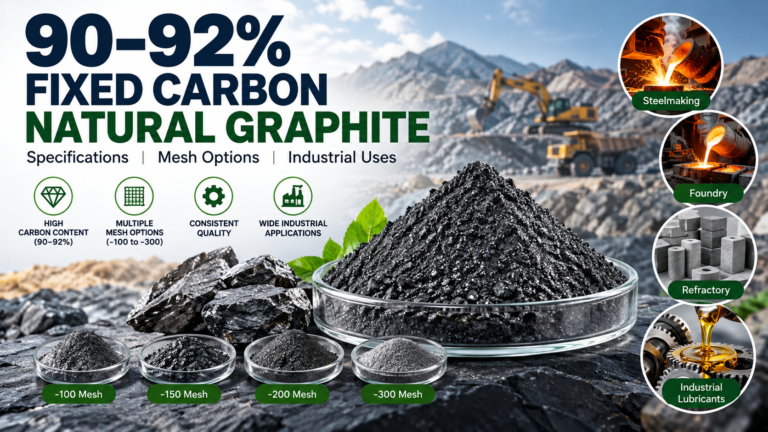
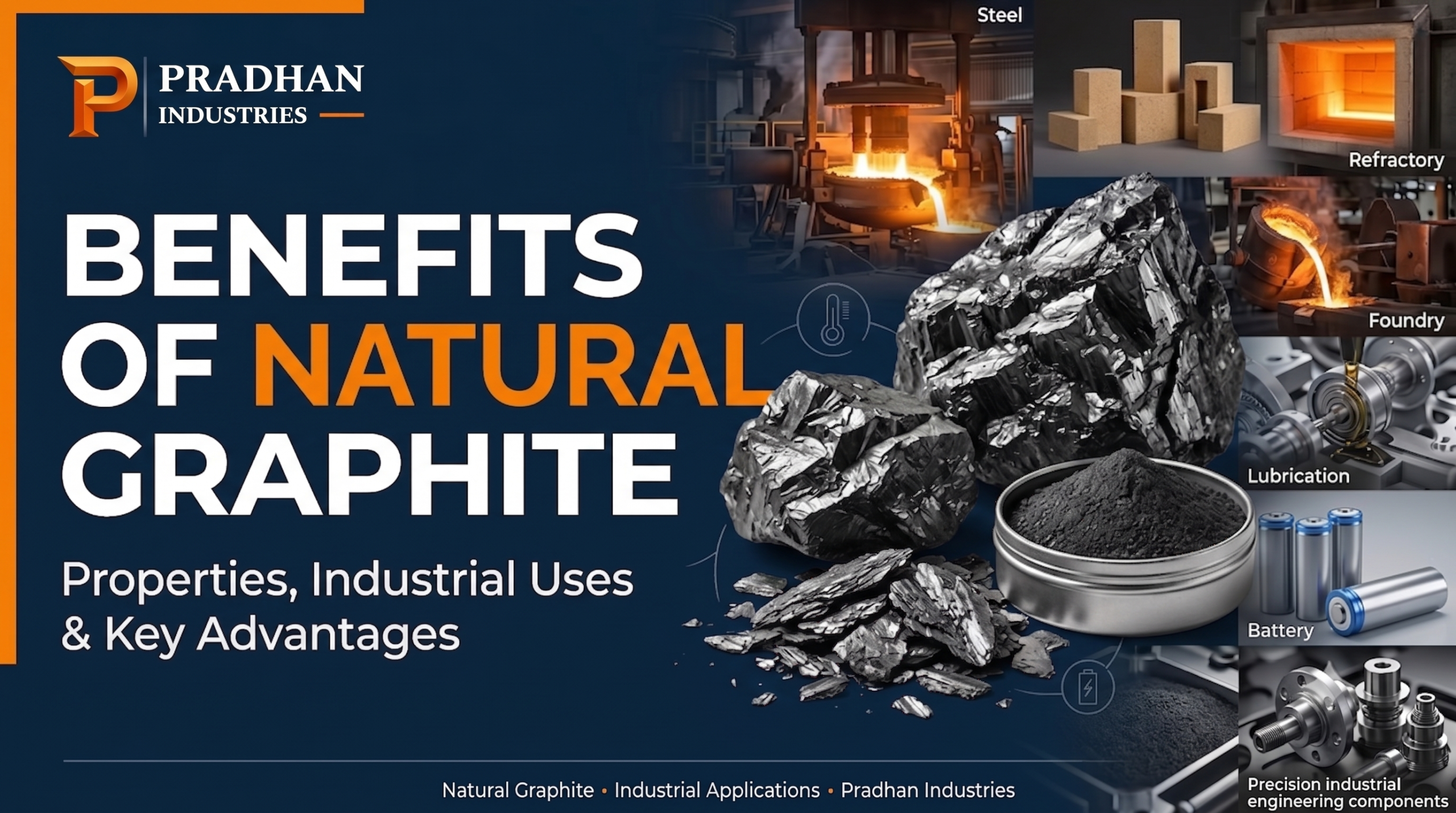
In steelmaking, it’s used as a carbon raiser to hit precise steel grade specifications. In foundries, it’s the secret behind smooth casting surfaces (used in mold facings) and is the core material for crucibles used to melt down aluminum and brass.
Refractories & Lubricants
Refractory bricks (like magnesia-carbon) use graphite to survive constant exposure to molten metal and corrosive slag. Meanwhile, industrial plants use it as a dry lubricant in high-heat or vacuum environments where standard greases would instantly fail.
The EV Battery Boom
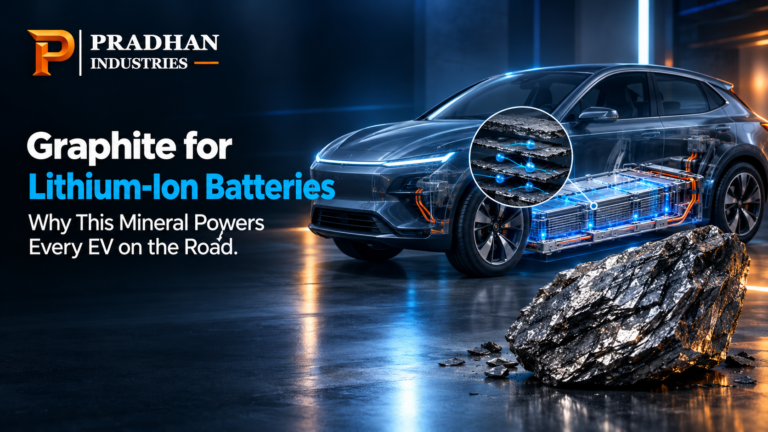
Graphite is the primary anode material in most lithium-ion batteries. However, you can’t just scoop industrial graphite into a battery. It requires intense purification, shaping (spheroidization), and coating to meet incredibly tight particle-size specs.
The growing importance of graphite in energy-storage technologies is also highlighted in research from the International Energy Agency, particularly its work on critical minerals and clean-energy supply chains.
Natural vs. Synthetic Graphite: Which is Better?
There is no “universal winner” here. The right choice comes entirely down to your budget and your process constraints.
The Indian Market Advantage
For manufacturers in India, relying entirely on imported raw materials (largely from China) can be a supply chain risk. Fortunately, India holds meaningful domestic graphite resources.
With an estimated 8.6 million tons in reserves and active production concentrated in Odisha, Jharkhand, Tamil Nadu, and Kerala, domestic mining offers a reliable, localized supply. As India’s EV and battery ecosystem rapidly expands, having a local source for beneficiated graphite is becoming a major strategic advantage for the region’s heavy industries.
The Buyer’s Checklist: What to Ask Before You Order
Two bags of powder might both say “Natural Graphite,” but they can behave wildly differently inside a 3,000-degree furnace. Before you place a bulk order, force your supplier to answer these questions:
-
What is the exact fixed carbon percentage? (Don’t accept estimates).
-
What is the particle and flake size distribution?
-
What are your hard limits on ash and moisture?
-
Can you provide test certificates for every batch?
-
How do you ensure batch-to-batch consistency over a year-long contract?
Getting full technical specifications up front is the only way to prevent costly production line shutdowns later.
Sourcing Natural Graphite for Your Plant
If you need a reliable supply chain partner, Pradhan Industries mines and processes natural crystalline graphite straight from rich deposits in Odisha. We supply high-quality graphite powder and processed materials to industrial buyers for both domestic bulk and export requirements.
Because our beneficiation process is built strictly around consistent fixed carbon content and exact particle specifications, you know exactly what is going into your equipment every single time.
Looking for natural graphite for an industrial application?
Contact Pradhan Industries today to discuss your specific grade, fixed carbon needs, and bulk supply requirements.
Frequently Asked Questions
What are the main benefits of natural graphite?
It offers incredible high-temperature stability, strong thermal and electrical conductivity, dry lubrication without oil, chemical resistance, and a lower production energy footprint than synthetic alternatives.
Is natural graphite better than synthetic graphite?
Not necessarily. Natural graphite is much more cost-effective and perfectly suited for refractories, foundries, and lubricants. Synthetic graphite is more expensive but offers the extreme purity and uniformity needed for precision electronics.
Why is natural graphite used in refractories?
It resists chemical reactions with molten metal and slag. When combined with its ability to handle severe thermal shock (rapid heating and cooling), it significantly extends the lifespan of furnace linings and ladles.
Can standard natural graphite be used in EV batteries?
Yes, but not straight out of the ground. It must go through complex additional processing—including intense purification and spheroidization—to meet strict battery-grade requirements.
How do I choose the right grade for my business?
Start with your core need (e.g., heat resistance vs. electrical conductivity). Then, work with your supplier to match the fixed carbon percentage, ash limits, and particle size to that specific application. Always demand batch test certificates before signing off.