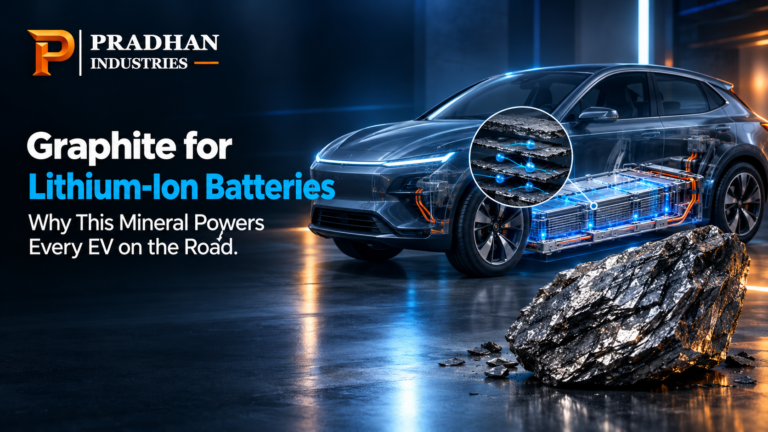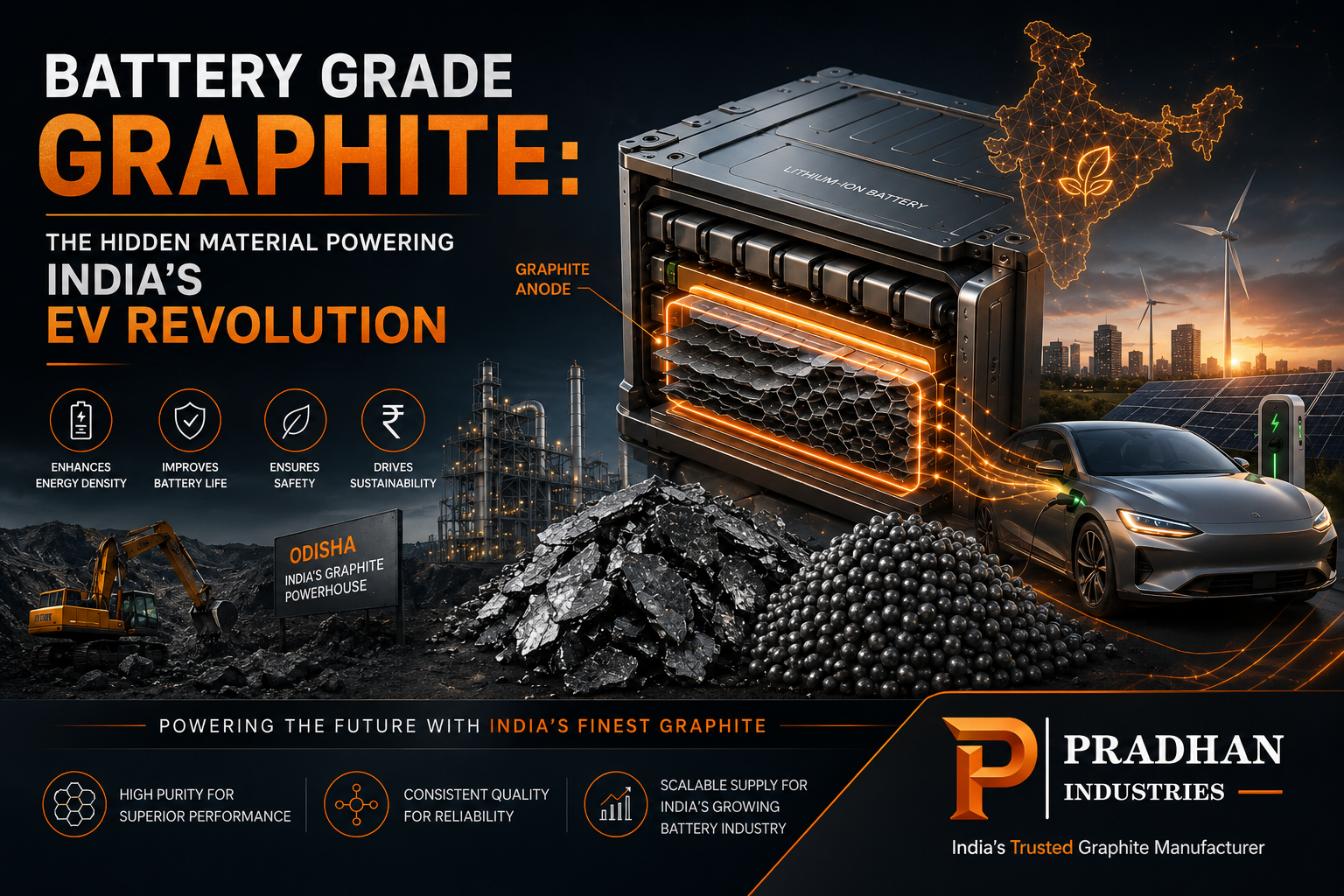
India’s electric vehicle market is growing at an unprecedented pace. Government incentives, expanding charging infrastructure, rising fuel costs, and increasing environmental awareness are accelerating EV adoption across the country. While most discussions focus on lithium, battery technology, and vehicle range, there is another critical material quietly enabling this transformation—battery-grade graphite.
In fact, graphite is one of the most essential components of every lithium-ion battery. Without graphite, modern electric vehicle batteries simply cannot function efficiently at commercial scale.
Despite its importance, graphite receives only a fraction of the attention given to lithium. For manufacturers, battery researchers, and procurement teams, understanding the strategic importance of graphite is becoming increasingly important as India builds its domestic battery manufacturing ecosystem.
Why Graphite Is Essential for Lithium-Ion Batteries
A lithium-ion battery consists of two primary electrodes: the cathode and the anode.
While significant attention is often given to cathode chemistries such as Lithium Iron Phosphate (LFP) and Nickel Manganese Cobalt (NMC), the anode is equally important. Today, graphite remains the dominant material used in lithium-ion battery anodes worldwide.
When an EV battery charges, lithium ions move from the cathode and are stored within the layered crystalline structure of graphite. During discharge, these ions travel back to the cathode, generating electrical energy that powers the vehicle.
This repeated movement occurs thousands of times throughout the battery’s lifespan. Graphite’s unique structure makes it exceptionally suitable for this process.
Key Benefits of Graphite in EV Batteries
Excellent Electrical Conductivity
Graphite efficiently conducts electrons throughout the battery cell. This enables smooth charging and discharging while minimizing energy losses.
Superior Structural Stability
The layered atomic structure of graphite can repeatedly accommodate lithium ions with minimal degradation. This characteristic contributes significantly to battery longevity and cycle life.
High Energy Density
Graphite allows manufacturers to maximize energy storage capacity while maintaining practical battery weight. This directly influences EV driving range and overall vehicle efficiency.
Enhanced Thermal Performance
Battery safety is a major concern in electric vehicles. Graphite helps dissipate heat effectively, supporting thermal management systems and improving battery reliability.
Cost Effectiveness
Compared to many alternative anode materials, graphite offers an excellent balance between performance, scalability, and cost, making it the preferred commercial choice for battery manufacturers worldwide.
Graphite Consumption in Electric Vehicles
Many people are surprised to learn that lithium-ion batteries require significantly more graphite than lithium.
On average, a typical electric vehicle battery uses approximately 50–100 kilograms of graphite, depending on battery size and chemistry. In comparison, the lithium content is substantially lower.
Industry experts often estimate that lithium-ion batteries consume roughly 10 to 15 times more graphite than lithium by weight.
This reality explains why global demand for battery-grade graphite is increasing rapidly alongside EV adoption.
As electric vehicle production expands across India and the world, graphite is becoming one of the most strategically important raw materials in the energy transition.
Not All Graphite Is Battery Grade
One common misconception is that all graphite can be used in batteries.
The reality is very different.
Battery manufacturers require highly specialized graphite with extremely stringent quality specifications. Battery-grade graphite must undergo extensive processing before it becomes suitable for anode production.
Characteristics of Battery Grade Graphite
- Fixed carbon content typically above 99.9%
- Low sulfur content
- Minimal iron contamination
- Controlled moisture levels
- Consistent particle size distribution
- High purity standards
- Excellent electrochemical performance
Even minor impurities can negatively impact battery efficiency, cycle life, and safety.
As a result, battery-grade graphite production involves advanced beneficiation, purification, classification, and quality control processes.
The Growing Demand for Graphite in India
India has ambitious plans to become a global hub for electric vehicle manufacturing and battery production.
Government initiatives such as Make in India, FAME incentives, and Production Linked Incentive (PLI) schemes are accelerating investments in battery manufacturing facilities.
However, achieving true supply chain independence requires more than assembling battery packs. It requires reliable access to critical raw materials.
Graphite sits at the center of this challenge.
Currently, a significant portion of battery-grade graphite used globally is processed in China. This concentration creates supply chain risks for manufacturers seeking long-term security and stable pricing.
Consequently, Indian battery manufacturers are increasingly looking for domestic sources of high-quality graphite.
Odisha: India’s Graphite Capital
When discussing graphite resources in India, Odisha stands out as one of the country’s most significant graphite-producing regions.
The state possesses substantial natural graphite deposits that have supported industrial applications for decades.
Today, these resources are attracting renewed attention due to the rapid growth of the electric vehicle and energy storage sectors.
Advantages of Odisha Graphite
Rich Natural Deposits
Odisha contains some of India’s most promising graphite reserves, offering long-term supply potential.
Strategic Location
The state’s industrial infrastructure and connectivity support efficient transportation and logistics.
Growing Processing Capabilities
Investments in beneficiation and purification technologies are helping transform raw graphite into higher-value industrial products.
Support for Domestic Manufacturing
Locally sourced graphite contributes to India’s goal of strengthening critical mineral supply chains.
As battery demand increases, Odisha is expected to play an increasingly important role in supporting India’s clean energy future.
Why Graphite Supply Chain Reliability Matters
Battery manufacturers operate in highly demanding environments where consistency is essential.
Variations in graphite quality can affect:
- Battery performance
- Charging efficiency
- Energy density
- Product reliability
- Manufacturing yield
- Safety standards
This is why leading battery producers prioritize suppliers capable of delivering consistent material quality across every production batch.
A reliable graphite supplier should provide:
1. Consistent Fixed Carbon Levels
Purity directly impacts battery performance and manufacturing outcomes.
2. Controlled Particle Size Distribution
Parameters such as D50 and D90 influence anode performance and processing behavior.
3. Advanced Purification Processes
High-purity graphite requires sophisticated thermal and chemical purification techniques.
4. Full Material Traceability
Manufacturers increasingly demand transparency from mine to finished product.
5. Comprehensive Quality Documentation
Certificates of analysis and batch-specific testing reports help ensure compliance and consistency.
Pradhan Industries: Supporting India’s Battery Materials Future
As a leading graphite manufacturer in India, Pradhan Industries recognizes that the EV revolution represents a long-term structural shift in global industry.
Our operations are designed to support the growing demand for high-quality graphite products across battery, industrial, metallurgical, and advanced manufacturing applications.
Integrated Graphite Operations
Pradhan Industries maintains control over sourcing, processing, quality assurance, and delivery, ensuring consistency throughout the supply chain.
Focus on Quality
We continuously invest in advanced beneficiation and processing technologies to meet evolving industry requirements.
Reliable Supply
Our Odisha-based sourcing network supports dependable material availability for customers across India.
Customer-Centric Approach
We work closely with manufacturers, research institutions, and industrial clients to deliver graphite solutions aligned with their specific requirements.
The Future of Graphite in India’s EV Industry
The future of electric mobility depends not only on vehicle manufacturers and battery companies but also on the strength of the underlying raw material ecosystem.
Graphite will remain a critical component of lithium-ion battery technology for years to come.
Although next-generation battery technologies continue to evolve, graphite remains the preferred commercial anode material due to its proven performance, availability, and cost-effectiveness.
As India expands domestic battery manufacturing capacity, demand for high-quality graphite is expected to increase significantly.
Companies that establish reliable graphite supply chains today will be better positioned to capitalize on tomorrow’s opportunities.
Conclusion
While lithium often dominates discussions about electric vehicles, graphite is the material quietly powering every lithium-ion battery.
Its role in energy storage, battery performance, safety, and longevity makes it indispensable to the EV industry.
With abundant natural resources, growing processing capabilities, and increasing demand from battery manufacturers, India is uniquely positioned to strengthen its graphite supply chain.
Odisha’s graphite resources and companies such as Pradhan Industries are helping build the foundation for a more resilient and self-reliant battery manufacturing ecosystem.
As India’s electric vehicle revolution accelerates, battery-grade graphite will continue to be one of the most important materials driving the country’s sustainable energy future.
Frequently Asked Questions
Why is graphite used in EV batteries?
Graphite is used as the primary anode material because it efficiently stores and releases lithium ions during charging and discharging cycles.
Is graphite more important than lithium in EV batteries?
Both materials are essential, but EV batteries typically use significantly more graphite than lithium by weight.
What is battery-grade graphite?
Battery-grade graphite is highly purified graphite with very high carbon content and controlled physical properties suitable for lithium-ion battery manufacturing.
Which state produces the most graphite in India?
Odisha is among India’s most important graphite-producing states and holds significant natural graphite resources.
Why choose an Indian graphite supplier?
Domestic sourcing improves supply chain security, reduces dependency on imports, and supports India’s manufacturing ecosystem.