High-Carbon Graphite Market Trends are reshaping how industrial buyers source natural graphite across global markets. Rising demand from electric vehicles, renewable energy, steel manufacturing, refractories, lubricants, and advanced industrial applications has increased the importance of selecting the right graphite grades and reliable suppliers. Understanding these market trends helps businesses reduce procurement risks, improve product quality, and build a more resilient supply chain.
Why Businesses Search for a Local Graphite Supplier
Graphite is heavy, dusty, and freight-sensitive. Every extra kilometre between the supplier’s warehouse and your plant adds cost, transit risk, and lead time.
A nearby supplier changes the economics of your entire supply chain. Shorter routes mean lower landed costs, faster emergency replenishment, and fewer damaged consignments.
There is also a trust factor. When a supplier operates in your region, you can inspect their facility, meet their technical team, and audit their quality control process in person — something no overseas trader can offer.
The Real Benefits of Sourcing Graphite Locally
1. Lower Freight and Handling Costs
Graphite is typically sold by the tonne, and transport can account for a significant share of your final price. A regional supplier cuts that share immediately.
Local sourcing also reduces the number of handling points. Fewer transfers mean less bag damage, less contamination, and less material loss.
2. Faster, More Flexible Delivery
Production schedules rarely wait for shipping containers. When a furnace campaign runs long or an order spikes, a nearby supplier can often deliver within days instead of weeks.
That flexibility acts like free insurance. You can hold smaller inventories without risking a stock-out, which frees up working capital.
3. Easier Quality Verification
With a local partner, you can request pre-shipment samples, visit the plant, and watch how material is stored and processed. Moisture control, batch labelling, and warehouse hygiene tell you more than any brochure.
Crystalline Graphite Grades: A Complete Guide to Fixed Carbon, Mesh Size & Industrial Applications
What to Check Before Choosing a Graphite Supplier Near You
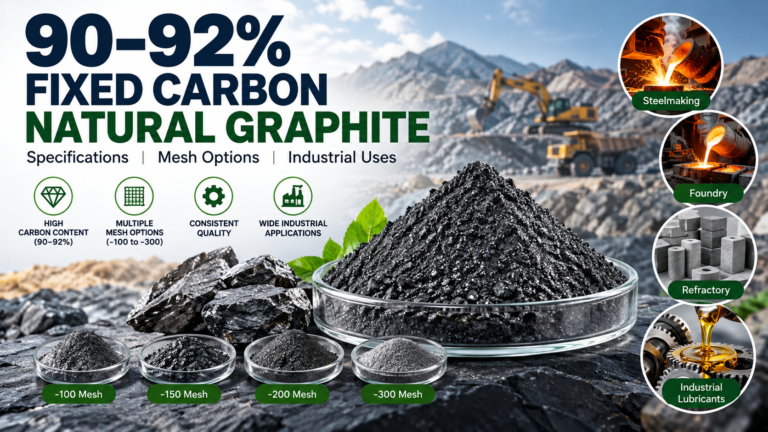
Fixed Carbon (F.C) Percentage
Fixed carbon is the most important number on any graphite specification. It tells you how much pure carbon the material contains after moisture, volatiles, and ash are removed.
Industrial grades commonly range from 60–65% F.C for foundry and carbon-raising duties, up to 94–95% F.C for lubricants, conductive products, and high-performance applications. A serious supplier will state the F.C range for every grade and back it with laboratory test reports.
Mesh Size and Particle Consistency
Mesh size defines how fine the graphite powder is. Common industrial cuts include -100 Mesh (coarse), -200 Mesh (standard), and -300 Mesh (fine).
The right mesh depends on your application. Coarse material suits bulk carbon addition, while fine powders perform better in lubricants, coatings, and brake linings.
Pulverised vs Unpulverised Supply
Pulverised graphite arrives milled to a controlled fineness, ready for direct use. Unpulverised graphite is coarser and suits buyers who run their own milling and want to control particle size in-house.
A capable local supplier should offer both states, so your make-versus-buy decision on milling stays flexible.
Testing, Certification, and Documentation
Industrial buyers can also refer to the U.S. Geological Survey (USGS) Mineral Commodity Summaries for reliable information on graphite production, reserves, and industry data:
Red Flags That Signal an Unreliable Supplier
Not every listing that appears for “graphite supplier near me” deserves your purchase order. Watch for these warning signs before committing volume:
A supplier who quotes only “typical values” instead of lot-specific test results is asking you to carry their quality risk. Similarly, vague answers about material origin often hide re-traded stock of unknown consistency.
Extremely low prices deserve extra scrutiny, not celebration. In the graphite trade, a price far below market usually means lower fixed carbon, higher ash, or moisture-loaded bags that cost you more per usable tonne.
Questions to Ask on Your First Call
A ten-minute conversation can reveal more than a week of website research. Use these questions to separate professionals from traders:
Ask which F.C grades and mesh sizes they stock regularly, and which they source on demand. Regular stock means faster delivery and better batch consistency.
Ask which F.C. grades and mesh sizes they stock regularly, and which they source on demand. Regular stock means faster delivery, greater supply reliability, and better batch consistency. To better understand how graphite grades, fixed carbon content, and mesh sizes affect industrial performance, read our guide on Crystalline Graphite Grades: .
Industries That Depend on Local Graphite Supply
Reliable regional graphite supply supports a surprisingly wide range of manufacturing sectors. Foundries and steel plants use it for carbon raising and mould facings, where steady weekly deliveries matter more than exotic purity.
Refractory and crucible manufacturers depend on consistent 90%+ F.C material for thermal performance. Lubricant, brake lining, and paint producers need fine, high-purity powders with tight particle control.
Even newer sectors — batteries, conductive polymers, and expanded graphite products — increasingly prefer regional suppliers to shorten qualification cycles and reduce import risk.
Local vs Imported Graphite: Getting the Balance Right
Local sourcing does not mean ignoring the global market. Smart buyers use a nearby supplier as their primary partner while keeping awareness of international graphite price trends.
The strongest local suppliers actually bridge both worlds. They import or source from multiple origins, hold buffer stock regionally, and shield you from export-control delays and shipping volatility.
That combination — global sourcing with local stock and service — is exactly what your “near me” search should aim to find.
Key Takeaways
- Proximity cuts cost and risk: A local graphite supplier reduces freight, lead times, and handling damage while enabling in-person quality audits.
- Specification beats location: Always verify fixed carbon percentage, mesh size, and processing state before comparing prices.
- Demand lot-specific test reports: Batch-wise certificates for F.C, ash, and moisture are non-negotiable for professional supply.
- Both processing states matter: A supplier offering pulverised and unpulverised material keeps your milling strategy flexible.
- Cheap usually costs more: Below-market prices typically hide lower purity or moisture-loaded weight.
- Ask before you order: Stock grades, moisture control, traceability, and references reveal supplier quality faster than any brochure.
Ready to Source High-Quality Graphite?
Choosing the right graphite supplier can make a real difference to your production process. At Pradhan Industries, we supply consistent, high-quality natural graphite backed by batch-wise test reports, dependable delivery, and experienced technical support.
If you’re looking for the right grade for your application or need help selecting the best specification, our team is here to assist. Get in touch with us to discuss your requirements, request technical data, or receive a quick quotation tailored to your needs.
Internal Link: Contact Pradhan Industries
https://pradhanindustries.com/contact-us/