Ask most people what’s inside an electric car battery, and they’ll say “lithium”. That’s only part of the story. By weight, the biggest battery material in a typical EV is graphite, and almost nobody talks about it.
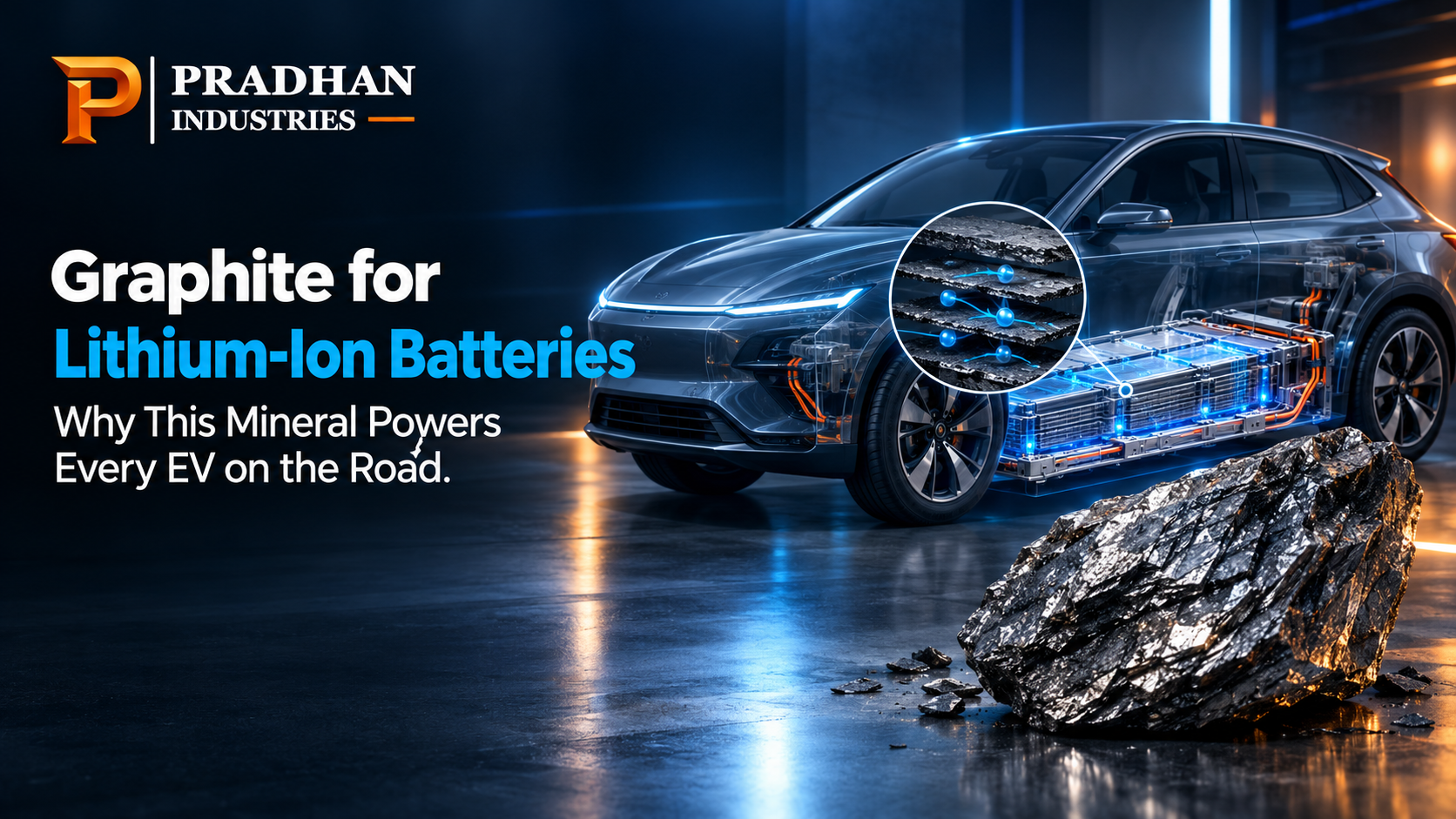
Graphite for lithium-ion batteries forms the anode, the electrode that stores lithium ions while the battery charges. Without it, today’s EVs, laptops, phones and home energy storage systems would not work the way we know them.
In this guide, we’ll explain in simple terms how graphite works inside a battery, which types are used, why demand is surging, and what it means for buyers and manufacturers in India.
How a Lithium-Ion Battery Works
A lithium-ion battery has four main parts: a cathode, an anode, an electrolyte and a separator. When you charge the battery, lithium ions travel from the cathode and settle into the anode. When you drive or use your device, they travel back, and that movement creates the electric current. For a deeper technical explanation, Britannica’s lithium-ion battery article is a good reference.
The anode has to hold a lot of lithium, release it easily, and survive thousands of charge cycles. Graphite does all three well, which is why it became the industry standard.
Why Graphite for Lithium-Ion Batteries Is the Anode Material of Choice
Graphite has a layered structure, like a stack of very thin sheets. Lithium ions slide between these layers (a process called intercalation) and slide back out when the battery discharges. Think of it as parking spaces for lithium ions that can be used again and again.
Here’s why manufacturers still prefer it:
- Stable and long-lasting: It handles thousands of charge and discharge cycles.
- Good conductivity: Electrons move through it easily, which improves efficiency.
- Reasonable cost: It is cheaper than most alternative anode materials.
- Proven technology: Decades of use mean predictable, reliable performance.
- High energy storage: It holds a useful amount of lithium for its weight.
If you want to understand the material itself first, read our guide on what natural graphite is and where it is used.
How Much Graphite for Lithium-Ion Batteries Does an EV Need?
A typical EV battery pack contains roughly 50 to 100 kg of graphite, depending on the battery size and chemistry. That is often more than the amount of lithium, which is why the graphite supply chain matters so much. A bigger battery with a longer driving range needs more of it.
Even the small battery in a smartphone depends on graphite. Multiply that by the millions of vehicles and devices sold every year, and you can see why demand keeps climbing.
Natural vs Synthetic Graphite for Lithium-Ion Batteries
Battery makers use two main kinds of graphite. Each has its own strengths.
| Feature | Natural Graphite | Synthetic Graphite |
|---|---|---|
| Source | Mined from the earth | Made from petroleum coke or coal tar pitch |
| Production process | Mining, purification and shaping | Heated to around 3,000°C for long periods |
| Cost | Generally lower | Generally higher |
| Energy use | Lower | Very high |
| Performance | High capacity, good for fast production | Excellent cycle life and consistency |
| Common use | EVs, consumer electronics | Premium EVs, long-life batteries |
Many battery makers blend both types to balance cost and performance. Natural graphite is attractive because it needs far less energy to produce, which helps lower the carbon footprint of the battery. You can compare current rates in our article on the natural graphite price per tonne in India.
From Mine to Battery: What Is Spherical Graphite?
You can’t put raw graphite straight into a battery. It has to be transformed first.
- Mining and flotation: Flake graphite is mined and concentrated.
- Milling and shaping: The flakes are ground and rounded into tiny potato-shaped particles called spherical graphite.
- Purification: The material is purified to 99.9% carbon or higher using chemical or thermal methods.
- Coating: A thin carbon coating is often added to improve stability.
- Anode production: The finished powder is mixed into a slurry and coated onto copper foil.
The rounded shape matters because it packs tightly and lets lithium ions move smoothly. This is called battery-grade graphite, and it sells at a much higher price than ordinary industrial graphite.
Why Demand for Graphite for Lithium-Ion Batteries Is Growing So Fast
Electric vehicle sales have grown rapidly over the past few years. The International Energy Agency’s Global EV Outlook tracks this growth and shows how strongly EV adoption is reshaping demand for battery minerals.
Several trends are pushing demand higher:
- EV adoption: More car makers are launching electric models in every price segment.
- Energy storage: Solar and wind projects need large battery systems.
- Consumer electronics: Phones, laptops, earbuds and power tools all use lithium-ion cells.
- Government support: Many countries, including India, are backing domestic battery manufacturing.
Because graphite makes up the largest share of an anode, this growth translates directly into higher consumption.
The Supply Chain Challenge
Here is where things get complicated. Graphite production and processing are concentrated in a few countries. According to the USGS graphite statistics, China is the world’s largest producer, and it also dominates the processing of graphite into battery anode material.
When export rules or supply conditions change, battery makers elsewhere feel it quickly. That’s why the US, Europe, India and other regions are working to build their own mining and processing capacity.
Sourcing Graphite for Lithium-Ion Batteries in India
India’s EV market and battery manufacturing sector are growing, and graphite is now seen as an important mineral for the country’s energy transition. India has graphite deposits in states such as Arunachal Pradesh, Jharkhand, Odisha and Tamil Nadu, though most battery-grade needs are currently met through imports. For official information on mineral policy and critical minerals, visit the Ministry of Mines, Government of India.
This creates real opportunities for:
- Battery manufacturers looking for reliable anode material suppliers
- Processors who can purify and shape graphite locally
- Traders and importers serving the growing cell manufacturing industry
If you are planning to source graphite for batteries or related industrial use, our team can help you match the right grade to your needs. Talk to our graphite experts.
What to Check Before Buying Graphite for Lithium-Ion Batteries
Quality makes or breaks battery performance. Before you order, confirm these points:
- Carbon purity: Battery-grade material is usually 99.9% carbon or above.
- Particle size distribution: It should be consistent, because uneven particles hurt performance.
- Tap density and surface area: These affect how well the anode coating performs.
- Impurity levels: Metals such as iron can cause safety problems in cells.
- Certificate of Analysis (COA): Always ask for batch-wise test reports.
- Supplier reliability: Choose a partner with stable supply and clear documentation.
Not every application needs battery-grade purity. For steel, foundry or refractory use, lower grades work well. See our overview of graphite grades and applications to find the right one.
The Future of Graphite for Lithium-Ion Batteries
Researchers are testing silicon-graphite blends that could store more energy and charge faster. Even so, graphite remains the base of these designs, since silicon alone expands too much during charging. Most experts expect graphite to stay central to lithium-ion batteries for many years, even as new chemistries develop.
In short, the EV revolution is, in many ways, a graphite story too.
Frequently Asked Questions (FAQs)
Why is graphite for lithium-ion batteries so widely used?
Graphite has a layered structure that lets lithium ions enter and leave easily. It is stable, conductive and affordable, which makes it ideal for the battery anode.
How much graphite is in an EV battery?
A typical EV battery contains about 50 to 100 kg of graphite, depending on its size and design.
Is natural or synthetic graphite better for batteries?
Neither is better in every case. Natural graphite costs less and uses less energy to produce, while synthetic graphite offers very consistent quality and a long cycle life. Many manufacturers use a blend.
What is battery-grade graphite?
It is graphite that has been shaped into spherical particles and purified to around 99.9% carbon or higher so it can be used in battery anodes.
Does every EV battery use graphite?
Almost all mainstream lithium-ion EV batteries use a graphite-based anode. A few specialised chemistries use other materials, but they are not common in passenger cars.
Is graphite available in India?
India has some graphite reserves, but a large share of battery-grade material is still imported. Domestic processing capacity is expected to grow.
Conclusion
Graphite for lithium-ion batteries is the quiet backbone of the electric vehicle industry. It forms the anode, stores lithium ions, and helps batteries last through thousands of cycles. As EV sales, energy storage projects and local battery manufacturing grow, so will the demand for high-quality graphite.
If you’re a manufacturer, trader or buyer looking for dependable graphite supply, now is the right time to build a strong sourcing plan. Request a free quote and get guidance on the right grade for your need.