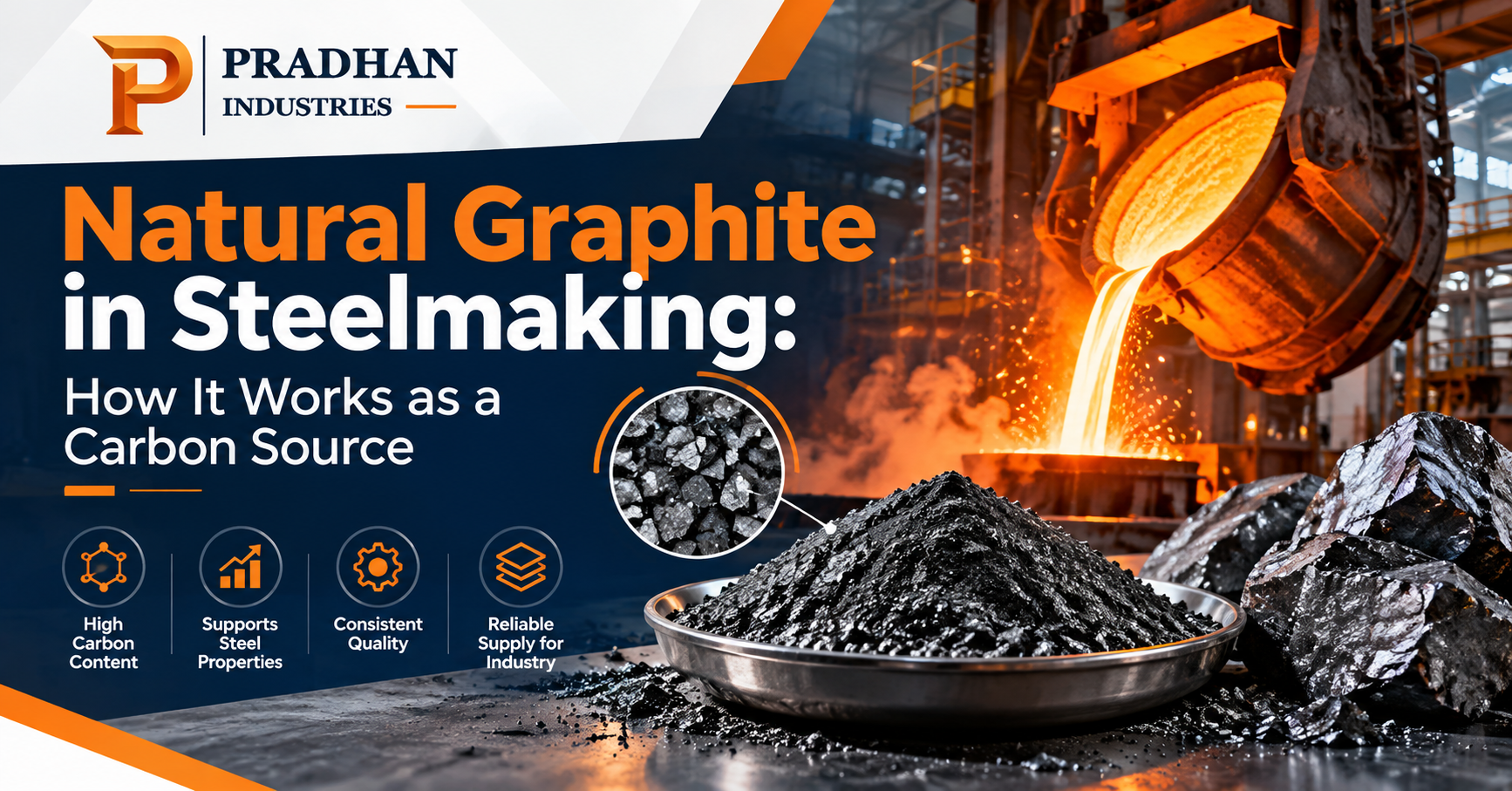
Natural Graphite in Steelmaking: How It Works as a Carbon Source
Natural graphite in steelmaking is used as a carbon-bearing material when steelmakers and foundries need to increase or adjust the carbon content of molten metal. Because graphite contains a high proportion of carbon, it can be considered when a controlled carbon addition is required.
However, choosing graphite for steelmaking is not simply a matter of selecting the highest fixed-carbon percentage. The application, furnace type, addition method, particle size, ash, moisture, sulphur, and other impurities all need to be considered.
For buyers, the important question is not only whether a material contains carbon, but also whether its chemical and physical specifications are suitable for the production process.
What Is Natural Graphite in Steelmaking?
Natural graphite is a naturally occurring crystalline form of carbon. Depending on its source and processing, it can be supplied in different grades, particle sizes, and levels of purity.
In steel and foundry operations, natural graphite in steelmaking can be used as a carbon additive or recarburising material. Its purpose is to introduce additional carbon into molten metal when the existing carbon level needs to be increased.
The European Carbon and Graphite Association identifies recarburising as an application in which carbon is added to molten iron or steel to increase its carbon content. European Carbon and Graphite Association
The actual performance of graphite depends on the production conditions. Furnace temperature, addition technique, mixing, particle size, slag conditions, and material quality can all affect carbon recovery.
How Does Natural Graphite Work as a Carbon Source?
The principle behind natural graphite in steelmaking is straightforward: carbon-bearing graphite is introduced into molten metal so that carbon can be incorporated into the melt.
The amount of carbon that ultimately enters the metal can depend on:
- Fixed carbon content
- Particle size
- Furnace temperature
- Addition location
- Mixing and turbulence
- Slag conditions
- Holding time
- Addition rate
- Initial carbon content
- Target carbon content
This means the theoretical carbon content of the graphite does not always represent the exact amount of carbon recovered in the final melt.
For this reason, steelmakers normally evaluate graphite according to both its laboratory specification and its behavior in the actual production process.
Why Carbon Control Matters in Steelmaking
Carbon is an important element in steel chemistry. The required carbon level varies according to the steel grade and the intended mechanical and processing characteristics.
A typical carbon adjustment process may involve:
- Checking the initial chemistry of the molten metal.
- Determining the required final carbon level.
- Calculating the required carbon addition.
- Selecting an appropriate carbon-bearing material.
- Adding the material under controlled conditions.
- Sampling the melt.
- Making any necessary final adjustment.
This is why natural graphite in steelmaking should be viewed as part of a broader metallurgical control process rather than simply another bulk raw material.
A consistent graphite specification makes it easier for production teams to predict material behavior and manage carbon additions.
Natural Graphite in Steelmaking: Key Specifications
When purchasing graphite for carbon addition, buyers should establish a clear technical specification before requesting quotations.
The most important parameters commonly include fixed carbon, ash, moisture, particle size, and relevant impurities.
1. Fixed Carbon
Fixed carbon is one of the first specifications buyers examine when evaluating natural graphite in steelmaking.
A high fixed-carbon value means that a larger proportion of the material is carbon rather than mineral residue and other components.
However, fixed carbon should not be considered in isolation. A buyer should also examine ash, sulfur, moisture, and other relevant chemical parameters.
For example, two graphite products may have similar fixed-carbon values but different ash compositions or particle-size distributions. Their behavior during production may therefore differ.
2. Ash and Mineral Impurities
Ash represents the non-carbon mineral residue associated with the graphite.
For steelmaking applications, both the total ash percentage and the composition of the ash can be relevant.
Depending on the steel grade, unwanted mineral components may affect the overall chemistry or slag balance.
For this reason, buyers should request a complete chemical specification rather than relying on a simple description such as “high-carbon graphite.”
3. Particle Size
Particle size can influence how graphite behaves during storage, feeding, and addition.
Fine graphite may have different handling characteristics from coarser material. Particle size can affect:
- Feeding behavior
- Dispersion
- Dust generation
- Material losses
- Addition efficiency
- Handling requirements
The appropriate particle size depends on the furnace and addition system.
A buyer should therefore specify the required mesh or particle-size distribution when sourcing natural graphite in steelmaking.
4. Moisture
Moisture is another specification that should not be overlooked.
A high moisture level can affect the amount of dry material being delivered and may also influence handling and addition practices.
When comparing different suppliers, buyers should make sure that moisture values are reported on a consistent testing basis.
5. Sulphur and Other Elements
For certain steel grades, sulfur and other trace elements can be particularly important.
The acceptable limits should be established according to the final steel chemistry and production requirements.
A good procurement specification should therefore clearly identify the maximum limits for relevant impurities rather than focusing only on fixed carbon.
Natural Graphite vs. Other Carbon Sources
Steelmakers and foundries can use different carbon-bearing materials depending on their process.
These may include:
- Natural graphite
- Synthetic graphite
- Calcined petroleum coke
- Petroleum coke
- Other carbonaceous recarburisers
Each material has different physical and chemical characteristics.
Natural graphite in steelmaking may be selected when its carbon content, physical properties, and impurity profile fit the customer’s requirements. However, it should not automatically be treated as interchangeable with synthetic graphite or other carbon raisers.
The correct choice depends on the furnace, steel grade, addition method, required chemistry, and commercial requirements.
How Addition Method Affects Graphite Performance
The performance of natural graphite in steelmaking can vary depending on how the material is introduced into molten metal.
Possible addition approaches can include manual charging, mechanical feeding, injection, or other controlled systems.
Important factors include:
- Where the graphite enters the melt
- Addition speed
- Furnace temperature
- Melt movement
- Slag conditions
- Holding time
- Particle size
- Total addition quantity
A graphite grade that performs well in one system may require adjustment when used in another.
Therefore, suppliers and buyers should discuss the actual application rather than selecting a grade based only on a product name.
Natural Graphite in Steelmaking for Electric and Induction Furnaces
Carbon addition requirements can vary between electric furnaces, induction furnaces, and foundry melting systems.
It is also important to distinguish graphite used as a carbon additive from graphite electrodes.
Graphite electrodes are specialized components used in electric arc furnaces to conduct electrical current and generate an arc for melting. They are manufactured and used differently from graphite supplied as a carbon-bearing additive.
Nippon Steel’s technical publications describe the role and manufacture of graphite electrodes for electric steelmaking. Nippon Steel Technical Reports
Therefore, a buyer looking for a carbon raiser should clearly specify that the material is intended for carbon addition or recarburising, rather than simply asking for graphite.
How to Select Natural Graphite for Steelmaking
Selecting natural graphite in steelmaking should begin with the customer’s production requirements.
Before placing an order, buyers should define:
Application
Specify whether the material is intended for steelmaking, induction melting, foundry production, or another metallurgical process.
Fixed Carbon
Define the minimum acceptable fixed-carbon level.
Particle Size
Specify the required mesh or particle-size distribution.
Ash
Establish the maximum acceptable ash level.
Sulphur and Impurities
Set limits for sulfur and any other elements that may affect the final steel chemistry.
Moisture
Specify the maximum moisture level and testing basis.
COA
Request a Certificate of Analysis showing the agreed chemical and physical parameters.
Packaging
Define the required packaging according to the feeding and storage system, such as bags or bulk packaging.
Quality Control for Natural Graphite in Steelmaking
Quality control is particularly important when graphite is purchased regularly for industrial production.
A typical quality specification may include:
| Parameter | Why It Matters |
|---|---|
| Fixed Carbon | Indicates the carbon concentration |
| Ash | Shows mineral residue |
| Moisture | Important for material consistency |
| Volatile Matter | Indicates volatile components |
| Sulfur | Relevant to steel chemistry |
| Particle Size | Influences feeding and addition |
| Trace Elements | Important for sensitive steel grades |
Testing methods should also be clearly defined.
This is especially important when comparing materials from different suppliers because apparently similar results may be reported using different testing conditions or bases.
For additional information about graphite processing, see Pradhan Industries’ article on the graphite beneficiation process in Odisha.
Why Consistent Graphite Supply Matters
A consistent specification is important for buyers using natural graphite in steelmaking on a regular basis.
If the fixed carbon, ash, or particle-size distribution changes significantly between shipments, the material may behave differently during production.
A reliable supply program should aim to maintain consistency in:
- Fixed carbon
- Ash
- Moisture
- Particle size
- Impurity levels
- Packaging
- Batch documentation
For bulk buyers, consistency can be just as important as the initial product specification.
A Practical Buying Checklist
Before purchasing graphite for steelmaking, buyers can use the following checklist:
1. Define the application.
Tell the supplier how the graphite will be used.
2. Specify fixed carbon.
Set a minimum acceptable carbon level.
3. Define particle size.
Mention the required mesh or particle distribution.
4. Set ash and impurity limits.
Include sulfur and other relevant elements.
5. Confirm moisture.
Specify the acceptable moisture range.
6. Request a COA.
Review documented test results before approving the material.
7. Conduct a production trial.
Where practical, evaluate the graphite under actual operating conditions.
8. Standardize the approved grade.
Once a material is accepted, maintain a consistent specification for repeat orders.
Choosing a Natural Graphite Supplier
For bulk procurement, supplier capability should be evaluated alongside product quality.
A graphite supplier should be able to clearly discuss:
- Graphite source
- Available fixed-carbon grades
- Particle-size options
- Ash and impurity levels
- Quality-control procedures
- COA availability
- Packaging options
- Bulk supply capability
- Delivery requirements
Pradhan Industries supplies natural graphite for industrial applications and can discuss requirements based on fixed carbon, particle size, application, and quantity. Explore the company’s graphite information and applications for additional background.
For bulk inquiries, buyers can also contact Pradhan Industries with their required grade, fixed carbon, mesh size, quantity, and application.
Final Thoughts
Natural graphite in steelmaking can be a useful carbon source when its specification is properly matched to the production process.
The most important consideration is not simply the carbon percentage printed on a product sheet. Buyers should evaluate fixed carbon, ash, moisture, particle size, sulphur, other impurities, testing methods, and batch consistency.
The right graphite grade depends on the steel chemistry, furnace, addition method, and production requirements.
For steelmakers and foundries, the most practical approach is to define the process, establish a clear graphite specification, test the material, and standardize the approved grade for consistent supply.
Frequently Asked Questions
Is natural graphite used as a carbon source in steelmaking?
Yes. Natural graphite in steelmaking can be used as a carbon-bearing material for recarburising molten iron or steel when additional carbon is required. The European Carbon and Graphite Association identifies recarburising as one of graphite’s applications. ECGA – Main Uses of Graphite
What specifications are important when buying graphite for steelmaking?
Important specifications can include fixed carbon, ash, moisture, particle size, sulfur, and other relevant impurities. The exact limits should be based on the steel grade and production process.
Does graphite particle size affect steelmaking?
Yes. Particle size can influence feeding, dispersion, dust generation, and material losses. The appropriate size depends on the addition system and operating conditions.
Is natural graphite the same as a graphite electrode?
No. Graphite electrodes are specialized components used in electric arc furnaces, while graphite used as a carbon additive is intended to adjust molten-metal chemistry.
Should I request a COA when buying graphite?
Yes. A Certificate of Analysis can document parameters such as fixed carbon, ash, moisture, and other agreed specifications, making it easier to verify batch quality.
Can natural graphite be used in foundries?
Yes. Graphite can be used in foundry applications as a carbon-bearing material and in other metallurgical applications. The required grade depends on the melt chemistry and process.