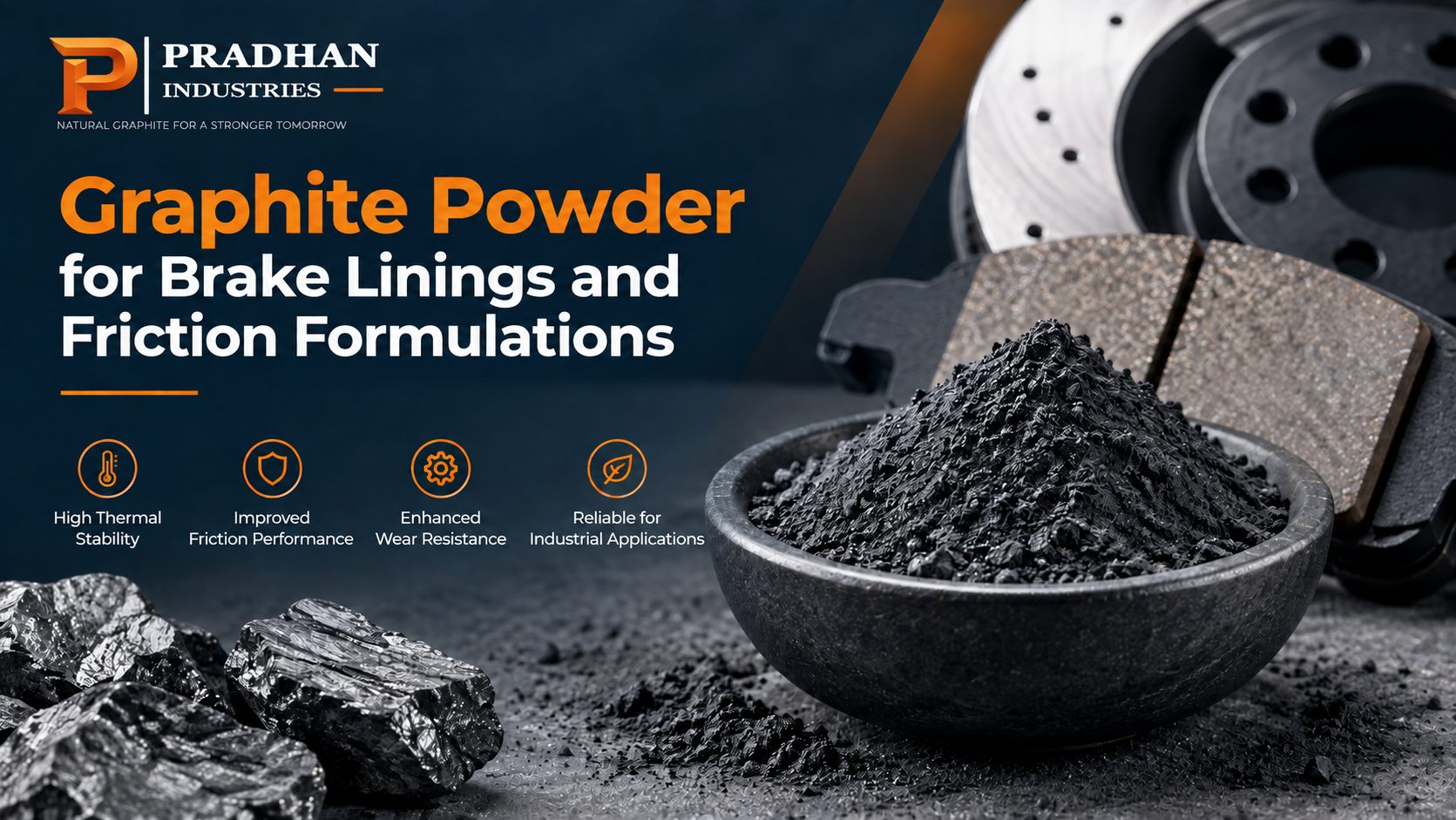
When engineers formulate a brake lining or brake pad, every ingredient has a specific job. The binder holds the formulation together, fibers provide reinforcement, abrasives help maintain the required friction level, fillers influence density and cost, and friction modifiers control how the material behaves during braking.
Graphite powder is one of the important friction modifiers used in many brake lining and friction-material formulations. Its role is not simply to “make the material slippery.” Instead, graphite can influence friction stability, wear, heat transfer, surface-film formation, and brake noise. The challenge is selecting a graphite grade that works with the complete formulation rather than evaluating graphite in isolation.
Research has shown that graphite is commonly used in brake pads for solid-state lubrication and friction-coefficient stabilization. Its performance can vary substantially with graphite type, particle size, morphology, and thermal conductivity.
For manufacturers buying graphite powder for brake linings, this creates several practical questions:
- What type of graphite should be selected?
- Is natural graphite suitable, or is synthetic graphite better?
- What particle size should be used?
- How important is fixed carbon?
- Does higher purity always produce better brake performance?
- How does graphite affect friction coefficient?
- Can graphite reduce brake noise?
- What information should be included in a supplier specification?
This guide answers those questions from a formulation and procurement perspective.
Graphite Powder in Brake Lining Materials
Graphite powder for brake linings is used as a functional component in friction-material formulations. Modern brake friction materials are engineered composites rather than single-material products. Depending on the application, they may contain binders, reinforcing fibers, metallic ingredients, abrasives, fillers, and friction modifiers.
Graphite generally falls into the solid lubricant or friction-modifier category. Its layered crystal structure allows relatively easy shear between graphite planes, which is one reason graphite can form lubricating films under appropriate conditions.
A review of brake friction materials describes graphite as a lubricant that can reduce direct contact between the friction material and brake disc, thereby influencing wear behavior.
However, the objective of graphite addition is not necessarily to minimize friction as much as possible. A brake system needs a controlled and predictable coefficient of friction. Too much lubrication can reduce friction, while too little can contribute to excessive wear, temperature generation, or unstable friction.
That is why graphite selection should always be considered as part of the complete friction formulation.
Why Is Graphite Used in Brake Linings?
Graphite can perform several functions simultaneously. Graphite is used in various industrial applications because of its characteristic physical and thermal properties. These properties can make it a useful component in friction-material formulations. For broader information about graphite resources and applications, see the U.S. Geological Survey’s graphite information
1. Solid lubrication
The primary function is solid lubrication. Graphite can help reduce severe direct contact between the mating surfaces and influence the tribological layer that develops during braking.
2. Friction stabilization
Graphite can help control changes in friction under different operating conditions. Research on automotive brake pads has specifically identified graphite as a material used to stabilize the required friction coefficient.
3. Wear control
A properly selected graphite grade can contribute to wear control by modifying the contact conditions between the brake lining and disc.
4. Thermal behavior
Graphite has relatively high thermal conductivity compared with many non-metallic friction-material constituents. Consequently, the type and amount of graphite can influence heat dissipation through the friction material.
5. Noise control
Graphite can also affect brake noise. A 2026 study examining graphite-containing polymer brake friction materials reported that increasing graphite content reduced measured noise in its experimental formulations while also reducing the coefficient of friction. Importantly, the study found that wear performance depended on the graphite level, illustrating why formulation optimization matters.
So, graphite is not simply a filler. It is a functional ingredient.
Natural Graphite vs. Synthetic Graphite for Brake Linings
One of the first questions a friction-material manufacturer may ask is whether to use natural graphite powder or synthetic graphite powder.
Both can be technically useful, but they are not interchangeable automatically.
Natural graphite is produced from naturally occurring graphite deposits and can be supplied in different forms, purities, and particle-size distributions. Synthetic graphite is manufactured from carbonaceous feedstocks through high-temperature processing.
Their differences can include:
| Property | Natural Graphite | Synthetic Graphite |
|---|---|---|
| Origin | Naturally occurring mineral | Manufactured carbon material |
| Crystal structure | Depends on source and processing | Controlled through manufacturing |
| Purity | Grade dependent | Grade dependent |
| Particle morphology | Often flake-like | Can vary considerably |
| Thermal conductivity | Grade dependent | Grade dependent |
| Cost | Often competitive | Can be higher depending on grade |
| Brake formulation use | Commonly considered | Commonly considered |
| Selection basis | Purity, PSD, morphology, ash | Purity, PSD, morphology, structure |
Studies on brake-pad formulations have compared different graphite types and found that graphite characteristics can influence thermal conductivity and noise performance.
Therefore, the correct question is not simply, “Natural or synthetic?”
The better question is
Which graphite grade gives the required friction, wear, thermal, and NVH performance in the target formulation?
What Graphite Grade Is Suitable for Brake Lining?
There is no universal graphite specification that works for every brake lining formulation.
A graphite supplier should normally discuss at least:
- Fixed carbon
- Ash
- Moisture
- Volatile matter
- Particle-size distribution
- Maximum particle size
- Flake morphology
- Bulk density
- Thermal properties where relevant
- Lot-to-lot consistency
For example, commercially available natural graphite specifications can include high fixed-carbon content, controlled ash, low moisture, and a defined mesh distribution. One published refractory-grade natural graphite specification lists 90% minimum fixed carbon, 10% maximum ash, 2% maximum volatility, 0.5% maximum moisture, and a 100-mesh distribution requirement. That specification is an example of how a graphite product can be defined, not a universal brake-lining specification.
Brake manufacturers should establish their own limits through formulation and validation testing.
Fixed Carbon in Graphite Powder
Fixed carbon is one of the first specifications buyers commonly examine.
Higher fixed carbon generally indicates a higher proportion of carbonaceous graphite relative to ash and other non-carbon components. However, higher fixed carbon by itself does not guarantee better brake-pad performance.
Why?
Because friction performance depends on multiple variables.
Suppose two graphite powders have similar fixed carbon but significantly different particle-size distributions. They may behave differently in mixing, packing, surface-film development, and tribological performance.
Similarly, two grades with similar carbon content may have different ash chemistry or morphology.
For brake-lining applications, fixed carbon should therefore be treated as one part of the specification rather than the entire specification.
Why Ash Matters in Brake Friction Formulations
Ash represents the non-combustible mineral residue associated with the graphite product.
For a friction-material manufacturer, ash is important because it can introduce mineral components into a formulation that is already carefully engineered.
The actual impact depends on:
- Ash quantity
- Ash chemistry
- Particle size
- Interaction with other formulation ingredients
- Processing temperature
- Target friction characteristics
A supplier COA should therefore identify the agreed ash specification rather than simply stating that the product is “high purity.”
The phrase “high-purity graphite powder” has little technical value unless the supplier defines what “purity” means.
For example, ask whether purity refers to:
- Fixed carbon percentage
- Ash percentage
- Elemental carbon
- Graphitic carbon
- Or another analytical method
Clear definitions prevent misunderstandings between the graphite supplier and friction-material manufacturer.
Particle Size of Graphite Powder for Brake Linings
Particle size can have a major influence on how graphite behaves inside a friction composite.
Graphite is available in a wide range of particle sizes, from relatively coarse flakes to fine powders.
Particle size can influence:
- Dispersion
- Mixing behavior
- Packing
- Surface area
- Friction-film development
- Thermal behavior
- Wear
- Manufacturing consistency
Research into graphite-containing brake pads has specifically examined the influence of graphite type and particle-size distribution on thermal conductivity and brake squeal.
This means a manufacturer should avoid specifying graphite only as “graphite powder.”
A better purchase specification might say something like
Natural graphite powder, specified fixed carbon, controlled ash, controlled moisture, and defined particle-size distribution.
The actual numerical limits should be established through formulation trials rather than copied from another application.
Fine Graphite vs. Coarse Graphite
The choice between fine and coarse graphite depends on the formulation.
Fine graphite
Fine graphite can offer greater surface area and may disperse differently within the binder and other components. It can be useful where a formulation requires a controlled fine friction modifier.
However, very fine powder may behave differently during handling and mixing and may increase dust-management requirements.
Coarser graphite
Coarser graphite particles may influence the friction interface differently and can contribute to the formation of larger graphite-rich regions.
The important point is that particle size is a formulation variable, not simply a quality ranking.
Finer does not automatically mean better.
How Graphite Influences the Coefficient of Friction
The coefficient of friction, or COF, is one of the most important properties in brake development.
Graphite can influence COF because it changes the tribological interaction between the brake lining and counterface.
Research published in 2026 on graphite-based solid lubricants found that increasing graphite content reduced the coefficient of friction in the tested formulations, while the friction behavior became more stable and measured noise decreased.
This illustrates a fundamental formulation principle:
Adding more graphite does not automatically mean better brake performance.
The manufacturer needs to find a balance between:
- Friction level
- Friction stability
- Wear
- Temperature behavior
- Noise
- Rotor interaction
A graphite grade that works well at one loading level may produce an undesirable result at another.
Graphite and Brake Wear
Wear is another important consideration.
During braking, the contact interface is continuously changing. The brake lining and disc generate heat, particles, and a tribological third body.
Research into brake-material tribology has shown that graphite can influence the behavior of iron-oxide-based third bodies and contribute to smoother sliding conditions.
This is significant because brake performance is not simply determined by the original surface roughness of the pad.
The braking process itself creates a dynamic contact layer.
Graphite becomes part of that complex system.
However, excessive graphite can also lower friction or affect mechanical and wear properties in undesirable ways. A 2026 experimental study found the best wear resistance among its tested graphite levels at 5% graphite, while higher additions reduced friction and lowered measured noise. The result reinforces the fact that there is no universal optimum graphite percentage.
Graphite for Noise and NVH Control
Noise, vibration, and harshness—commonly called NVH—are major concerns in automotive brake development.
Brake squeal can be influenced by numerous factors, including:
- Friction-material formulation
- Disc condition
- Contact pressure
- Temperature
- Material stiffness
- Surface morphology
- Particle formation
- Graphite type
Experimental research has found that graphite characteristics can affect brake squeal and thermal conductivity.
More recent research also found lower measured noise with increasing graphite content in its experimental samples.
But graphite should not be treated as a standalone anti-noise additive.
Brake noise is a system-level problem.
Changing graphite can affect friction, thermal behavior, and wear at the same time. Therefore, NVH improvement should be validated using the complete brake formulation and appropriate dynamometer or component-level testing.
Graphite in Copper-Free Brake Pad Formulations
The transition toward lower-copper and copper-free friction materials has increased interest in alternative friction modifiers.
Graphite is particularly interesting because some of its functions overlap with functions historically provided by other formulation components.
A study on copper substitution in brake pads noted that graphite is commonly used for friction-coefficient stabilization and solid lubrication and examined its influence on thermal conductivity and noise.
This does not mean graphite can simply replace copper at a one-to-one ratio.
Copper and graphite perform different functions in friction materials.
Copper can contribute to thermal conductivity, mechanical behavior, and tribofilm formation, while graphite acts primarily as a solid lubricant and friction modifier.
Therefore, copper reduction normally requires reformulation rather than simple substitution.
Typical Components in a Brake Lining Formulation
A modern friction material can contain several categories of ingredients.
| Component | General Function |
|---|---|
| Phenolic or modified resin | Binder |
| Aramid/mineral/glass fibers | Reinforcement |
| Graphite | Solid lubricant / friction modifier |
| Barite | Filler / density control |
| Alumina or silica | Abrasive |
| Metallic particles | Strength and thermal behavior |
| Other friction modifiers | COF and wear control |
| Organic friction dusts | Friction and formulation modification |
Published reviews describe friction materials as combinations of binders, reinforcement fibers, friction additives, and fillers. Lubricants such as graphite and abrasives perform different functions within the composite.
This is why a graphite supplier needs to understand the application before recommending a grade.
How Much Graphite Is Used in Brake Linings?
There is no single graphite dosage that applies to every brake formulation.
Published research has evaluated different graphite levels, including formulations containing 5%, 10%, 15%, and 20% graphite, while other studies use different concentrations depending on the formulation and target application.
These research values should not be treated as a commercial formulation recipe.
A brake manufacturer may need a completely different concentration depending on:
- Passenger-car application
- Commercial vehicle
- Heavy-duty vehicle
- Industrial brake
- Sintered friction material
- Resin-bonded friction material
- Required COF
- Wear target
- Thermal requirements
- Noise target
The correct loading is established through controlled formulation development and testing.
Graphite Powder for Resin-Bonded Brake Linings
Resin-bonded friction materials are widely used in automotive and industrial applications.
In these systems, graphite must be compatible with the overall mixing and curing process.
Important considerations include:
- Particle distribution
- Dispersion
- Resin compatibility
- Moisture
- Bulk density
- Mixing sequence
- Curing conditions
A powder that looks excellent on a laboratory certificate may still perform poorly if it disperses inconsistently during production.
That is why production trials are essential.
Graphite for Sintered Friction Materials
Graphite is also used in powder metallurgy and sintered friction materials.
In these applications, graphite interacts with metallic powders and other solid constituents during processing and braking.
Research on high-speed and heavy-duty friction materials has examined the combined effects of iron and graphite and found that their proportions influenced hardness, strength, friction coefficient, and wear behavior.
This again demonstrates that graphite performance depends on the surrounding formulation.
A graphite supplier serving sintered-material manufacturers should therefore be prepared to provide technical information beyond simply carbon percentage.
Important Graphite Specifications for Brake Lining Manufacturers
A practical supplier specification should consider the following:
| Specification | Why It Matters |
|---|---|
| Fixed carbon | Indicates carbonaceous content |
| Ash | Controls mineral residue |
| Moisture | Affects handling and processing |
| Volatile matter | Important during thermal processing |
| Particle-size distribution | Influences dispersion and tribology |
| Maximum particle size | Controls coarse particles |
| Flake morphology | Can influence lubrication and thermal behavior |
| Bulk density | Relevant to dosing and handling |
| Consistency between lots | Important for production stability |
The exact limits should be established between the buyer and supplier based on the application.
Why Lot-to-Lot Consistency Matters
Imagine developing a brake formulation with one graphite grade and achieving excellent friction stability, wear, and noise performance.
Then a second shipment arrives.
The fixed carbon is technically within specification, but the particle-size distribution is substantially different.
The material may process differently.
The brake formulation may then show changes in:
- COF
- Wear
- Density
- Mixing behavior
- Noise
- Thermal response
This is why consistency is often just as important as nominal quality.
A good graphite supplier should be able to provide a consistent product and a certificate of analysis for each agreed batch or shipment.
What Should a Graphite COA Include?
A Certificate of Analysis should be specific enough for the customer to compare the supplied batch with the agreed specification.
Depending on the application, a COA may include:
- Product identification
- Batch number
- Fixed carbon
- Ash
- Moisture
- Volatile matter
- Particle-size results
- Test method
- Production date
- Dispatch information
For critical friction-material applications, buyers may also request additional testing or independent verification.
A supplier should not rely solely on a generic technical data sheet.
Testing Graphite Before Approving a Supplier
A sensible qualification process can involve several stages.
Stage 1: Documentation review
Review the technical data sheet, specification, COA format, and available test methods.
Stage 2: Laboratory evaluation
Evaluate the graphite in a controlled formulation.
Stage 3: Prototype friction testing
Measure friction, wear, and thermal behavior.
Stage 4: NVH evaluation
Where relevant, evaluate brake noise and vibration.
Stage 5: Production trial
Check whether the powder performs consistently in the actual manufacturing process.
Stage 6: Supplier approval
Approve the grade only after technical and commercial requirements are satisfied.
This process is more reliable than choosing a graphite grade solely because it has a higher carbon percentage.
Common Mistakes When Buying Graphite Powder for Brake Linings
Buying Only on Price
The lowest-cost graphite may not be the lowest-cost solution.
A small difference in powder quality can affect formulation performance and production consistency.
Assuming Higher Purity Is Always Better
Higher fixed carbon can be valuable, but graphite performance depends on several characteristics.
Ignoring Particle Size
Two products with similar carbon content can behave very differently if their particle-size distributions are different.
Changing Suppliers Without Requalification
Even if two suppliers claim to offer “natural graphite 99%,” the products may differ in morphology, PSD, ash chemistry, and processing characteristics.
Using a Generic Industrial Grade
Graphite designed for refractories, lubricants, or foundry applications is not automatically suitable for brake friction materials.
The application must determine the specification.
How to Choose a Graphite Powder Supplier
A brake-material manufacturer should ask potential suppliers:
- Is the graphite natural or synthetic?
- What is the fixed-carbon specification?
- What is the ash specification?
- What is the moisture limit?
- What is the particle-size distribution?
- Is the PSD controlled for every batch?
- What testing methods are used?
- Can the supplier provide batch-specific COAs?
- Can samples be provided for formulation trials?
- Can the supplier maintain consistent quality over regular shipments?
For long-term production, supply consistency should be treated as a technical requirement rather than merely a purchasing preference.
Example Buyer Specification for Graphite Powder
A manufacturer could structure a preliminary purchasing specification like this:
| Parameter | Example Requirement |
|---|---|
| Material | Natural graphite powder |
| Application | Brake lining / friction material |
| Fixed carbon | Buyer-defined minimum |
| Ash | Buyer-defined maximum |
| Moisture | Buyer-defined maximum |
| Volatile matter | Buyer-defined maximum |
| Particle size | Buyer-defined PSD |
| Maximum coarse fraction | Buyer-defined |
| Appearance | Consistent graphite powder |
| Packaging | Moisture-protected industrial packaging |
| COA | Required for each batch |
| Sample approval | Required before production supply |
The numerical values should be established through the manufacturer’s own formulation work and validation testing.
Graphite Powder and Friction Formulation Development
The best graphite supplier is not necessarily the one offering the highest carbon percentage.
Instead, the supplier should be able to provide a grade that works predictably inside the customer’s formulation.
Think of graphite as one instrument in an orchestra.
The resin, fibers, abrasives, fillers, metals, and friction modifiers all contribute to the final sound. Changing one ingredient can alter the behavior of the entire system.
The same principle applies to brake friction materials.
Graphite influences the tribological interface, but its final effect depends on the complete composition and operating conditions.
Natural Graphite Supplier for Brake Lining Manufacturers
For buyers sourcing natural graphite for brake linings, the supplier should ideally provide:
- Consistent natural graphite powder
- Defined fixed-carbon specification
- Controlled ash
- Controlled moisture
- Controlled particle-size distribution
- Batch-specific COA
- Samples for testing
- Technical documentation
- Stable production capability
- Consistent packaging
- Responsive technical support
A supplier who understands the application can also help the customer compare different particle sizes and grades during development.
This can be particularly useful when a manufacturer is trying to balance friction, wear, noise, and thermal behavior.
Why Graphite Quality Should Be Evaluated by Performance
Why Graphite Quality Should Be Evaluated by Performance
A common mistake in industrial raw-material purchasing is to judge quality using one number.
For graphite, that number is often fixed carbon.
But brake friction materials demonstrate why this approach can be incomplete.
A graphite powder with high fixed carbon but poor particle-size consistency may cause more production problems than a slightly lower-carbon grade with tightly controlled PSD.
Similarly, a very fine grade may behave differently from a coarse flake grade even when both have similar chemical purity. Understanding crystalline graphite grades can help manufacturers evaluate how graphite characteristics may vary between grades.
The best evaluation therefore combines chemical analysis, physical properties, processing behavior, and friction performance. For manufacturers interested in how graphite is processed and upgraded before use in industrial applications, see our guide to the graphite beneficiation process in Odisha.
Future Trends in Brake Friction Materials
Brake-material development continues to focus on performance, environmental considerations, and material optimization.
A 2024 review highlights ongoing development around friction-material ingredients, processing methods, and environmentally improved formulations.
Recent research also continues to investigate graphite-based solid lubricants, copper reduction, hybrid friction modifiers, and alternative fillers.
This creates opportunities for graphite suppliers that can offer more than a commodity powder.
Manufacturers increasingly need materials with predictable characteristics and reliable supply.
Graphite Powder for Brake Linings: Final Buyer Checklist
Before approving a graphite powder for a brake-lining formulation, confirm:
- Graphite type: Natural or synthetic?
- Fixed carbon: Is the minimum clearly defined?
- Ash: Is the maximum controlled?
- Moisture: Is it suitable for the manufacturing process?
- PSD: Is particle-size distribution documented?
- Morphology: Is the graphite form consistent?
- COA: Is batch-specific testing available?
- Trial: Has the material been tested in the actual formulation?
- Friction: Does it provide the required COF behavior?
- Wear: Is the wear rate acceptable?
- NVH: Does the formulation meet noise requirements?
- Supply: Can the supplier maintain consistent quality?
- Packaging: Is the product protected during storage and transport?
Conclusion
Graphite powder for brake linings is a functional friction-material ingredient, not simply a carbon filler. Its solid-lubricating behavior can influence friction coefficient, wear, thermal characteristics, and brake noise.
Research has shown that graphite type, particle size, and concentration can all affect brake friction performance.
For manufacturers, the most important approach is to evaluate graphite as part of the complete friction formulation.
A suitable specification should address fixed carbon, ash, moisture, volatile matter, particle-size distribution, and consistency. Supplier samples should then be evaluated through controlled formulation and friction testing before full-scale approval.
The right graphite grade is ultimately the one that delivers the required combination of friction stability, wear behavior, thermal performance, NVH characteristics, and manufacturing consistency for the specific brake application.
In other words, choosing graphite for brake linings is less about finding the “highest purity” powder and more about finding the right, repeatable graphite grade for the complete formulation.
Frequently Asked Questions
1. What is graphite powder used for in brake linings?
Graphite is primarily used as a solid lubricant and friction modifier. It can influence friction stability, wear, thermal behavior, and the tribological layer formed during braking.
2. Is natural graphite suitable for brake pad formulations?
Yes, natural graphite can be used in brake friction materials, provided its chemical and physical characteristics are appropriate for the formulation. Natural and synthetic graphite grades can behave differently, so qualification testing is important.
3. Does more graphite always improve brake performance?
No. Increasing graphite can reduce friction and may influence noise and wear. Recent experimental work demonstrated that different graphite concentrations produced different combinations of friction, wear, and noise performance.
4. What graphite specifications should brake manufacturers check?
Important specifications include fixed carbon, ash, moisture, volatile matter, particle-size distribution, and morphology. Batch-to-batch consistency is also important.
5. How should a graphite supplier be qualified for brake-lining production?
Start with technical documentation and samples, then evaluate the graphite in the actual friction formulation. Test friction, wear, thermal behavior, and, where relevant, NVH performance before approving the material for regular production.