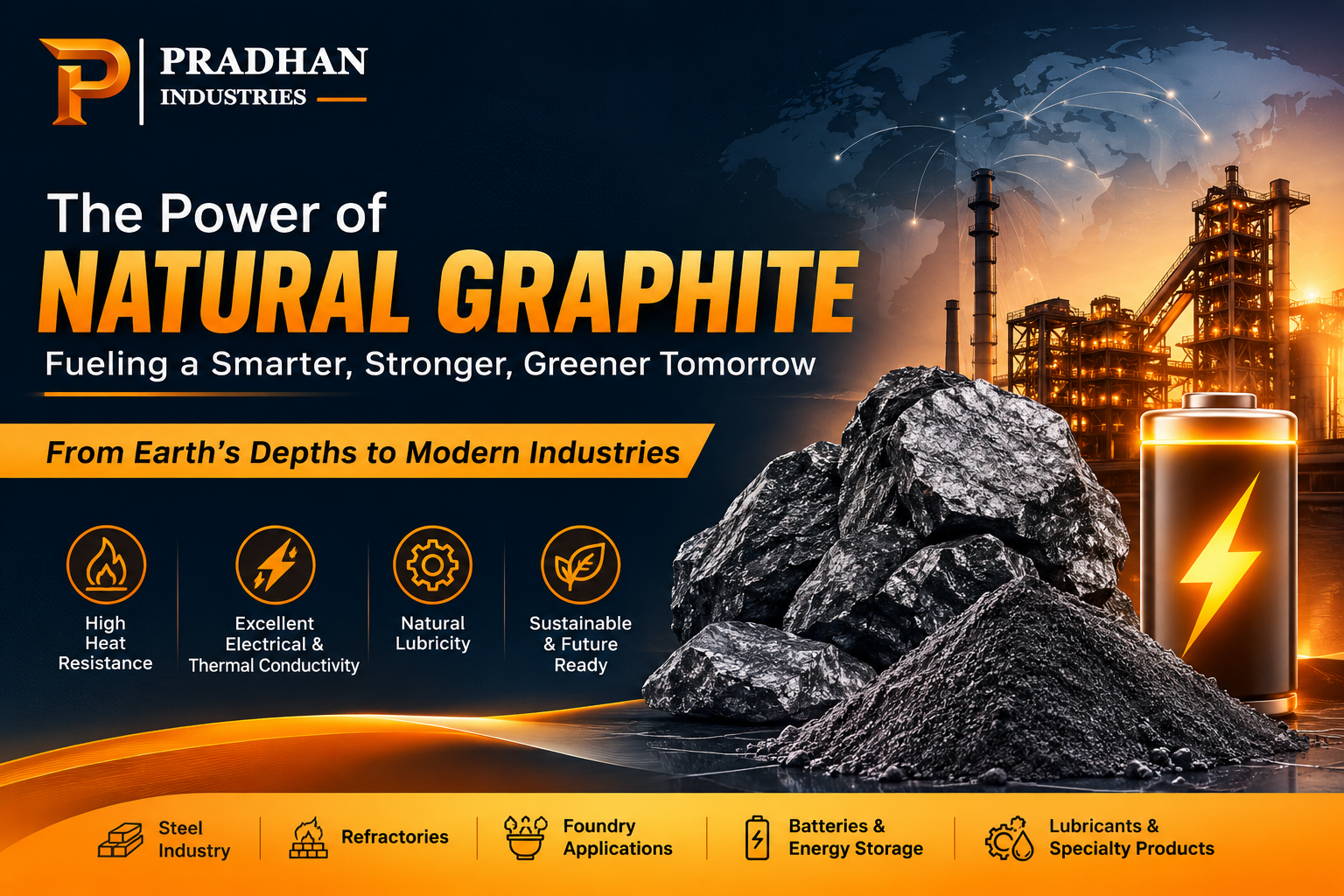
Few minerals work as quietly — or as universally — as natural graphite. It lines the furnaces that melt our steel, lubricates machinery running at extreme temperatures, and stores the energy inside every lithium-ion battery.
Heavy industries from foundries to refractory plants treat it as an irreplaceable input, because no other material combines conductivity, heat resistance, and lubricity in one crystal structure.
As electrification accelerates and manufacturing standards tighten, understanding how natural graphite is extracted, processed, and applied has become essential knowledge for every serious industrial buyer.
What Makes Natural Graphite Unique
Graphite is a naturally occurring form of crystalline carbon, arranged in stacked layers of atoms. Those layers slide easily over one another, giving graphite its famous lubricity.
At the same time, the bonds within each layer are extremely strong. This is why graphite conducts electricity like a metal yet withstands temperatures above 3,000°C in inert conditions.
Nature produces it in three commercial forms: flake graphite, amorphous graphite, and vein (lump) graphite. Flake dominates high-value applications, while amorphous serves bulk industrial duties at a lower cost.
From Ore to Industry: Extraction and Beneficiation
Mining the Ore
Natural graphite rarely comes out of the ground pure. Typical ore contains only a small percentage of graphitic carbon locked inside host rock.
Miners extract it through open-pit or underground methods, depending on deposit depth. The raw ore is then crushed and ground to liberate graphite particles from the surrounding gangue minerals.
Beneficiation: Concentrating the Carbon
Beneficiation is where commercial value is created. The industry-standard method is froth flotation, which exploits graphite’s natural water-repellent surface.
Ground ore is mixed into a water slurry, and air is bubbled through it. Graphite particles attach to the bubbles, float to the surface as a froth, and are skimmed off, leaving waste rock behind.
Multiple flotation and regrinding stages progressively raise purity. This is how run-of-mine ore becomes concentrate graded by fixed carbon (F.C.) percentage, typically from 60–65% F.C. up to 94–95% F.C. for premium industrial grades.
Sizing, Drying, and Pulverising
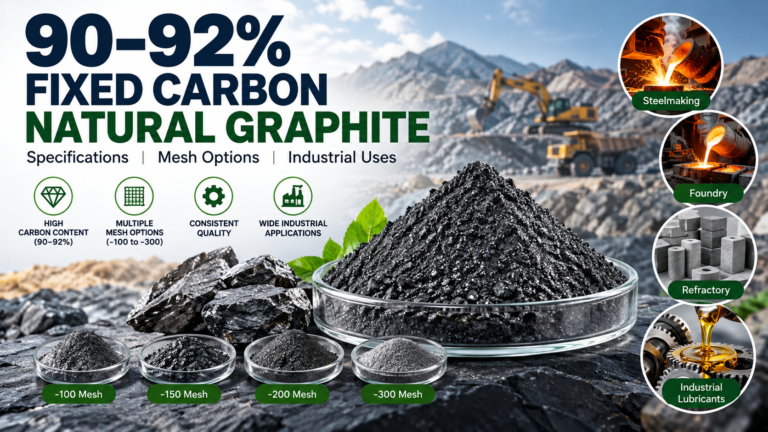
After flotation, the concentrate is dried to strict moisture limits and screened into mesh sizes—commonly -100, -200, and -300 mesh cuts.
Some material ships unpulverized for buyers who mill in-house; the rest is pulverized to a controlled fineness for direct use. Matching grade, mesh, and processing state to the application is the core skill of graphite procurement. [INTERNAL LINK: [Insert link to your website’s services page]
Core Industrial Applications of Natural Graphite
Batteries and Energy Storage
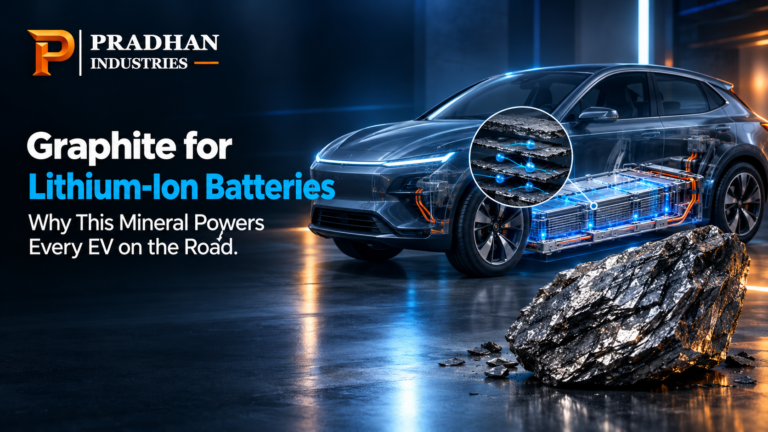
Graphite is the single largest material by weight in a lithium-ion battery. It forms the anode, storing lithium ions between its carbon layers during every charge cycle.
Each electric vehicle battery consumes tens of kilograms of graphite — far more than the lithium it contains. This demand has turned high-purity flake graphite into a critical mineral for governments and manufacturers worldwide.
Battery-grade material requires exceptional purity and tightly controlled particle shape, achieved through spheronization and purification of natural flake concentrate.
Lubricants and Release Agents
Where oils burn off and greases fail, graphite keeps working. Its layered structure provides dry lubrication at temperatures and pressures no liquid lubricant can survive.
Fine, high-carbon powders (-200 to -300 mesh, typically 90%+ F.C.) are dispersed into forging lubricants, wire-drawing compounds, and anti-seize pastes.
Foundries also rely on graphite-based mold coatings and release agents, which give castings smooth surfaces and prevent metal from bonding to molds.
Refractories and Crucibles
Refractories remain the backbone of graphite demand in heavy industry. Magnesia-carbon bricks, alumina-graphite shrouds, and clay-graphite crucibles all depend on graphite’s thermal stability.
Graphite gives these products resistance to thermal shock and molten-metal corrosion. A crucible with 90–92% F. C graphite lasts measurably longer under repeated heating cycles than one made with lower-grade carbon.
Steelmakers additionally use graphite as a carbon raiser (recarburiser), fine-tuning the carbon content of molten steel and iron with precision.
Other Growing Applications
Beyond the big three, natural graphite serves in brake linings and friction materials, conductive paints and coatings, gaskets made from expanded graphite, and pencils—its oldest commercial use.
Emerging fields such as graphene research, fuel cells, and thermal management foils all begin with high-purity natural flake, widening the mineral’s industrial footprint every year. [EXTERNAL LINK: [Insert link to industrial data or mineral standard source]
Key Benefits of High-Grade Graphite
- Extreme heat resistance: Performs reliably in furnace and molten-metal environments where most materials degrade or fail.
- Excellent electrical conductivity: Enables batteries, electrodes, brushes, and conductive coatings without metallic corrosion issues.
- Natural lubricity: Provides dry lubrication under loads and temperatures that destroy conventional oils and greases.
- Chemical inertness: Resists acids, alkalis, and molten metals, extending the life of refractories and crucibles.
- Thermal shock resistance: Absorbs rapid temperature swings without cracking, critical for casting and refractory service.
- Consistency at high F.C. grades: 90–95% fixed carbon material delivers predictable performance, lower ash contamination, and less process variation.
Why Purity and Particle Size Decide Performance
Two numbers on a specification sheet predict how graphite will behave in your plant: fixed carbon percentage and mesh size.
Higher F.C. means less ash and fewer impurities—directly improving conductivity, lubrication film quality, and refractory life. Finer mesh increases surface area, improving dispersion in lubricants and coatings but demanding better dust control.
The most efficient buyers match both variables to the mechanism of their application, rather than defaulting to the highest grade available. Over-specifying wastes budget; under-specifying wastes product life.
The Market Context: Why Sourcing Strategy Matters Now
Global graphite supply is concentrated, with China dominating both mining and refining. Recent export-permit requirements have reminded industrial buyers how quickly availability can tighten.
Meanwhile, battery demand keeps pulling high-purity flake out of traditional industrial channels. The result is widening price premiums for 94%+ F.C. material and growing value in suppliers who hold regional stock across multiple grades.
For manufacturers, the lesson is clear: qualify suppliers who provide certified, batch-tested material in both pulverized and unpulverized forms—before supply pressure makes qualification urgent.
Conclusion: The Mineral Behind Modern Manufacturing
Natural graphite has earned its place on critical-mineral lists the hard way — by being genuinely difficult to replace. From the beneficiation plant to the battery cell, from the crucible to the brake pad, it enables processes that modern industry cannot run without.
Buyers who understand extraction, grading, and application-matching turn this knowledge into longer equipment life, cleaner processes, and stronger supply security.
Looking for certified high-carbon graphite in the grade and mesh your process demands? Explore our full range of crystalline graphite grades—from 60% to 95% fixed carbon, in pulverized and unpulverized forms—and request batch test reports with your quote today. [INTERNAL LINK: [Insert link to your website’s services page]