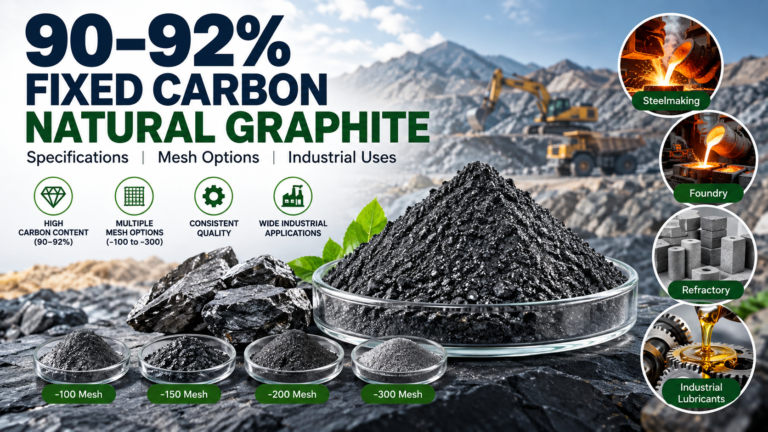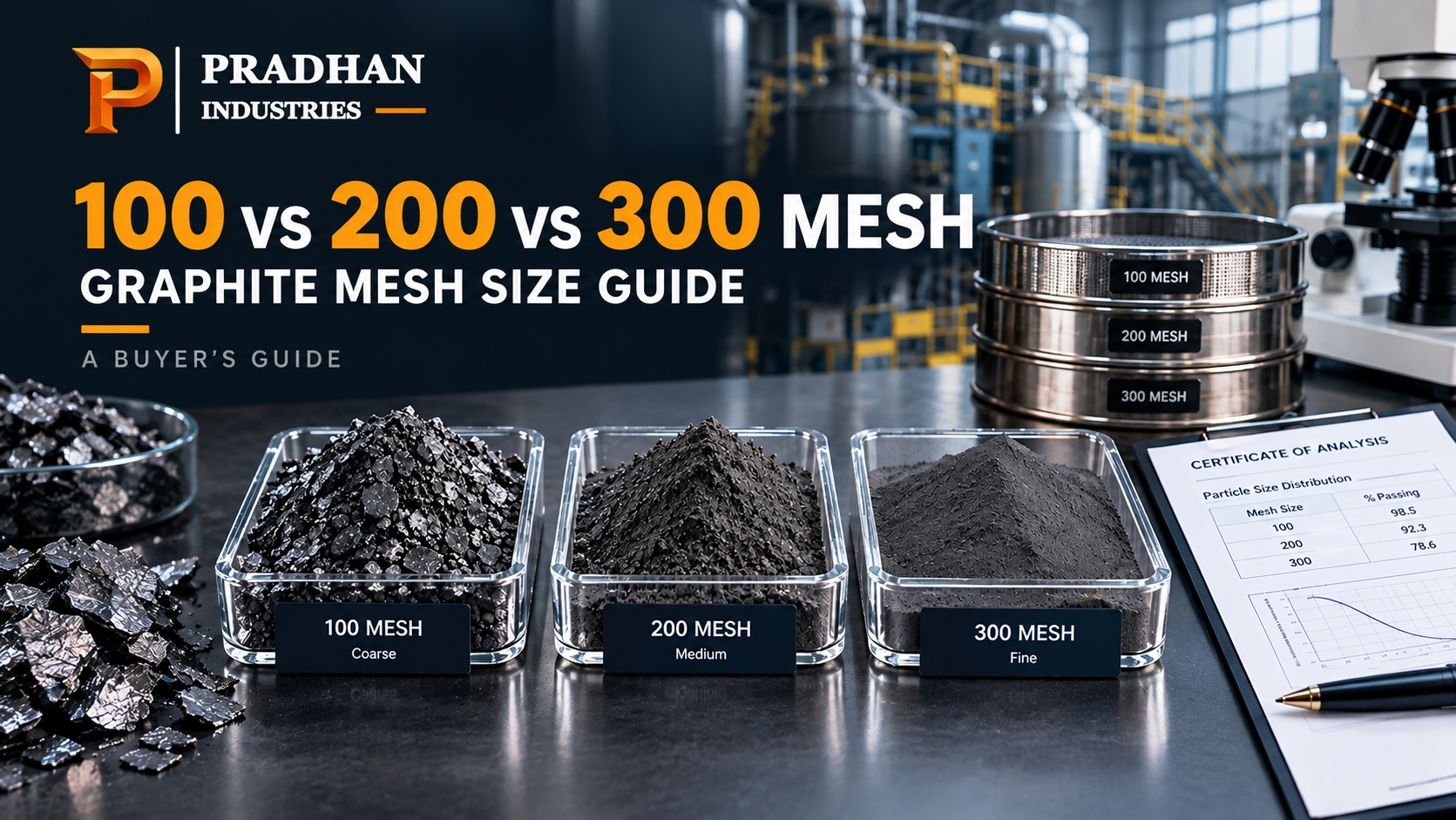
When you buy graphite powder for an industrial application, one specification appears again and again: mesh size. You may see products described as 100 mesh, 200 mesh, 300 mesh, or even finer grades. At first, these numbers can look like a simple ranking where a higher number automatically means better graphite. But is 300 mesh really better than 200 mesh? And is 200 mesh always a better choice than 100 mesh?
The answer is no.
Mesh size primarily tells you about the fineness of the graphite particles. It does not, by itself, tell you the fixed carbon content, ash level, moisture, flake structure, particle-size distribution, or overall suitability of the material for your production process. For industrial buyers, understanding this difference can prevent costly mistakes when selecting graphite for steel, foundry, refractory, friction, coating, lubrication, or other applications.
This graphite mesh size guide explains the practical difference between 100, 200, and 300 mesh graphite, how mesh relates to particle size, why micron specifications matter, how mesh affects graphite performance, and what you should check before placing a bulk order.
What Is Graphite Mesh Size?
Graphite mesh size is a classification used to describe the fineness of graphite powder or particles. In general, a higher mesh number represents a finer particle classification. Therefore, 200 mesh graphite is generally finer than 100 mesh graphite, while 300 mesh graphite is generally finer than both.
However, mesh should not be confused with a precise statement that every particle has exactly the same size.
A commercial graphite powder normally contains a distribution of particles. Some particles may be smaller than the nominal classification, while others may be close to the upper limit allowed by the specification. This is why professional buyers should look beyond the product label and request actual particle-size data when particle consistency is important.
The ASTM E11 standard for test sieves defines technical requirements for test sieves used to classify materials according to particle size. The current ASTM E11-24 specification covers sieve apertures from 125 mm down to 20 µm and establishes requirements for sieve cloth, construction, tolerances, and inspection.
So, when a supplier gives you a mesh number, the next question should be:
What particle-size specification does that mesh number actually represent?
That simple question can make your graphite purchasing much more precise.
Graphite Mesh Size vs. Particle Size
Mesh and particle size are closely related, but they are not exactly the same thing.
A mesh designation is associated with a screening system, while particle size is often expressed directly in microns (µm). One micron equals one-thousandth of a millimeter.
For example, the ASTM sieve system identifies No. 100 and No. 200 by their nominal sieve apertures. No. 200 corresponds to a nominal 75 µm opening. ASTM’s current E11 standard is specifically designed around controlled sieve aperture sizes and tolerances.
This distinction becomes especially important with commercial terms such as 300 mesh graphite.
There is no need to assume that “300 mesh” is automatically an ASTM E11 No. 300 sieve designation. Instead, ask the supplier for the actual micron range, percentage passing, or particle-size distribution associated with the commercial grade.
This approach is much safer because different suppliers can use commercial mesh descriptions differently.
Why Buyers Should Ask for Micron Data
Suppose two suppliers both quote 200 mesh graphite.
Supplier A provides only:
200 Mesh Graphite
Supplier B provides:
200 Mesh Graphite, defined particle-size specification, fixed carbon specification, ash limit, moisture limit and batch COA.
The second quotation gives you far more information.
That is because particle size is only one part of graphite quality. If you are buying material for a process where consistency matters, you need to understand not only whether the material is called 200 mesh, but also how much of the material actually falls within the required particle-size range.
100 Mesh Graphite: What Buyers Should Know
What Is 100 Mesh Graphite?
100 mesh graphite is generally a relatively coarse graphite powder compared with 200 mesh and 300 mesh grades.
For the ASTM E11 sieve system, No. 100 has a nominal aperture of 150 µm. However, this should be treated as a sieve-aperture reference rather than a statement that every commercial 100-mesh graphite particle is exactly 150 µm. The actual commercial product will have a particle-size distribution based on how it was processed and classified.
100 mesh graphite can be useful where the production process does not require an extremely fine powder.
For example, some applications may benefit from a relatively coarse material because of feeding behavior, handling characteristics, or the way the graphite interacts with other raw materials.
A common purchasing mistake is to assume that because 100 mesh is coarser, it must be lower quality.
That is not correct.
Mesh size and purity are separate specifications.
A 100 mesh graphite grade can have a high fixed carbon content and excellent quality control. Likewise, a finer 300-mesh material can have a lower carbon content or higher impurity level.
This is why you should always evaluate mesh + fixed carbon + ash + moisture + particle-size distribution together.
Typical Applications of 100 Mesh Graphite
The appropriate application for 100 mesh graphite depends on its carbon content, morphology, processing condition, and other technical characteristics.
Coarser graphite grades may be considered for applications where very fine powder is not required and where particle handling is an important part of the production process.
For example, Pradhan Industries currently lists crystalline graphite specifications that include 80–85% FC at 100 mesh, 90–92% FC at 100 mesh,, and 94–95% FC at 100 mesh. This demonstrates an important point: the same mesh size can be available at different fixed carbon levels.
If you want to understand how graphite quality changes with carbon content, see the detailed guide to high-carbon crystalline graphite grades and applications. The article explains why fixed carbon should be evaluated separately from particle size.
For a buyer, this means that “100 mesh” should never be treated as a complete product specification.
200 Mesh Graphite: The Common Middle Ground
What Is 200 Mesh Graphite?
200 mesh graphite is finer than 100 mesh graphite and is widely used as a commercial graphite powder specification.
In the ASTM sieve system, No. 200 has a nominal aperture of 75 µm. ASTM’s sieve standards are designed to provide controlled and measurable aperture dimensions for particle classification.
200 mesh can be an attractive option for buyers who need a finer powder but do not necessarily require an extremely fine commercial grade.
However, even here, the label “200 mesh” does not tell you everything.
Two 200-mesh graphite products can behave differently because their:
- Fixed carbon content may differ.
- Ash content may differ.
- Moisture content may differ.
- Particle-size distributions may differ.
- Flake structure may differ.
- Processing methods may differ.
- Passing percentages may differ.
This is why a professional purchase specification should contain more than one number.
Why 200 Mesh Graphite Is Popular
One reason 200 mesh graphite is commonly considered by industrial buyers is that it can provide a practical balance between particle fineness and handling.
The material is fine enough for applications where a more controlled powder is needed, while not necessarily being as fine as specialized micronized grades.
Pradhan Industries currently publishes several crystalline graphite products at 200 mesh, including 60–65% FC, 80–85% FC, 90–92% FC, and 94–95% FC grades, depending on the product and processing state.
This is another reason why the mesh number alone should not determine your purchasing decision.
If your process requires 94–95% fixed carbon, a 200-mesh grade with that carbon specification may be much more appropriate than a finer product with significantly lower carbon content.
300 Mesh Graphite: What Makes It Different?
Is 300 Mesh Graphite Finer?
Generally, 300-mesh graphite is marketed as a finer graphite powder than 100- or 200-mesh grades.
However, buyers need to be careful with the terminology.
A commercial “300 mesh” designation should not automatically be treated as a direct ASTM E11 sieve designation. The current ASTM E11 standard defines specific sieve sizes and aperture requirements, so suppliers should clarify exactly how their 300 mesh product is classified.
A professional graphite supplier should be able to provide information such as
- Particle-size range
- Percentage passing
- Test method
- Fixed carbon
- Ash
- Moisture
- Product type
- COA
This turns a vague commercial description into a measurable specification.
When Should You Consider 300 Mesh Graphite?
Finer graphite may be useful where the production process requires greater particle fineness, dispersion, or controlled powder characteristics.
For example, Pradhan Industries currently lists 90–92% FC and 94–95% FC crystalline graphite grades at 300 mesh.
The company’s graphite beneficiation information also describes fine powders at -300 mesh for applications including lubricants and specialized coatings, while larger flakes are used in applications such as steel and refractory industries.
This demonstrates why mesh selection should be connected to the final application.
If your process requires a fine graphite powder, 300 mesh may be worth testing.
But if your process was designed around a coarser material, simply switching to 300 mesh can change feeding, dust generation, mixing behavior, and overall process performance.
100 Mesh vs. 200 Mesh vs. 300 Mesh Graphite
The simplest way to understand the three grades is
100 mesh → coarser
200 mesh → finer
300 mesh → generally finer still
But this does not create a quality ranking.
| Feature | 100 Mesh | 200 Mesh | 300 Mesh |
|---|---|---|---|
| Relative fineness | Coarser | Fine | Finer |
| Typical use | General/coarser powder applications | Many industrial powder applications | Fine powder applications |
| Particle-size control | Important | Very important | Especially important |
| Fixed carbon | Can vary | Can vary | Can vary |
| Ash | Depends on grade | Depends on grade | Depends on grade |
| Moisture | Supplier specification | Supplier specification | Supplier specification |
| Best selection method | Application + COA | Application + COA | Application + COA |
The table makes one point clear:
Mesh size should be treated as one specification, not the complete definition of graphite quality.
Does Higher Mesh Mean Better Graphite?
The Short Answer: No
A higher mesh number does not automatically mean better graphite.
Imagine you are buying flour. Very fine flour is not necessarily better than coarse flour. It depends on what you are trying to make.
Graphite works in a similar way.
A manufacturer producing a particular refractory formulation may need one particle-size range, while a coating manufacturer may require another. A foundry may need graphite with particular thermal and release properties, while a steel producer may be more concerned with carbon recovery and impurity levels.
This is why the question should not be:
“What is your highest mesh graphite?”
Instead, ask:
“Which graphite grade matches my application and process requirements?”
That change in thinking can save money and reduce production problems.
How Mesh Size Affects Graphite Performance
Particle size can influence several important characteristics of graphite.
Dispersion
Fine graphite particles can behave differently from coarse particles when mixed into another material.
In a coating, for example, particle size can affect how uniformly graphite is distributed. In a lubricant or compound, particle size can influence how the material mixes and spreads.
The actual result depends on the surrounding formulation, binder, mixing energy, moisture and particle morphology.
Surface Area
As particles become smaller, the available surface area can increase.
This can affect interaction with binders and other materials. In some applications this is useful; in others, excessive fines can create handling or dust-related challenges.
Flow and Feeding
Particle size also influences how powders move through equipment.
A very fine powder may behave differently in hoppers, feeders and conveying systems than a coarser graphite product.
This is why a successful laboratory formulation may still require production-scale testing before changing mesh size.
Why Particle-Size Distribution Matters
One of the biggest mistakes buyers make is focusing only on the nominal mesh.
A graphite powder is not necessarily made up of particles that are all identical in size.
Instead, it contains a particle-size distribution.
For demanding applications, ask your supplier whether particle-size data such as D10, D50 and D90 is available.
These measurements can give you a better picture of how the powder is distributed across different particle sizes.
Sieve analysis is one established method for determining particle-size distribution. ASTM standards describe sieve-based particle classification and the requirements for the test sieves used in that work.
The benefit for a buyer is straightforward: instead of comparing two products simply labelled “200 mesh,” you can compare measurable particle-size characteristics.
How Fixed Carbon and Mesh Size Work Together
Mesh size and fixed carbon should always be considered separately.
Mesh tells you about particle fineness.
Fixed carbon tells you about the carbon content of the graphite grade.
Imagine two graphite products:
| Specification | Product A | Product B |
|---|---|---|
| Mesh | 100 | 300 |
| Fixed Carbon | 95% | 85% |
| Particle Size | Coarser | Finer |
Which one is better?
There is no universal answer.
If your application requires high carbon content, Product A could be more suitable even though it has a coarser mesh.
This is exactly why technical graphite purchasing requires a complete specification rather than a single headline number.
For a deeper explanation, read High Carbon Crystalline Graphite: Grades, Properties and Industrial Uses.
Why Ash and Moisture Also Matter
Mesh is only one part of the material specification.
Ash content can be particularly important in applications where mineral impurities can affect the final process.
Similarly, moisture can influence handling, storage, feeding and certain manufacturing processes.
A buyer should therefore avoid approving graphite simply because:
“The mesh is correct.”
The better question is:
“Does the complete batch specification meet our requirements?”
A good technical specification can include:
- Fixed carbon
- Ash
- Moisture
- Volatile matter where relevant
- Mesh
- Particle-size distribution
- Flake size where applicable
- Product type
- Test method
- COA requirements
This approach provides a much stronger basis for long-term procurement.
Why the COA Is Important When Buying Graphite
A Certificate of Analysis (COA) provides documented test results for a particular graphite batch.
For bulk buyers, this can be extremely useful because it allows you to compare incoming material against the agreed specification.
A COA may contain information such as fixed carbon, ash, moisture and particle-size characteristics, depending on the product and supplier.
Pradhan Industries states that its graphite batches undergo laboratory testing and that COAs are provided for grade compliance. Its published product specifications include multiple fixed-carbon and mesh combinations.
The key is consistency.
If your first shipment performs well but the next five shipments vary significantly, your production team may spend time adjusting the process.
A consistent specification helps reduce that uncertainty.
How Graphite Is Classified and Tested
Sieve Analysis
Sieve analysis involves passing material through sieves with defined openings and measuring the quantity retained or passing.
ASTM E11 establishes requirements for the test sieves themselves, including aperture tolerances and construction requirements.
The important lesson for buyers is that testing should be carried out using a defined and consistent method.
Instrumental Particle-Size Analysis
For some fine powders, suppliers may also use instrumental methods to understand particle-size distribution.
The choice of method depends on the material, particle-size range and technical requirement.
Therefore, when comparing suppliers, ask:
“How was the particle size measured?”
That question can be more valuable than simply asking for a mesh number.
What Does -100, -200 and -300 Mesh Mean?
The minus sign can cause confusion.
In many commercial graphite specifications, terms such as -100 mesh, -200 mesh and -300 mesh are used to indicate material classified as finer than the stated mesh designation.
But the exact acceptance criterion can vary by supplier and specification.
For example, a product specification may state 94–95% FC, -300 mesh, pulverized. Pradhan Industries currently publishes such combinations among its crystalline graphite grades.
Do not assume that “-300 mesh” means 100% of the particles are below one exact size.
Ask the supplier:
What percentage passes the specified sieve?
That gives you a much clearer technical understanding.
Which Graphite Mesh Size Should You Buy?
There is no universal answer.
Choose 100 Mesh When Your Process Needs a Coarser Grade
100 mesh may be appropriate where the application does not require extremely fine graphite and where handling or feeding characteristics are important.
Consider 200 Mesh for a Balanced Fine Powder
200 mesh can be a practical option for many industrial applications where finer material is required without moving into an extremely fine classification.
Consider 300 Mesh When Fine Particle Size Is Required
300 mesh can be considered for applications where finer graphite is beneficial, but you should confirm the actual particle-size specification and test the material in your process.
The best selection method is:
Application → Required particle size → Fixed carbon → Impurities → Testing → Trial → Bulk purchase
Not:
Highest mesh → highest price → automatic approval
Questions to Ask Your Graphite Supplier Before Buying
Before placing a bulk order, ask the supplier these questions:
- What is the fixed carbon percentage?
- What is the mesh size?
- What does your mesh designation mean in microns?
- What percentage passes the specified mesh?
- Can you provide particle-size distribution data?
- What is the ash content?
- What is the moisture content?
- Is the graphite natural crystalline or another graphite type?
- Is the material pulverized or unpulverized?
- Can you provide a recent COA?
- Can you provide a sample before bulk supply?
- Can you maintain the same specification from batch to batch?
- What testing standard or method is used?
- Can you supply custom mesh sizes?
These questions make supplier comparisons much easier.
Common Graphite Mesh Buying Mistakes
Mistake 1: Choosing the Highest Mesh
A higher mesh number does not automatically mean higher quality.
Mistake 2: Ignoring Fixed Carbon
A fine graphite powder can still have an unsuitable carbon specification.
Mistake 3: Comparing Suppliers Only by Price
A lower purchase price may not mean a lower total production cost if the material creates process problems.
Mistake 4: Not Asking for a COA
Without batch documentation, it is harder to verify whether the material meets your agreed specification.
Mistake 5: Treating 300 Mesh as a Universal Standard
Always ask the supplier how the commercial 300 mesh grade is defined.
Mistake 6: Changing Mesh Without Production Testing
Even a seemingly small particle-size change can affect feeding, dispersion, dust and mixing behaviour.
How to Choose a Reliable Graphite Manufacturer
If you are purchasing graphite regularly, supplier capability matters just as much as the product specification.
Look for a manufacturer that can demonstrate:
- Consistent fixed carbon grades
- Controlled particle-size classification
- Laboratory testing
- Batch documentation
- Reliable bulk supply
- Technical support
- Custom mesh capability
- Clear product specifications
Pradhan Industries currently publishes crystalline graphite grades ranging from 80–85% to 94–95% fixed carbon across 100, 200 and 300 mesh specifications, with both pulverized and unpulverized product types listed.
The company also describes mining, beneficiation, micronization, grading and quality assurance operations in Odisha.
For buyers interested in understanding the production side, the graphite beneficiation process explains how graphite is processed, classified and tested for industrial applications.
You can also learn more about Pradhan Industries as a graphite manufacturer in India before requesting a bulk quotation.
100 vs 200 vs 300 Mesh: Quick Buyer Decision Guide
| Your Requirement | Grade to Consider | What to Verify |
|---|---|---|
| Coarser graphite powder | 100 mesh | Fixed carbon, particle range and passing percentage |
| General fine powder requirement | 200 mesh | 75 µm reference, PSD and COA |
| Finer powder requirement | 300 mesh | Exact supplier definition and micron distribution |
| High carbon application | Any suitable mesh | Fixed carbon + ash + mesh |
| Coating or fine dispersion | 200/300 mesh may be considered | PSD and application testing |
| Process needing controlled feeding | 100/200 mesh may be considered | Flow, moisture and PSD |
| Custom industrial specification | Custom mesh | Supplier’s testing and classification capability |
This table should be treated as a starting point, not a universal specification. Your actual application should determine the final grade.
Final Graphite Buying Checklist
Before approving a graphite supplier, confirm all of the following:
Product: Natural crystalline graphite or required graphite type.
Fixed Carbon: Clearly specified minimum or range.
Mesh: 100, 200, 300 or custom classification.
Particle Size: Micron range or PSD where necessary.
Ash: Maximum acceptable level.
Moisture: Maximum acceptable level.
Testing: Defined laboratory method.
COA: Required for representative or every batch as appropriate.
Sample: Approved before bulk supply.
Consistency: Supplier can maintain the agreed specification.
Application: Supplier understands the actual industrial use.
This checklist can help you move from a basic commodity purchase to a more controlled technical procurement process.
Conclusion
Choosing between 100 mesh, 200 mesh and 300 mesh graphite is not simply about selecting the highest number.
100 mesh is generally coarser, 200 mesh is finer, and 300 mesh is generally finer still. But mesh size alone does not define graphite quality. Fixed carbon, ash, moisture, particle-size distribution, flake characteristics, processing method and batch consistency can all affect how the material performs.
The biggest lesson for buyers is simple:
Do not buy graphite by mesh number alone.
Instead, define the complete specification and ask the supplier for technical documentation. Confirm the actual particle-size range, fixed carbon, ash, moisture and COA. If the material is going into an important production process, test a representative sample before moving to a large bulk order.
For buyers comparing 100 vs 200 vs 300 mesh graphite, the right grade is the one that matches the process—not necessarily the one with the highest mesh number.
If you are looking for consistent natural crystalline graphite with defined carbon and mesh specifications, explore Pradhan Industries’ crystalline graphite grades and compare the available specifications for your application.
Frequently Asked Questions
Is 300 mesh graphite better than 200 mesh graphite?
Not automatically. 300 mesh is generally a finer commercial classification, but finer graphite is not necessarily better for every application. The correct choice depends on particle-size requirements, fixed carbon, ash, moisture, dispersion, feeding and the specific production process.
What is the difference between 100 mesh and 200 mesh graphite?
100 mesh is generally coarser than 200 mesh. In the ASTM E11 sieve system, No. 100 has a nominal 150 µm aperture, while No. 200 has a nominal 75 µm aperture. Commercial graphite specifications should still be checked with the supplier because the actual product distribution can vary.
What does 300 mesh graphite mean?
300 mesh generally refers to a finer commercial graphite powder classification. However, buyers should ask the supplier for the actual micron range and testing method rather than assuming that “300 mesh” corresponds to a specific ASTM E11 sieve number.
Does higher mesh mean higher graphite purity?
No. Mesh measures particle fineness, while purity is normally evaluated through parameters such as fixed carbon and ash. A 100 mesh product can have higher fixed carbon than a 300 mesh product.
What should I check before buying graphite powder?
Check fixed carbon, mesh, particle-size distribution, ash, moisture, graphite type, processing condition, testing method and COA. For bulk orders, request a sample and verify that the material performs correctly in your actual process.